
Pick your wall color and your trim, and see the interior door colors that go with them, painted on a room: the trim’s color, the wall color, a shade deeper, black, or a color of its own. Each shows whether the door stands out or blends in, and the closest Sherwin-Williams, Benjamin Moore and Behr paint. Your photo never leaves your device.
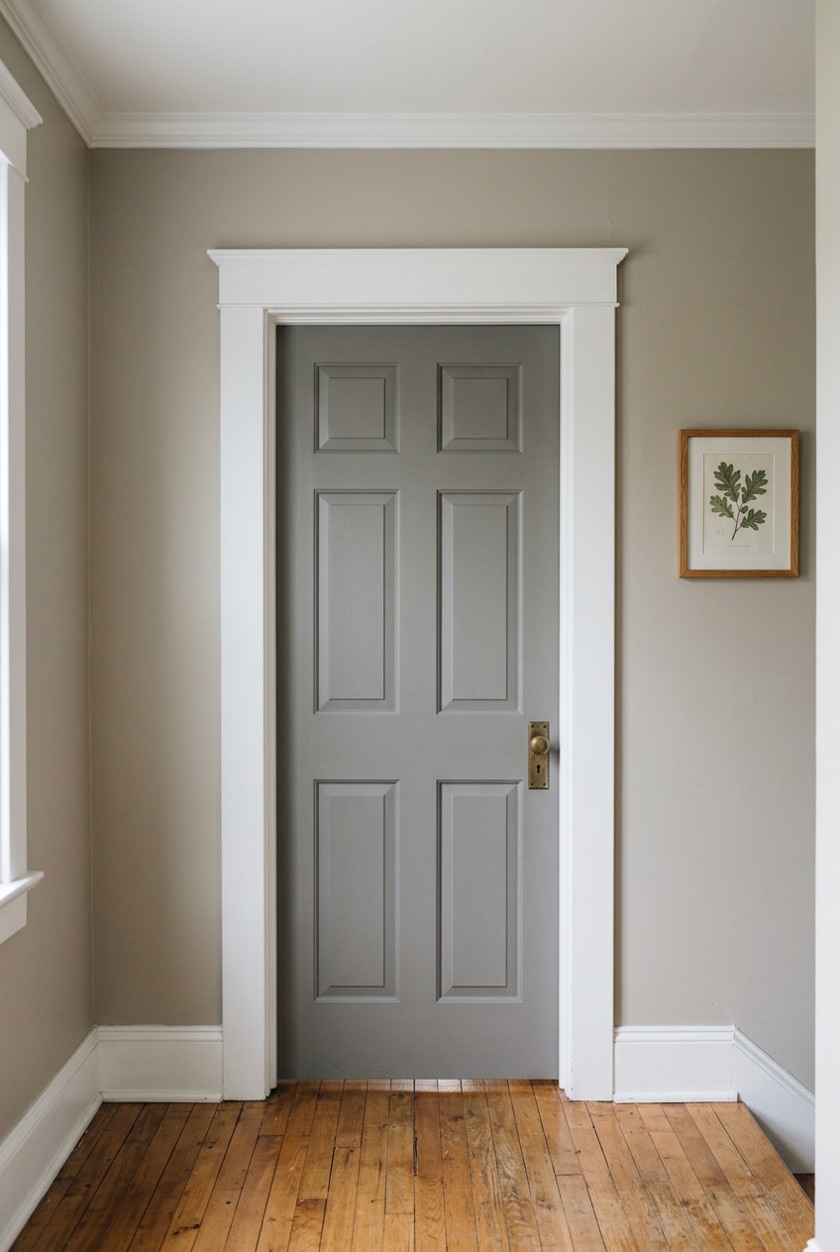
Pick your wall color, then a door
1Your room
2Pick your wall color
3Pick a door color
Colored walls: the door in the trim’s white lets the walls be the star, or in the wall color to be more immersed in it.
Closest paints to this door
Paint the door in a higher sheen than the walls: Sherwin-Williams uses satin on trim and gloss on doors. A screen shows each brand's digital version of a paint: check a real chip on your door before you buy. We are not connected to any of these brands.
4Tap to paint
On a sample room the walls, the trim and the door are painted for you. On your own photo, tap each wall in your wall color, then pick a trim and tap the casings and baseboards, then pick a door and tap it (a paneled door may need a tap on each panel). Narrow trim is easier with the brush.
Quick answer: an interior door looks right in one of five colors: the trim’s color (the classic, usually a white), the wall color (the door disappears), a shade deeper than the walls, black, or a color of its own. Whether it stands out or blends in depends on how far its LRV is from the walls’: more than 30 points stands out in any light, under 20 blends in. Pick your wall color and your trim above to see every door on a room, with its gaps and the closest real paints.
How to use the interior door color picker
- Pick your wall color. Tap a swatch, type its color code from a paint chip, or use the color picker. On a sample room the walls repaint at once.
- Say what your trim is. White, the wall color, or black. The door options and the two to try first change with it.
- Tap a door color. Each shows its LRV, its gap from the walls and from the trim, and whether it stands out from the walls, stands out only in a bright room, or blends in. On a sample room the door is repainted in it. For a color of your own, use Your own door color.
- Read the paints. Under the doors are the closest Sherwin-Williams, Benjamin Moore and Behr colors to the door you chose.
- Try your own room. Use your photo, tap the walls in your wall color, pick a trim and tap the casings and baseboards, then pick a door and tap the door. A paneled door may need a tap on each panel.
The door colors, in the paint makers’ words
Each option on the picker is one a paint maker shows or recommends on its own pages.
- The same color as the trim. Benjamin Moore’s trim guide offers its whites for
the perfect white paint for your interior doors and trim
, and shows a bathroom wherethe walls, trim, ceiling, and doors are all painted in White Heron OC-57
. - The same color as the walls.
When using one color for the walls and trim, we love painting the interior doors the same color as well for a completely uninterrupted look
, says Benjamin Moore color expert Arianna Barone.When using bolder hues, it allows you to be more immersed in the color.
- A shade deeper than the walls. Sherwin-Williams, answering a reader on its blog:
Whichever color, it should come from the existing trim and/or walls, don’t leave the doors white, it may make your space look unfinished.
A deeper shade of the wall color is a door that comes from the walls but still shows. - Black. Benjamin Moore shows walls in dark gray Wrought Iron with white trim, and
The door is painted in rich Black 2132-10 for even more drama and contrast.
- A color of its own. Sherwin-Williams:
Add a pop of color to any room in your home by giving the door a fresh coat of paint.
The picker starts it on a navy, the color of the French doors in Benjamin Moore’s trim guide (Hale Navy HC-154).
The picker makes each one from your colors. The trim’s white is a near-white in the walls’ own hue (CIELAB lightness 94, a chroma of 4 at most), the same white as our trim color picker. The black is a soft black, #2B2A29. “A shade deeper” is two steps darker, 20 points of CIELAB lightness, in the same hue. Those recipes, and which two doors the picker suggests trying first, are ours, not the paint makers’.
Stands out, or blends in
LRV is how much light a color reflects, from 0 for black to 100 for a perfect white. How far apart two LRVs must be before a door stands out from the wall around it is set out in the UK’s building guidance for accessible buildings. Approved Document M, Volume 2, paragraph 0.26 defines “contrast visually” like this:
“the difference in light reflectance value between the two surfaces is greater than 30 points. Where illuminance on surfaces is greater than 200 lux, a difference in light reflectance value should be a minimum of 20 points.”
It was written so people with low vision can find a door. It is not a rule for decorating, but it is a measured answer to “will my door show”, so the picker uses it as a yardstick, against the walls and against the trim:
- Over 30 points: stands out from the walls in any light.
- 20 to 30 points: stands out in a bright room. In daylight the door reads; on a dull evening it fades toward the walls.
- Under 20 points: blends into the walls. That is the point of a door in the wall color: it disappears.
The gap from the trim matters too. A door the trim’s color makes one frame with its casing; a dark door inside white casing is outlined by it, which is why a black door can work even on dark walls.
Door colors by wall color
With white trim: the LRV gap between each door and the walls, what it does, and the two doors the picker suggests trying first. “Stands out” = over 30 points, “bright room” = 20 to 30, “blends” = under 20. A door in the wall color is always a gap of 0.
| Walls | LRV | Door in the trim’s white | A shade deeper | Black door | Try first |
|---|---|---|---|---|---|
| Bright White #F8F8F5 | 94 | 1 · blends | 41 · stands out | 92 · stands out | trim color, black |
| Greige #D6CFC4 | 63 | 22 · bright room | 31 · stands out | 61 · stands out | trim color, black |
| Dove Gray #C9CAC6 | 59 | 26 · bright room | 30 · bright room | 57 · stands out | trim color, black |
| Pewter #A3A5A1 | 37 | 48 · stands out | 21 · bright room | 35 · stands out | trim color, black |
| Sage #A9B59B | 44 | 41 · stands out | 24 · bright room | 42 · stands out | trim color, wall color |
| Powder Blue #B9CDD8 | 59 | 26 · bright room | 29 · bright room | 57 · stands out | trim color, black |
| Warm Sand #DCC7A6 | 59 | 26 · bright room | 30 · bright room | 57 · stands out | trim color, wall color |
| Terracotta #C0704F | 23 | 62 · stands out | 14 · blends | 21 · bright room | trim color, wall color |
| Navy #2B3A55 | 4 | 81 · stands out | 3 · blends | 2 · blends | trim color, wall color |
| Charcoal #45484A | 6 | 79 · stands out | 5 · blends | 4 · blends | trim color, wall color |
Color names here are the picker’s own, not a paint brand’s; the picker names the closest brand paints for the door you choose.
The sheen: glossier than the walls
Sherwin-Williams, for walls, doors and trim in one color: A flat finish is perfect for walls, but when it comes to the other details, you’ll want to add more dimension. Use a satin finish for trim and a gloss finish for doors.
A higher sheen also takes the hand marks a door gets around its handle. With the door in the wall color, the sheen is the only thing that sets it apart, so do not skip it. The paint sheen finder picks the sheen for each surface.
Three worked examples
Greige walls, white trim, white door. Greige (LRV 63) with a door in the trim’s warm white (LRV 85) is a gap of 22: the classic, but the door reads clearly only in a bright room. In a dim hallway, a shade deeper (31) or black (61) gives a door that shows at any hour.
Sage walls in a bedroom. Sage (LRV 44) sits mid-scale. A door in the trim’s white (LRV 85) is 41 points away and black 42: both stand out. A door in the wall color is 0 away and disappears: Benjamin Moore’s uninterrupted look. The hallway sample opens on Sage walls with a white door; tap The same color as the walls to see it vanish.
Navy walls. Navy (LRV 4) and a black door are 2 points apart: the door blends in, and only white trim around it outlines it. A door in the trim’s white (81 away) is the strongest frame; a door in the navy itself makes the room one deep color.
Common mistakes when choosing an interior door color
- A different white on the doors than on the trim. Two whites side by side make one of them look dirty. Use the trim’s own white, as Benjamin Moore and Sherwin-Williams both do.
- The wall color in the wall sheen. A door the same color and the same flat sheen as the walls loses its edges and looks unfinished. Go glossier on the door.
- Black doors in a dark room with dark trim. On navy, forest or charcoal walls a black door is within a few points of the walls: without white trim around it, it disappears.
- Every door a different color. A color of its own works best on one door: a pantry, an office, a bathroom. In a hallway with many doors, one color for all of them keeps it calm.
- Judging the color from a chip. A door is a big surface and reads darker and stronger than a chip. Paint a large sample board and look at it next to the door at night as well as by day.
Painting the whole room? The room paint visualizer paints every wall on your photo, and the color drenching visualizer paints walls, trim and ceiling in one color. For the door outside, the front door color picker does the same for your house. Planning the furniture too? The free 2D room planner lays out the room.
Paint the whole roomRead next
- Dark doors with white trim
- Bathroom door ideas
- Space-saving door ideas for small spaces
- Black trim ideas for an interior
- Ideas for white walls with black trim
Interior door color questions
What color should interior doors be?
Most often the trim’s color, so door and casing read as one frame. The other good choices are the wall color (the door disappears), a shade deeper than the walls, black, or one door in a color of its own. Sherwin-Williams’ advice is that the color should come from the existing trim and/or walls.
Should interior doors be the same color as the walls?
They can be, especially when the trim is the wall color too: Benjamin Moore paints the doors the same color for a completely uninterrupted look. Use a glossier sheen on the door so it still reads as a door.
Should interior doors match the trim?
That is the classic choice, and the easiest: the same white on the doors, the casings and the baseboards. Benjamin Moore picks its whites for interior doors and trim together.
Do black interior doors look good with white trim?
Yes. A black door inside white casing is outlined by it, so it works on light walls (about 90 LRV points from white walls) and even on dark walls, where Benjamin Moore uses one for drama. On dark walls with dark trim, a black door disappears.
What color interior doors go with gray walls?
On Light Gray Walls, a door in the trim’s white is only about 26 LRV points away, so it stands out mainly in a bright room; a shade deeper or black stands out at any hour. On a mid gray like pewter, a white door clears 30 easily.
What sheen should interior doors be?
Glossier than the walls. For walls, doors and trim in one color, Sherwin-Williams suggests flat on the walls, satin on the trim and gloss on the doors.
Can I paint just one door a different color?
Yes: a pantry, an office or a bathroom door in a color of its own is the bold choice. Sherwin-Williams calls it adding a pop of color to any room. Keep the rest of the doors in the trim or wall color so the one door is the accent.
Can I try door colors on my own room?
Yes. Upload a photo, tap the walls in your wall color, pick your trim and tap the casings, then pick a door color and tap the door. Your photo never leaves your device: the painting happens in your browser.