
Pick your house color and see the front door colors that stand out from it, measured by the light each color reflects. Then paint the door on a sample house or on a photo of your own. Your photo never leaves your device.
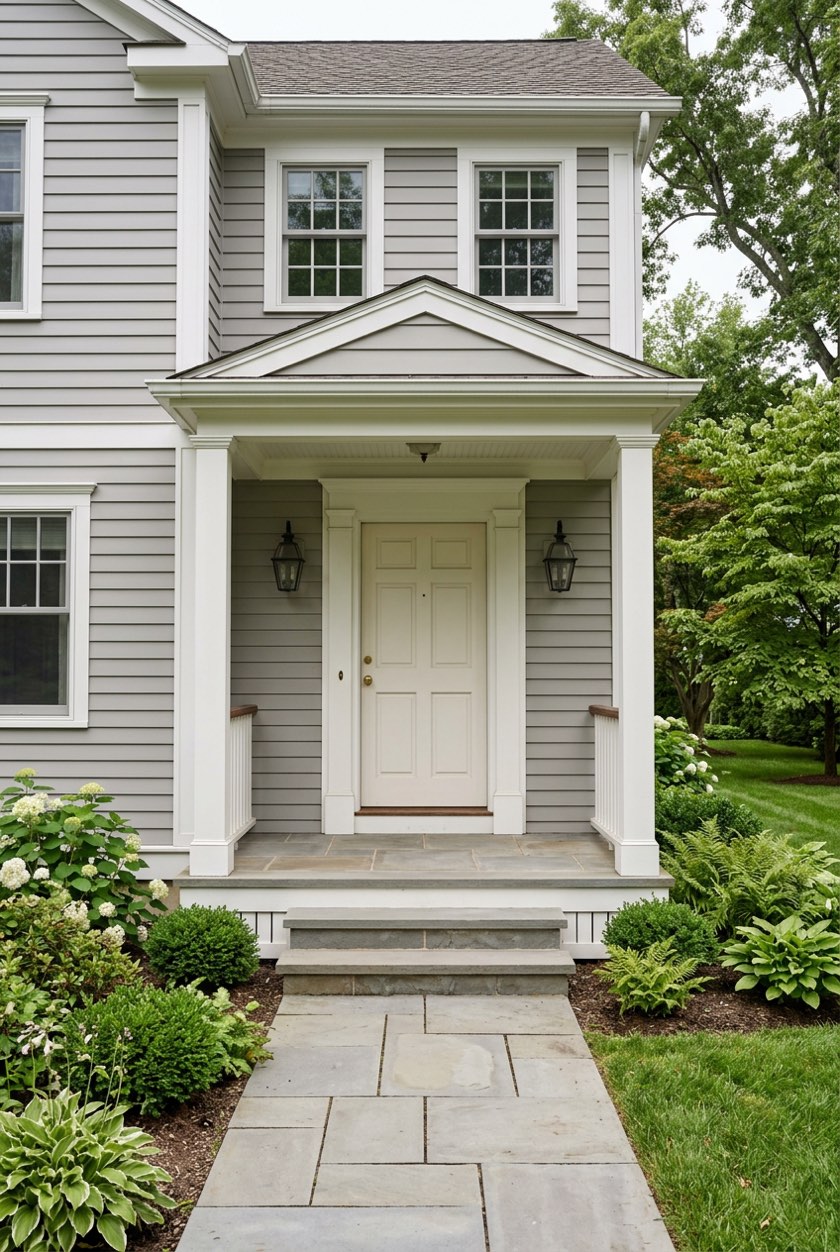
Tap the door to paint it
1Your house
2Your house and trim colors
3Doors that stand out
A Navy door on a gray house: an LRV gap of 33 with the siding (stands out in any light) and 90 with the trim (stands out in any light).
Gap = the difference in LRV (how much light a color reflects, 0 black to 100 white). Over 30 stands out in any light, 20 to 30 in daylight: the rule in the UK's Approved Document M.
4Or pick any door color
5Tap the door
Tap the middle of the door. A paneled door may need a second tap on a panel the first one missed. Paint on the frame? Move Spread left, or wipe it with the eraser. A wood stain shows grain this preview cannot draw: treat a wood tone as its color only.
Quick answer: the front door colors that stand out are the ones whose LRV (light reflectance value) differs from your siding by more than 30 points. On a white, cream, beige, gray or tan house that means a dark door: black, navy, hunter green or barn red. On a dark or brick house it means a light or bright door: yellow or white, or a pale blue on charcoal and navy. Pick your house color above and the picker ranks every door color by that gap. Then paint the door on a sample house or on your own photo.
How to use the front door color picker
- Pick your house color. Tap the chip closest to your siding, type its color code if you have one from a paint chip, or tap Read it off my photo and then tap the siding in your own photo.
- Say what the trim is. The trim is the frame right around the door. White trim is the default; cream, black or the same color as the house change the second number on every idea.
- Read the ideas. Each door color family (black, navy and blue, green, red, yellow, wood, white and gray) shows its shade that stands out most clearly, with two gaps: against the siding, which is what you see from the street, and against the trim, which is what frames the door.
- Tap an idea, then tap the door. The idea becomes your paint color. Tap the door in the photo and it is repainted with your photo’s own light and shade. No photo yet? Start with the gray, red brick or white farmhouse sample.
- Compare and save. Compare puts a before and after slider across the photo, and Save image keeps the result to send to whoever is choosing with you.
The rule: an LRV gap of more than 30 points
LRV is how much light a color reflects, from 0 for black to 100 for a perfect white. Paint makers print it on most color cards. The picker works it out from each color’s on-screen value, so it is close to the printed figure but not a measurement of a real chip.
How far apart two LRVs must be before one surface stands out against another is set out in the UK’s building guidance for accessible buildings. Approved Document M, Volume 2, paragraph 0.26 defines “contrast visually” like this:
“the difference in light reflectance value between the two surfaces is greater than 30 points. Where illuminance on surfaces is greater than 200 lux, a difference in light reflectance value should be a minimum of 20 points.”
That guidance was written so people with low vision can find a door in a public building. It is not a rule for houses, but it is a clear, measured answer to “will my door stand out”, so the picker uses it as a yardstick. Daylight is far brighter than 200 lux, so in the picker:
- Over 30 points: stands out in any light. Morning, dusk or a shaded porch.
- 20 to 30 points: stands out in daylight. In full sun the door reads; under a deep porch or at dusk it fades into the wall.
- Under 20 points: blends in. That can be a choice, for a quiet tone-on-tone look, but it will not draw the eye to the entrance.
The ideas also say when a door sits on the opposite side of the color wheel from your siding (complementary, like a yellow door on a navy house) or in the same hue family (analogous, like a terracotta door on a beige house). That label is color theory, a matter of taste, and it never changes the ranking.
Front door colors by house color
With white trim, these are the door colors from the picker’s board that stand out from each house color in any light, with their LRV gap from the siding, and the ones that blend in.
| House color | LRV | Doors that stand out (gap) | Blend in |
|---|---|---|---|
| White #F4F1EA | 88 | Soft Black (86), Navy (84), Hunter (83) | none |
| Cream #F3EAD3 | 83 | Soft Black (81), Navy (79), Hunter (78) | none |
| Beige #DCC7A6 | 59 | Soft Black (57), Navy (55), Hunter (54) | none |
| Tan #C4A882 | 41 | Soft Black (39), Navy (37), Hunter (36) | none |
| Light gray #C9CAC6 | 59 | Soft Black (57), Navy (55), Hunter (54) | none |
| Gray #A3A5A1 | 37 | Soft Black (35), Navy (33), Hunter (32) | none |
| Sage #A9B59B | 44 | Soft Black (42), Navy (40), Hunter (39) | none |
| Blue-gray #7D8C96 | 25 | Lemon (36), Bright White (69) | none |
| Red brick #9B4A3A | 12 | Sunflower (37), Bright White (82) | Jet Black, Oxblood |
| Charcoal #45484A | 6 | Sunflower (43), Coastal Blue (32), Bright White (88) | Rust, Jet Black |
| Navy #2B3A55 | 4 | Sunflower (45), Coastal Blue (34), Natural Oak (32) | Rust, Iron Gray |
Color names here are the picker’s own, not a paint brand’s. To try a brand’s color, type its code into the color box, or get the code from a photo with the paint color matcher.
Three worked examples
A gray house. The gray sample’s siding is close to Gray (LRV 37) with white trim. Navy has an LRV of 4: a gap of 33 with the siding, so it stands out in any light, and 90 with the white trim. That is why navy, black and dark green doors are the classic answer on gray. A lemon yellow door (LRV 61) is only 24 points from the siding, so it shows in daylight but is quieter at dusk. The sample opens with its door painted Navy.
A red brick house. Red brick is dark (LRV about 12), so a black door is only 11 points from the brick: it blends with the wall. What makes a black door work on brick is the white surround, 93 points away. If your door has no light trim around it, the picker’s top ideas for brick are a sunny yellow (37 points) and white (82). The sample opens with a Soft Black door inside its white surround.
A white farmhouse. On white siding (LRV 88) almost every dark door clears 30 points: Soft Black 86, Navy 84, Hunter 83, Barn Red 79. The choice is about mood, not visibility. The sample opens with a Hunter green door; try Barn Red and Natural Oak on it with Compare to see the difference.
Common mistakes when choosing a front door color
- Judging the door against the trim only. A black door in a white frame looks crisp close up, but from the street the eye compares it with the whole wall. On brick or dark siding, check the gap with the siding too.
- Choosing a light door for a deep porch. A porch roof keeps the door in shade most of the day. There, pick a door that clears 30 points, not one that only clears 20.
- Forgetting the hardware. Approved Document M also asks for door furniture that contrasts with the door. A black handle on a navy door disappears; brass or satin nickel shows.
- Trusting the screen for the final decision. Screens and phone cameras shift colors, and daylight makes paint look lighter. Narrow it to two or three here, then paint a large sample board and hold it against the door in the morning and the evening.
- Skipping the rules. Homeowners associations and historic districts often have to approve an exterior color, a door included. Ask before you buy the paint.
Repainting more than the door? The exterior house color visualizer paints the siding and trim the same way, and the free 2D room planner lays out the rooms inside.
Plan the rooms freeRead next
- Front door colors that make a gray house pop
- Front door colors for brick homes
- Red front door ideas
- Main entrance door design ideas
- Curb appeal ideas
Front door color questions
What are the best front door colors?
The best front door color is one that stands out from your house. Measured by light reflectance, that means a gap of more than 30 LRV points from the siding. On light houses black, navy, dark green and red do it; on dark or brick houses yellow and white do. Pick your house color above to see the ranking for yours.
What front door colors go with a gray house?
On a mid gray (LRV around 37), the doors that stand out in any light are the dark ones: Soft Black, Navy, Hunter green, a dark walnut stain and cranberry red each sit more than 30 points away. A light gray house (LRV around 59) also takes barn red, honey wood and terracotta.
What front door color for a red brick house?
Red brick is dark, so a door stands out from it by being lighter: sunny yellow or white in any light, a pale blue in daylight. A black or oxblood door blends with the brick itself and relies on a light surround to show. Set the trim in the picker to see the difference the surround makes.
What front door color for a white house?
Almost any deep color: on white siding (LRV about 88) black, navy, hunter green and barn red all clear a 30-point gap by a wide margin. A natural wood door clears it too. On white, the choice is about style rather than visibility.
What front door colors go with a tan house?
On tan (LRV about 41), black, navy, hunter green, barn red and a walnut wood tone each stand out by more than 30 points. Navy also sits on the opposite side of the color wheel from tan, a classic complementary pairing.
Can I see a front door color on my own house?
Yes. Upload or take a photo of your house, tap a door color idea, then tap the door. The picker repaints it with your photo’s own light and shade. Your photo never leaves your device: the painting happens in your browser.
What does LRV mean on a paint color?
LRV, light reflectance value, is how much light a color reflects, from 0 (black) to 100 (perfect white). A gap of more than 30 points between two surfaces is what UK accessibility guidance calls visual contrast, and it is the rule this picker uses for a door that stands out.