
Pick your siding and see the window trim colors that suit it: Benjamin Moore's own pair, a deeper shade, white, cream or black. Try them on a sample house or your photo, which never leaves your device.
Pick a color to paint the window trim
1Your house
2Your siding and windows
3Window trim colors for your house
Black window trim on a tan house: an LRV gap of 39 with the siding (stands out in any light) and 92 with the windows (stands out in any light).
Your siding reads warm. Sherwin-Williams’ color experts: because your siding and brick are warmer, a colored trim or a creamy white might look more cohesive than say, a white with gray undertones, which would look cold.
Your siding reads cool. Benjamin Moore: Want to add more definition and tie the whole color palette together? Try a bright white paint color on your exterior window or door trim.
A white house. Benjamin Moore: Gray, neutral, and white paint colors remain homeowner favorites for their versatility and classic look, while blue, green, and black paint colors are popular choices for making a statement with your exterior accents.
Gap = the difference in LRV (how much light a color reflects, 0 black to 100 white): over 30 the trim stands out in any light, 20 to 30 in daylight, under 20 it blends in. Benjamin Moore: There is no hard and fast rule for the color of exterior trim.
4Or pick any trim color
5Tap the window trim
On a sample house every window's trim is painted for you. On your own photo, tap the trim around each window; thin trim is easier with the Brush. Paint on the glass or the walls? Move Spread left, or wipe it with Erase.
Quick answer: there is no single right trim color. Benjamin Moore says There is no hard and fast rule for the color of exterior trim.
Most houses take one of three: a white (bright on cool siding, creamy on warm siding), black for a bold outline, or a deeper shade of the siding for a quiet, tonal look. Pick your siding above to see each one around the windows, with how much it stands out from the walls and from the windows.
How to use the exterior trim color picker
- Pick your siding color. Tap a chip, type its color code, or tap Read it off my photo and then your siding.
- Say what color your windows are. White, almond, bronze or black: the trim sits between the windows and the walls, so the picker measures it against both.
- Read the trim colors. Three come first: Benjamin Moore’s own trim for a siding close to yours, a deeper shade of your siding and the siding’s own color. Then the trim colors that suit your siding, each with its LRV and its gap from the siding and from the windows.
- Tap a trim color and every window’s trim on the sample house is repainted in it, or pick any color on the board below.
- Try your own house. Use your photo, pick a color and tap the trim around each window. Thin trim is easier with the Brush.
What the paint makers say about trim
Benjamin Moore’s answer to Should exterior trim be lighter or darker than the house?
is that there is no fixed rule: Try an analogous color scheme for visual interest, using colors for the siding and trim that sit next to each other on the color wheel—or go even bolder with complementary colors that sit across from each other.
Its other advice gives the three usual choices:
- A bright white.
Want to add more definition and tie the whole color palette together? Try a bright white paint color on your exterior window or door trim.
- A deeper hue. For drama without a garage door to paint:
choosing a deeper hue for the front door, porch, or exterior window trim.
The picker’s deeper shade is your siding’s own color, darker, so it stays in the same hue family. - The siding’s own color. Benjamin Moore shows a house in
Black HC-190, shown here, used on both siding and trim
: the trim disappears and the windows become the outline.
Warm or cool matters for the whites. Sherwin-Williams’ color experts, quoted by the window maker Andersen: because your siding and brick are warmer, a colored trim or a creamy white might look more cohesive than say, a white with gray undertones, which would look cold.
So on beige, tan, cream or brick the picker lists the creamy whites and the bronzes first; on gray, sage or blue, the bright whites. Black is listed for every siding: Benjamin Moore calls blue, green and black popular choices for making a statement with your exterior accents.
The picker reads your siding the way its roof and gutter pickers do: no clear hue and an LRV of 75 or more is white; otherwise its hue says warm (beige, tan, cream, brick) or cool (gray, sage, blue). That reading is ours; the advice is the makers’.
Benjamin Moore’s own siding and trim pairs
Benjamin Moore’s 14 Exterior Paint Colors We Love gives a body, a trim and an accent for each of its popular exterior colors. Thirteen name a trim. When your siding is close to one of those bodies (a color difference of 8 or less), the picker offers that trim first, by name.
| Siding (body) | Trim |
|---|---|
| Revere Pewter HC-172 | Swiss Coffee OC-45 |
| Carrington Beige HC-93 | China White OC-141 |
| Morrel AF-125 | Stonington Gray HC-170 |
| Monroe Bisque HC-26 | Monterey White HC-27 |
| Horizon OC-53 | Ashwood Moss 1484 |
| Hampshire Gray HC-101 | November Rain OC-50 |
| Sweet Rosy Brown 1302 | Feather Down OC-6 |
| Caldwell Green HC-124 | White Heron OC-57 |
| Silver Gray 2131-60 | Brilliant White OC-150 |
| Van Courtland Blue HC-145 | White Diamond OC-61 |
| Charcoal Slate HC-178 | Pure White OC-64 |
| Chambourd AF-645 | White Opulence OC-69 |
| Black HC-190 | White OC-151 |
Most of its trims are whites and off-whites a few shades from the body; two go the other way, a dark trim on a pale body (Ashwood Moss on Horizon) and a light gray on a warm tan (Stonington Gray on Morrel).
Stands out, or blends in
Each trim color shows how far its LRV (how much light it reflects, 0 black to 100 white) is from the siding’s and from the windows’. The yardstick is the UK’s Approved Document M, paragraph 0.26, which calls two surfaces contrasting when the difference in light reflectance value between the two surfaces is greater than 30 points
, or at least 20 in good light. It was written so people can find a door, not to choose a trim, so here it only answers “will the trim read as a frame around the window”.
Trim colors by siding color
With white windows: how the picker reads each siding, Benjamin Moore’s pair where one is close, the deeper shade, and how far a bright white and a black trim are from the siding. “Stands out” = over 30 points, “daylight” = 20 to 30, “blends” = under 20. Color names other than Benjamin Moore’s are the picker’s own.
| Siding | Reads | Benjamin Moore’s pair (gap) | Deeper shade (gap) | White trim (gap) | Black trim (gap) |
|---|---|---|---|---|---|
| White #F4F1EA | white | Ashwood Moss 1484 (78, stands out) | #92918C (60, stands out) | 4, blends | 86, stands out |
| Cream #F3EAD3 | warm | — | #928C7F (57, stands out) | 9, blends | 81, stands out |
| Beige #DCC7A6 | warm | Monterey White HC-27 (19, blends) | #847764 (40, stands out) | 33, stands out | 57, stands out |
| Tan #C4A882 | warm | Stonington Gray HC-170 (18, blends) | #76654E (27, daylight) | 51, stands out | 39, stands out |
| Greige #D6CFC4 | warm | Swiss Coffee OC-45 (21, daylight) | #807C76 (43, stands out) | 29, daylight | 61, stands out |
| Light gray #C9CAC6 | cool | Brilliant White OC-150 (27, daylight) | #797977 (40, stands out) | 33, stands out | 57, stands out |
| Gray #A3A5A1 | cool | — | #626361 (25, daylight) | 55, stands out | 35, stands out |
| Sage #A9B59B | cool | — | #656D5D (30, daylight) | 48, stands out | 42, stands out |
| Blue-gray #7D8C96 | cool | White Diamond OC-61 (61, stands out) | #4B545A (16, blends) | 67, stands out | 23, daylight |
| Red brick #9B4A3A | warm | — | — | 80, stands out | 10, blends |
| Charcoal #45484A | cool | — | — | 86, stands out | 4, blends |
| Navy #2B3A55 | cool | — | — | 88, stands out | 2, blends |
On siding already darker than an LRV of 20 (brick, charcoal, navy) the picker offers no deeper shade: deeper than that is black, which is on the list anyway.
Three worked examples
A white house with black trim. Black trim is 86 points from white siding: every window gets a dark outline, the look behind the “white house with black trim” searches. White trim on the same house is 4 points away and disappears; Benjamin Moore’s pair for its near-white Horizon OC-53 is the dark Ashwood Moss 1484 (78 points).
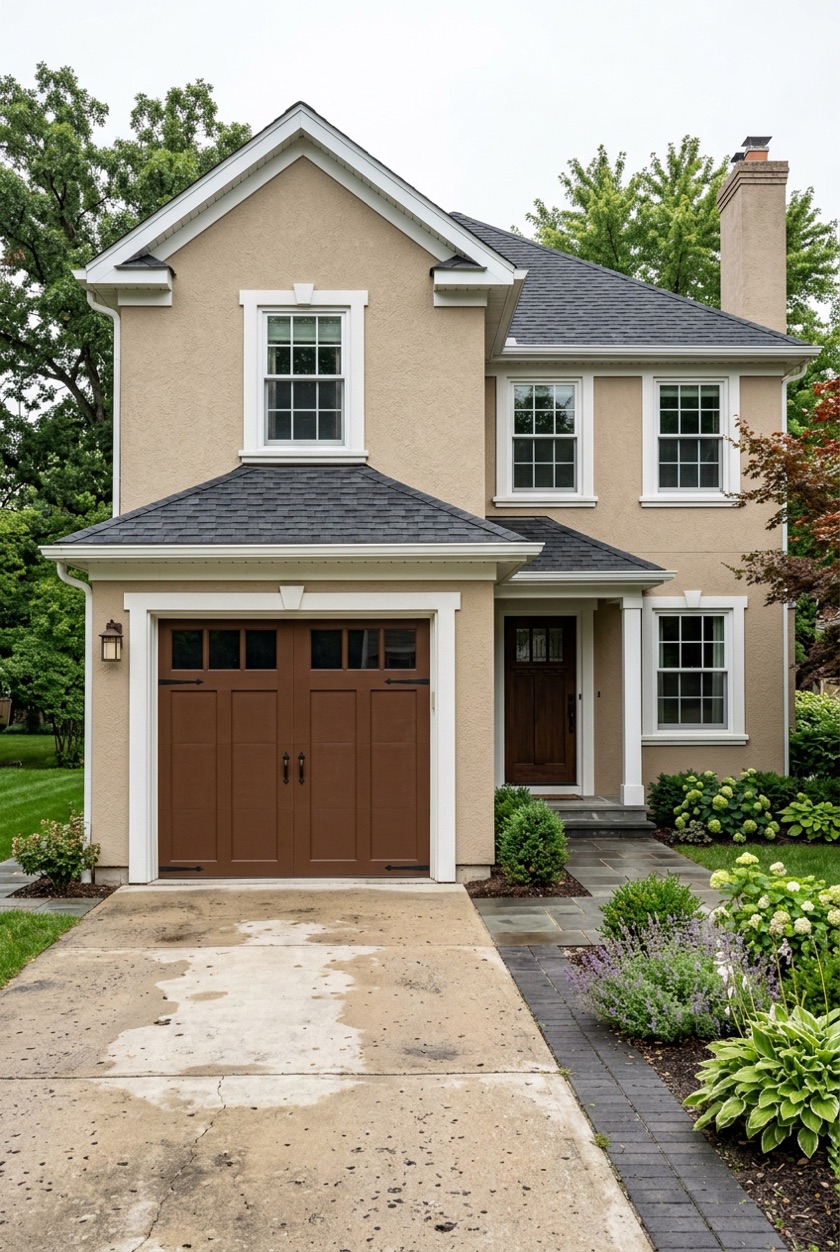
Tan stucco. The siding reads warm, so the creamy whites and the bronzes come first. Black stands out at 39 points, a bright white at 51. The deeper shade (#76654E) is 27 points from the walls: a tonal frame that shows in daylight. Benjamin Moore pairs its Morrel AF-125, close to this tan, with Stonington Gray HC-170, 18 points away, which blends.
Gray siding with white trim. On a light gray (#C9CAC6) a bright white trim is 33 points away and stands out; Benjamin Moore pairs its Silver Gray 2131-60 with Brilliant White OC-150. On a mid gray (#A3A5A1) white stands out at 55 and black at 35, so both read as a frame.
Common mistakes when choosing a trim color
- A gray-white on warm siding. Sherwin-Williams’ experts warn that next to warm siding or brick a white with gray undertones
would look cold
; a creamy white looks more cohesive. - Forgetting the windows. The trim sits between the window frames and the walls. Black trim around white windows is a double frame; black trim around black windows reads as one wide outline. Set the window color above to see both gaps.
- Choosing from a screen. Benjamin Moore: exterior colors
can look vastly different as the light changes throughout the day, we strongly suggest using color samples
. Paint a sample on a board, hold it against a window, and look in the morning and in the evening. - The wrong sheen. Benjamin Moore lists Low Lustre as the most popular sheen for siding and trim, and Pearl or Satin and Semi-Gloss or Soft Gloss for trim, shutters and doors. A glossier trim is easier to wipe and catches the light.
- Too many colors. Benjamin Moore:
Homeowners typically use three to four colors when creating an exterior color scheme.
The siding, the trim, the front door and perhaps the shutters already make four.
Finishing the outside? The shutter color picker and the front door color picker pair with your siding and trim, the gutter color picker matches the gutters to the trim, and the exterior house color visualizer paints the siding on your photo. The paint calculator counts how many gallons of trim and body color to buy. Planning the inside too? The free 2D room planner lays out every room.
Pair the shuttersRead next
- Exterior color palette ideas
- Exterior color schemes for red brick houses
- Cape Cod house exterior ideas
- Updated split level exterior ideas
- Curb appeal ideas
Exterior trim color questions
What color should my exterior trim be?
Benjamin Moore says there is no hard and fast rule. Most houses take a white (bright on cool siding, creamy on warm), black for a bold outline, or a deeper shade of the siding for a tonal look. Pick your siding above and the picker shows each one around the windows, with Benjamin Moore’s own trim first when your siding is close to one of its palettes.
Does a white house look good with black trim?
Yes, as a strong outline: on white siding black trim is about 86 LRV points away, so every window reads as framed. Benjamin Moore calls black one of the popular choices for making a statement with exterior accents. With black windows the trim and the frames read as one wide line; with white windows, as a double frame.
Should window trim be lighter or darker than the house?
Either. Benjamin Moore: there is no hard and fast rule, so try colors next to each other on the color wheel (a deeper or lighter shade of the siding) or across from it for a bolder look. Lighter trim on a mid or dark house outlines the windows; darker trim on a light house does the same in reverse.
What trim color goes with a gray house?
Gray siding reads cool, so the picker lists bright whites first: Benjamin Moore pairs its Silver Gray 2131-60 with Brilliant White OC-150 and its Charcoal Slate HC-178 with Pure White OC-64. Black works too on a light or mid gray (35 points or more on a mid gray), and a deeper gray makes a tonal frame.
What trim color goes with a blue house?
White is the classic: Benjamin Moore pairs its Van Courtland Blue HC-145 with White Diamond OC-61, 56 points apart. On a navy house a white trim stands out at about 88 points; black blends in (about 2 points), which gives a darker, all-in-one look.
What trim color goes with tan or beige siding?
Tan and beige read warm, so a creamy white or a bronze looks more cohesive than a gray-white, Sherwin-Williams’ experts say. Benjamin Moore pairs Monroe Bisque HC-26 with Monterey White HC-27 and Morrel AF-125 with Stonington Gray HC-170. Black stands out on tan too.
What paint finish is best for exterior trim?
Benjamin Moore lists Low Lustre as its most popular exterior sheen for siding and trim, and Pearl or Satin and Semi-Gloss or Soft Gloss for trim, shutters and doors. A glossier finish wipes clean more easily and makes the trim stand out a little more from flat siding.
Can I try trim colors on my own house?
Yes. Upload a photo, pick a color and tap the trim around each window, or use the brush on thin trim. Your photo never leaves your device: the painting happens in your browser.