
Pick your wall color and see four ceilings with it, painted on a room: a white with your walls’ undertone, a lighter version of the wall color, the same color as the walls, and a darker one. Each shows its LRV and the closest Sherwin-Williams, Benjamin Moore and Behr paint. Your photo never leaves your device.
Pick your wall color, then a ceiling
1Your room
2Pick your wall color
3Pick a ceiling
Mid or dark walls: a white with the same undertone, or a lighter version of the walls, keeps the ceiling from closing in.
Closest paints to this ceiling
Paint the ceiling flat, the finish Benjamin Moore calls the best choice
for ceilings. A screen shows each brand's digital version of a paint: check a real chip on your ceiling before you buy. We are not connected to any of these brands.
4Tap to paint
On a sample room the walls and the ceiling are painted for you. On your own photo, tap each wall in your wall color, then pick a ceiling above and tap the ceiling. Missed a strip? Tap it too, or use the brush.
Quick answer: paint the ceiling a white with the same undertone as your walls if you are unsure: it is the classic choice and it bounces the most light. For more color, Benjamin Moore names three other good options: a lighter version of the wall color, the same color as the walls, or a ceiling a few shades darker in a room with a high ceiling. Use a flat finish. Pick your wall color above to see all four on a room.
How to use the ceiling color picker
- Pick a room. Start with the sample bedroom or home office, or tap Upload or take a photo to use your own room.
- Pick your wall color. Browse the six color families or type any color code. On a sample room the walls are repainted in it and the ceiling follows.
- Say how high the ceiling is. Low, standard or high. The two ceilings that suit that height are marked try first, with the reason.
- Tap a ceiling. A white with your walls’ undertone, a lighter version, the same color or two steps darker. Each shows its LRV (how much light it reflects) and, once the page has loaded, the closest Sherwin-Williams, Benjamin Moore and Behr paint.
- On your own photo, tap each wall in your wall color first. Then tap a ceiling in the list and tap the ceiling in your photo. Compare shows the before and after.
What Benjamin Moore says about ceiling colors
Benjamin Moore treats it as a choice, not a rule: Whether you paint your ceiling a color that’s darker or lighter than the surrounding walls is a design choice. Many like the look of a clean white paint color on the ceiling. Some prefer to use the same color on the walls and ceiling for a cohesive feel. For a dramatic style, opt for a darker or more saturated hue on the ceiling for a bold pop.
Those are three of the picker’s four ceilings. The fourth comes from its ceiling ideas article: painting the ceiling with a lighter shade–often a lighter variant of the wall color–is a clever design choice
.
On a white ceiling, the same article says: For seamless color flow, select a white for your ceiling that shares a similar undertone as the wall color.
That is why the picker’s white is not plain white: it carries a trace of your wall color. On height: A lighter paint color above eye level can help to visually raise the ceiling.
For a dark ceiling, the article suggests a paint color that is two to three shades darker on your ceiling than your walls
, and Benjamin Moore’s ceiling colors page adds that darker hues like navy blue or charcoal look striking, especially in rooms with high ceilings
.
On the finish, Benjamin Moore is plain: When painting ceilings, a flat finish is the best choice.
Sherwin-Williams and Behr name flat for ceilings too (the free paint sheen finder reads all three).
How the picker works out each ceiling
Benjamin Moore gives no numbers for “a lighter variant” or “a few shades darker”, so the picker uses its own, shown here so you can check them. Colors are measured in CIELAB, where L* is lightness from 0 (black) to 100 (white).
- A white with your walls’ undertone: lightness 94 (or your walls’ own, if they are lighter still), in your wall color’s hue at a chroma of 4 or less, so a trace of it shows. A warm wall gets a warm white, a blue-gray wall a cool one.
- A lighter version: halfway between your wall color and that white. It is lighter and softer, the way a paint store’s half-strength mix of the wall color is.
- The same color: your wall color.
- Two steps darker: the same hue, 20 points of lightness lower.
Which two the picker marks try first is our reading of the quotes above: a low ceiling gets the white and the lighter version, a high one the darker and the same color, and a standard one the same color for light walls (LRV 55 and up) or the white and the lighter version for mid and dark walls.
Ceiling colors for common wall colors
The four ceilings for eight of the wall colors on the board, with each one’s LRV and the closest Benjamin Moore paint to the white and the lighter version. The picker shows Sherwin-Williams and Behr too, for any color you pick.
| Walls | Wall LRV | White ceiling | Lighter ceiling | Two steps darker |
|---|---|---|---|---|
| Greige | 63 | LRV 85 · OC-71 Sand Dollar | LRV 74 · CSP-365 Grandma’s China | LRV 32 |
| Dove Gray | 59 | LRV 85 · 872 White Christmas | LRV 71 · 1471 Shoreline | LRV 29 |
| Warm Sand | 59 | LRV 85 · OC-71 Sand Dollar | LRV 71 · 1051 Lambskin | LRV 29 |
| Sage | 44 | LRV 85 · CW-5 Harwood Putty | LRV 62 · CC-610 Tea Light | LRV 20 |
| Duck Egg | 62 | LRV 85 · 2135-70 Patriotic White | LRV 73 · CW-585 Ewing Blue | LRV 31 |
| Terracotta | 23 | LRV 85 · 2093-70 Pink Bliss | LRV 48 · 053 Crazy For You | LRV 9 |
| Navy | 4 | LRV 85 · 2069-70 Polar White | LRV 27 · CSP-530 Flower Box | LRV 1 |
| Charcoal | 6 | LRV 85 · 2128-70 Lily White | LRV 31 · CW-705 Tucker Gray | LRV 1 |
LRV is light reflectance value: 0 is black, 100 a perfect white. Every closest paint is from the brand’s own digital color file; check a real chip before you buy, because a screen cannot show paint exactly.
Three worked examples
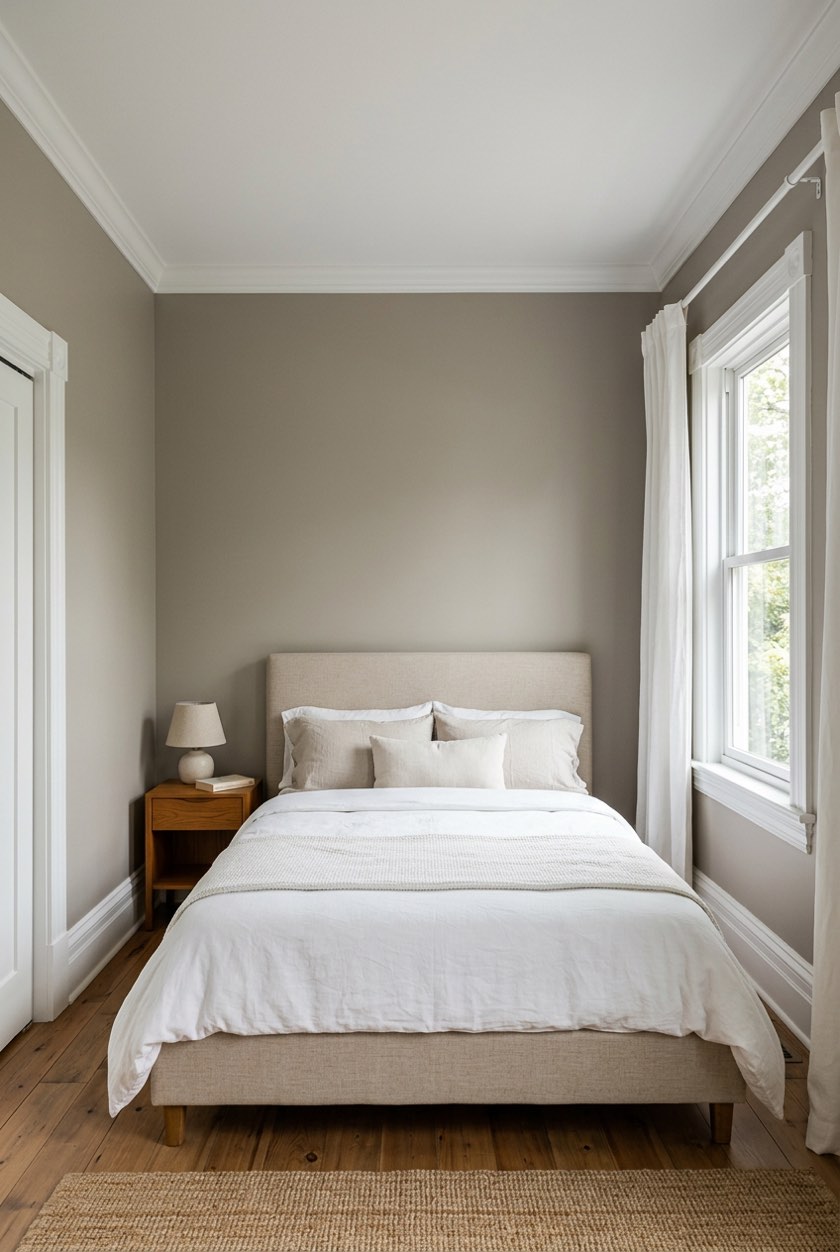
Sage walls, an 8-foot ceiling. The sample bedroom opens with Sage walls (LRV 44) and a white ceiling with Sage’s undertone (LRV 85), close to Benjamin Moore’s Harwood Putty. The white and the lighter version, a pale sage at LRV 62, are marked try first: for mid-tone walls they keep the ceiling from closing in.
Navy walls, a 10-foot ceiling. Pick Navy and High. The suggestion becomes two steps darker or the same navy: a dark lid on a tall room is the cozy, dramatic look Benjamin Moore describes. Not that brave? The white with navy’s cool undertone (LRV 85) is still there.
Greige walls, the same color on the ceiling. Pick Greige (LRV 63, a light color) with a standard ceiling, and the same color comes first: on light walls there is no line where the walls stop, so the room reads as one wrapped space. The one shopping-list catch is the finish: the walls take their usual sheen, the ceiling flat.
Common mistakes when picking a ceiling color
- A stark white over warm walls. A bright blue-white ceiling over beige or greige walls can look cold next to them. Pick a white that shares the walls’ undertone, as Benjamin Moore advises.
- Using wall paint with a sheen. Eggshell or satin on a ceiling shows every bump and roller lap when the light rakes across it. Ceilings get flat.
- Going dark under a low ceiling. A dark ceiling brings it down visually. Keep dark ceilings for high rooms, or for a small room you want to feel like a cocoon on purpose.
- Judging a ceiling chip held in your hand. A ceiling gets less direct light than a wall, so it usually reads darker than the same chip at eye level. Look at a sample painted on the ceiling itself.
- Forgetting the paint. A colored ceiling is a second color to buy. The free paint calculator works out the gallons for the walls and the ceiling.
Want the trim in it too? The color drenching visualizer paints the walls, the ceiling and the trim in one color, and the free 2D room planner lays out the furniture to scale.
Plan the room freeRead next
- Bold ceiling paint ideas
- Can you use the same paint for walls and ceilings?
- Flat or satin paint for your ceiling?
- Color drenching room ideas
- Sloped ceiling bedrooms
- Decorating tall walls in high-ceiling rooms
Ceiling color questions
What color should I paint my ceiling?
If you are unsure, a white with the same undertone as your walls: warm walls get a warm white, cool walls a cool one. Benjamin Moore also names a lighter version of the wall color, the same color as the walls and a darker color as good choices. Pick your wall color in the picker to see all four.
Should the ceiling be the same color as the walls?
It can be. Benjamin Moore says some prefer the same color on the walls and ceiling “for a cohesive feel”, and it works best with light walls, where it blurs the line where the walls meet the ceiling. With dark walls and a standard or low ceiling, the same color makes the room feel enclosed; that is the cozy look, so choose it on purpose.
Should the ceiling be lighter or darker than the walls?
Lighter is the usual choice and makes a ceiling feel higher: Benjamin Moore says a lighter color above eye level helps visually raise it. Darker is for drama and coziness and suits high ceilings best; Benjamin Moore suggests two to three shades darker than the walls.
What is the best ceiling paint color?
There is no single one, because the best ceiling color depends on your walls. Benjamin Moore lists White Dove (OC-17), Cloud White (OC-130) and Decorator’s White (OC-149) among its favorite ceiling whites. The picker finds the closest Sherwin-Williams, Benjamin Moore and Behr paint to whichever ceiling you choose.
What finish should ceiling paint be?
Flat. Benjamin Moore calls a flat finish the best choice for ceilings because it does not reflect light, so it hides bumps and roller marks. Sherwin-Williams and Behr name flat for ceilings too.
Can I paint my ceiling a color?
Yes. Ceiling paint comes in any color: Benjamin Moore’s ceiling paint is made in all of its colors. A pale tint of the wall color is the easy way in; a dark ceiling is the bold one.
Can I try ceiling colors on my own room?
Yes. Upload a photo, tap the walls in your wall color, then tap a ceiling in the list and tap the ceiling in your photo. Your photo never leaves your device: the painting happens in your browser.