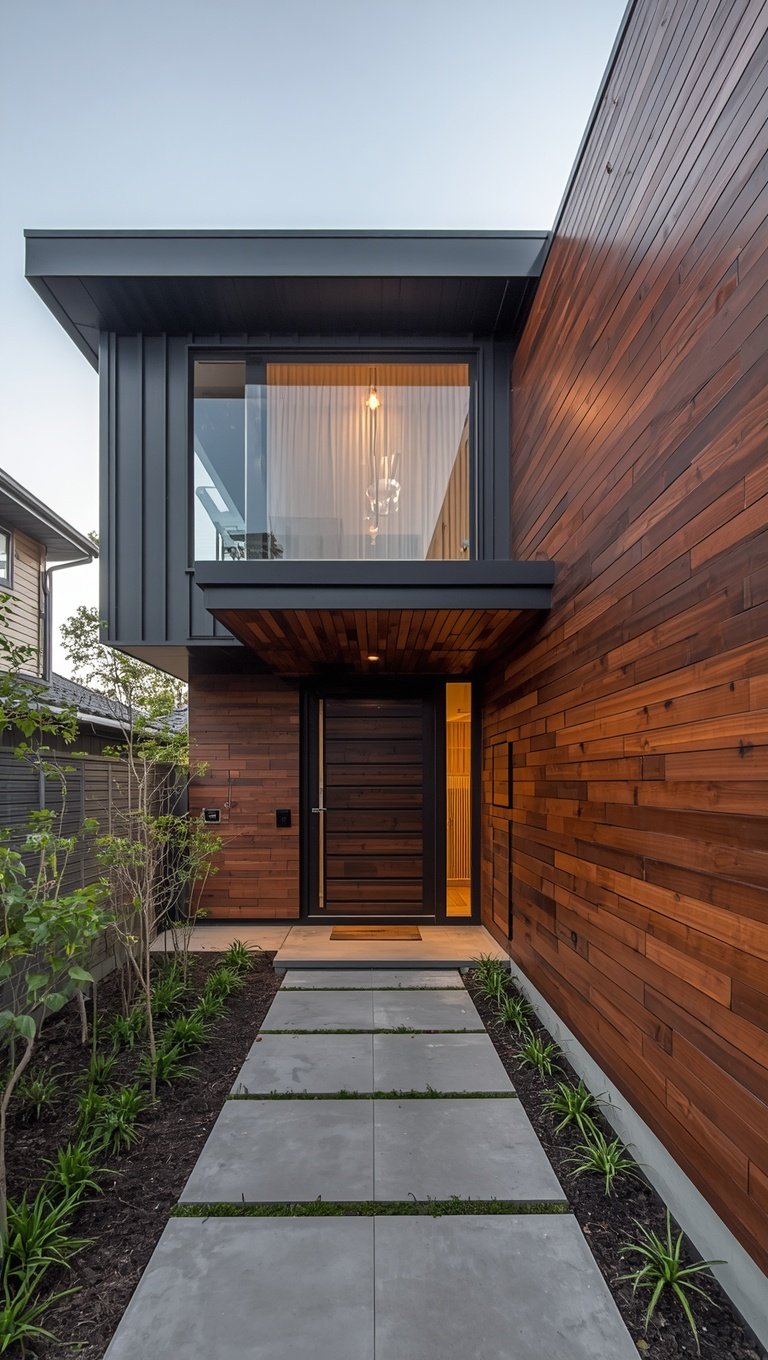

I used to walk past the side of my house every single day without even glancing at it.
It was just… there.
A narrow strip of cracked concrete, a sad little gap between the fence and the wall, collecting leaves and zero compliments.
And then one afternoon I actually stopped and looked at it — really looked — and I thought, this could be something.
Not just a path you rush through to grab the garden hose.
Something you actually want to walk down.
Something that makes a neighbor slow their car just a little.
That tiny shift in perspective honestly changed everything about how I think about outdoor spaces now.
Because the side walkway?
It’s the most underrated design opportunity on your entire property.
Why the Side Walkway Deserves So Much More Attention
Most people treat the side of their house like a utility corridor.


And honestly, I get it.
It’s not the front yard with its curb appeal pressure, and it’s not the backyard with its entertaining energy.
It’s just… the in-between.
But here’s what I’ve learned after obsessing over outdoor spaces for years — the in-between spots are where the real magic happens.
When I finally gave my side walkway some attention, the whole property felt more intentional.
More finished.
Like someone actually cared about every inch of the space.
The side walkway is also one of the most budget-friendly areas to transform because it’s typically small.
You’re not landscaping an acre.
You’re curating a corridor.
And there’s something so satisfying about that — a small canvas with a big visual payoff.
If I had to pick one outdoor project that gives you the most return on effort, this would honestly be it.
Laying the Right Foundation: Pathway Materials That Feel Beautiful Underfoot

The surface you choose sets the entire mood.
And this is where so many people just… default to plain concrete and never look back.
I totally understand the practicality of it.
But there are options that are just as durable and about a thousand times more gorgeous.
My personal favorite?
Flagstone with creeping thyme growing in the gaps.
When I did this in my own side yard, I could not stop walking back and forth just to look at it.
The texture of the stone, the soft green spilling between the cracks — it feels like something out of a cottage in the countryside.
Gravel paths are another option I’m a little obsessed with.
Pea gravel especially has this warm, crunchy, satisfying quality that feels very intentional and designed.
Brick pavers in a herringbone pattern are also stunning — very classic, very timeless.
And if your budget is tight right now, even basic stepping stones laid thoughtfully through mulch or ground cover can look incredibly curated.
The material doesn’t have to be expensive.
It just has to feel chosen.
Adding Greenery That Hugs the Path Without Overwhelming It
Plants are what turn a walkway from a surface into an experience.


But in a narrow side yard, plant choice really matters.
You don’t want something sprawling and wild that’s going to swallow the path by midsummer.
You want plants that frame, soften, and guide.
Tall, slender plants like ornamental grasses or columnar shrubs work beautifully because they add height without eating up your horizontal space.
I love a row of feather reed grass along a side walkway — it sways so gently in a breeze and it has this warm golden color in the afternoon light that feels almost magical.
Ferns are another soft, lush option if your side yard is on the shadier side.
They bring this deep, moody green that photographs insanely well.
For something a little more structured and low-maintenance, boxwood hedges trimmed neatly along both sides give a really polished, almost European feel.
And trailing plants like creeping jenny or sweet alyssum along the edges add that soft, romantic overflow that makes everything look effortless.
Layer your heights if you can — low ground cover at the base, mid-height shrubs in the middle, taller accent plants as focal points.
That layering is what makes a walkway feel designed rather than just planted.
Lighting the Path: How to Make Your Side Walkway Glow at Night

This is the detail that most people skip, and it is honestly the one I would never give up.
Good lighting on a side walkway does something almost emotional.
It makes your home look like it belongs in a magazine spread — even if everything else is still a work in progress.
Solar path lights are the easiest entry point.
You can find beautiful ones in matte black or aged bronze finishes that look genuinely elevated.
I lined my side path with small solar lantern-style lights and the glow they cast in the evening is just cozy in the best possible way.
String lights draped along a fence or overhead between hooks are another option I love for a more whimsical, warm feeling.
Low-voltage landscape lighting tucked into the garden beds along the path creates that dramatic, uplight effect that looks incredibly luxurious.
Wall sconces mounted to the side of the house if there’s a wall running along your path add a really architectural, intentional touch.
The goal with lighting is always warmth over brightness.
You’re not illuminating a parking lot.
You’re creating atmosphere.
Warm white bulbs only — always.
Fence and Wall Styling That Adds Personality to the Corridor


A lot of side walkways are bordered by a fence on one side and a house wall on the other.
And both of those surfaces are design opportunities most people completely ignore.
The fence?
It can be so much more than a boundary.
A simple coat of a deep, moody color — think charcoal, navy, or a rich forest green — immediately transforms it from background noise into a backdrop.
I painted my cedar fence a deep charcoal and suddenly the whole side yard felt like it had a design story.
You can also add vertical planters or hanging baskets along the fence to bring in greenery without using any floor space.
Lattice panels with climbing plants like clematis or climbing roses are absolutely dreamy — they turn a plain fence into a living wall over time.
On the house wall side, consider adding a water feature, a piece of outdoor art, or even a simple mirror designed for outdoor use.
An outdoor mirror on a side wall sounds a little unexpected, but it reflects light and greenery and makes the whole space feel wider and more open.
Don’t let those vertical surfaces just sit there doing nothing.
They are free real estate for personality.
Storage and Function That Doesn’t Kill the Vibe

Okay, real talk — side walkways often have to pull double duty.
They’re where the garden hose lives, where you stash the trash bins, where tools get propped against the wall.
And that’s totally fine and completely normal.
The goal isn’t to pretend the function doesn’t exist.
The goal is to make the function look good.
A beautiful wooden storage bench with a hinged lid along the fence line can hold garden tools and hoses while actually adding to the aesthetic of the space.
Matching, lidded containers for trash bins — especially in a material that complements your fence or home exterior — make a massive difference.
Wall-mounted hooks in a consistent finish (matte black is my personal go-to) keep tools organized and off the ground in a way that looks almost intentional.
A small cedar garden shed at the end of a side walkway can anchor the space and give you serious storage while looking absolutely charming.
The trick is consistency.
When everything — storage included — is in a cohesive color palette and material family, the functional stuff stops reading as clutter.
It just becomes part of the design.
Ground Cover Alternatives That Add Texture and Life

Not every side walkway needs a hard surface path the entire way through.
Sometimes the most beautiful solution is a mix of paving and living ground cover.
Creeping thyme is probably my most-recommended ground cover for side walkways because it is incredibly tough, tolerates foot traffic, smells amazing when you brush past it, and blooms in tiny purple flowers that are just ridiculously pretty.
Mondo grass is another one I love — that deep, almost black-green variety especially.
It’s slow-growing, very tidy, and it adds this lush, moody quality to the ground plane.
Irish moss creates a velvety, soft look between stepping stones that feels very romantic and intentional.
For drier climates, decomposed granite with drought-tolerant ground covers like ice plant or sedum can create something really striking and sculptural.
Ground cover isn’t just filler.
It’s texture.
It’s the thing that makes the space feel alive rather than just constructed.
When I tackled my own side yard and started mixing flagstone with creeping thyme, I remember standing back and genuinely being surprised by how soft the whole space suddenly felt.
Like it had always been there, just waiting.
Color Palette Ideas That Feel Cohesive and Considered


Color is the secret ingredient that ties an entire outdoor space together.
And in a side walkway — which is essentially a long, narrow room with no ceiling — a considered color palette makes everything feel intentional and designed.
My personal approach is always to start with the house.
What color is your siding, your trim, your front door?
Pull those tones into the side yard and everything will feel connected.
If your home is white or cream, warm terracotta pots, honey-toned wood, and dusty sage greenery create a color story that feels incredibly warm and welcoming.
If your home is darker — charcoal, navy, deep gray — I love leaning into that drama with dark fence paint, black metal accents, and bold, dark-leafed plants like black mondo grass or deep burgundy heuchera.
For a lighter, more cottage-inspired feel, soft white, blush, and lavender tones in your plant choices with natural wood and aged stone materials are just chef’s kiss.
Keep your hard material colors in the neutral family so they never fight with your plants.
Let the plants carry the color energy.
And don’t be afraid of dark colors in a narrow space — they actually make it feel more intimate and special rather than smaller.
Adding a Seating Nook or Moment of Pause

Not every side walkway has room for this.
But if yours has even a slightly wider section, or a little bump-out near a gate or door — please, please use it.
A small bench, a single chair, even a little stool tucked into a corner with a potted plant beside it creates what I call a “pause moment.”
It gives the eye somewhere to land and rest.
It makes the space feel lived-in rather than purely utilitarian.
I have a tiny curved iron bench tucked into the widest point of my side walkway, beside a large terracotta pot with a lemon tree.
And I’m not even sure I sit there that often.
But every single time I walk past it, I feel something.
A kind of quiet joy.
It’s the feeling of a space that has been thought about and loved.
A folding bistro chair and a small side table in a nook can work just as beautifully if your space is really tight.
Even a single beautiful planter that’s large enough to anchor the space gives it that moment of weight and intention.
Small gestures matter enormously in narrow spaces.
Overhead Elements That Add Dimension and Drama

Most people design side walkways entirely at ground level.
And I get it — that’s where the path is, that’s where the plants go, that’s the obvious zone.
But looking up is where side walkways can go from pretty to genuinely stunning.
A simple pergola structure over a side walkway — even a very minimal one — immediately transforms it into an outdoor room.
It creates enclosure, depth, and drama.
And when you drape it with climbing plants like wisteria, roses, or jasmine?
The scent alone is worth the entire project.
Overhead string lights stretched between the house wall and the fence line are a lower-effort version of the same idea.
They create that canopy feeling without any construction.
In the evenings, the light through string lights on a side walkway is honestly one of the coziest things I’ve ever experienced in an outdoor space.
Even a simple pergola beam with hanging planters cascading down brings the eye upward and adds a layer of lushness that ground-level planting alone can’t achieve.
Think of the overhead zone as your ceiling.
And design it accordingly.
Personalizing With Details That Make It Yours


This is honestly my favorite part.
Because anyone can lay a path and plant some grass.
But the details are what make a side walkway feel like you.
A mosaic stepping stone you made yourself.
A collection of small ceramic pots in a color you’re obsessed with.
A vintage garden sign that makes you smile every single time you pass it.
A wind chime hung near the gate that you chose purely because the sound makes you happy.
These are the touches that can’t be purchased as a package or copied from a trend board.
They come from knowing what you love and actually putting it out there.
When I added a small hand-painted tile plaque to the wall of my side walkway — something completely impractical and purely decorative — it became my favorite detail in the whole yard.
Every visitor who came through commented on it.
Not the flagstone, not the lighting, not the arch.
The little tile.
Because personal details connect with people.
They tell a story.
And your side walkway, however narrow and overlooked it has been until now, deserves to have a story worth stopping for.