

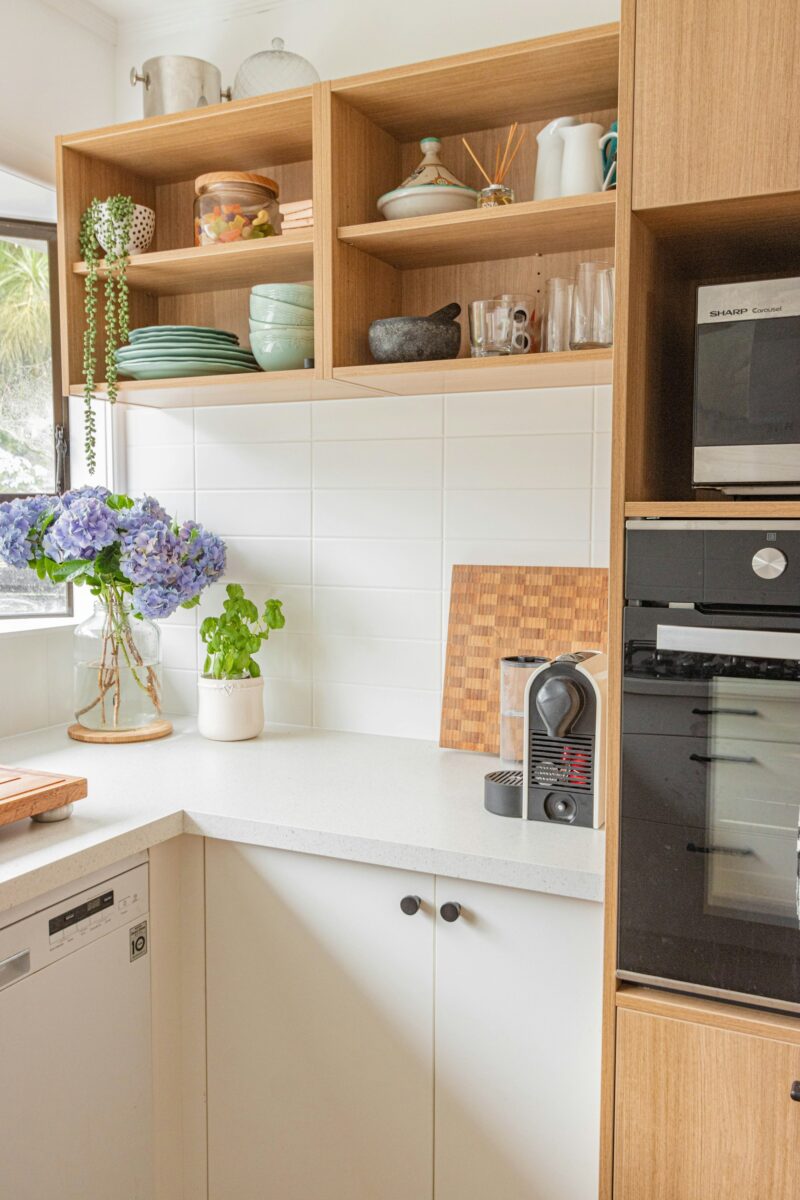
Minimalist kitchens have a reputation problem.
Too many of them look like a dentist’s office with a fridge, all white, all shiny and so empty you’re scared to set down a spoon.
Warm minimalism is the fix, and I’m a big fan.
You still keep the counters clear and the cabinets simple, but you bring in wood, texture, a few plants and soft light, so the room feels calm instead of cold.
And the best part for those of us on a budget is that a lot of it comes down to editing what you already own.
Here’s how these kitchens pull it off, photo by photo.
Let One Wood Tone Do the Talking

Look at how calm this corner is, even though there’s a lot going on.
The open shelves, the cutting board and the little wood details are all in the same light oak family.
That repetition is what keeps it from looking busy.
Your eye sees one wood, then sees it again, and decides everything belongs together.
The white flat-panel cabinets underneath stay quiet, and the small black knobs give them just enough edge.
Then the color comes from things you’d actually use, like the sage plates and bowls, a pot of basil and a vase of blue hydrangeas.
If your kitchen already has a few different woods going on, don’t panic.
Here’s how I handle mixing wood tones in one room without it looking like a mistake.
But if you’re starting fresh, picking one wood tone and repeating it is the easiest win in this whole post.
Mostly White, a Little Wood, a Little Black

Here’s the wide shot of that same kitchen, and I think the balance is spot on.
The lower cabinets are white, the tall cabinets are light oak, and there’s an open oak shelf for cookbooks and a woven basket.
So the white does most of the work, and the wood shows up in the big tall pieces where it can really warm things up.
Now notice the black.
It’s sneaky.
It’s in the bar pulls, the long handles on the tall cabinets and the window frames over the sink.
Those thin black lines give the room some edges, so all that white and pale wood doesn’t go soft and mushy.
And honestly, I’m thrilled the only ceiling light I can spot is one small fixture.
Which brings me to my favorite rant.
Turn Off the Big Light

You all know where I stand on this one.
Overhead lighting is a crime, and it’s especially rough in a white kitchen, where it bounces off every surface and makes everything look flat.
See that little swing-arm sconce over the floating shelves?
It’s lit, and it throws a warm pool of light right onto the wood and the woven balls, which is exactly the cozy look people are chasing with warm minimalism.
The light from a bulb has a color, and it’s measured in kelvins on the box.
Warm light looks more yellow, and cool light looks more blue.
For homes, the warm range is usually around 2,700 K, and 3,000 K is a soft white that’s a touch crisper.
That’s where I’d stay in a kitchen like this.
Cool white, around 4,100 K, is the one usually listed for offices, which is the opposite of what we’re going for.
My advice?
Swap one bulb, live with it for 3 days, and see if you ever want the big light back (spoiler, you won’t).
The rest of this kitchen is a lesson in quiet texture, too.
There’s a plaster-look hood with a wood band, tiny white tiles all the way to the ceiling and nickel cup pulls on plain shaker drawers.
Nothing shouts, but nothing’s boring either.
Give the Counter One Home Base

This one’s so simple it’s almost silly, and it’s the habit I’d start with tonight if your counters are a free-for-all right now and you can’t face a big clean-out.
Every kitchen has a handful of things that live on the counter, no matter how minimal you are.
Salt, pepper, oil, a crock of spoons, maybe the butter (and in my house, always the coffee stuff).
Instead of letting them scatter, this kitchen gathers them all onto one wooden turntable.
It spins.
So you can grab the oil from the back without knocking the salt over.
And because everything sits on one base, the rest of the counter stays clear, which is the whole point.
If you try it, I’d look for a turntable or tray around 10 to 12 inches across, so it holds the basics without eating up your prep space.
A hand-painted cruet or a thrifted crock is a great way to sneak in some personality, too.
For more on clearing the decks, I’ve got a whole post on decluttering kitchen counters.
Open Shelves Need Texture, Not More Stuff

I love open shelves, and I’ve also learned how fast they turn into clutter.
The secret in this one is mixing materials, not adding more things.
Easy.
There’s speckled stoneware with brown rims, clear glass, a worn wooden board, a woven rattan trivet and a plain white candle.
That’s five different textures on one short shelf, and every single piece is something you’d actually use.
The lilac in the glass vase is the only purely pretty thing up there, and it’s enough.
Upturned wine glasses are a nice trick too, since they stay cleaner inside and look intentional.
If you want the step-by-step, here are my kitchen shelf styling lessons, mistakes and all.
My rule now is that if I haven’t used something in a few weeks, it goes back in a cabinet.
Small, Old or Rented? You Can Still Do This

This little kitchen might be my favorite of the bunch, because it’s real.
It’s tiny, the painted floorboards are worn, and the fridge is a little retro one.
But it still feels warm and calm.
Seriously.
The thick pale wood counter carries most of the warmth, and the plain white shaker cabinets keep everything quiet.
Then a trailing plant, a black kettle and a small vintage rug do the rest.
None of that needs a renovation, a contractor or a loan, and you could hunt down every piece of it at a thrift store or on Facebook Marketplace.
If you rent or you’re fixing up an older house like I am, this is the version to copy.
A thrifted runner, one wood board leaned against the backsplash and one plant can get you most of the way there in a weekend.
Want to plan the whole room this way?
My Scandinavian minimalist room layout guide uses the same less-but-warmer thinking.
Start with one wood tone, keep the counters to one home base and swap that big overhead light for something softer.