
Pick your siding color and see the deck and fence stain colors that go with it: the ones the stain maker Behr pairs with that siding first, each with how much it stands out from the house. Then stain a sample deck, a fence or a photo of your own. Your photo never leaves your device.
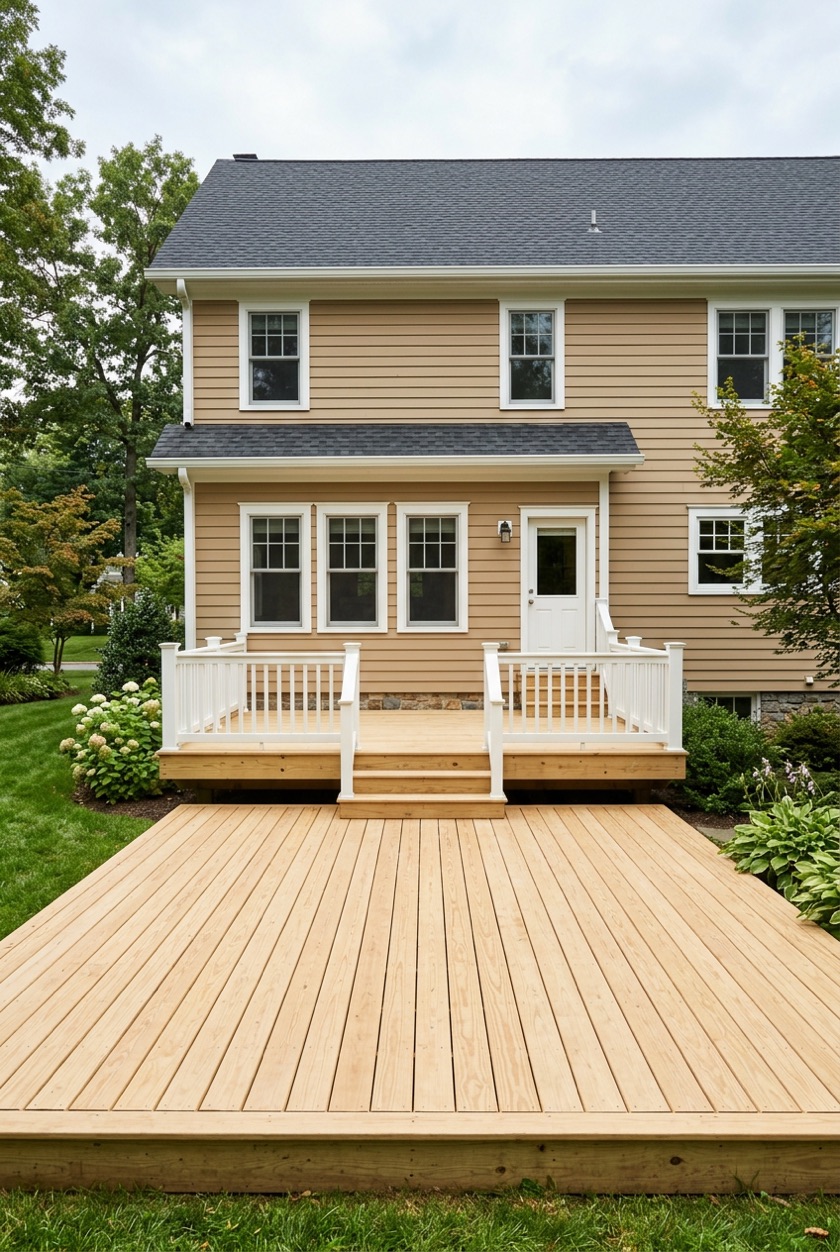
Pick a stain to try on the deck
1Your house
2Your siding and trim colors
3Stain colors for your siding
A Chestnut stain on a tan house: an LRV gap of 34 with the siding (stands out in any light) and 87 with the trim (stands out in any light).
Your siding reads warm. Behr: If your home has warm siding or brick, outdoor colors with brown, cedar, clay, olive, or warm gray undertones usually feel connected.
Your siding reads cool. Behr: If the exterior is cooler, look at weathered grays, charcoal, blue-gray, or soft neutral stain colors.
A white house. Behr’s warm and cool rule names no white of its own; its choices for any deck: Natural browns, warm cedar tones, weathered grays, charcoal, and soft taupes are strong choices because they work with wood grain, stone, concrete, and greenery.
Gap = the difference in LRV (how much light a color reflects, 0 black to 100 white): over 30 the deck or fence stands out from the walls in any light, 20 to 30 in daylight, under 20 it blends in. A stain is see-through: the same color looks lighter or darker on different wood, so test it on your own boards.
4Or pick any stain color
5Tap the deck or fence
On a sample the deck boards, the steps and the rim boards (or the whole fence) are stained for you; the thin stair rails take the Brush. On your own photo, tap the deck floor, then each step and board that is not stained yet. Stain on the grass or the house? Move Spread left, or wipe it with Erase.
How much stain: the gallons for your deck or fence
Stain to buy
1 gallon of Cabot #300192 sq ft of deck · 1 coat at 450–650 sq ft a gallon on smooth wood: 0.3–0.4 gallon
Quick answer: stain the deck or fence in the same warmth as your house. The stain maker Behr says that with warm siding or brick, colors with brown, cedar, clay, olive or warm gray undertones feel connected, and with a cooler house, weathered grays, charcoal, blue-gray or soft neutrals. Pick your siding color above to see Behr’s pairings first, stained on a sample deck, a fence or your own photo, with how much each one stands out from the house. Under the photo, how much stain: the gallons for your deck or fence, by Cabot’s and Sherwin-Williams’ own coverage and coats.
How to use the deck stain color picker
- Pick your siding color. Tap a chip, type its color code, or tap Read it off my photo and then your siding.
- Say what your trim and railings are. White, cream, black or the house color.
- Read the stain colors. The families Behr pairs with your siding come first, with Behr’s reason, each with its LRV and its gap from the siding and from the trim.
- Tap a stain and the sample deck (boards, steps and rim boards) or the fence is stained in it, or pick any color on the board below.
- Try your own deck or fence. Use your photo, pick a color and tap the boards. Wood is textured, so the picker starts on Wood (the grain shows).
- Count the stain. Under the photo, type the deck’s length and width, or the fence’s length and height, and say if the wood is smooth or rough-sawn: you get the gallons of two makers’ stains, semi-transparent or solid. A wood deck in the deck board calculator hands its size over.
The stain maker’s rule: warm house, warm stain
Behr’s outdoor color guide starts with what will not change: Start with the permanent exterior elements: siding, trim, roof, brick, stone, and landscaping.
Then it gives the two halves of the rule:
- Warm siding or brick.
If your home has warm siding or brick, outdoor colors with brown, cedar, clay, olive, or warm gray undertones usually feel connected.
- A cooler house.
If the exterior is cooler, look at weathered grays, charcoal, blue-gray, or soft neutral stain colors.
For porches, patios and decks Behr puts it in one line: choose colors that complement the house instead of competing with it.
And for a deck or fence in general: Natural browns, warm cedar tones, weathered grays, charcoal, and soft taupes are strong choices because they work with wood grain, stone, concrete, and greenery.
Those five lead on a white house, which Behr’s warm and cool rule leaves open.
The picker reads your siding as the roof color picker does: a siding with no clear hue and an LRV of 75 or more is white; otherwise its hue says warm (beige, tan, cream, brick) or cool (gray, sage, blue). That reading is ours; the pairings are Behr’s. The color names on the board are the picker’s own, not a stain maker’s.
Semi-transparent or solid stain
Behr: Semi-transparent stain is a good fit when the wood is in good condition and you want visible character.
and Solid color stain is better when you want more color impact and coverage.
Cabot’s, the deck stain maker in Australia, says the depth comes from the coats: One coat would provide a semi-transparent look whereas two or more coats would provide a more opaque finish.
A semi-transparent stain lets the wood’s own color through, so the same can looks warmer on cedar and redwood than on pale pine. The picker keeps the grain and the light of the photo and changes the color, which is closest to a solid stain; on your own deck, a see-through stain will lean toward your wood. Behr: For wood surfaces, remember that the existing wood tone and surface condition can affect how a stain appears.
How much stain for a deck or fence
Measure the surface, then divide by what a gallon covers. A deck is its length × width; Cabot’s data sheet puts it the same way: Square feet can be calculated by multiplying length and width; e.g., 10′ W x 25′ L = 250 sq. ft.
A fence is its length × height for one face, twice that for both. Times the coats, divided by the coverage on the can, is the gallons. The calculator under the photo does it for two makers’ stains of the kind you pick, each by its own data sheet:
| Stain | Kind | Listed here for | Coats | Smooth wood, sq ft a gallon | Rough-sawn, sq ft a gallon |
|---|---|---|---|---|---|
| Cabot Semi-Transparent Stain + Sealer #300 | semi-transparent | decks, fences | 1 | 450–650 | 200–300 |
| Sherwin-Williams SuperDeck Oil-Based Semi-Transparent Wood Stain | semi-transparent | decks, fences | 1 | 150–400 | 150–400 (any wood) |
| Cabot Solid Color Acrylic Stain + Sealer #1800 | solid | decks | 2 | 400–500 | 200–300 |
| Sherwin-Williams SuperDeck Waterborne Solid Color Deck Stain | solid | decks | 2 | 200–400 | 200–400 (any wood) |
| Cabot Solid Color Acrylic Siding Stain #800 | solid | fences | 2 | 300–400 | 200–300 |
| Sherwin-Williams WoodScapes Rain Refresh Exterior House Stain | solid | fences | 2 | 300–400 | 200–300 |
Rough-sawn wood drinks about twice the stain of planed boards, which is why Cabot prints two ranges. Sherwin-Williams prints one range for any wood, Depending on porosity and texture.
, and notes that old, weathered wood takes more than new. The calculator buys for the low end of each range, the most stain, because every one of these sheets says to mix all the cans before you start: Cabot, If project requires more than 1 container, blend all containers together to ensure uniformity.
; Sherwin-Williams, For uniformity, mix all cans together before use.
A can bought halfway is another batch, and may not match.
The coats are the makers’: Cabot’s semi-transparent #300 Requires a 1-coat application.
, and SuperDeck’s oil stain warns If a second coat is applied, it will not penetrate or adhere properly.
The solid stains take two. The WoodScapes house stains are for fences and siding only: Not for use on horizontal surfaces, such as a roof, deck, or floor, where water may collect.
Cabot expects its #300 to last 2–5 years on decks and 4–8 years on siding and fences
, so a deck is restained about twice as often as the fence.
Two worked examples. A 16 × 12 ft deck is 192 sq ft. One coat of Cabot #300 on smooth boards is 0.3–0.4 gallon, so one gallon; SuperDeck’s semi-transparent, at 150–400 sq ft a gallon on any wood, is 0.5–1.3 gallons, so two. A 50 ft fence 6 ft high is 300 sq ft a face; two coats of Cabot #800 in a solid color on rough-sawn pickets is 2–3 gallons a face, so three, and six for both faces.
Coverage and coats from the makers’ product data sheets, read on 19 October 2026: Cabot #300, Cabot #1800, Cabot #800, SuperDeck Oil-Based Semi-Transparent, SuperDeck Waterborne Solid Color and WoodScapes Rain Refresh. The label on your can has the last word.
Stands out, or blends in
Each stain also shows how far its LRV (how much light it reflects, 0 black to 100 white) is from the siding’s. The yardstick is the UK’s Approved Document M, paragraph 0.26, which calls two surfaces contrasting when the difference in light reflectance value between the two surfaces is greater than 30 points
, or at least 20 in good light. It was written so people can find a door, not to choose a stain, so here it only answers “will the deck read as a separate color from the house”.
Both are good choices. Cabot’s: Light stain colours can create a more open and airy feeling, while darker colours can create a cosier vibe.
A deck that blends with the siding makes the house and deck one piece; a darker one frames the house.
Stain colors by siding color
With white trim: how the picker reads each siding and the stain colors Behr pairs with it, each with its LRV gap from the siding. “Stands out” = over 30 points, “daylight” = 20 to 30, “blends” = under 20.
| Siding | Reads | Stain colors Behr pairs with it (gap) |
|---|---|---|
| White #F4F1EA | white | Natural Cedar (64, stands out); Chestnut (81, stands out); Taupe (66, stands out); Weathered Gray (61, stands out); Charcoal (81, stands out) |
| Cream #F3EAD3 | warm | Natural Cedar (59, stands out); Chestnut (76, stands out); Redwood (72, stands out); Olive (71, stands out); Taupe (61, stands out) |
| Beige #DCC7A6 | warm | Natural Cedar (35, stands out); Chestnut (52, stands out); Redwood (48, stands out); Olive (47, stands out); Taupe (37, stands out) |
| Tan #C4A882 | warm | Natural Cedar (17, blends); Chestnut (34, stands out); Redwood (30, daylight); Moss (31, stands out); Taupe (19, blends) |
| Light gray #C9CAC6 | cool | Weathered Gray (32, stands out); Charcoal (52, stands out); Blue-Gray (45, stands out) |
| Gray #A3A5A1 | cool | Weathered Gray (10, blends); Charcoal (30, daylight); Blue-Gray (23, daylight) |
| Sage #A9B59B | cool | Weathered Gray (17, blends); Charcoal (37, stands out); Blue-Gray (30, daylight) |
| Blue-gray #7D8C96 | cool | Silver Gray (13, blends); Charcoal (18, blends); Blue-Gray (11, blends) |
| Red brick #9B4A3A | warm | Light Natural (34, stands out); Dark Brown (9, blends); Clay (7, blends); Moss (2, blends); Warm Gray (18, blends) |
| Charcoal #45484A | cool | Silver Gray (32, stands out); Slate (5, blends); Harbor Gray (15, blends) |
| Navy #2B3A55 | cool | Silver Gray (34, stands out); Slate (7, blends); Harbor Gray (17, blends) |
Three worked examples
A tan house. Warm siding, so Behr’s browns, cedars, clays and olives lead. Chestnut is 34 points from the tan and stands out; Natural Cedar is 17 away and blends in, a soft, all-of-a-piece look. The first sample opens on Chestnut.
A gray house. Cool siding, so Behr’s grays lead. Charcoal is 30 points from mid gray, a frame in daylight; Weathered Gray is 10 away and blends, the deck as part of the house. Tap the gray sample to see both.
A fence beside a white house. Every stain stands out from white: Weathered Gray by 61 points, Chestnut and Charcoal by 81. The fence sample opens on Weathered Gray.
Common mistakes when choosing a deck stain
- A cool gray deck on warm siding, or the reverse. Behr’s rule keeps the deck in the house’s warmth.
- Judging the color in one light. Behr:
Outdoor colors can look very different depending on sunlight, shade, landscaping, and the direction your space faces.
andTest colors on the actual surface when possible, and view them in morning, afternoon, and evening light.
- Testing on the wrong wood. A sample on a scrap of the same boards tells you more than a chip. Cabot’s suggests
a spare piece of your decking timber
. - Forgetting the neighbors. Cabot’s:
Consider the existing colour palette of your home’s exterior, the architectural style, and even the colour schemes of neighbouring houses.
An HOA may limit fence and deck colors too. - A see-through stain on worn wood. Behr’s semi-transparent advice is for wood in good condition; a weathered deck takes a solid stain better.
Finishing the outside? The exterior house color visualizer paints the siding on your photo, and the gutter color picker and the roof color picker pair the roofline with it. Planning the inside too? The free 2D room planner lays out every room.
Paint the sidingRead next
- Deck paint color ideas
- The most popular colors to paint a fence
- The best colors to paint a wood fence
- Deck railing designs
- Outdoor deck decorating ideas
Deck and fence stain questions
What color should I stain my deck?
One in the same warmth as your house. Behr: with warm siding or brick, colors with brown, cedar, clay, olive or warm gray undertones; with a cooler house, weathered grays, charcoal, blue-gray or soft neutrals. Pick your siding above and the picker puts Behr’s pairings first.
What deck color goes with a gray house?
A gray one, in Behr’s rule for a cooler house: weathered gray, charcoal or blue-gray. Weathered gray blends with mid-gray siding; charcoal reads as a frame. If your gray is a warm greige, the warm stains fit better.
What deck color goes with a white house?
Every stain the picker lists stands out from white siding, by 60 LRV points or more. Behr’s choices for any deck are natural browns, warm cedar tones, weathered grays, charcoal and soft taupes; brown and charcoal give the strongest frame.
What stain goes with red brick?
Behr pairs warm siding and brick with brown, cedar, clay, olive and warm gray. Most of those blend with red brick (under 20 LRV points); a light natural cedar stands out from it instead.
Should I use a semi-transparent or a solid stain?
Behr: semi-transparent when the wood is in good condition and you want to see its grain; solid when you want more color and coverage, which also suits older, weathered wood.
What color should I stain my fence?
The same rule as a deck: match the house’s warmth. A fence is seen against the house and the garden, so a weathered gray or a natural cedar stays quiet, and a dark brown or charcoal makes the fence a dark backdrop for the planting.
How much stain do I need for a deck or fence?
Measure the surface: length × width for a deck, length × height for each face of a fence. Times the coats, divided by what a gallon covers. A 16 × 12 ft deck is 192 sq ft: one coat of a semi-transparent stain like Cabot #300 (450–650 sq ft a gallon on smooth boards) is under half a gallon, so buy one. A 50 ft fence 6 ft high is 300 sq ft a face: two coats of a solid stain is two to three gallons a face. Rough-sawn wood takes about twice as much; buy it all at once and mix the cans.
Can I try stain colors on my own deck?
Yes. Upload a photo, pick a color and tap the deck floor, the steps and the boards. Your photo never leaves your device: the painting happens in your browser.