
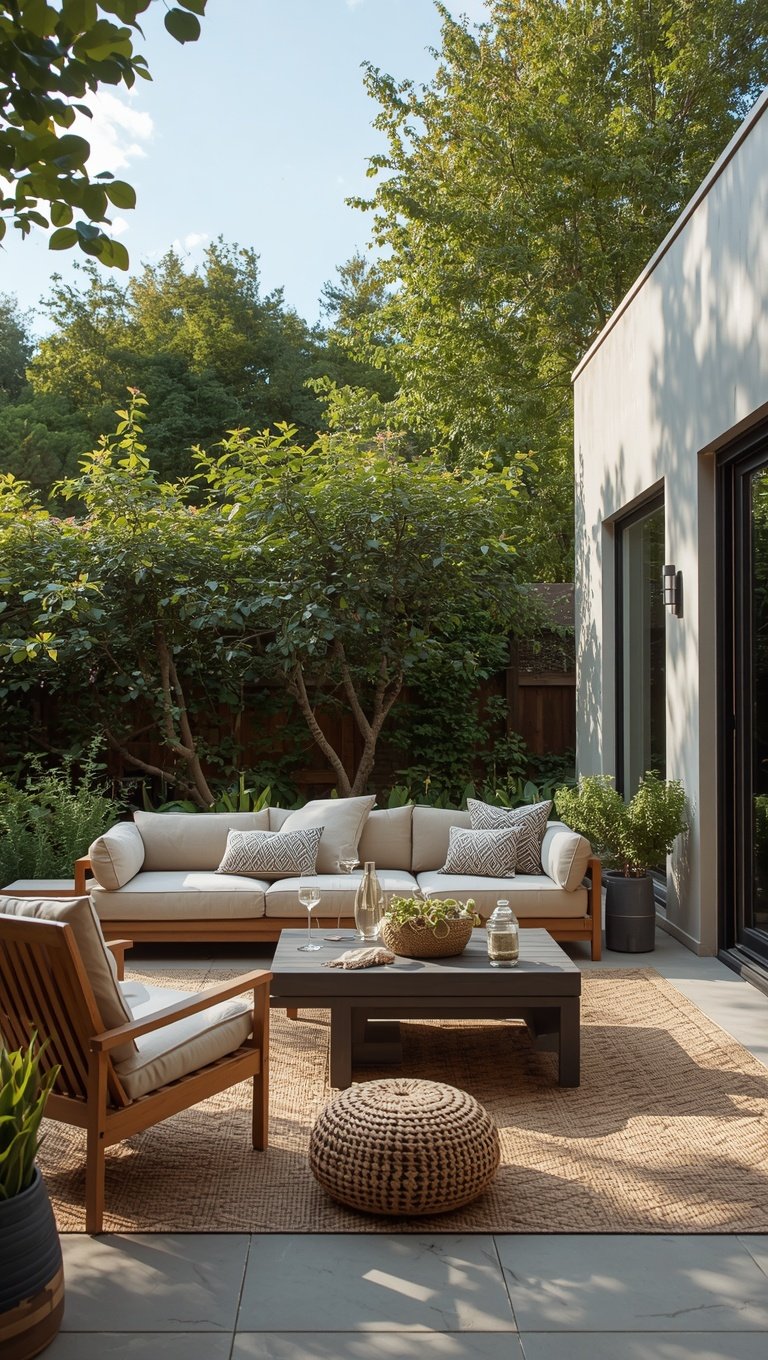

There’s a particular sound I love, the clink of ice in a glass on a warm evening.
I used to only hear it inside my kitchen, standing at the counter, looking out at a yard I barely used.
That always bugged me, if I’m honest.
So one summer I dragged a chair outside just to sit for five minutes, and five minutes turned into two hours.
The air felt different out there, softer somehow, and I didn’t want to go back in.
That was the moment I realized my patio wasn’t just outdoor space, it could actually be a room.
My favorite room, it turns out.
And once you feel that shift, you start seeing your whole backyard differently too.
Want another variation, or should I drop this one into the file in place of the current intro?
Start With a Rug That Grounds Everything
I know it sounds a little backwards to put a rug outside.


But trust me on this one.
An outdoor rug is honestly the fastest way to turn a slab of concrete into a “room.”
The first time I laid one down under my seating area, the whole space just clicked into place.
Suddenly there were boundaries, you know, like an invisible wall telling your brain “this is the living room part.”
I love a chunky, textured weave in a soft neutral, something that feels a little woven and imperfect.
If your space is small, a smaller rug still works, just make sure the front legs of your furniture sit on it.
That little trick alone makes everything feel intentional instead of scattered.
My personal pick is always a faded, sort of vintage-looking pattern, because it hides pollen and leaf debris like a champ.
A solid color is beautiful too, but oh my gosh, it shows every little smudge.
So if you have pets or kids running through, go patterned, trust me.
And if you’re worried about rain, look for rugs specifically rated for outdoor use, they dry so much faster than you’d think.
Honestly, this one purchase changed how my whole yard felt before I even added another piece of furniture.
It’s such a small thing, but it does so much emotional heavy lifting for the space.
Choose Sofas That Feel Like Furniture, Not “Patio Gear”

For the longest time I thought outdoor furniture had to look like, well, outdoor furniture.
Stiff, boxy, a little cold.
Then I found a deep-seated sectional with cushions that looked almost like something from my actual living room.
I remember sinking into it for the first time and just going “oh, this is it.”
That’s the feeling you’re after, the one where you forget you’re technically sitting outside.
Look for a low, relaxed profile, something you can curl your legs up on.
Quick-dry foam cushions are a total game changer if you live somewhere with surprise afternoon showers.
I also love mixing in a couple of deep lounge chairs instead of doing a totally matchy set.
It feels more collected, more like a room that grew over time instead of one bought in a single trip.
If your budget is tighter, a smaller loveseat with the same cushy proportions gives you that same cozy energy.
And honestly, a couple of good floor cushions scattered around can fill in extra seating for guests without costing much at all.
My tip: sit in the furniture before you buy it if you possibly can.
You want that little sigh of relief when you sit down, not a stiff, formal feeling.
That sigh is basically the whole point of an outdoor living room.
Add a Coffee Table That Anchors the Conversation

A coffee table might feel like a small detail, but it’s honestly the heart of the seating area.
It’s where the drinks go, the snack bowls, the book you never quite finish reading.
I went with a woven rattan-style table with a stone top, and it feels so grounded and warm.
Wood tones do something magical outside, they soften all that hard concrete and metal around them.
If you love a more industrial look, a metal-topped table with reclaimed wood legs feels really striking too.
One of my favorite little hacks is adding a tray on top, it keeps everything from feeling cluttered.
Candles, a small plant, maybe a stack of coasters, all corralled in one spot.
It’s such a small styling trick but it makes the whole table look curated instead of messy.
For smaller patios, a round table works so much better for traffic flow than a big rectangle.
You can tuck it closer to the seating without anyone banging their shins on a corner.
And if you’re someone who loves to entertain, consider two smaller ottomans instead of one fixed table.
They can slide around, double as extra seating, and just flex with whatever the night calls for.
I switch mine around depending on how many people are coming over, and it never feels like a compromise.
Layer in Lighting That Makes Evenings Feel Like Magic
Nothing, and I mean nothing, transforms an outdoor space after sunset like good lighting.

I remember the first night I strung warm bistro lights above my seating area.
I actually gasped a little, it felt like a whole different world out there.
Overhead string lights give you that soft, ambient glow that makes everyone look a little prettier, honestly.
But don’t stop there, layer in lower lighting too, like lanterns on the coffee table.
A few flickering candles at different heights add so much warmth and depth to the space.
I’m a little obsessed with flameless candles now, since I can leave them out overnight without worrying.
Path lighting along the edges of the patio also helps define the whole room, almost like a soft glowing baseboard.
If you can swing it, a dimmer switch on any wired fixtures is worth every penny.
Being able to shift from bright and lively to soft and moody changes the whole mood of a gathering.
My favorite trick is layering three light sources minimum, overhead, table level, and ground level.
It sounds fussy, but it’s honestly what separates a pretty patio from one that feels like a real room.
Once the sun goes down, lighting is basically ninety percent of the atmosphere.
Build in Storage So It Feels Like a Real Room, Not a Setup
Here’s something nobody tells you about outdoor spaces, clutter kills the cozy vibe fast.

Cushions, games, extra throws, they all need somewhere to live when you’re not using them.
I added a low storage bench along one wall, and it changed everything about how tidy the space felt.
It works as extra seating too, which is such a nice bonus when you have a crowd over.
A weatherproof cabinet or sideboard can double as a little bar station if you love hosting.
I keep my citronella candles, extra napkins, and a corkscrew tucked inside mine, so nothing’s ever scrambling at the last minute.
If built-in storage isn’t in the budget, even a few woven baskets tucked under a bench work wonders.
Baskets are so forgiving, honestly, you can just toss things in without folding or organizing perfectly.
My personal rule is that if it’s out and visible, it needs to look intentional, not like leftover camping gear.
So anything a little rough or plastic-y gets a basket or a bin.
It’s a small shift, but it’s the difference between a space that photographs well and one that just functions.
And truly, a tidy space is a space you’ll actually want to sit in every single evening.
Make a Fire Feature the Heart of the Space

There’s something so primal and comforting about gathering around a flame, even a small one.
My fire table became the unofficial center of my whole backyard almost immediately.
Everyone naturally pulls their chairs a little closer when there’s a flicker of fire in the middle.
I went with a propane fire table because it’s low maintenance and lights up in seconds.
A wood-burning pit gives off more of that crackling campfire feeling, if you don’t mind a little extra smoke and upkeep.
Either way, it becomes this magnetic little gathering point that makes people linger longer than they planned.
I’ve had friends over for “just one drink” that turned into three hours around that fire table.
That’s the whole goal, honestly, creating a spot people don’t want to leave.
If a full fire feature feels like too much, a simple tabletop fire bowl gives you a similar glow on a smaller scale.
My tip is to keep a stack of cozy blankets nearby for cooler nights.
There’s nothing better than wrapping up in something soft while the fire does its thing.
It turns a chilly evening into one of the coziest memories of the whole season.
Frame the Space With a Pergola or Overhead Structure

An overhead structure does something wild psychologically, it tells your brain “you are inside a room.”
Without it, even a beautifully furnished patio can feel a little exposed, a little unfinished.
I added a simple wood pergola over my seating area and the whole yard suddenly felt architectural.
It gives you a ceiling, essentially, even if it’s an open one you can see the sky through.
Draping a simple canvas or fabric across the top adds shade and softens the light beautifully during the day.
At night, string lights woven through the beams turn that same structure into something almost dreamy.
If a full pergola isn’t in the cards, even a large market umbrella creates some of that same “room” feeling.
I love how it casts a defined shadow, almost like a soft boundary around your seating area.
Climbing vines on a pergola are one of my favorite touches, they soften all those straight hard lines.
Jasmine especially, oh my gosh, the smell in the evening is unreal.
My tip is to think about the structure first, before furniture, because it really does set the whole tone.
It’s the bones of the room, and everything else gets to be the decoration.
Layer in Textiles for Warmth and Softness

Hard surfaces are everywhere outside, stone, concrete, metal, wood.
Textiles are what soften all of that and make a space feel huggable, if that makes sense.
I go a little overboard with outdoor pillows, honestly, mixing patterns and textures until it feels collected.
A chunky knit throw draped over the arm of a chair adds so much cozy visual weight.
Outdoor fabric has come such a long way, it resists fading and handles a surprise rain shower like nothing happened.
I mix in a few solid colors with one or two bold patterns so it doesn’t feel too busy.
Curtains are another one of my favorite additions, hung along the edges of a pergola or covered patio.
They billow so beautifully in a breeze, and they add privacy without feeling closed off.
My personal trick is layering at least three textures, something woven, something knit, something smooth.
It mimics exactly what makes an indoor living room feel finished and lived in.
So don’t skip this step just because it’s outside.
Softness matters just as much out here as it does on your actual living room sofa.
Blur the Threshold Between Indoors and Out

This is honestly the secret sauce of the whole “blurred lines” concept.
The transition point between your kitchen or living room and the patio matters so much more than people realize.
I swapped my old solid back door for a big sliding glass one, and it changed the whole feel of my downstairs.
Suddenly my eye could travel straight through the house into the yard without any hard stop.
If a full door swap isn’t realistic, even matching your indoor and outdoor flooring tones helps trick the eye.
I used a similar warm gray tone on both sides, and it visually stitches the two spaces together.
Removing a step or leveling a threshold, if you’re able to, makes the walk outside feel completely seamless.
Even something as simple as continuing your indoor curtain style onto the patio creates that same visual thread.
My tip is to stand inside your house and look toward the yard.
Ask yourself honestly, does your eye stop somewhere, or does it flow all the way through?
That flow is the whole goal here.
Once you nail that, the outdoor space stops feeling separate and starts feeling like the next room over.
Use Greenery as Living Walls

Plants do something furniture simply can’t, they add movement, scent, and life to a space.
I use tall potted plants almost like furniture, placing them at the corners of my seating area to define the room.
Something about a cluster of planters just says “wall” to your brain, even though there’s nothing solid there.
I love mixing heights, a tall olive tree, a mid-height grass, something trailing near the ground.
Herbs in pots near the seating area are one of my favorite little touches, rosemary especially.
Brushing against it releases this incredible scent, it’s such a small sensory moment that guests always comment on.
If you’re short on ground space, hanging planters or a vertical garden wall adds greenery without eating up your floor space.
My tip is to repeat the same planter style throughout, even if the plants inside differ.
It keeps the whole space feeling cohesive instead of like a random collection of pots.
And don’t be afraid of a little wildness, a slightly overgrown, lush look feels so much warmer than perfectly trimmed hedges.
That imperfection is honestly what makes a space feel alive and lived in.
Greenery truly is the softest, most affordable way to build “walls” without ever picking up a hammer.
Create a Cozy Entertainment Corner

An outdoor living room, just like an indoor one, benefits from something to gather around besides conversation.
I added a small weatherproof television tucked under my pergola, and movie nights outside became an instant favorite.
A simple bar cart nearby makes hosting so much easier, everything’s within arm’s reach without constant trips inside.
I stock mine with a few glasses, a shaker, and whatever seasonal drink I’m currently obsessed with.
Outdoor speakers are another small addition that make a huge difference, soft music playing really sets a mood.
You don’t need anything fancy, a small weatherproof speaker tucked behind a planter does the trick beautifully.
My tip is to keep this zone a little separate from the main lounge area if your space allows it.
That way conversation can still happen without a screen dominating everyone’s attention the whole night.
A stack of board games in a nearby basket is such a sweet, low-tech option too.
Some of my favorite summer nights have ended with cards spread across that coffee table we talked about earlier.
It’s those little unplanned moments that end up mattering the most, honestly.
Build the space to invite that kind of lingering, and it will.
Add Personal Touches That Make It Feel Like Yours
This is the part people skip, and it’s honestly my favorite part of the whole process.

A generic outdoor space, no matter how nice the furniture, still feels a little like a showroom without personal touches.
I added a small piece of weatherproof art near my seating area, something that just makes me smile every time I glance at it.
A collection of vintage watering cans, a piece of driftwood, whatever tells a little bit of your story works.
Scent matters here too, I keep a citronella candle in a beautiful vessel instead of the plain tin it usually comes in.
Little upgrades like that make even functional items feel like intentional decor pieces.
I also love displaying a small stack of my favorite books on the coffee table, ones I’m actually reading.
It sounds silly, but it signals “this is a space I actually use,” not just one styled for photos.
A soft blanket that’s a little worn in, one you actually reach for, adds so much more warmth than a brand-new one.
My tip is to bring at least one item outside that has genuine sentimental value to you.
It could be a plant from a friend, a mug you love, anything that feels like “you.”
That one detail is what turns a beautifully furnished patio into an actual living room you love.
Plan for Every Season, Not Just Summer

The biggest mistake I made early on was designing my space only for peak summer nights.
Then September rolled around and suddenly my beautiful setup felt useless the second it got chilly.
Now I keep a stash of heavier blankets specifically for the patio, tucked in that storage bench we talked about.
A patio heater or the fire feature we mentioned earlier becomes so much more important once the temperature drops.
I also switch out lighter throw pillow covers for deeper, richer tones as the seasons shift.
It’s such a small change but it makes the whole space feel seasonally intentional instead of stuck in July.
Clear plastic curtains along an open pergola can extend your outdoor season by weeks, blocking wind without blocking the view.
I was skeptical at first, honestly, but they’ve become one of my favorite additions for shoulder-season evenings.
My tip is to think of your outdoor living room the same way you’d think of any room in your house.
You don’t stop using your living room in October, so why would you stop using this one?
A few small seasonal swaps keep the space feeling relevant and cozy no matter what month it is.
And honestly, some of my favorite memories out there happened wrapped in blankets under a cool autumn sky.