
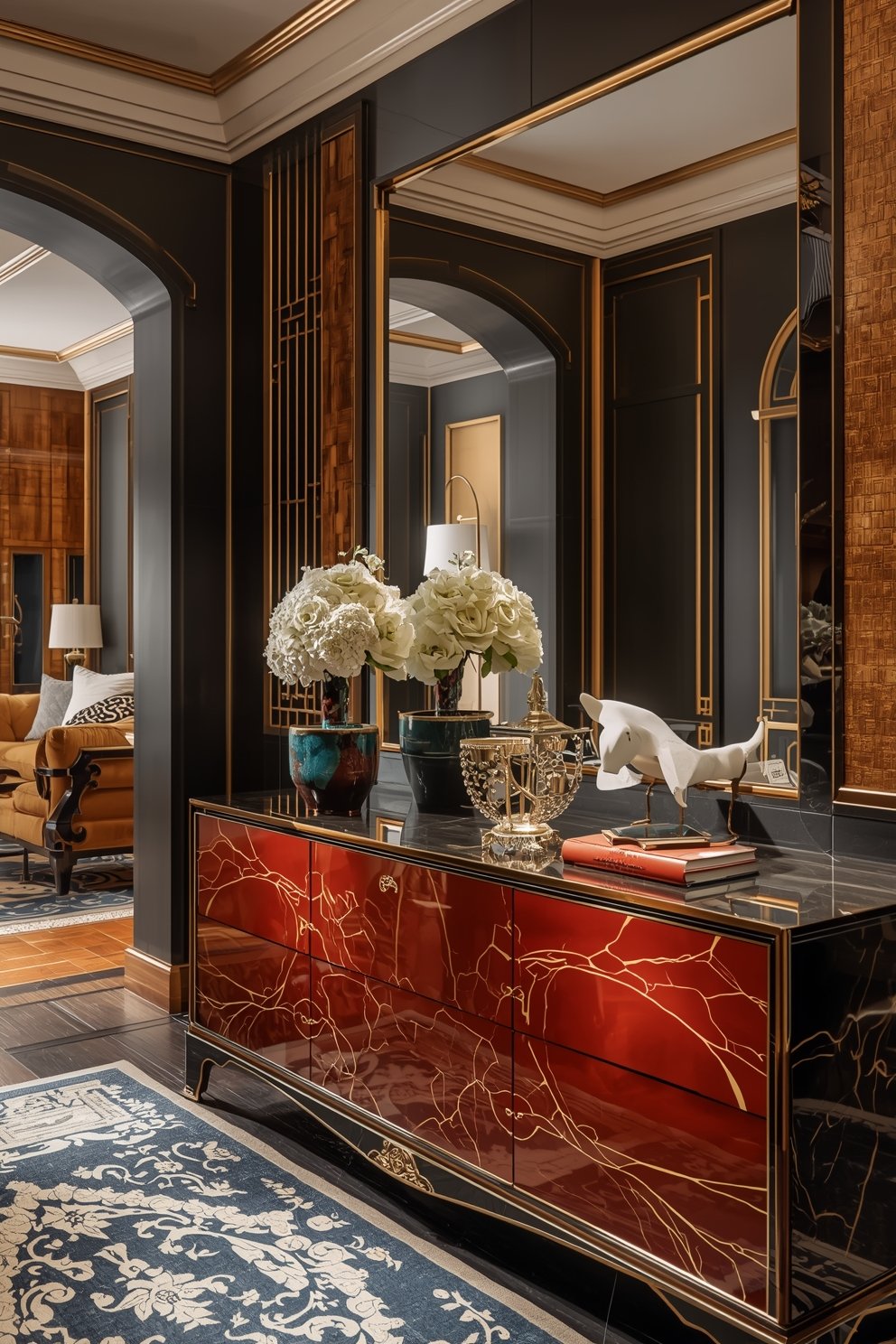

There’s a reason glossy finishes have been a staple in high-end interiors forever.
It’s not just the look — it’s the feeling.
When I added my first lacquer piece to my living room, the whole vibe shifted.
The room felt more intentional.
More finished.
Like I actually knew what I was doing in there.
Glossy surfaces reflect light back into the room, which makes spaces feel bigger, brighter, and honestly just more alive.
It’s a visual trick that works every single time.
There’s also something deeply satisfying about a surface that’s smooth and rich and almost mirror-like.
It triggers that cozy, “I live well” feeling that’s really hard to explain but impossible to ignore.
And honestly?
I think that’s the emotional reason gloss works so well.
It tells a story of care and curation without you saying a single word.
It signals that you chose this.
That you were intentional.
And in a world where so many homes feel like they were just “assembled,” that intentionality is everything.
My Favorite Way to Use Lacquer: The Statement Sideboard


Okay, let me just say — if you’re going to try one lacquer piece, make it a sideboard.
This is my number one recommendation, hands down.
A lacquered sideboard in a dining room or entryway is just chef’s kiss.
The surface reflects candlelight, overhead pendants, even just the glow from a nearby lamp.
I have mine in a deep, moody emerald green and I genuinely get compliments every single time someone walks in.
It doesn’t need anything fancy on top of it — a simple tray, a candle, maybe a small vase.
The piece itself does all the talking.
If I were styling a small apartment and could only have one glossy statement, I’d pick a sideboard in a jewel tone without even thinking twice.
Burgundy, midnight blue, forest green, even a creamy ivory — all gorgeous.
The key thing to remember (and I learned this the hard way) is to keep the pieces around it matte or textured.
Glossy next to glossy next to glossy gets chaotic fast.
One hero piece.
Let it breathe.
Lacquer Cabinetry in the Kitchen: A Total Game-Ch— Wait, I Mean, Life-Changing Move
When I first considered lacquer kitchen cabinets, I thought it was too bold.
Too “high maintenance.”
Too “I’ll regret this in six months.”
But then I saw a kitchen with crisp white high-gloss cabinets and warm brass hardware and I literally could not stop staring.
The shine bounced the natural light all around the room.
It felt so clean.
So crisp.
So European boutique hotel.
If you have a smaller kitchen especially, gloss cabinetry is one of the smartest moves you can make.
The reflectivity adds perceived space in a way that matte paint just can’t.
For a softer look, I love pairing gloss uppers with matte lowers.
It breaks it up just enough.
My personal tip: stick with a single, consistent hardware finish — all gold, all chrome, or all black.
Mixing metals with glossy cabinets gets busy very quickly.
And wipe them down with a microfiber cloth regularly — they show smudges, but they clean up in about thirty seconds flat.
Worth it.
Absolutely worth it.
Glossy Accent Walls: The Bold Move I Didn’t Know I Needed

I painted one wall in my home office with a high-gloss finish and I genuinely gasped when I saw it dry.
It looked like a lacquered panel straight out of a Parisian apartment.
A gloss accent wall is one of those ideas that feels risky and then immediately feels right once you do it.
The depth you get from a high-sheen paint in a dark, moody color is something else entirely.
Think deep plum, slate blue, or even a dramatic charcoal.
The paint catches every bit of light in the room and shifts throughout the day.
In the morning, it’s bright and crisp.
By evening with a lamp on, it’s soft and glowing.
It’s almost like it changes the mood of the room on its own.
My personal hack: use a foam roller for your gloss wall instead of a brush.
You’ll get a much smoother finish with fewer streaks.
And go slow.
Apply thin coats and let each one dry fully.
It takes patience, but the result looks absolutely professional.
Lacquer Furniture in the Bedroom: Soft Meets Sleek

I used to think glossy furniture belonged only in bold, modern spaces.
Then I put a lacquered blush-pink nightstand next to my linen bed and sort of fell in love with my own bedroom again.
The mix of soft textures and high-gloss surfaces creates this really beautiful tension.
It’s like the room has layers.
Something cozy and something chic living right next to each other.
For bedrooms specifically, I always suggest going with softer lacquer tones.
Blush, ivory, soft sage, warm taupe — these feel warm and dreamy rather than cold or stark.
A lacquered dresser in a creamy white with gold knobs?
I’m obsessed with that look.
Like, genuinely obsessed.
And if you’re going for a more maximalist bedroom vibe, you can absolutely do a full glossy furniture suite — nightstands, dresser, and a small bench at the foot of the bed.
Just anchor it with lots of matte textiles.
Big chunky knit throw.
Linen duvet.
Velvet pillows.
The contrast is everything.
Small Lacquer Details That Make a Huge Impact


Here’s something I love to tell people who feel intimidated by gloss: you don’t have to go big.
Small lacquer details can shift the entire energy of a room just as powerfully as a major furniture piece.
Think about a lacquered tray on your coffee table.
Or a set of glossy vases on a shelf.
Even a lacquered picture frame grouping on a gallery wall can add that polished, editorial feel.
When I tackled my own cluttered entryway a while back, I added just one small lacquered bowl in a deep coral for keys and mail.
The whole entry felt more styled overnight.
That’s the magic of it.
These small moments of shine act like punctuation in your room’s story.
They say: I finished this.
This was intentional.
My go-to affordable glossy detail is a lacquer tray in a bold color — black, red, deep teal.
Put it on your nightstand, your vanity, your kitchen counter.
Stack a candle, a perfume bottle, a small plant on it.
Instantly styled.
Instantly elevated.
Color Choices for Lacquer: What I Reach for Every Single Time


Color is everything when it comes to lacquer.
Because gloss amplifies everything — the good and the overwhelming.
Over time, I’ve developed a pretty solid personal philosophy about what works.
For bold statements: I always gravitate toward deep jewel tones.
Emerald.
Cobalt.
Oxblood.
These colors with a high-gloss finish look incredibly rich and expensive.
For something more understated: crisp white or warm off-white gloss is timeless and endlessly versatile.
It’s what I’d use in a kitchen or bathroom where you want the sleekness without too much drama.
For something romantic and feminine: blush, dusty rose, or a soft mauve lacquer is beyond dreamy.
Especially in a bedroom or dressing area.
One color I’d personally avoid in gloss?
Very bright, saturated yellow or orange.
In a matte finish, those colors can be beautiful.
In high-gloss, they get really intense really fast.
Start with one color.
Test it.
Live with it.
And trust your gut — if a color makes you feel something when you look at it in the swatch stage, it’ll make you feel even more in the gloss finish.
Layering Textures With Gloss: The Rule I Live By

The single most important thing I’ve learned about decorating with lacquer?
You must balance it with texture.
This is non-negotiable in my book.
Gloss is smooth, hard, reflective.
So everything around it should be the opposite — soft, tactile, matte.
Bouclé upholstery next to a lacquer side table.
A rough jute rug beneath a glossy console.
Velvet curtains flanking a gloss accent wall.
The contrast is what makes the room feel considered and layered rather than flat or cold.
When I was styling my living room with a glossy black media console, I layered in a chunky knit throw on the sofa, a linen ottoman, and a woven basket underneath.
The room felt cozy and polished at the same time.
That balance is the whole game.
And honestly, this is the fun part.
Because you get to shop for all the soft, cozy things — and justify it by calling it “texture layering.”
Works every time.
Lacquer in the Bathroom: Small Space, Big Impact


Bathrooms are honestly one of my favorite places to experiment with lacquer.
Because the space is small, you don’t need a lot to make a major statement.
A lacquered vanity in a deep moody color can completely transform the bathroom experience.
I’m talking about walking in to brush your teeth in the morning and feeling like you’re in a boutique spa.
That’s not an exaggeration.
I did a small powder room with a black lacquer vanity and a round brass mirror and it became the most talked-about room in my home.
People walk in, stop, and go “wait, where did you get that?”
If a full vanity feels like too much, try a lacquered medicine cabinet or a gloss-painted interior inside open shelving.
Even painting the inside of a cabinet a high-gloss color while leaving the outside matte is such a clever little trick.
You open the door and there’s this little pop of shine.
It’s a detail only you will know about — and that kind of private joy is very much my love language.
Lacquer Trays, Boxes, and Accessories: The Easiest Entry Point

If you’re just dipping your toes into the glossy decor world, start here.
Lacquer accessories — trays, boxes, bowls, decorative objects — are the lowest-commitment, highest-impact starting point.
You can find beautiful lacquer trays at every price point, and they work in literally every room.
On a coffee table.
On a dresser.
On a kitchen counter.
In a bathroom.
On a bookshelf.
On a side table.
They’re one of those rare decor items that are both functional and beautiful.
My personal favorite use is the “styled tray” moment on a coffee table.
A glossy tray in a deep jewel tone, with a candle, a small decorative object, maybe a coaster or two.
Instant editorial vibe.
And if you ever feel like your room is looking a little “blah,” adding or swapping out a lacquer tray is genuinely one of the fastest fixes I know.
It sounds too simple to work.
But it really, really does.
Caring for Lacquer and Gloss: What Nobody Tells You

Let’s have an honest moment because I think this is important.
Lacquer and glossy finishes do require a bit more care than matte surfaces.
They show fingerprints.
They show dust.
They show water spots.
But here’s what I want you to know — they are not actually hard to maintain.
The key is a soft, slightly damp microfiber cloth.
That’s it.
Wipe it down gently, dry it immediately, and it’ll look brand new every time.
I wipe down my lacquer sideboard maybe once a week and it always looks like the day I got it.
The one thing I’d warn against is using harsh chemical sprays or abrasive cloths.
Those can dull the finish over time.
Also, avoid placing very hot or very cold items directly on lacquer surfaces.
Use a coaster.
Always use a coaster.
And if you do get a small scratch?
Touch-up lacquer pens exist and they are a small miracle.
Don’t let the maintenance fear hold you back.
The upkeep is genuinely minimal for how stunning these pieces look.
Mixing Lacquer With Other Finishes: My Personal Styling Philosophy

One of the most common questions I get is: can you mix lacquer with other finishes like wood or metal?
Yes.
A thousand times yes.
In fact, that mix is what makes a room feel collected and real rather than catalog-perfect and stiff.
I love pairing lacquer with natural wood more than almost anything.
A glossy black console in front of a warm walnut bookcase?
So good.
A lacquered ivory side table next to a raw oak bed frame?
Also so good.
The contrast between the sleek, refined surface and the organic warmth of the wood creates this beautiful dialogue.
Metal is another gorgeous pairing.
Brass hardware on lacquered furniture is an absolute classic for a reason.
It feels timeless and elevated without trying too hard.
For a more modern edge, try matte black metal paired with a high-gloss white lacquer.
Clean.
Graphic.
So chic.
My philosophy is simple: let the lacquer piece be the polished element in the room and let everything around it be a little more raw, a little more natural.
The contrast does all the work.
And you’ll end up with a room that feels genuinely special every time you walk into it.