
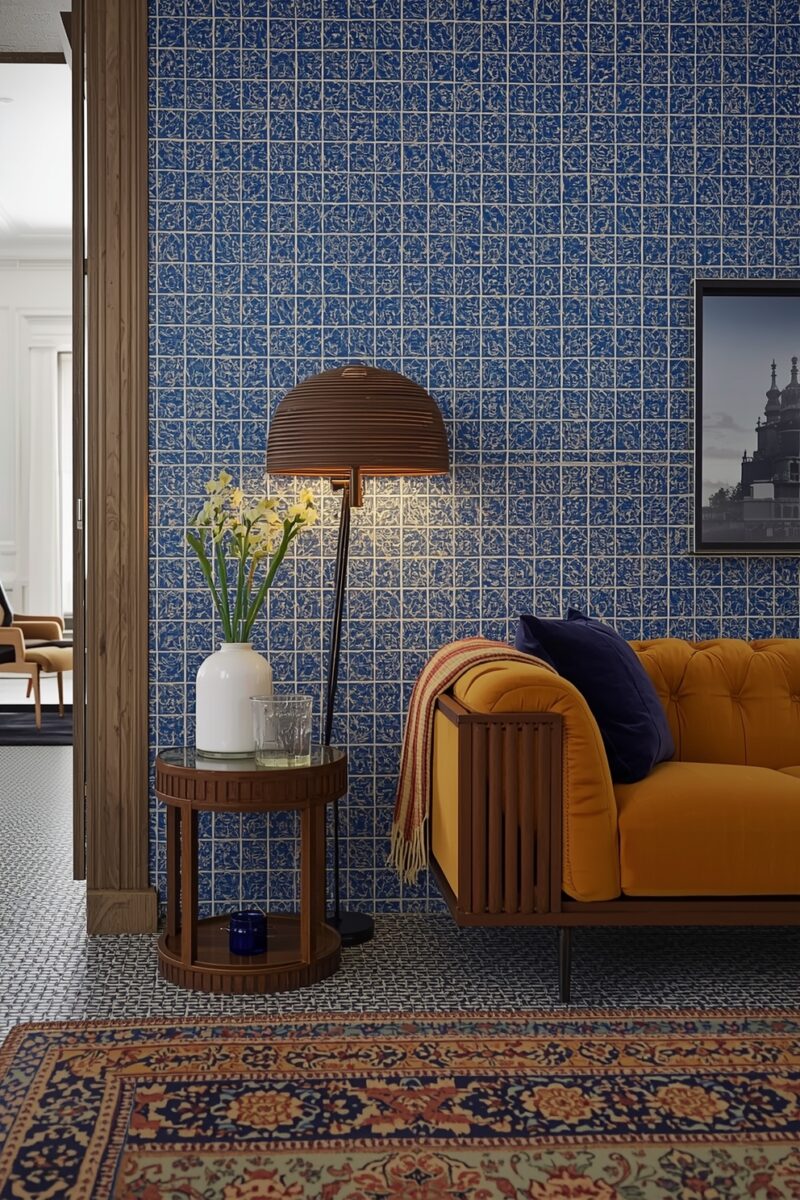
The first time I ran my hand across a zellige tile, I didn’t expect to feel anything.
But I did.
It was cool, slightly uneven, and it caught the light in this imperfect, beautiful way that no perfectly machine-made tile ever could.
I was standing in a little showroom, completely off-script from my planned reno budget, and I thought — this is the texture my home has been missing.
Blue zellige specifically?
It stopped me cold.
There’s something about that color — moody, layered, ancient — that feels both wildly modern and deeply timeless at the same time.
If you’ve been circling this tile on your saved boards for months, I totally get it.
Let me share exactly how I’d use it.
Why Blue Zellige Tile Feels So Different From Everything Else

Let me just say this upfront — blue zellige is not your average backsplash tile.
It’s handmade in Morocco, pressed from raw clay, and glazed by hand, which means every single tile is slightly different.
And that’s the whole magic of it.
You get this organic, shimmery, almost jewel-like surface that shifts depending on where the light hits.
In the morning, a blue zellige wall can look soft and pale, almost gray.
By afternoon, it deepens into something rich and inky.
It’s kind of alive, honestly.
That variation — the slight warps, the uneven glaze, the color that never quite repeats — is what makes it feel luxurious without being cold.
Most modern tiles are smooth, consistent, and precise.
Zellige is the opposite of all that, and somehow it fits perfectly into modern spaces because of it.
It brings warmth to clean-lined rooms that desperately need a soul.
If you’ve ever stood in a beautifully designed kitchen and thought something feels missing — it might just be texture.
Zellige is the answer to that feeling.
My Favorite Shade of Blue to Work With


Okay, so “blue zellige” is sort of a whole universe, and I want to help you navigate it.
Because there’s a big difference between a pale powder blue and a deep cobalt, and they will do completely different things to your space.
My personal favorite?
A mid-tone Moroccan blue — sometimes called “bleu de Fès” — with those beautiful teal and navy undertones layered in.
It’s warm enough to feel cozy but rich enough to feel elevated.
I love it because it pairs beautifully with natural wood, unlacquered brass, and white plaster walls without trying too hard.
If your home leans more minimal and you want something softer, a washed blue-gray zellige is incredibly chic.
It photographs like a dream and feels very calm in person.
If you want drama — like real, jaw-dropping drama — go full deep navy.
A navy zellige feature wall in a bathroom is something I think about more than I probably should.
The shade you choose will set the entire emotional tone of the room.
Soft blue says breathe.
Deep blue says wow.
Both are stunning — it just depends on how bold you’re feeling.
The Bathroom Transformation Nobody Talks About Enough


A blue zellige bathroom is something that feels like a spa and a piece of art at the same time.
I’m not exaggerating even a little.
When I tackled a bathroom refresh for a friend last spring, we used a soft Moroccan blue zellige on the shower walls, and the transformation was so dramatic it made us both tear up a little.
The light bouncing off those uneven glazed surfaces — it was genuinely beautiful.
For a modern bathroom, I love using zellige on the full shower enclosure and keeping the rest of the room very clean.
Matte plaster walls in white or warm sand.
Simple stone or concrete floors.
A vintage-style faucet in matte black or aged brass.
That contrast between the handmade, ancient feel of the tile and the clean architecture of a modern bathroom?
It is so good.
You can also use blue zellige as a half-wall treatment — running it up to about counter height around the vanity area.
It’s a more subtle use, but still incredibly impactful.
And if you’re working with a small bathroom, don’t be scared of the tile.
The texture and depth actually make small spaces feel more interesting, not more crowded.
How to Use Blue Zellige in a Modern Living Room

This is where I feel like people hesitate, and I want to talk them out of that hesitation.
A zellige feature wall in a living room is one of the most beautiful things you can do in a modern home.
I’d tile an entire fireplace surround — hearth, face, and all — in a deep cobalt or teal-tinted blue zellige.
The fireplace becomes this glittering, moody centerpiece that you cannot stop looking at.
Imagine sitting across from it in the evening with a candle lit nearby.
The way that tile catches flame light?
It almost glows.
If a full fireplace feels like too much commitment, try a smaller zellige moment — a tiled niche, a built-in bookshelf back panel, or even a small accent column.
Even a modest amount of zellige does a lot of visual work.
The key thing in a living room is contrast.
Keep your furniture in warm neutrals — creamy linen, natural leather, soft terracotta.
Let the blue zellige be the cool, unexpected element that makes everything else feel more intentional.
It’s sort of like jewelry.
You don’t need a lot of it to change the whole outfit.
Mixing Blue Zellige With Other Materials

This is where modern design gets really fun, and I love talking about material pairings.
Blue zellige plays beautifully with so many different textures, but there are a few combinations I keep coming back to.
Natural wood is probably my number-one pairing.
The warmth of oak or walnut against the cool shimmer of blue zellige is just perfect — earthy and sophisticated at the same time.
Plaster walls are another incredible partner.
The matte, chalky texture of Venetian plaster or limewash paint creates the most gorgeous contrast with the glossy, faceted surface of zellige.
I’m also obsessed with pairing it with aged or unlacquered brass hardware.
The patina of the brass pulls out the warm undertones in the blue glaze, and it feels so intentional and collected.
What I’d avoid?
Anything too shiny or too sterile alongside it.
High-gloss white cabinetry or chrome fixtures can fight with zellige instead of complement it.
You want materials that feel lived-in, real, and slightly imperfect — just like the tile itself.
Think organic.
Think layered.
Think of materials that look like they’ve always been there, together.
The Colors That Look Best Alongside Blue Zellige

I get asked this constantly, and I love this question because the answer is both simple and surprising.
Blue zellige is more versatile than you’d think.
The most beautiful backgrounds for it are warm whites, creamy off-whites, and sandy plaster tones.
They let the blue really sing without competing.
Terracotta and rust tones are an absolute dream alongside a mid-tone Moroccan blue — that warm-cool contrast is so alive and vibrant.
Olive green is another underrated pairing.
An olive green cabinet with a blue zellige backsplash?
Genuinely stunning.
Very European countryside meets modern studio.
For a more muted, sophisticated palette, try pairing blue zellige with charcoal, warm gray, and linen tones.
It feels incredibly calm and intentional.
What I’d be careful with — other strong, saturated colors competing for attention.
Blue zellige already brings so much visual richness that it’s happiest when the surrounding palette gives it room.
Think of the tile as the lead singer and everything else as the backup.
Let it do its thing.
The whole room will be better for it.
Small Space? Blue Zellige Works Even Harder for You

I know some of you are looking at your tiny powder room or your narrow entryway and wondering if zellige is even realistic.
It is.
In fact, small spaces are sometimes the best places to use it.
A fully tiled powder room in blue zellige — floor to ceiling — is one of the most dramatic and delightful design moments you can create in a home.
Because it’s a small space, you’re not spending a fortune on square footage, but the impact is enormous.
Guests walk in and they gasp.
I’ve seen it happen.
For a narrow hallway, I’d do the back wall in zellige and keep the side walls simple.
It draws the eye forward and makes the space feel purposeful instead of just… narrow.
You can also use it as a tiled niche in a small bathroom — just a little inset shelf tiled in blue zellige — and that small detail adds so much character.
In small spaces, the goal isn’t to minimize.
It’s to make every inch feel intentional.
And zellige, even in small doses, does exactly that.
My Honest Tips for Installing Blue Zellige (What Nobody Warns You About)

Okay, real talk — because I think you deserve to know this before you fall in love and order eight hundred tiles.
Zellige is handmade, which means it’s irregular.
The tiles are not perfectly flat, they’re not perfectly sized, and the glaze can vary significantly from batch to batch.
This is a feature, not a bug — but your installer needs to know what they’re working with.
Please, please hire someone with zellige or handmade tile experience.
A standard tile installer might panic at the unevenness and try to “correct” it, which defeats the whole point.
You want an installer who understands that the imperfection is intentional.
Also — order more than you think you need.
I’d suggest ordering at least fifteen to twenty percent extra because of the natural breakage during cutting and the color variation between batches.
Grouting matters more than people realize with zellige.
I love a warm, slightly tinted grout that disappears into the tile rather than a stark white that makes every variation visible.
A warm gray or sand grout is usually my recommendation.
And seal it.
Zellige is porous, and especially in a kitchen or bathroom, sealing it properly protects that beautiful glaze for years.
Budget Reality Check — What I’d Spend and Where

I’m not going to pretend that authentic zellige tile is cheap, because it isn’t.
But I want to help you think about it smartly.
Genuine handmade Moroccan zellige typically runs on the higher end per square foot, especially with shipping from artisan producers.
But here’s what I’ve learned — you don’t need to cover every surface.
A strategic small application of authentic zellige can feel more luxurious than a large amount of a cheaper imitation.
My honest recommendation?
Save and invest in real zellige for the one spot that matters most — your kitchen backsplash, your shower niche, your fireplace surround.
Keep it focused, and it will feel incredibly special.
If budget is genuinely tight, there are zellige-inspired tiles made in larger formats that mimic the rippled glaze and slight irregularity at a much lower price point.
They won’t have the same depth, but they’re a real option.
Personally?
I’d rather have three square feet of the real thing than thirty square feet of the imitation.
But I also know that’s not always realistic, and there’s no shame in finding the option that works for your life right now.
The Moodiest, Most Beautiful Use of Blue Zellige I Keep Thinking About

I have to tell you about this one specific design moment that lives rent-free in my head.
It was a small wet bar — maybe four feet wide — tucked into a living room nook.
The back wall of the bar was tiled floor to ceiling in the deepest, richest midnight blue zellige.
The shelves in front were raw unlacquered brass, holding a few simple glasses and a stone carafe.
There was a small sconce on each side casting this warm amber light across the tile.
That tile, in that light, with those materials — it looked like the inside of a jewel.
It felt impossibly glamorous and completely cozy at the same time.
And that’s the thing about blue zellige that I can’t stop coming back to.
It has this rare ability to feel both grand and intimate.
It doesn’t overpower a space — it deepens it.
If I ever have a little bar nook or wet bar to design, this is exactly what I’m doing.
No question.
No hesitation.
That image is permanently pinned in my brain as the blueprint.
When Blue Zellige Meets Outdoor and Garden Spaces

This might be my most underrated suggestion, and I’m really excited to share it.
Blue zellige outdoors?
Absolutely stunning — and so much less common than indoor use, which means it will feel incredibly unique.
I love the idea of a zellige-tiled outdoor kitchen backsplash behind a built-in grill.
That deep blue against natural stone counters and the open sky is something special.
An outdoor shower tiled in blue zellige is another dream of mine.
The way rain or water moves across that glazed, irregular surface — I mean, it almost looks like the tile was made to be wet.
You can also use blue zellige as a decorative element in a garden wall — a tiled panel or niche surrounded by climbing plants and greenery.
The contrast between the organic texture of the tile and lush foliage is really, really beautiful.
One important note for outdoor use — make sure you’re sourcing zellige specifically rated for exterior applications or freeze-thaw cycles if you live somewhere cold.
Not all zellige is suitable for outdoor conditions, so ask your supplier directly before purchasing.
But if you can make it work?
It is one of the most magical, unexpected design moves you can make outside your four walls.