
As an Amazon Associate I earn from qualifying purchases. This post contains affiliate links. If you buy through them we may earn a commission at no extra cost to you.
Product prices and availability are accurate as of the date and time indicated and are subject to change. Any price and availability information displayed on Amazon at the time of purchase will apply to the purchase of this product. Certain content that appears on this site comes from Amazon. This content is provided "as is" and is subject to change or removal at any time.
Every Kallax idea here still has to work with IKEA’s own numbers.
Those numbers sit right on every KALLAX product page, and most idea lists skip them.
Turns out the boring numbers are the useful part.
Each unit is 15 3/8 inches deep.
Each shelf is rated for 29 lb.
The top of a 2×4 takes 55 lb, and the 2×2 and 2×1 pages say the same about theirs.
And then there’s the line IKEA prints on every one of them: “WARNING! Tipping hazard – this product must be securely anchored.”
So if you’ve ever stood in the IKEA Kallax aisle wondering which size to grab, here’s my honest take.
A Kallax top isn’t a seat.
I’ll show you what to do instead, room by room, with IKEA’s US prices as of November 1, 2026.


Use Kallax as a Room Divider (IKEA Sells It as One)


This is the one I’d start with, and it isn’t even a hack.
IKEA’s own page for the 4×4 says it: “You can use this shelving unit as a room divider to create a room within a room while enjoying plenty of storage.”
Its inserts are made for that too: IKEA says its 1-shelf insert works in a room divider “from both sides.”
So you can style each side for the room it faces.

Got an open living and dining area that reads as one big blob?
A 4×4 is 57 7/8 inches wide and 57 5/8 inches tall, and it’s $179.99.
Baskets and wine bottles face the dining table.
Books and a plant face the sofa.
Same shelf, two personalities (and honestly, that’s the fun part).
And if you want a few cubes closed, IKEA’s door insert is $20 and, per its page, “looks nice in a room divider as the back has also been finished.”
Now, the part the pretty photos leave out.
Look, I get it, nobody buys a Kallax for the anchoring.
IKEA’s tipping warning doesn’t take a day off because the shelf is in the middle of the room, and the IKEA page adds, “If you are uncertain, seek professional advice.”
My rule for a divider: run it out from a wall, like a peninsula, so one end meets something solid you can anchor into.
A unit floating in the middle of the floor has nothing to hold it.
In a rental, ask your landlord before you drill.
The CPSC’s Anchor It site says covering the holes from your anchors “won’t be a problem” when you move.
Studio apartment people, this part’s for you.

A 2×4 lying on its side is 57 5/8 inches long and 30 1/8 inches tall.
That’s low enough to see over from the sofa side when you’re standing, and tall enough to say “bedroom starts here.”
Face a few cubes toward the bed and give them a reading lamp and an alarm clock, and the back of the divider turns into a headboard shelf.
If you’re planning the whole studio, there’s a full post on where the bed and sofa go in a studio apartment layout.
Want the bed side a bit more private?
A small tension rod inside one cube with a scrap of linen on it closes that one opening without closing the whole room.

Okay, plant people, hear me out.
A divider with something green in every open cube is honestly gorgeous.
Just know two things first.
If you have a dog or a cat, the ASPCA lists golden pothos, snake plant and monstera (it calls it the Swiss cheese plant) as toxic to both, while spider plant and Boston fern are on its non-toxic list.
And every pot of wet soil counts toward that 29 lb a shelf, so put a saucer under each one and wipe up spills.
IKEA’s care line for KALLAX is a damp cloth, then “Wipe dry with a clean cloth.”
One more divider idea: two units back to back in a big walk-in closet, one side for each of you.
Two units that are 15 3/8 inches deep each make a block 30 3/4 inches deep, so measure the walkway on both sides before you buy.
There’s a whole post on using a Kallax to divide a room if you want more layouts.

Back to back, each side is its own little closet.
You can even choose different insert colors for each side if one of you is a maximalist and one of you is not.
Measure first, then pick the size. Our IKEA Kallax Size & Fit Finder does the math for any spot here:
- Tap As a room divider for a setup like these, or Against a wall for a TV wall or a nook.
- Type the width to fill and how tall it can go. Add the depth if the spot is shallow.
- Leave Standing or lying on, so it tries units on their side too.
You’ll see which units fit, the cubes and the room left, with IKEA’s US price. Divider or not, IKEA says every Kallax “must be securely anchored.”
Living Room Entertainment Unit That Doesn’t Look Like a Dorm Room

The thing is, most people miss this trick.
IKEA’s 2×4 page literally tells you to “place it standing and use it as a shelving unit or lying and use it as a sideboard.”
Lying down, a 2×4 is a 57 5/8-inch-long, 30 1/8-inch-tall media console with eight cubes, for $79.99.
Before the TV goes on top, look up two numbers.
The top of a 2×4 is rated for 55 lb, so check your TV’s weight on its spec sheet.
And anchor both of them.
The CPSC’s Anchor It site is all about “TV and furniture tip-overs,” and the kit it tells you to get is a furniture/TV anchoring kit, with a strap between two brackets.
Then plan the cubes so it looks like you meant it.
It’s worth it:
- Cubes right under the TV: leave them open for the soundbar and anything the remote has to see.
- Cubes on either side: door inserts ($20 each) to hide game consoles, cable boxes and the cord spaghetti.
- A drawer cube: IKEA’s insert with 2 drawers is $25 and holds the remotes and charging cables you need every day but never want to see.
- Whatever’s left: open and styled, with a few books, a plant and a framed photo. This is your personality zone.
One opinion I’ll stand by: stick to one finish.
IKEA’s 2×4 page shows it in white and black-brown, plus a white stained oak effect.
Mixing them reads as a mistake rather than eclectic, at least to me.
Put the personality in the cubes instead.
If you want it to look more custom, there’s a whole post on making your IKEA Kallax look expensive.
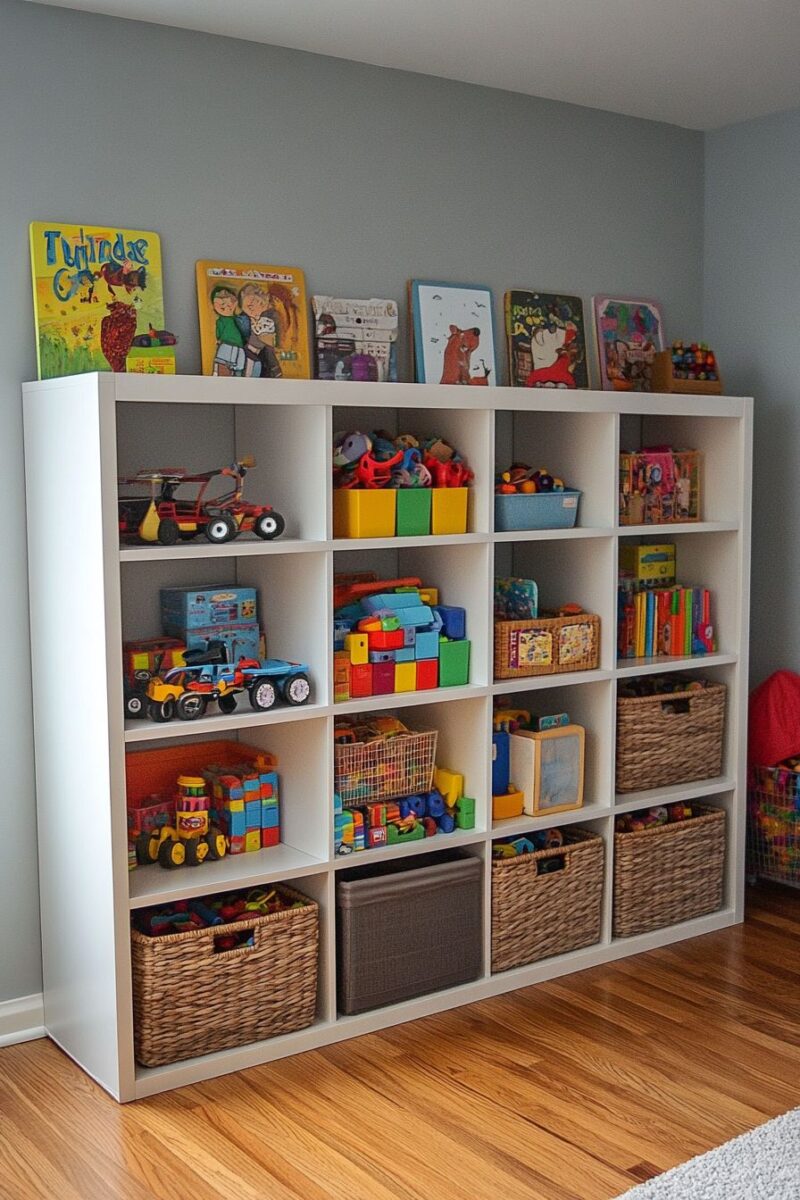
Kids’ Toy Organizer That Kids Will Actually Use

My theory on why so many toy systems collapse: kids can’t see what’s in them.
That’s why I think the Kallax holds up better.
A kid can see into every cube, and a cube is small enough that one bin is one category.
The combo I’d use: open cubes for the stuff they play with every day, and a door insert on the cubes for the games with a million tiny pieces.
Favorite stuffed animals go in an open cube at kid height.
A few things that make it work:
- Picture labels, not word labels. A kid who can’t read yet can still match a photo of cars to the bin of cars, and cleanup turns into a matching game.
- Fabric bins in the open cubes for LEGO or toy cars. Dump and done. The whole bin comes out and goes back in.
- One whole cube for books, with a bookend so the spines stay upright and readable.
- The bottom row belongs to the kid. Everything at their height is theirs to put away.
Two safety notes, because a 4×4 full of toys at kid height is basically a ladder.
The CPSC’s message is “Anchoring all furniture with drawers, doors, and shelves to the wall prevents tip-over injuries and deaths,” so this one gets anchored before a single toy goes in.
And a bin packed with LEGO gets heavy fast, so remember IKEA’s 29 lb a shelf.
And the nice part is that it grows with them.
The same unit that holds diapers in the nursery can hold the LEGO later and the school stuff after that.
You’re rearranging, not buying new furniture every few years.
Sponsored: through a KAKAMAY campaign on Amazon, we earn a higher commission on this product.
For those fabric-bin cubbies, KAKAMAY makes a 2-pack sized for standard Kallax shelves, 13 x 15 x 13 inches and 30 liters each, with solid wood handles that make the whole bin easy to carry.
Each one holds up to 30 pounds and folds flat when you don’t need it.

- Fits Kallax Shelves with 30L Spacious Storage. Designed to fit standard Kallax cube shelving and most cubby storage systems, each 13 x 15 x 13 inch fabric storage bin provides 30L of organized space for toys, clothes, blankets and everyday essentials.
- Thick Linen-Look Fabric with Reinforced 3-Layer Construction. Made with thick linen-look fabric, a reinforced 3 mm cardboard support layer and soft inner lining, this cube organizer features a 0.192 inch overall thickness for improved stability, structure and shape retention.
- Reinforced Support Holds Up to 30 lbs. Built for everyday organization, each storage cube supports up to 30 lbs while maintaining its shape. The sturdy construction helps reduce sagging and provides a more premium feel than standard lightweight fabric bins.
$30.99 In Stock
Paid link · price checked November 7, 2026 09:25
One thing to square with that safety note: the 30 pounds is the bin’s rating, not the shelf’s.
The cube it sits in is still rated for 29 lb, so a bin that full is already past it.
Mudroom and Entryway Storage (a Shoe Shelf, Not a Bench)

The entryway is where a Kallax lying down really earns its keep.
A 1×4 on its side is 57 5/8 inches long and 16 3/8 inches tall, with four cubes for shoes.
A 2×4 on its side gives you eight cubes at 30 1/8 inches tall.
Here’s where I break with the usual idea lists, though.
Plenty of Kallax hacks turn it into a bench.
IKEA rates the top of a 2×4, 2×2 or 2×1 at 55 lb, which is less than any grown-up weighs, and the 1×4’s page gives no top rating at all.
It says its shelf numbers apply “when the product is used vertically standing on the floor and anchored correctly to the wall.”
So yeah, I’d treat it as a shoe shelf with a tray on top for keys and mail.
Love the wood-topped bench in that photo?
That look needs a bench built to be sat on.
Above it, wall hooks for coats, screwed into studs or with anchors that suit your wall.
If you’ve got kids, add a second row of hooks at their height, or their coats end up on the floor again and you’re back to square one.
For the cubes:
- Closed cubes: hats, scarves, mittens, dog leashes and sunglasses, all the random stuff that ends up everywhere.
- Open cubes: one per person, with a fabric bin for their things.
- One cube for bags and backpacks, if your bags fit in 13 inches by 13. Measure the big one first.
Having one place for shoes by the door sounds so small.
But it’s not small, no joke.
It’s a weekend project that changes every single morning.
Kitchen Pantry Setup That Actually Makes Sense

If your pantry is cans stacked in front of other cans, and you’ve ever bought a third jar of cumin because the first two were hiding, a Kallax is weirdly good at fixing it.

Each cube takes IKEA’s 13 x 13 inch inserts, which is a nice size for one food category per cube.
Here’s how I’d split it:
- Cubes with door inserts: baking supplies, grains, pasta, anything in crinkly bags that looks messy. Out of sight.
- Open cubes with bins: cans by type, beans in one and tomatoes in another. Pull the bin, grab what you need, slide it back.
- Open cubes at eye level: oils and vinegars, plus the spices you use daily, on a small tray.
- Bottom cubes: the heavy stuff, like the big pot and the cast iron skillet. With 29 lb a shelf, heavy goes low.

Label the closed cubes on the inside of the door.
You think you’ll remember.
You won’t remember.
For a narrow pantry, a 2×4 standing up gives you eight cubes in a footprint 30 1/8 inches wide and 15 3/8 inches deep, and it’s 57 5/8 inches tall.
Measure your pantry closet with the door swinging open before you buy, because a door that hits the unit gets old on day one.
The real win is seeing your inventory at a glance.
My bet: when every category has its own cube, you buy fewer duplicates.
Bedside Tables That Have Actual Storage

Normal nightstands have one drawer and maybe a shelf.
If your bedside pile is books, a charger and your reading glasses (plus about six bookmarks), one drawer is not enough.
Three small KALLAX sizes work here, and they’re pretty much nothing alike in height:
- The 1×1 is 16 3/8 inches wide and 16 inches tall, for $24.99. One cube, low.
- The 2×1 stood on its end is 16 1/8 inches wide and 30 1/8 inches tall, for $34.99. Two cubes stacked, and IKEA’s page says “Standing or lying” for this one.
- The 2×2 is 30 1/8 inches square, for $49.99. Four cubes, and the most storage.
My tip: hold a tape measure to the top of your mattress and pick the one that lands closest.
A lamp you can reach from bed beats overhead lighting every single time, and I will die on that hill.
What I’d put in it:
- Top cube: the current read and your glasses. A clip light on the wall above it saves the surface for your coffee mug.
- Middle cube: a fabric bin for chargers and cables, or a folded throw.
- Bottom cube: the books you’re reading next, or a spare pillow.
And yes, anchor it, even a small one.
IKEA’s tipping warning is on the 1×1’s page too, and the sizes that can hang on a wall carry a second one: “WARNING! Falling hazard.”
Home Office Storage That Doesn’t Become Chaos by Week Three

The home office is where good organization goes to die.
You start with a system, and three weeks later there are sticky notes everywhere and a printer living on the floor.
A 2×4 on its side behind or beside your desk is one of the most useful things you can add.
And if you’d rather keep the floor clear, IKEA says the 1×1 and 2×1 can hang on the wall, and so can the 2×2 and 1×4.
It lists 44 lb for a wall-hung 2×2 and 66 lb for a 1×4, and the 2×2 page adds the catch: “The max load for a wall-hung frame depends on the wall material.”
Here’s a setup that works day to day:
- A printer cube, maybe: measure first. IKEA sizes its inserts to fit a cube at 13 x 13 inches, so a printer much wider or taller than that won’t go in.
- File cubes: magazine files or office file boxes, one per project or client. Label the spines. This is the thing that keeps paper under control.
- A daily-essentials cube: pens and tape, scissors, sticky notes. No lid, no bin.
- Door inserts for anything that looks messy: extra paper, cords, supplies you don’t touch daily.
- One purely decorative cube: a plant or a candle, something that has nothing to do with work.
Mildly controversial opinion: closed doors are the secret to an office that stays tidy.
The instinct is to keep everything visible so you don’t forget it.
I mean, I think visible clutter pulls your eye, and then you’re reorganizing a cube instead of working.
Hide more than you think you need to.
The decorative cube is your reward.
Bathroom Storage Without the Ugly Wire Rack

I have strong opinions about bathroom storage.
Wire racks look messy, medicine cabinets fill up fast, and the cabinet under the sink is a graveyard of half-empty bottles.
A small Kallax gives everything its own box, and it doesn’t look clinical.
Two sizes make sense here.
The 2×2 is 30 1/8 inches square, so it tucks into a corner without taking over.
The 1×4 stands 57 5/8 inches tall and only 16 3/8 inches wide, more like a tower for a narrow wall.
Bathroom square footage is not forgiving, so measure twice.
- Rolled towels in open cubes. Three white towels rolled in a cube look way better than the same three towels folded on a shelf. This is not debatable.
- Closed cubes: toilet paper, shampoo backstock, hair tools and cleaning stuff. Anything you don’t want on display.
- One open cube with a small tray: daily skincare and a little plant if you’ve got the light. The tray keeps it from looking scattered.
One practical note.
IKEA’s materials list for KALLAX is particleboard and fiberboard with a honeycomb paper filling, and its care line ends with “Wipe dry with a clean cloth.”
So keep it out of the shower’s splash zone and wipe up drips instead of letting them sit.
Display Shelves for Collections (Without the Hoarder Feeling)

I think collections look cluttered when there’s no frame around them.
Everything is just… out.
A Kallax fixes that by giving each thing its own square, like a tiny gallery.
Each open cube becomes its own display case.
Vintage cameras, one or two per cube.
Pottery, one piece front and center.
The grid sort of frames each thing for you, so a lot of objects still look intentional.
A few display tricks that make a real difference:
- Give the cube a back. A Kallax is open at the back, so cut a piece of foam board to fit the opening, cover it in wallpaper or contact paper, and stand it at the back of the cube. A dark backing makes light-colored objects pop.
- Add a battery puck light to the top of a cube for anything you really want to highlight. Honestly, a few small lights in the shelf beat overhead lighting for a collection.
- Group by color or by category, not both. Pick one rule and stick to it.
For books, face out your favorite covers and keep the rest spine out.
A row of face-out books in one cube looks editorial in a really good way.
Deep navy, forest green or terracotta behind the objects all work, and a remnant of contact paper keeps it on budget.
Craft and Hobby Storage That Stays Organized Past Day One


Craft storage takes honest self-assessment.
What do you use weekly?
What comes out once a month?
What are you saving “just in case” that should probably go?
The Kallax only works if you’re honest about what goes where.
Here’s the rule I’d follow: anything sharp or anything that stains goes behind a door.
Scissors, rotary cutters, acrylic paint and ink pads all go in closed cubes.
It’s tidier, and it’s one less thing to knock over.
What works in open cubes:
- Yarn in small baskets, sorted by color, which is honestly decor on its own
- Rulers, paintbrushes in a cup, and tape
- Stamps and ink pads together, so you can grab the whole setup at once
- One “current project” cube where whatever you’re working on lives until it’s done
If you sew, fold your fabric and file it upright, spine out, like books.
You can actually see your stash that way.
Need more shelves than cubes?
IKEA’s insert with 1 shelf is $20, and its page says you can use it “either as an extra shelf or as a practical vertical divider.”
And about that “current project” cube: I think it’s the habit that gets things finished.
When the project lives in one visible spot, there’s nothing to dig out and set up, so picking it back up is easy.
Garage Storage (Yes, It Actually Works in There)

An IKEA shelf in the garage sounds kinda weird at first.
Garages are for metal shelving and pegboards, right?
But cubes solve one specific problem wire shelving doesn’t: small, oddly shaped things that roll off or fall through.
- Car stuff: funnels and rags, small tools too, each in its own cube instead of one bin where you can never find anything.
- Sports gear: balls, bike helmets and gloves. One sport per cube.
- Garden bits: seed packets, hand tools and plant labels, in closed cubes.
Now the limits, because they matter more out here.
IKEA rates each shelf at 29 lb, so paint cans and big jugs belong on the floor or on shelving built for weight.
A door insert hides things, but nothing on its IKEA page says it locks, so if kids or pets are around, chemicals go somewhere that does.
And with particleboard and paper filling inside, I’d only put a Kallax in a dry garage, up off a floor that gets wet.
Short on floor space?
The four sizes IKEA says can hang on a wall work here too, into studs or with fasteners made for your wall, since IKEA says the load “depends on the wall material.”
Window Box Platform With Hidden Storage Underneath


This one is clever, and I kind of love it for anyone with awkward space under a window that’s currently just… nothing.
Lay a unit on its side under the window with the cubes facing into the room.
Measure your sill first: a 2×4 on its side is 30 1/8 inches tall and a 2×1 is 16 1/8 inches tall, so pick the one that sits under your sill, not over it.
The top turns into a ledge for plants, right in the window light, and the cubes below hold books, extra pots or baskets.
Pillows on top look cozy in a photo.
But I’d still keep it a ledge, for the same 55 lb reason as the mudroom.
Plants are a better fit: a saucer under every pot, drips wiped dry, and the pet list from the divider section if you have a dog or cat.
Under-window spaces are so often wasted.
This makes them useful and genuinely pretty.
It’s probably the brightest shelf in the room, too, so give it to the plants that want the most light.
Nursery Storage That Actually Grows With the Baby

The nursery is one of those spaces where you think you need every specialized piece of baby furniture, and then the baby outgrows half of it.
A Kallax doesn’t have that problem.
A white 4×4 can be the dresser, the bookcase and the toy storage in one, at 57 7/8 inches wide.
Here’s how I’d break the cubes down:
Newborn phase:
- Closed cubes for folded onesies and sleep sacks, plus swaddles and burp cloths. They’re tiny, but there are so many of them.
- Open cubes for diapers and wipes in a basket you can reach without looking, tiny socks in a small bowl (they escape if not contained) and a few board books.
- One cube with a small basket for diaper cream, the nail file and the thermometer.
Crawling to toddler:
- Bottom rows: soft toys, board books and stacking toys they can pull out and put back.
- Middle rows: puzzles with lots of pieces and anything that needs you sitting with them.
- Top rows: out of reach. Supplies, clothes they’ll grow into, backups.
The minute a baby starts pulling up on furniture, a cube shelf looks like a ladder.
So anchor it on day one, before it’s full.
That’s IKEA’s rule for every KALLAX, and the CPSC’s rule for furniture with shelves too.
So by school age, the same unit turns into a bookshelf and homework storage.
One piece of furniture, the whole childhood.
And to any new or expecting parent reading this: the pressure to buy all-matching, purpose-built nursery furniture is real, and you can skip it.
I think a white Kallax goes with modern, boho, classic or maximalist, and it doesn’t look like a compromise.
It looks like you made a thoughtful choice.
Because you did.
Closet Storage That Actually Doubles Your Space

Closets are where I get the most excited about Kallax, which is maybe a strange thing to say, but hear me out.
If your closet is one rod and one shelf, a Kallax is one of the easiest upgrades there is.
For a reach-in closet:
- Stand a 2×4 at one end. It takes 30 1/8 inches of the width and gives you eight cubes for the things you fold: sweaters, jeans, workout clothes. It’s $79.99.
- The rest of the rod is for hanging only. No more folded sweaters on the shelf above the rod, falling every time you grab a hanger.
- Top cubes: bags and seasonal things you reach for rarely.
- Bottom cubes: shoes, with a small tray to keep pairs together.
Check the depth too.
A Kallax needs 15 3/8 inches, plus room for the closet door to close in front of it.
For a walk-in:
- Two units back to back in the middle, like the divider idea up top, with rods along both long walls.
- Or one unit on each short wall, with one long rod between them.
If a cube is taller than a stack of folded T-shirts needs, that’s where IKEA’s $20 insert with 1 shelf earns its keep: two short shelves instead of one tall one.
I like cubes over drawers in a closet because you can see everything at once, and a top you can see is likely a top you remember to wear.
That’s either a win for your wardrobe or a threat to your budget.
Probably both.
The last thing I want to say about Kallax in general is that the magic isn’t any single use.
It’s that the same unit can do totally different jobs in totally different rooms and not look out of place in any of them.
Before you pay full price, check Facebook Marketplace.
A used one gets anchored the same as a new one.
Related read: Things I Wish I Knew Before I Decorated My First Home — Instant PDF + Kindle download. Secure checkout by Stripe