
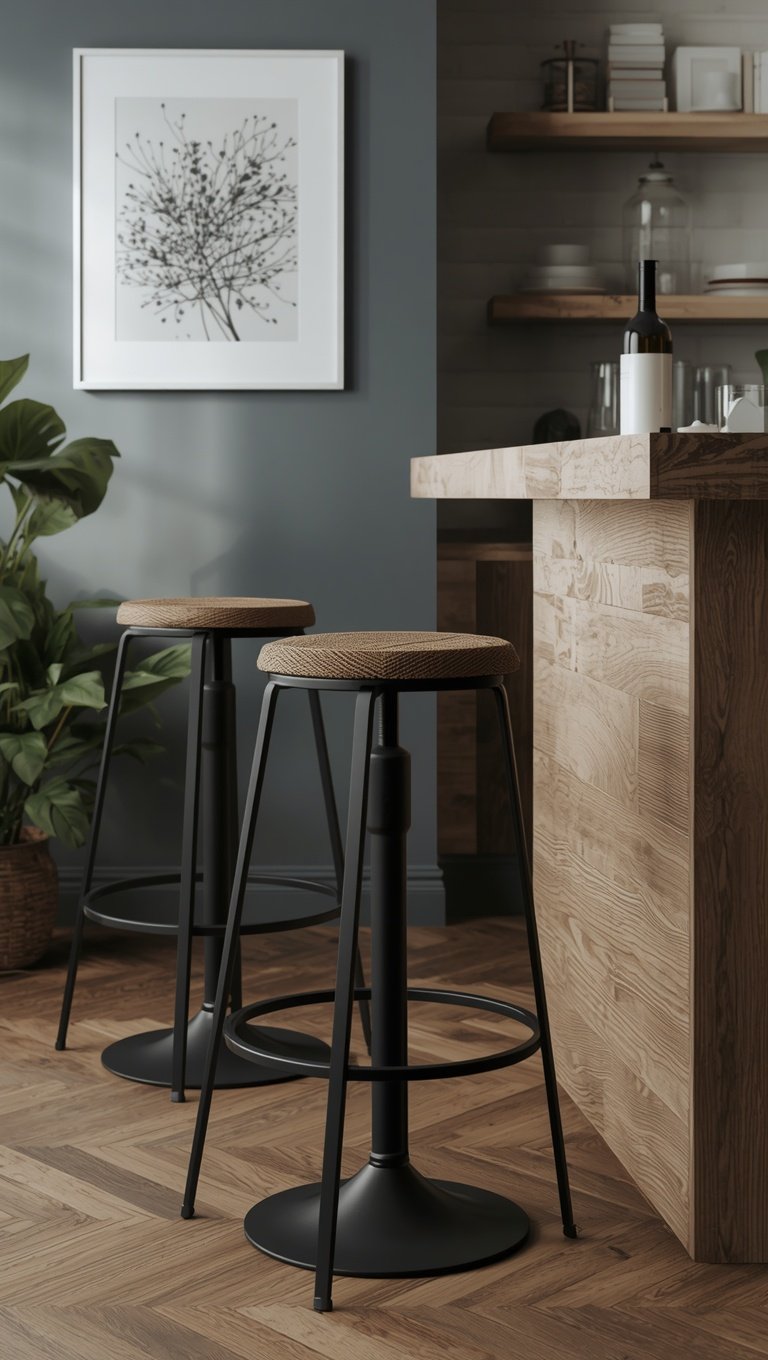

I sat on the wrong bar stool for almost two years before I admitted it out loud.
My knees kept hitting the counter every single time I sat down for coffee.
And I just kept telling myself it was fine, it was fine, it was fine.
It was not fine.
So when I finally swapped those stools out, it felt like my whole kitchen exhaled.
That’s kind of the thing about bar stools, right?
They seem like a small decision until you’re the one perched on them every morning, wincing.
So today I want to walk you through everything I’ve learned about getting the height and the comfort actually right, no guessing involved.
Grab your coffee, get cozy, and let’s talk stools.
Getting the Right Height for Your Counter or Island

Okay, this is the one people skip and then regret.
The rule of thumb is about ten to twelve inches between your seat height and the underside of your counter.
So for a standard kitchen counter, which is usually around thirty-six inches, you’re looking at a twenty-four to twenty-six inch stool.
For an island at bar height, closer to forty-two inches, you’ll want a twenty-eight to thirty inch stool.
I know it sounds like a lot of math for furniture.
But trust me, this is the difference between a stool that feels effortless and one where you’re doing this weird half-crouch every time you sit down.
When I measured my own counter before buying, I felt kind of silly standing there with a tape measure.
But it saved me from a return, and honestly, from more knee bruises.
If you’re between two sizes, I’d say size down a touch rather than up.
A stool that’s slightly too short is annoying.
A stool that’s too tall is genuinely uncomfortable, and nobody wants to feel like they’re at a kids’ table in reverse.
My little hack: sit in a dining chair you already love, measure that seat height, and use it as your gut check.
It’s not scientific, but it works.
Backless vs. Backed Stools and the Real Comfort Trade-off
I used to think backless stools were just the prettier option.

They’re sleek, they tuck away nicely, and they photograph beautifully.
But here’s the honest truth: if you’re sitting for longer than a quick snack, your lower back is going to complain.
I learned this the hard way during a very long game night that turned into three hours of chili and cards.
By hour two, I was shifting every few minutes trying to get comfortable.
So now my rule is simple.
If the stools are purely for quick perches, morning toast, a fast coffee, backless is totally fine and honestly kind of chic.
But if you know your family lingers, does homework there, eats full dinners there, get some back support.
Even a low back rest makes a noticeable difference.
And if you’re torn, a mix works beautifully too.
I’ve seen kitchens do two backed stools and one backless on the end, and it looks intentional, not mismatched.
My personal pick is always a low, curved back.
It supports you without feeling bulky or blocking the sightline across your kitchen.
It’s a small detail, but it changes how the whole space feels.
Swivel Stools for Effortless Movement

I did not think I needed swivel stools until I had one.
Now I’m kind of obsessed, not gonna lie.
There’s something so satisfying about being able to turn toward whoever’s cooking without dragging the whole stool across the floor.
It sounds like a tiny thing, but it changes how the kitchen feels socially.
Suddenly you’re not sitting with your back half-turned to the conversation.
You just swivel, and you’re part of it.
I especially love swivel stools for families with kids who fidget, because let’s be honest, they’re going to spin anyway.
Might as well build it into the design instead of fighting it.
The one thing I’d say is to look for a smooth, quiet mechanism.
Some cheaper swivel bases squeak or feel loose after a few months, and that little wobble drives me a bit crazy.
Spend a touch more here if you can.
It’s worth it for the stools that still feel solid a year in.
If your space is tight, swivel stools also help because people can turn to get on and off without needing extra clearance space around them.
It’s a small functional win that most people don’t think about until they’re the one bumping elbows with a guest.
Cushioned Seats: Why Comfort Matters More Than You Think

I’ll be honest, I used to pick stools almost entirely on looks.
The seat cushion was an afterthought, if I thought about it at all.
Big mistake.
A hard wooden or metal seat feels fine for the first five minutes.
After that, it’s just not it.
Once I added stools with a proper cushioned seat, breakfast suddenly felt like something I wanted to linger over instead of rush through.
There’s a real emotional shift there, and it’s subtle but it matters.
When your body is comfortable, you actually stay, you actually talk, you actually enjoy the space.
I look for a cushion that’s firm but has a little give, kind of like a good armchair.
Too soft and it feels cheap and squishy.
Too firm and you’re basically back to the hard seat problem.
Fabric matters too.
A slightly textured woven fabric or a soft vegan leather wipes clean and feels warm to the touch, not cold and stiff like some faux leathers can.
If you have kids or pets, and honestly who doesn’t, go for something with a stain-resistant finish.
It’ll save you so much stress later.
My tip: sit on the stool in the store for a full two minutes before buying, not just a quick perch.
That’s usually enough time to know if it’s actually comfortable or just looks that way.
Footrests: The Detail That Changes Everything

Nobody talks about footrests enough, and I really think they should.
When your feet are just dangling, your legs get tired faster than you’d expect.
A proper footrest, whether it’s a built-in ring or a low bar, lets your legs relax completely.
I noticed this the first time I sat at a stool with a wide, sturdy footrest.
I didn’t even realize how much my legs had been working until they suddenly weren’t.
It’s such a quiet kind of relief.
For taller stools especially, this isn’t optional in my opinion.
Your feet need somewhere to land, or the whole seat feels unstable and kind of awkward.
I also love footrests that wrap most of the way around the stool, not just a straight bar in front.
It gives you options for how you sit, whether you’re facing forward or turned to chat with someone.
If you’re shopping and torn between two similar stools, let the footrest be your tiebreaker.
It’s one of those details that feels invisible when it’s done well, and painfully obvious when it’s missing.
My own stools have a slightly padded footrest, and honestly, it’s a small luxury I didn’t know I needed until I had it.
Little things like that are what make a stool feel considered instead of just functional.
Adjustable Height Stools for Flexibility
If you’re someone who can’t quite commit, adjustable stools are kind of a dream.

I recommend these constantly to friends who are renting or still figuring out their forever kitchen setup.
They usually use a gas lift or a hand crank, and you can shift the height depending on the counter you’re using that day.
I have a set in my own home office nook, actually, and I move them between my desk and a side table all the time.
It’s so nice not to be locked into one exact height.
The trade-off is that adjustable stools sometimes look a little more utilitarian, a bit more like office chairs than statement furniture.
But there are gorgeous versions now with wood accents and woven details that soften that look a lot.
I’d say if you want flexibility without sacrificing style, look for adjustable stools with a wrapped leather or fabric seat instead of bare metal.
It warms up the whole vibe instantly.
These are also great if you have a mixed-height household, say a partner who’s much taller or much shorter than you.
Everyone gets their own perfect fit without buying two totally different stool sets.
It’s a practical solution that doesn’t feel like a compromise once it’s actually in your space.
Material Choices: Wood, Metal, and Woven Textures

The material of your stool changes the whole feeling of the room, more than people realize.
Wood stools feel warm and grounded, almost like they’ve always belonged there.
I love a light oak or a warm walnut for a kitchen that leans cozy and traditional.
Metal stools, especially in black or brass, bring a sleeker, more modern edge.
They’re great if your kitchen already has clean lines and you want the stools to feel a bit architectural.
Woven stools, think rattan or cane, are my personal soft spot.
There’s something about that texture that makes a kitchen feel a little more relaxed, a little more like a cottage even if the rest of the room is modern.
If I had to pick just one material for a first-time buyer, I’d lean wood.
It’s forgiving, it pairs with almost anything, and it ages beautifully instead of looking dated.
Metal can feel cold if the rest of your space is already minimal.
And woven pieces, while gorgeous, do need a bit more care over time.
My advice is to bring a small sample or a photo of your countertop and cabinets with you when shopping.
Holding the stool material next to your actual finishes tells you so much more than picturing it in your head ever will.
Matching Stools to Your Kitchen’s Overall Style

This is where personality gets to come through, and I love this part.
Your stools don’t have to match your cabinets exactly, and honestly, I think it’s more interesting when they don’t.
If your kitchen is mostly white and bright, a few black metal stools add a nice grounding contrast.
If your space leans warm and wood-heavy, a lighter woven or cream fabric stool keeps it from feeling too heavy.
I always tell people to think of stools as the jewelry of the kitchen.
They’re a smaller piece, but they can pull the whole look together or feel completely out of place.
When I redid my own kitchen, I actually chose my stools before some of my smaller decor pieces.
They ended up guiding a lot of my other choices, which surprised me.
If your kitchen already has a strong style, farmhouse, coastal, modern, whatever it is, let the stool material and shape lean into that rather than fight it.
But if your kitchen is more neutral and undecided, this is actually your chance to add some character without a full renovation.
A great stool is a low commitment way to test a style direction before you go all in on it elsewhere.
Spacing Stools Properly Around Your Island

Nobody wants to eat elbow to elbow with a stranger, or even someone they love.
The general spacing rule is about six inches between each stool, measured from edge to edge.
For wider stools, or if people tend to spread out more while eating, I’d give a little extra room if your counter allows it.
I learned this lesson hosting a small dinner where three stools were just slightly too close.
Everyone kept doing that awkward little shuffle to get comfortable, and it took away from the whole evening.
Now I measure before I buy, every single time.
It sounds tedious, but it saves so much frustration later.
If your island is on the smaller side, backless stools that tuck in fully underneath actually help you fit one more seat without it feeling cramped.
That’s a nice trick if you host often but don’t have a huge kitchen.
On the flip side, if you have generous counter space, don’t feel like you need to cram in extra seats just because you can.
Sometimes three well-spaced stools feel so much more inviting than four squeezed ones.
Comfort and breathing room matter more than maximizing every inch.
Mixing and Matching Stools for Personality

I know matching sets feel like the safe choice, and there’s nothing wrong with that.
But mixing stools is one of my favorite ways to make a kitchen feel like it actually belongs to you.
I did this in my own place, pairing two woven stools with one solid wood stool on the end, and people always ask about it.
The trick is to keep one element consistent, whether that’s the seat height, the general color tone, or the leg material.
That thread ties everything together even when the shapes are different.
If you’re nervous about mixing, start small.
Try the same stool in two different finishes rather than two totally different styles.
It’s a gentle way into the look without it feeling chaotic.
I also love mixing when a household has different needs, like one stool with a back for whoever needs more support, paired with backless ones for quick seats.
It feels practical and stylish at the same time, which is honestly the dream combination.
Don’t be afraid of a little asymmetry.
Some of the coziest, most lived-in kitchens I’ve seen have stools that don’t match perfectly, and it makes the space feel collected over time rather than bought all at once.
Bar Stools for Small Kitchens and Narrow Spaces

If your kitchen is on the smaller side, I promise you still have great options here.
Backless stools are your best friend because they slide fully under the counter when not in use.
I’d also look for stools with a smaller seat diameter, since bulky cushioned seats can eat up walking space fast.
When I helped a friend set up her narrow galley kitchen, we went with slim metal stools with a woven seat, and it completely changed how open the room felt.
Stacking stools are another underrated option if you need extra seating occasionally but not every day.
They tuck away in a closet and come out for guests, which is such a smart solution for tight spaces.
I’d avoid anything with wide arm rests in a small kitchen.
They look lovely in photos but they take up so much more room than you’d expect, and they make walking past the island feel tight.
Lighter colored stools also help visually in a small space.
They don’t create as much visual weight as a bulky dark stool would.
If I had a small kitchen right now, I’d go backless, light wood, slim profile, every time.
It’s simple, but it works so well.
Outdoor Bar Stools for Patios and Outdoor Bars

If you’ve got an outdoor bar or a patio counter, this deserves its own kind of thinking.
Regular indoor stools just won’t hold up to sun and rain the way you’d want them to.
Look for materials rated specifically for outdoor use, like powder-coated aluminum, teak, or all-weather wicker.
I made the mistake once of leaving a “mostly outdoor” stool out through a full summer, and it faded and warped within a few months.
Lesson learned, the hard way.
For cushions, if you want that extra comfort outside, choose fabric labeled for outdoor use, since it resists mold and fading so much better than regular indoor fabric.
I love a soft outdoor cushion in a warm terracotta or a soft sage for that patio feel.
It just makes the whole space feel a little more like a getaway.
Swivel stools work beautifully outside too, especially around a small grill station or outdoor bar, since people are usually turning to chat rather than sitting still for a full meal.
If storage is an option, stackable outdoor stools save so much space when the season changes.
I bring mine in during winter, and it’s honestly not much of a hassle once it’s part of the routine.
Caring for and Maintaining Your Stools

Once you’ve found the right stools, a little care keeps them looking good for years.
For wood stools, a simple wipe down with a slightly damp cloth is usually enough, and I’d avoid harsh cleaners that strip the natural finish.
For metal, keep an eye out for any small rust spots, especially if they’re near a sink or a humid kitchen window.
A quick touch of matching paint or a bit of oil on the joints keeps them moving smoothly if they swivel.
For cushioned or fabric seats, I always recommend a fabric protector spray when they’re new, even if the fabric claims to be stain-resistant already.
It’s such an easy extra step that saves you from panicking over spilled wine or coffee later.
Woven stools need the gentlest care of all.
Keep them out of direct, harsh sunlight if you can, since it can dry out and crack the natural fibers over time.
I rotate mine slightly every few months just to even out any sun exposure.
For swivel mechanisms, tighten the screws every so often, since they do loosen naturally with regular use.
It takes two minutes with a screwdriver and it keeps everything feeling sturdy instead of wobbly.
Taking care of your stools is such a small habit, but it really does stretch their life so much further, and honestly, they end up feeling like old friends instead of just furniture.
Related read: Things I Wish I Knew Before I Decorated My First Home — Instant PDF + Kindle download. Secure checkout by Stripe