I still remember the first dinner party I ever hosted as a newlywed, staring at my empty table about an hour before guests arrived, completely panicking.
I called my mom, practically whispering “I don’t know what to do,” like the table was some unsolvable puzzle.
She just laughed and said, “Honey, walk into your kitchen and tell me what’s already there.”
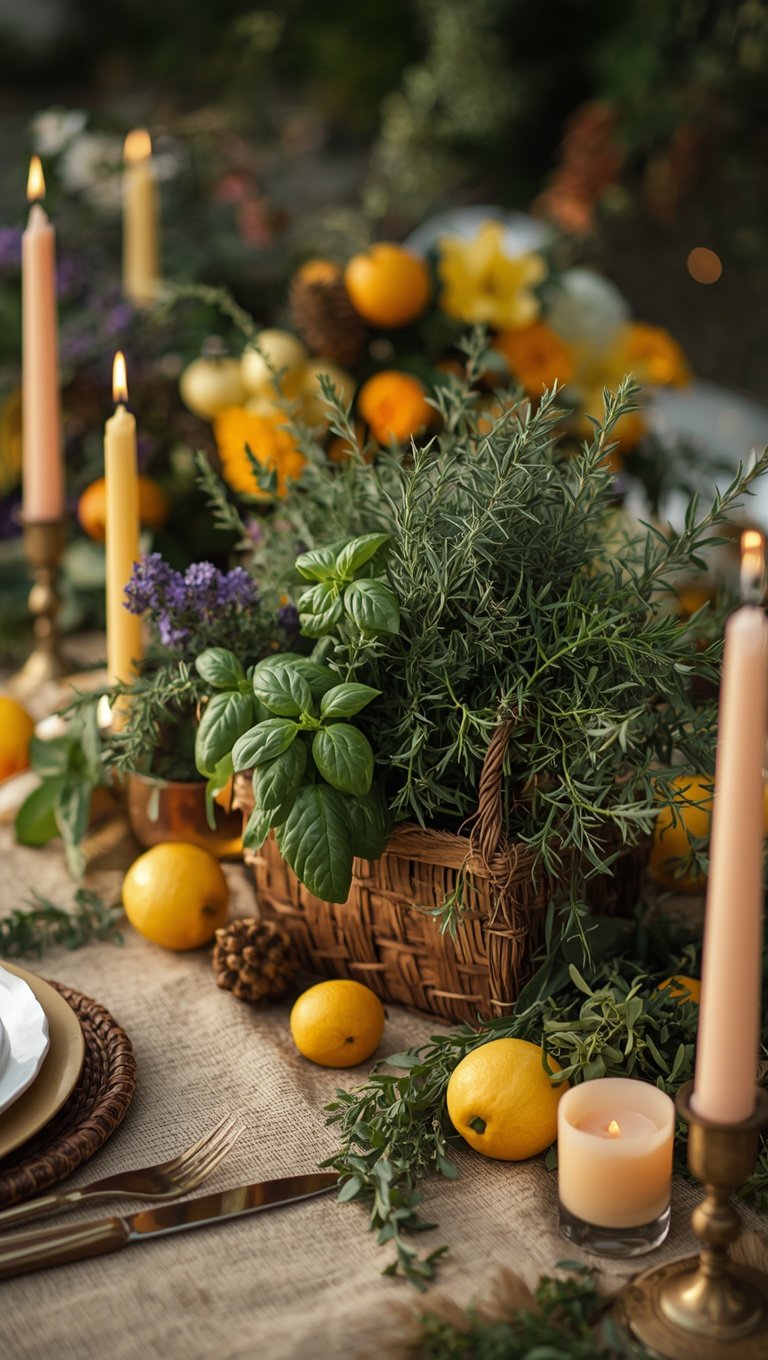
Turns out I had a bowl of lemons, some basil on the windowsill, and a pitcher I never used.
Fifteen minutes later, my table looked like something out of a cookbook, and I didn’t spend a single extra dollar.
That phone call changed how I think about centerpieces forever, the good stuff is almost always already in your kitchen.
So if you’re staring at a bare table right now feeling that same little flutter of panic, take a breath.
You probably already have everything you need.
Fresh Herbs in Mismatched Jars
This is my number one, no-fail, almost-zero-effort move.

I literally walk outside, snip whatever’s growing, basil, mint, rosemary, doesn’t matter, and stuff it into whatever jars I have lying around.
Old jam jars, a chipped mason jar, even a clean salsa jar works.
The mismatched part is the whole point, it makes the table feel collected over time instead of staged.
And the smell, oh my gosh, the smell.
Basil and mint mingling on a warm evening just smells like summer to me.
If I had a tiny apartment with no yard, I’d still do this with a grocery store herb bunch split into three little jars.
It costs almost nothing and somehow reads as the most thoughtful detail on the table.
My tip: snip the herbs right before guests arrive so the oils are still releasing that fresh scent.
A variation I love is swapping in lavender stems when I want something a little more romantic and soft.
Why it works emotionally is simple, herbs feel alive and edible and a little wild, which makes the whole table feel less “decorated” and more like a home that’s actually lived in.
That’s the vibe I’m always chasing.
A Citrus and Greenery Runner
This one feels fancy but it’s honestly so simple it almost feels like cheating.

I lay a long piece of eucalyptus or lemon leaf garland straight down the center of the table.
Then I scatter whole lemons, limes, or even little kumquats right on top of the greenery.
No vase, no arranging skills required, just toss and adjust.
The first time I did this for my sister’s bridal shower, people kept asking who I hired.
Nobody, it was me, in my kitchen, with a bag of limes from Trader Joe’s.
The colors against the green are just so saturated and happy looking.
It photographs beautifully too, which I love for sharing the table on Instagram before everyone digs in.
A little hack, mist the greenery with water right before guests arrive so it looks dewy and fresh instead of wilted.
If you want a fall twist later in the season, swap citrus for small pomegranates and the same trick still works.
I genuinely think this is the easiest “wow” you can create for under fifteen dollars.
It works because the eye reads abundance, and abundance on a table always feels generous and warm.
Wildflowers in a Vintage Pitcher

There’s something about an imperfect, slightly wild bouquet that feels so much more inviting than a stiff, perfectly arranged one.
I keep an old milk-glass pitcher on my shelf just for this purpose.
When I see wildflowers at the farmers market, queen anne’s lace, cosmos, black eyed susans, I grab a few stems of each.
I don’t trim them evenly either, I let some flop a little over the edge.
That looseness is the whole charm, it makes the table feel like someone just walked in from the garden.
My mom used to do this every Sunday growing up, and honestly, smelling sweet peas still takes me right back to her kitchen.
If wildflowers aren’t available, a grocery store bouquet broken apart and remixed into a vintage pitcher works almost as well.
Tip, cut the stems at an angle and change the water every other day to keep them perky longer.
A pretty variation is using all one color family, like dusty pinks and creams, if you want something a touch more elevated for a dinner party.
This idea works emotionally because flowers signal that you made an effort without trying too hard, and that balance is everything in summer entertaining.
Fruit as the Star

Sometimes the prettiest centerpiece is also dessert, and I love that kind of efficiency.
I’ll pile a wooden bowl high with peaches, plums, and a few clusters of grapes spilling over the sides.
Watermelon wedges fanned out on a platter in the center can look shockingly elegant, especially with mint tucked between the slices.
The colors are just so vivid, deep purples, blushing pinks, sunny yellows, it’s like the table is wearing summer.
I did this for a backyard birthday last year and people kept snacking straight off the centerpiece all night, which honestly made me so happy.
It felt communal in the best way.
My tip is to choose fruit that’s slightly underripe so it holds up visually for hours without bruising.
A fun variation is layering fruit on a tiered stand for height and drama.
I also love mixing in a few fresh figs when they’re in season, they add this rich, almost jewel-toned color that elevates everything around it.
Why this works is pretty simple, fruit feels generous and a little indulgent, and it removes any pressure to “decorate” because the food itself is the decoration.
It’s lazy-girl elegance, and I’m so here for it.
Low and Lush, Why Short Arrangements Win
Here’s a mistake I made for years, going too tall with centerpieces.

Tall arrangements look gorgeous in photos, but at an actual dinner they block your view of the person across from you, and honestly that kind of ruins the whole point of gathering.
So now I almost always keep things low and spread out instead.
I’ll use three or four small bud vases scattered down the table instead of one big arrangement.
Each one gets just a stem or two, super minimal.
This way conversation flows easily and the table still feels full and styled.
The first time I switched to this approach, my husband actually commented on how much easier dinner felt, and I realized he was right, we could finally see each other.
My hack is to raid my own cabinet for little juice glasses or even shot glasses to use as mini vases.
A pretty variation is alternating vase heights just slightly, like two inches difference, so it still feels dynamic without blocking sightlines.
This works because connection is the actual goal of the table, and a centerpiece should support that, not compete with it.
That little shift changed how I host completely.
Layering Textures With Linen and Woven Chargers

A centerpiece isn’t only about what’s in the middle, it’s also about what it’s sitting on.
I always start with a linen runner, slightly wrinkled on purpose, because that relaxed texture instantly makes a table feel warmer.
Then I layer in woven rattan chargers underneath each plate.
The mix of nubby linen against smooth ceramic and woven rattan creates this textural richness that photographs and feels incredible in person.
When I touch a table like that, it genuinely feels cozier, like a beach house and a grandmother’s dining room had a baby.
I picked up my chargers secondhand for basically nothing, so this doesn’t have to be expensive at all.
My tip, don’t iron the linen runner, the slight wrinkles are part of the charm and look intentional rather than sloppy.
A nice variation is swapping in a striped or block-print runner for a more global, well-traveled feel.
This approach works emotionally because texture signals comfort, and comfort is what makes people want to linger at your table instead of rushing through dinner.
That lingering, that’s the whole goal for me every single time I set a table.
Candlelight That Doesn’t Block Conversation

Candles are non-negotiable for me at any summer dinner, even an early one with daylight still streaming in.
But the trick is keeping them short and clustered rather than tall and singular.
I love grouping three or five taper candles at varying heights, just a couple inches apart, in simple brass holders.
The flicker adds this softness to everyone’s face that no overhead light can replicate, and honestly it makes people look and feel their prettiest.
I learned the hard way that one giant pillar candle in the center just becomes a wall between guests, so now it’s always small and scattered.
My favorite hack is using unscented candles at the table specifically, so they never compete with the food’s aroma.
A pretty variation is mixing in a few tea lights in little glass votives between the taper clusters for extra glow once the sun starts to set.
I keep a drawer of mismatched brass candlesticks just for this, thrifted over years, and I genuinely love that they all look a little different.
This works because candlelight is one of the fastest, cheapest ways to shift a table from “we’re eating” to “we’re celebrating,” and that shift matters more than people realize.
It’s a small thing that changes the whole feeling of the room.
A Single Statement Bloom

Sometimes simplicity is the boldest choice you can make.
One oversized peony, or a single dramatic sunflower, in a sculptural vase can carry an entire table on its own.
I did this once with one giant dahlia from my neighbor’s garden, just one stem in a slim ceramic vase, and it stopped people in their tracks.
There’s something so confident about not overdoing it, like the table is whispering instead of shouting, and somehow that’s louder.
This is my go-to when I’m short on time but still want impact, because arranging one flower takes about thirty seconds.
My tip is to choose a vase with real personality, a curvy shape or unexpected color, since it’s doing a lot of visual work here.
A variation I love for a more dramatic dinner is using one branch of flowering greenery instead, like a single eucalyptus stem arched dramatically over the table.
This approach works emotionally because restraint reads as intentional, and intentional always feels more luxurious than abundant but cluttered.
It’s proof that you don’t need a ton of flowers or a ton of time to make people feel like you tried.
Sometimes less really is so much more.
Mixing Heights With Cake Stands and Pedestals

I genuinely believe every home needs at least one cake stand, even if you never bake.
I use mine constantly to elevate fruit, flowers, or even a small potted herb plant right in the center of the table.
That extra height creates visual interest without blocking anyone’s sightline, since it’s narrow at the base.
I’ll stack a cake stand with a low bowl of lemons on top, and suddenly the whole table feels like it has architecture to it.
My favorite combo is a vintage glass pedestal with a cluster of votives on top, it catches the light so beautifully once evening hits.
This is one of those tricks nobody clocks consciously, but it makes a table feel curated instead of flat.
My hack, raid the thrift store for mismatched pedestal stands of different heights and group two or three together for a layered look.
A pretty variation is using a cake stand to display a whole watermelon, just sliced open, as a dramatic centerpiece moment.
This works because varying height adds rhythm to a table the same way it does in a bouquet, your eye has somewhere to travel instead of staying flat the whole time.
It’s such a small shift but it changes everything about how put-together a table feels.
Seasonal Vegetables as Decor

This one always surprises people, but vegetables can be gorgeous on a table.
I’ll lay out a few whole artichokes, their spiky purple-green texture is honestly sculptural, alongside cherry tomatoes still on the vine.
The deep reds and greens against a white linen feel so rich and earthy.
I started doing this after a trip to a farm stand left me with way more produce than I could cook in one week, and I just decided to use the extras as decoration first.
It felt resourceful in the best way, nothing wasted, everything beautiful.
My tip is to choose vegetables with strong shapes and colors, artichokes, radishes with their greens still attached, or a bundle of asparagus tied with twine.
A fun variation is mixing in fresh corn still in the husk for a more rustic, backyard barbecue kind of table.
People always ask if they’re allowed to eat the centerpiece, and honestly, yes, that’s part of the charm.
This works emotionally because it blurs the line between food and beauty, and that feels so true to how I actually want to live, where everyday things are allowed to be pretty too.
Nothing about my table needs to be precious or untouchable.
Color Palettes That Feel Like Summer

Before I even pick flowers or fruit, I think about a color story for the whole table.
My favorite summer palette is sherbet tones, soft peach, melon pink, a touch of buttery yellow, it just feels like sunset in a bowl.
Another one I reach for constantly is sage green with terracotta, which feels earthy and a little Mediterranean.
Once I pick a palette, everything gets so much easier, because I’m just shopping or foraging within that color world instead of second guessing every choice.
I remember planning a dinner around a “dusty rose and sage” palette last June, and it came together in under twenty minutes because I already knew exactly what I was looking for.
My tip is to pick your palette from one item you already love, a napkin, a vase, even a piece of fruit, and build outward from there.
A variation that always reads as elevated is a monochrome moment, all white flowers with green foliage, super crisp and timeless.
This approach works because color creates cohesion even when your individual elements are kind of random and thrown together.
It’s the secret behind tables that feel professionally styled but were actually assembled in fifteen minutes flat with whatever was on hand.
Cohesion really is doing most of the heavy lifting.
Personal Touches, Place Cards and Little Notes

This is the part that turns a centerpiece into a memory, honestly.
I love writing each guest’s name on a small card, sometimes with a little doodle or inside joke, and tucking it into their napkin or against their glass.
It costs nothing but a few minutes and a pen, and yet it’s the thing people remember most.
For my best friend’s birthday dinner, I wrote one word under each name describing why I loved having them there, and a few people actually got a little emotional reading it.
That’s the kind of reaction I’m always hoping for honestly, not “wow what a pretty table,” but “wow I feel so seen right now.”
My hack is using lemon leaves or small flowers as the place card holder instead of buying anything fancy, just tuck the card right into the stem.
A sweet variation is writing a tiny memory or inside joke instead of just a name, especially for close friends or family.
This works emotionally because it shifts the centerpiece from decoration to connection, and connection is really the whole reason we set a beautiful table in the first place.
So if you only do one thing from this whole list, honestly, let it be this one.
It’s the smallest effort with the biggest heart behind it, and that’s kind of my whole philosophy on hosting.
xo, Madison