I used to apologize for my backyard.
Every single time someone came over, I’d say “sorry, it’s so small” before they even stepped outside.
And then one summer evening, glass of rosé in hand, I sat on my tiny patio and realized something.
My yard wasn’t the problem.
My mindset was.
That was the night I stopped waiting for a bigger space and started falling in love with the one I actually had.
So if you’re standing at your back door right now, sizing up your little patch of grass and feeling kind of defeated, I get it.
I’ve been exactly there.
But I promise you, some of the coziest, most “you” outdoor spaces I’ve ever seen live in yards you could practically measure in footsteps.
Go Vertical Before You Go Anywhere Else

Here’s the thing nobody tells you about small yards.
You’re not actually short on space.
You’re short on floor space.
The second I looked up instead of just around, everything changed for me.
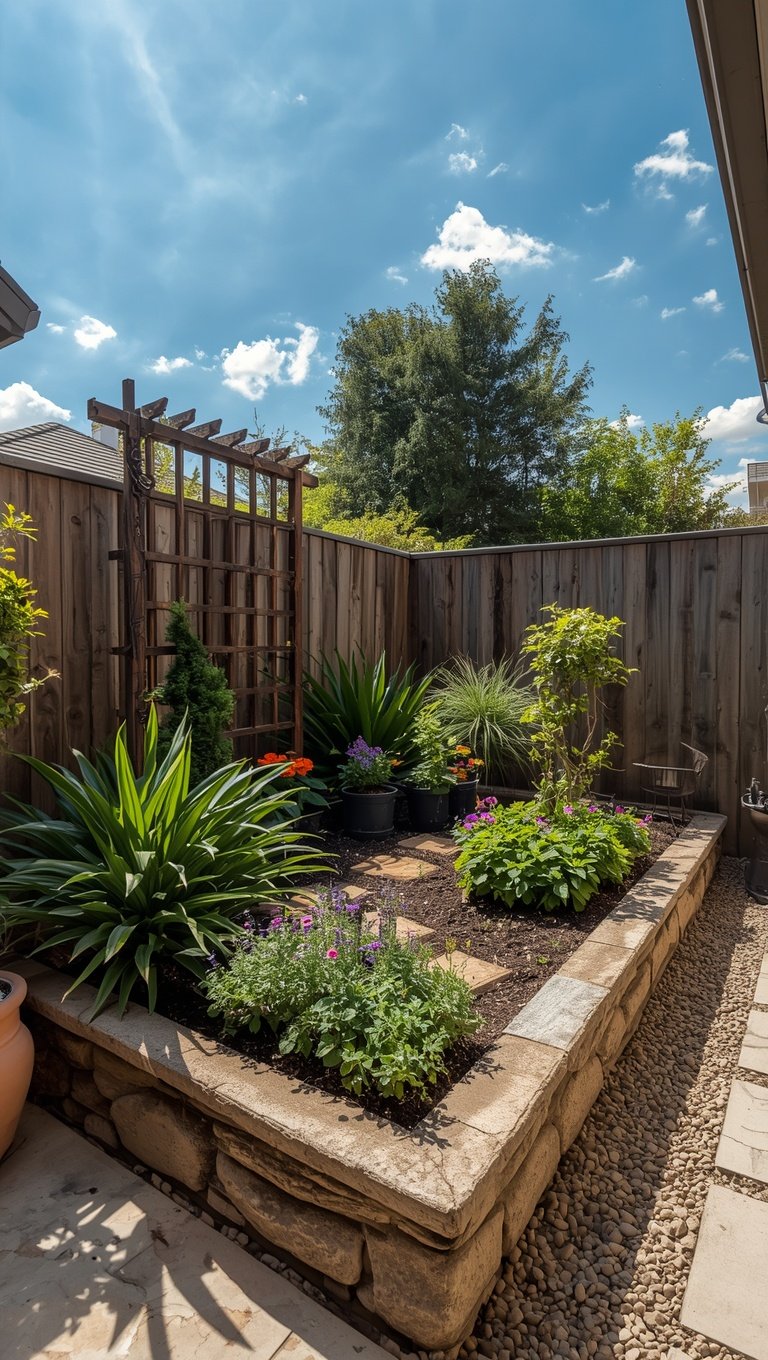
I added a simple wooden trellis along my fence line and trained jasmine up it.
Within one season, that plain fence became this fragrant, living wall.
And it didn’t eat up a single inch of my sitting area.
Vertical planters, wall-mounted pots, even a ladder shelf leaned against a wall can hold a whole garden’s worth of greenery.
If I had a narrow side yard, this is the very first thing I’d do.
It’s an instant mood lift, honestly.
There’s something about greenery at eye level that makes a space feel finished, not cramped.
A tip I always share: mix trailing plants with upright ones so the eye moves in a natural, gentle rhythm up and down.
Pothos, ivy, and climbing roses are my forever favorites for this.
They’re forgiving, they’re lush, and they do the heavy lifting without asking much of you.
Optional variation: if you rent, use a freestanding trellis or obelisk so you can take it with you when you move.
Why it works emotionally is simple.
Vertical greenery tricks your brain into feeling surrounded by nature instead of hemmed in by fences.
Let Furniture Do Double Duty

I’m a little obsessed with furniture that pulls double duty.
In a small backyard, every piece has to earn its keep.
My storage bench was the first big purchase I made for my patio, and honestly, it changed everything.
It seats three people comfortably, and inside it holds all my cushions, string lights, and citronella candles.
No more clutter, no more dragging stuff in and out from the garage.
A fold-down table mounted to the fence is another one of my favorites.
You pull it up when you’re eating, and you fold it flat when you’re not.
So simple, but so smart.
I also love ottomans that double as extra seating and a coffee table in one.
Stackable chairs are kind of a no-brainer too, especially if you host now and then but don’t need six chairs sitting out every single day.
When I redid my own space, I got rid of anything that only did one job.
It felt almost freeing, like decluttering but for the whole yard.
My honest tip is to measure twice before buying anything.
A piece that looks small in a showroom can swallow a tiny patio whole.
And that’s heartbreak nobody needs.
Create Zones With Rugs and Pavers

Small yards actually love zoning, and that surprised me.
You’d think dividing a tiny space would make it feel smaller, but it does the opposite.
An outdoor rug under my seating area instantly signals “this is the living room part.”
A few steps away, a cluster of pavers marks off a little reading nook.
Your eye reads these subtle cues as separate rooms, even in a space the size of a walk-in closet.
I love using a jute or bamboo-look outdoor rug because it feels warm underfoot and grounds the whole area.
It’s such a small detail, but it stops the yard from feeling like one flat, undefined slab of concrete.
Pea gravel is another favorite of mine for a casual, low-fuss zone.
It’s inexpensive, it drains beautifully, and it has this soft crunch underfoot that I genuinely love.
If I had a concrete slab yard, I’d break it up with a rug, then gravel, then maybe a few stepping stones leading to a corner.
Optional variation: use planters as soft dividers instead of hard materials if you want something you can rearrange on a whim.
The emotional payoff here is huge.
Defined zones make a small yard feel intentional, not accidental.
And intentional always reads as bigger.
Choose a Statement Corner Instead of Spreading Thin

One mistake I made early on was trying to fit a little bit of everything into my yard.
A dining spot, a lounge spot, a garden bed, a fire feature, all crammed together.
It looked busy, and worse, it felt busy.
So I picked one corner and made it my statement.
For me, that meant a cozy lounge corner with a loveseat, a small side table, and warm lighting overhead.
Everything else in the yard got quieter so that corner could shine.
If I had a narrow strip yard, I’d do the exact same thing at the far end, so it becomes this little destination you walk toward.
That’s the secret, honestly.
A small yard with one gorgeous focal point feels curated.
A small yard trying to do everything feels chaotic.
My tip is to pick the function you use most and build your statement corner around that.
For me it was lounging with coffee in the morning and wine in the evening.
For you it might be dining, or gardening, or reading.
Whatever it is, let that corner be a little indulgent.
Add the cushion you love, the lantern that makes you smile.
It’s your reward corner, so treat it like one.
Use Mirrors to Trick the Eye

This one feels like a little bit of magic every time.
An outdoor mirror, mounted on a fence, doubles the visual depth of your yard almost instantly.
I hung a round rattan-framed mirror on my back fence last spring, and guests genuinely ask if there’s another yard behind it.
There isn’t, I promise.
It’s just reflecting my little garden bed back at itself.
Weatherproof mirrors are easy to find now, so you don’t have to worry about them warping or fogging.
I’d angle it to reflect greenery or sky rather than a blank wall, since that’s where the real trick happens.
A cluster of smaller mirrors can work too, if one big statement piece feels like too much.
My honest tip is to keep the frame soft and natural, like rattan, wood, or aged brass, so it blends into the garden instead of screaming “look at me.”
Optional variation: a mirrored gazing ball on a stand gives you a similar effect with a more whimsical, cottage feel.
Why this works is almost embarrassingly simple.
Our brains read reflected space as real space.
So a mirror doesn’t just make your yard look bigger.
It genuinely makes it feel more open when you’re standing in it.
Hang String Lights Like You Mean It

I will die on this hill.
String lights are the single easiest way to make a small backyard feel like your favorite room in the house.
The first summer I strung warm white lights across my patio, I remember sitting outside long after the sun went down just because it felt so magical.
Not fancy, not expensive, just warm.
I zigzagged mine from the fence to a single pole in the corner, and it created this canopy effect overhead.
That canopy is what makes a tiny space feel cozy instead of exposed.
My tip is to always choose warm white over cool white or multicolor for that soft, golden glow.
Cool white can feel a little clinical outdoors, and that’s not the vibe we’re going for.
Solar-powered strands are lovely if you want zero extra wiring to deal with.
Optional variation: mix in a few lanterns or a flameless candle cluster on your table for layered lighting.
Layered light is what separates a nice yard from a truly magical one.
Overhead glow, table-level glow, and maybe a little path lighting near your steps.
It sounds like a lot, but it’s genuinely three quick additions.
The emotional reason this works is that soft light makes any space feel intimate.
And intimate, in a small yard, reads as intentional rather than cramped.
Swap In-Ground Beds for Containers
I gave up on in-ground garden beds pretty early into owning my tiny yard.

They just weren’t giving me the flexibility I needed.
Containers, on the other hand, completely changed my relationship with gardening.
I can move them, group them, and swap them out with the seasons without touching a single blade of grass.
My favorite trick is grouping odd numbers of pots together, like three or five, in varying heights.
It creates this lush, layered look instead of a straight little row.
Terra cotta is my forever go-to because it ages so beautifully and feels warm against greenery.
But I’ve also fallen for matte black planters when I want something a little more modern.
If I had a tiny concrete patio with zero soil access, containers would be the entire garden, full stop.
Herbs, small tomato plants, trailing petunias, they all thrive in pots if you keep up with watering.
My honest tip is to invest in a few larger pots rather than a dozen tiny ones.
Bigger pots hold moisture longer, and they just look more substantial from a distance.
Optional variation: a vertical pot stand or tiered plant ladder lets you fit a whole garden into a two-foot-wide footprint.
Why I love this approach is the freedom it gives you.
Nothing is permanent, so nothing feels like a mistake.
Build a Tiny Path to Guide the Eye

A path sounds like a strange thing to obsess over, but stay with me here.
When I added a short row of flat stepping stones through my yard, something shifted.
The space suddenly had a sense of journey to it, even though it only took four steps to walk the whole thing.
Our brains love a path.
It suggests there’s more to discover, even in a yard the size of a studio apartment.
I used reclaimed stone for mine because I loved the slightly uneven, lived-in texture.
But smooth pavers or even a mulch trail work just as well.
My tip is to let the path curve slightly instead of running it in a straight line, if your space allows.
A gentle curve makes a small yard feel like it’s unfolding rather than just sitting there flat in front of you.
Optional variation: line the path with low solar lights so it glows softly at night.
That’s one of my favorite small touches, honestly.
It makes even a quick walk to take out the trash feel a little bit enchanting.
The emotional payoff is subtle but real.
A path signals movement and possibility.
And possibility is exactly what a small space needs to feel bigger than its actual square footage.
Add a Small Water Feature for Instant Calm

I was skeptical about this one at first, I’ll admit it.
A water feature in a tiny yard felt like it might be too much.
But a small tabletop fountain completely changed the feeling of my patio.
The second that gentle trickle started, my whole nervous system relaxed a little.
It’s such a simple sound, but it drowns out street noise and neighbor chatter in the sweetest way.
I went with a compact ceramic fountain that sits right on my side table.
No plumbing, no installation, just fill it with water and plug it in.
If I had more room, I’d love a small pondless waterfall tucked into a garden corner.
But even the tiniest tabletop version gives you that same sense of calm.
My honest tip is to place it somewhere you’ll actually hear it from your seating area.
It sounds obvious, but I made that mistake the first time and barely noticed it was there.
Optional variation: a hanging water feature or wall-mounted spout can work beautifully if you’re tight on surface space.
Why this one matters so much emotionally is simple.
Moving water signals peace to our brains almost instantly.
In a small yard, where every element is doing a lot of visual work, sound becomes this quiet, powerful layer that makes the whole space feel like an escape.
Use a Single Bold Color Instead of a Rainbow

I learned this one the hard way.
My first attempt at decorating my patio involved cushions in about six different colors and patterns.
It looked like a yard sale, not a sanctuary.
So I started over, and this time I picked one bold color and let it repeat throughout the space.
For me, that color became a deep terracotta, echoed in my cushions, one planter, and a lantern.
Everything else stayed neutral, mostly wood tones and soft greens.
The difference was almost instant.
The space felt curated instead of cluttered, even though I didn’t actually remove much furniture.
My tip is to choose your bold color from something you already love, like a favorite candle or a piece of art inside your home.
That way your indoor and outdoor spaces feel like they’re speaking the same language.
Optional variation: if bold isn’t your thing, try a single accent in a soft blush or sage instead, repeated the same way.
The rule stays the same either way.
One color, repeated with intention, always beats five colors competing for attention.
Why this works emotionally is that repetition feels calming to our eyes.
A small space with too many competing colors reads as busy and chaotic.
A small space with one thoughtful color thread reads as designed, cozy, and completely yours.
Bring in Texture, Not Just More Stuff
Texture is the quiet hero of small space design, and I don’t think it gets enough credit.

When I added a chunky knit throw to my patio loveseat, the whole corner suddenly felt three times more inviting.
I didn’t add more furniture.
I just added feeling.
A woven rattan chair, a nubby outdoor rug, a smooth ceramic planter, they all talk to each other in this really satisfying way.
My tip is to think in layers the same way you would inside your home.
Something soft, something woven, something smooth, something a little rough around the edges.
That contrast is what makes a small space feel rich instead of sparse.
I love mixing a woven lantern with a sleek metal side table, for exactly this reason.
The tension between textures keeps your eye interested without adding a single extra object.
Optional variation: swap seasonal textures, like a chunky throw in cooler months and a lightweight linen cushion cover in summer.
It’s such a small switch, but it keeps the space feeling fresh all year.
Why texture matters so much emotionally is that it engages your senses, not just your eyes.
You want to reach out and touch a woven chair or a soft blanket.
And spaces that invite touch always feel warmer and more lived-in, no matter how many square feet they actually have.
Frame Your Sky Since You Can’t Frame More Yard

This is my favorite mindset shift of the whole list.
You might not be able to add more ground, but you can absolutely frame more sky.
A simple pergola, even a small one, does something magical to a tiny yard.
It draws your eye upward and gives the whole space a sense of height and structure.
I added a slim wooden pergola over my seating corner, and it instantly felt like its own little room, roof and all.
String lights woven through the beams made it feel even more like an outdoor living room.
If a full pergola isn’t in the cards, a simple shade sail stretched between two anchor points does something similar.
It creates a ceiling where there wasn’t one, and that ceiling makes the walls, aka your fences, feel like they belong to an actual room.
My tip is to keep the structure light and airy rather than bulky, especially if your yard is on the smaller side.
Slim wood slats or a single canvas sail will always feel more spacious than a heavy, solid roof.
Optional variation: climbing vines trained over a simple frame give you the same framed-sky effect with a softer, more romantic feel.
Why this one gets me every time is the emotional shift it creates.
A framed sky turns your yard from an empty outdoor space into an actual room.
And once it feels like a room, you stop apologizing for its size, the same way I finally did.
I still catch myself smiling every time I step out there now, coffee in hand, in a yard I used to think was too small to matter.