

I’ll be honest, Persian rugs can look a little scary.
They look expensive, fussy, and like something you’d only find in a grandma’s formal dining room that nobody was allowed to sit in.
But the more I poke around thrift stores and Facebook Marketplace, the more I think these rugs are some of the friendliest pieces you can bring into a home.
They hide dirt, they forgive a mismatched sofa, and they make a room look like it has a story even when everything in it came from three different decades.
So grab a coffee, because I want to walk you through how I’d pick one, how to read what you’re looking at, and where to put it once it’s home.
Start With the Background Color, Not the Pattern

Everybody stares at the pattern first.
I get it, the pattern is the fun part.
But from across the room, what you actually notice is the field, which is the big background color behind all the little details.
Look at this one.
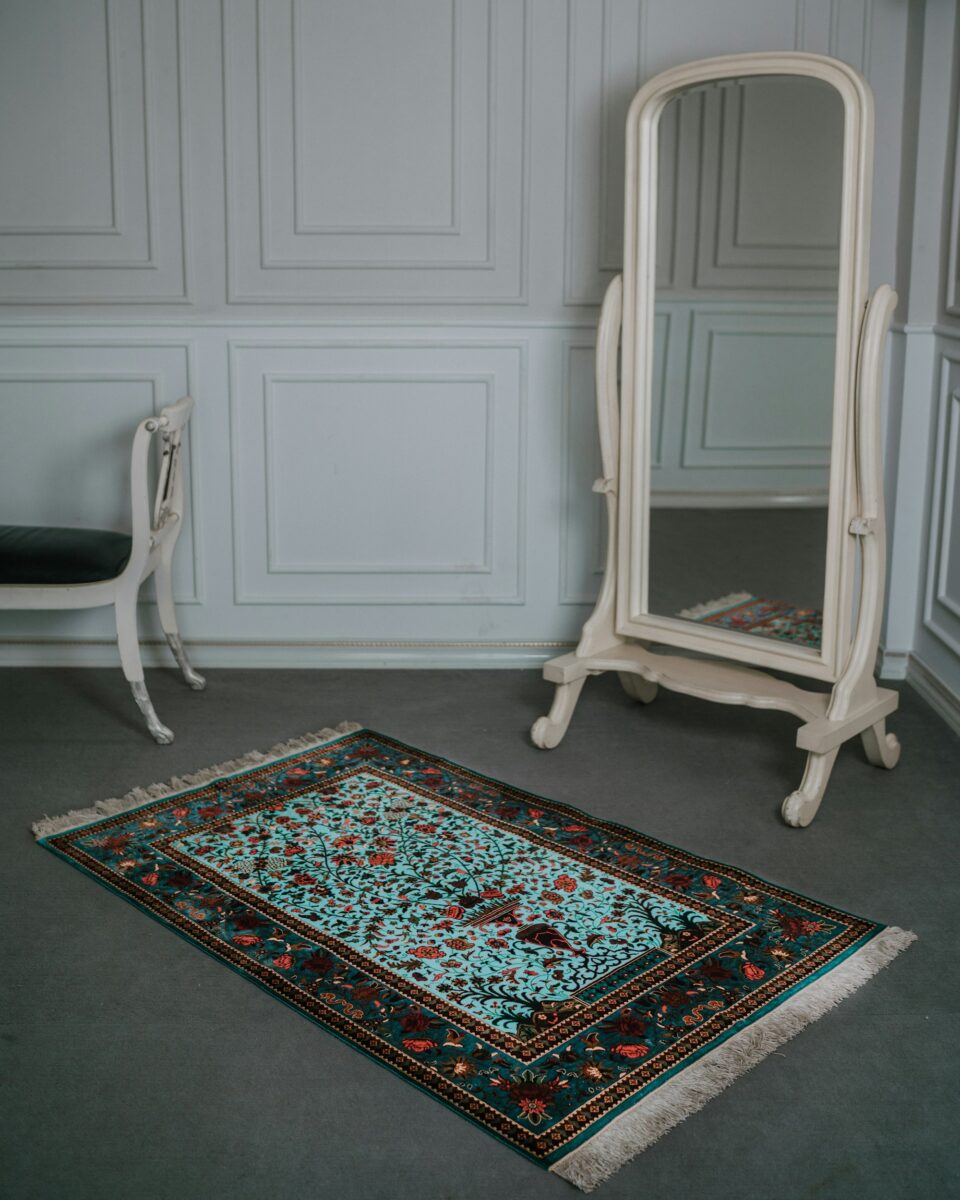
The field is a soft turquoise, and it sits right next to a pale gray-blue paneled wall without fighting it at all.
The red flowers in the dark teal border are the pop, and the green velvet bench seat picks up the deeper tones.
That’s the trick I use.
I squint at a rug until the pattern blurs (yes, you’ll look a little silly in the store), and whatever color is left is the color I’m matching to the room.
If that blurry color looks good next to your walls and your sofa, the pattern will take care of itself.
Also notice it’s a small rug sitting right on top of wall-to-wall carpet.
That’s totally allowed, and if you rent and can’t rip up the carpet, it’s one of the easiest ways to make a room feel like yours.
I wrote a whole guide to layering rugs the right way if you want the details.
Red Rugs and Dark Walls Are Best Friends

This is the kind of rug most of us picture when we hear “Persian.”
Deep red, with rows of octagon shapes marching across it.
Those octagons have a name, by the way.
They’re called guls, and rows of them are the classic look of Turkmen rugs, which you’ll often see sold under the name “Bukhara” or “Bokhara.”
So if a listing says Bokhara, picture exactly this kind of red rug with repeating medallions.
And look what happens with those dark green walls.
Red and green sit opposite each other on the color wheel, so they tend to make each other look richer instead of muddier.
The coral leather bench in the alcove is a softer cousin of the red, which keeps the whole corner from feeling like a holiday card.
If you’ve already got a red rug and you’re stuck on the furniture, here’s my take on what color couch goes with a red rug.
Learn a Few Pattern Families Before You Shop

Walking into a rug shop can feel like walking into a wall of noise.
Honestly, it helps to sort what you see into a few loose groups.
There are medallion rugs, with one big shape in the middle or rows of smaller ones.
There are all-over florals, where vines and flowers cover the whole field.
There are geometric ones, with diamonds and lattices, like the diamond lattice rug in this photo.
And there are striped flatweaves, which are a whole other animal, and I’ll get to those in a minute.
Rugs from nomadic and village weavers often have bolder, sometimes rougher designs, while bigger workshops weave patterns planned out ahead of time.
Neither one is better.
The bold one with the tiny animals in this photo is exactly my kind of rug, but plenty of people would pick the tidy floral every time.
Once you know which group makes your heart jump, scrolling listings gets so much faster.
Flip It Over Before You Fall in Love

Quick vocabulary note before you shop.
A true Persian rug is a hand-woven rug made in Iran, while “Persian-style” usually just means the look, made anywhere, by hand or by machine.
So how do you tell what you’re looking at?
Turn the rug over.
Or at least fold back a corner, maybe 12 inches, so you can see the back.
It’s the one habit that’ll save you money.
On a hand-knotted rug, the pattern on the back is about as clear as the pattern on the front.
On a machine-made rug, the back looks even and mechanical.
Tufted rugs are held together with glue and an extra backing layer, so that layer covers up the pattern on the back.
Now check the fringe.
On a hand-knotted rug, the fringe is the warp, the long threads the whole rug was woven on, so it’s part of the rug itself.
On a lot of machine-made rugs, the fringe gets sewn or glued on afterward.
None of that means a machine-made rug is bad.
It just means you should pay a machine-made price for it.
That’s all.
Hand-woven rugs usually cost more because of all the hand work, so a seller asking hand-knotted money for a rug with a glued-on fringe is a hard no from me.
Faded and Uneven Can Be a Good Thing

Look at all those reds in this stack.
Some are bright, some have faded into rust and pink, and some have bands where the color shifts a little.
That shifting color has a name too.
It’s called abrash, and it means bands of slightly different color running across the width of the rug.
A lot of rug lovers like it, me included, because it makes a rug look alive instead of printed.
To me, a softer, faded red is way easier to live with than a brand new fire-engine red.
It plays nicely with wood floors, with Warm White Walls, and with whatever thrift finds you drag home next.
So don’t walk away from a rug just because the color isn’t perfectly even.
Walk away if it smells musty or the back is crumbling, but give the faded ones a real look.
And if you’re buying online, ask the seller for a photo of the back and the fringe, then give yourself 24 hours before you hit buy, because a rug you were obsessed with at midnight looks a little different over your morning coffee.
A Kilim Is the Budget Way In

Okay, the flatweaves.
See the striped ones mixed into this pile?
Those are kilims.
A kilim is woven flat, with the warp and weft pulled tight together, so there’s no pile at all.
Because kilims are often cheaper than pile rugs, a lot of new collectors start with them.
That’s exactly why I love them for budget decorating.
You still get the old patterns and the faded colors, you just don’t get the fluffy pile.
They’re thinner, so they’re great in spots where a thick rug would trip you up, like in front of a door or under a desk chair.
If you’ve got a weekend free, check estate sales and Marketplace for “kilim” and “flatweave” instead of “Persian rug.”
You’ll probably find a lot more of them in your price range.
And before you buy any size, measure the space (I like to leave roughly 12 to 18 inches of bare floor between a rug and the walls) and think about where the rug should actually sit, because centering a rug the wrong way can throw off the whole room.
Put a Small One Somewhere Unexpected

Not every rug has to go on the floor.
Nope.
In this all-white room, a small geometric rug is draped right over the sideboard like a runner.
Suddenly there’s pattern at eye level, in a room that was all white paneling, white mirror and white furniture.
It warms everything up without a single gallon of paint.
I think this is the smartest way to use a rug that’s too small or too worn for the floor.
A scrappy little thrift rug with a bald spot can live on a dresser, the back of a sofa, or a bench, and nobody will ever see the sad part.
Just keep it away from candles and keep your coffee mug on a coaster, because you don’t want to be scrubbing a rug.
Pets, Fur and a Busy Pattern

And then there’s this little face.
If you’ve got pets, a busy Persian-style pattern is honestly the best fur camouflage there is.
My dog Biscuit sheds on everything, and a solid rug shows every last hair.
A pattern like this pink one breaks everything up, so a little hair or a little scuff just disappears into the flowers.
If your pets are hard on rugs, I’d go for a machine-made or thrifted one first.
You’ll get the look without panicking every time somebody throws up a hairball or skids across it.
And if you fall for a hand-knotted rug later, you’ll already know exactly how to read it.
Start with the background color, flip it over, check the fringe, and don’t be scared of a little fading.