
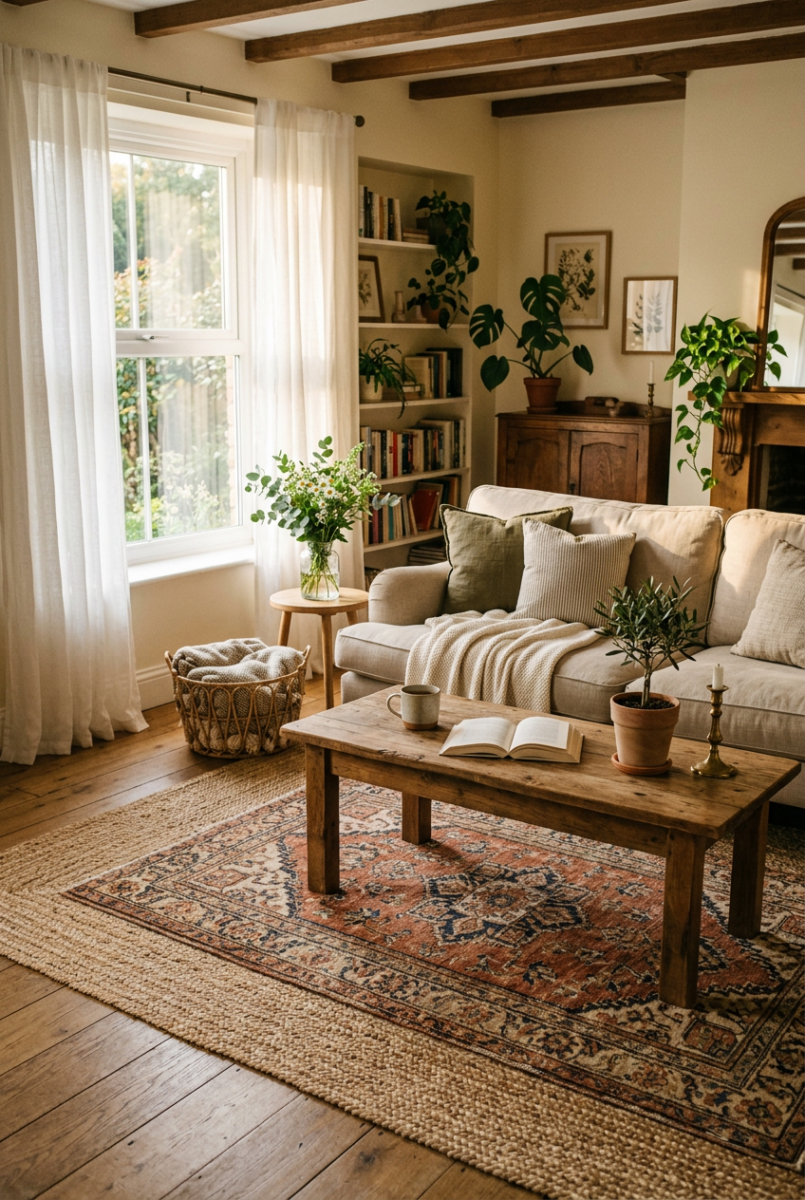
Okay, confession: I spent three years thinking layered rugs were just a design trick for people with way too much money and way too much Pinterest time.
Then I tried it in my own living room on a random Saturday afternoon — and I genuinely couldn’t believe the difference.
The room felt warmer, cozier, more *intentional* somehow.
Like it had a story.
If you’ve been scrolling past those gorgeous layered rug photos thinking it’s too complicated or too expensive, I want to walk you through exactly how I do it — with real room examples that actually make sense.
Not sure which size to buy? The free rug size calculator works it out from your room and furniture.
Why Layering Rugs Actually Works (It’s Not Just a Trend)
There’s something almost magical about a layered rug situation.
It adds depth and warmth in a way that a single rug — even a really beautiful one — just can’t replicate.
It’s like the difference between wearing one piece of jewelry and a thoughtfully styled stack.
From a design standpoint, layering creates visual texture.
Your eye moves across the room and finds something interesting at every level.
And on a practical note?
It anchors your furniture grouping in the most effortless way.
When I finally tried it in my own living room, I remember standing back and thinking, *this is why interior designers charge what they charge.*
It looked expensive.
But honestly?
It wasn’t.
The Golden Rule: Base Rug First, Always
Before you do anything else, you need a solid base rug.
This is your foundation layer — typically a neutral, flat-woven, or low-pile rug that covers a generous portion of your living room floor.
Think jute, sisal, a simple wool flat weave, or a solid cotton rug.
Size matters a lot here.
Your base rug should be large enough to ground the entire seating area.
A common mistake I see is going too small — the furniture ends up floating and the whole layered look loses its purpose.
I always say: if you’re unsure about sizing, go bigger than you think you need.
You can always adjust the top layer, but a skimpy base rug will undermine even the most gorgeous accent piece on top.
Choosing Your Top Rug: Where the Fun Begins
This is genuinely my favorite part.
Your top rug is where personality comes in — a vintage Persian, a bold geometric, a shaggy sheepskin, a hand-knotted Moroccan piece.
The options feel endless, and they kind of are.
The top rug should be noticeably smaller than the base.
I like a proportion where the base extends about a foot or more beyond the top rug on all visible sides.
That border of the base layer framing the accent piece?
So good.
Don’t stress about matchy-matchy.
In fact, I’d almost encourage you to pick a top rug that surprises you a little.
Contrast in pattern and texture is exactly what makes this technique feel layered rather than just… stacked.
Texture Combinations That Make Me Obsessed
Texture is honestly the secret sauce of a great layered rug moment.
When you pair a flat, tightly woven base with something plush and tactile on top, the contrast is everything.
Your eyes see it and your feet feel it — and both are happy.
Some of my absolute favorite combos: jute underneath a vintage wool kilim.
Or a simple flatweave under a shaggy, high-pile accent rug.
Or a sisal base paired with a silky hand-knotted piece.
When I tackled my own living room refresh last fall, I went with a chunky woven jute underneath a faded Turkish-style rug in terracotta tones.
The combination felt warm and layered, like the room had been collected over years rather than styled in an afternoon.
Which is exactly the vibe I was going for.
Pattern Mixing Without the Panic
I know pattern mixing sounds intimidating.
But I promise, if you follow one simple guideline, you’ll be fine: pair a busy pattern with a quiet one.
Not two competing prints at once — that’s when it tips from curated into chaotic.
A solid or subtly textured base is always safe.
Then you can go bold on the top layer — a graphic stripe, an intricate floral, a diamond medallion.
The base gives it breathing room.
If you love patterns on both layers (same, honestly), just make sure they’re different in scale.
A large-scale geometric on the bottom and a small, delicate print on top works beautifully.
It’s sort of like plaid and floral together — wrong on paper, right in person.
Color Strategy: How to Pull It All Together
Color is where people either nail the layered rug look or accidentally make it feel kinda off.
The goal is harmony — not matching, but *relating*.
Your rugs should feel like they belong in the same conversation.
A trick I love: pull one color from your top rug and echo it somewhere else in the room.
A throw pillow, a vase, the color of your curtains.
When that thread connects, the whole room feels intentional.
Neutrals are the easiest starting point if you’re nervous.
A cream or sand base with a muted vintage-toned top rug is almost impossible to mess up.
And once you get the feel for it, you can be bolder.
Real Room Example: The Neutral + Vintage Combo
This is probably the most classic layered rug setup, and honestly it’s classic for a reason.
A large natural fiber rug — jute or sisal — on the bottom, and a worn-in vintage Persian or Moroccan piece on top.
It works in almost any style of room.
In neutral living rooms, this combo adds warmth without overwhelming a quiet palette.
The texture of the jute does the heavy lifting, and the vintage rug brings in pattern and a little soul.
If I had a white-wall living room with minimal furniture, this is the layered rug moment I’d build the whole room around.
It’s warm, it’s collected-looking, and it genuinely photographs beautifully — not that that’s the *only* reason to love it, but, you know.
Real Room Example: The Boho-Layered Living Room
Bohemian interiors were basically *made* for rug layering.
The more texture, the more pattern, the more collected-over-time energy, the better.
And the great news is, in a boho room, you have a lot of latitude.
Think: a chunky woven base rug, then a hand-knotted Berber or kilim on top, then — yes, I said it — maybe even a small cowhide or sheepskin draped at one end.
It sounds like a lot, but in a richly styled room, it just looks abundant.
When my friend redid her boho-inspired living room, she layered a rust-toned kilim over a dark natural fiber rug, and the warmth it created felt almost like firelight.
It was cozy in the very best way.
Real Room Example: The Minimal Modern Room Done Right
Layered rugs in a modern minimal room can feel counterintuitive — isn’t minimalism about less?
But done well, it actually adds the warmth that minimal spaces sometimes lack.
The trick is keeping both layers quiet.
A low-pile solid rug in a warm gray or stone tone as the base, and then a slightly smaller solid or subtly textured piece on top in a tonal variation.
No loud patterns.
Just depth through texture.
The result is a room that feels serene but not cold.
Cozy but not cluttered.
And honestly, I think a minimal room with thoughtfully layered rugs looks more elevated than one with just a single, predictable rug.
Placement Tips That Make a Real Difference
Placement sounds obvious but there are a few things I’ve learned that genuinely change the outcome.
First: angle.
You can lay your top rug perfectly parallel to your base rug, or you can rotate it slightly — even fifteen degrees — for a more casual, effortless feel.
Slight rotation is actually my personal preference.
It looks less deliberate, more like you just dropped it there and somehow it looked incredible.
Which is, sort of, the goal.
Also think about off-centering the top rug.
Instead of perfectly centered on the base, shift it slightly toward the sofa or coffee table side.
It draws the eye and creates a more dynamic, layered composition.
How to Keep Layered Rugs From Sliding (Real Tips)
Okay, the practical stuff.
Because the most beautiful layered rug setup in the world means nothing if you’re constantly tripping over a bunched-up top rug.
Trust me — I’ve been there.
A rug pad under your base rug is non-negotiable.
It keeps the whole stack in place and honestly makes everything underfoot feel more cushioned and luxurious.
Worth every penny.
For the top layer, a few options: double-sided rug tape works really well on hard floors.
On carpet or over a thick base rug, a thin non-slip mesh pad cut to size does the job.
I’ve also seen people use a small dot of museum putty in the corners — low-key brilliant.
Budget-Friendly Ways to Get the Layered Look
Here’s something I want you to know: you absolutely do not need to spend a fortune on this.
Some of my favorite layered rug combinations came from mixing a big budget basic with a thrifted or vintage find.
A plain, affordable jute rug from a big-box home store makes a perfect base.
Then you hunt for a beautiful vintage or one-of-a-kind top rug at a flea market, estate sale, or online vintage shop.
The base doesn’t need to be precious — it just needs to be good-looking and well-sized.
I picked up my favorite top rug at an estate sale for less than I’d spend on a dinner out.
It had a little wear to it, a slight fade — and honestly, that made it more beautiful.
Character like that can’t be bought new.
Signs Your Layered Rug Setup Is Working
You’ll know when it’s right.
There’s a moment you step back and the room just *feels* different — warmer, richer, more complete.
Like the space finally exhaled.
Some specific things to look for: the seating area feels anchored and intentional.
Your eye has a place to land and then wander.
The textures feel inviting — you actually want to sit on the floor, which is sort of the highest compliment a rug can receive.
And if you catch yourself pausing in the doorway just to look at the room?
That’s the sign.
That little moment of quiet satisfaction — that’s exactly what a beautifully layered rug is supposed to give you.