
I messed up my hot tub surround the first time.
Dropped the tub on a flat concrete pad, stuck two plastic chairs next to it, called it done.
It looked like a sad car wash.
Two years later I ripped the whole thing out and started over — and that second attempt taught me basically everything I know about making an outdoor spa feel like somewhere you actually want to be.
Below I’m sharing 13 surround ideas that genuinely work: stone, wood, gazebo, concrete, Mediterranean tile, Zen garden, tropical, Southwest, cedar-and-fire, pergola, rooftop modern, courtyard, and sunken patio.
Some are big weekend projects, some are more like a full reno.
All of them are way better than two plastic chairs on concrete.
Stick around because the fire pit and cedar one near the bottom is my personal favorite — it changed how I use my whole backyard.

Natural Stone Paradise

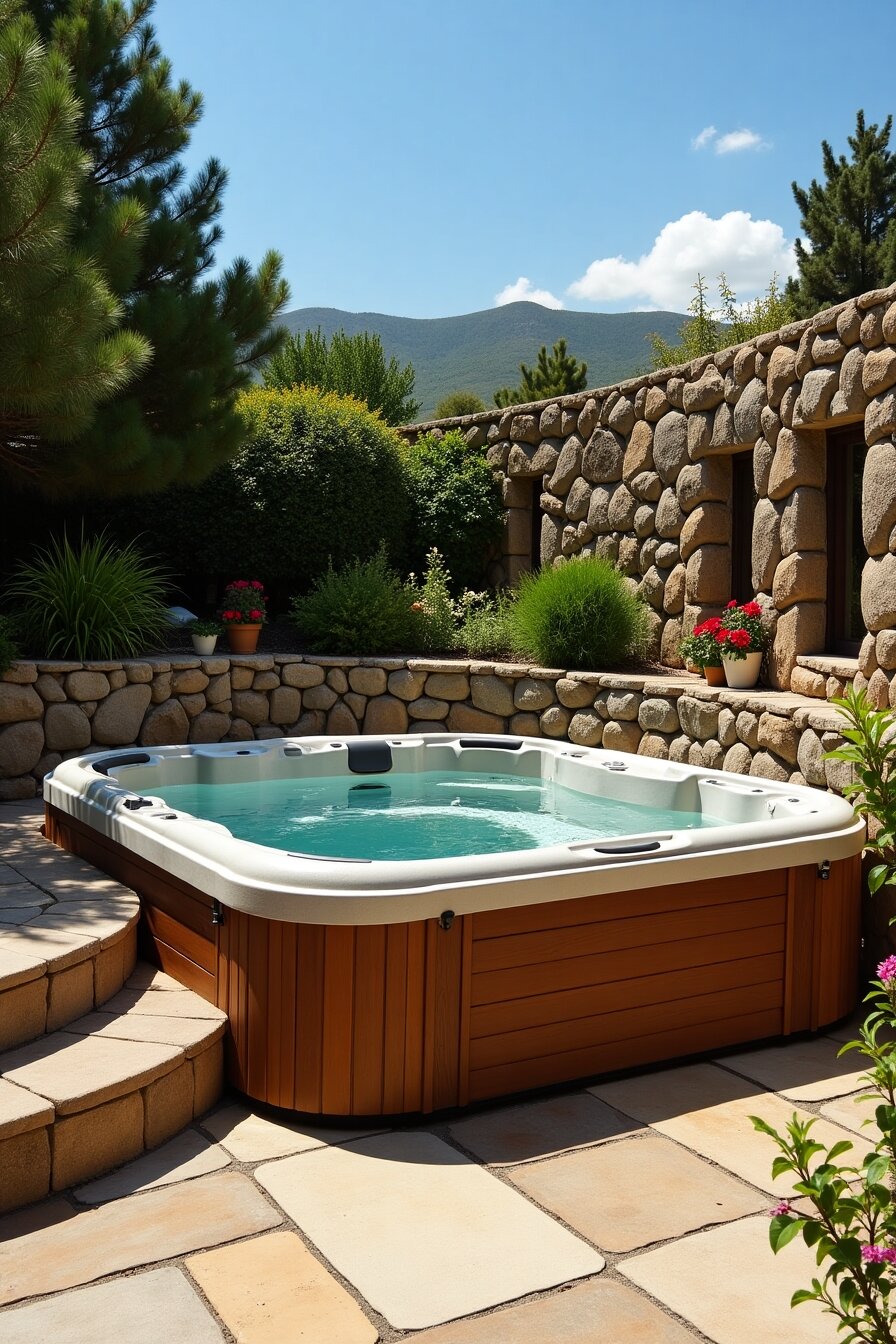
Honestly, nothing makes a hot tub feel more like it belongs outside than stacking natural stone around it.
Not fake stone veneer.
Real, heavy, slightly uneven stone that looks like it was always there.
You’ve got a lot of options for the type of stone, and they each give off a totally different feeling.
Limestone is light and airy — good for a bright, open yard.
Slate runs dark and dramatic, almost moody in the best way.
River rock is more relaxed, more cottage-y.
None of these are wrong.
It just depends on whether you want your yard to feel like a Tuscan villa or a mountain fishing cabin.
The thing most people don’t think about until it’s too late is height variation.
A flat stone surround is fine, but when you build in some changes in elevation — a slightly raised section here, a lower ledge there — you suddenly have built-in bench seating for perching when you get out, plus natural little shelves for a candle, a drink, a small potted succulent.
I keep a little waterproof lantern on my stone ledge and it makes the whole thing feel way more intentional.
If you’re going to add one thing to a stone surround, make it embedded LED lighting between the rocks.
Not a spotlight aimed at the tub from across the yard — small, warm lights tucked right into the stone itself.
At dusk it looks genuinely magical and costs maybe $40 in solar rope lights if you’re doing it on a budget (I did this first, then upgraded to hardwired LEDs later).
A small waterfall feature built into one wall of the stone surround takes this whole setup to another level.
The sound of trickling water layered over the jets of the tub is something else.
It’s the kind of thing where you close your eyes and forget you’re in your own backyard.
Add a stone fire pit a few feet away and you’ve got a reason to be outside even when you’re not soaking.
That proximity — hot tub on one side, fire crackling on the other — is genuinely one of the better outdoor experiences I’ve had at home.
Wooden Deck Masterpiece


A well-built wooden deck is probably the most versatile foundation you can create for a hot tub, and I say that as someone who went the stone route first.
Wood is warm in a way concrete and stone just aren’t.
The color, the texture, the slight give underfoot — it all signals “relax” before you even get in the water.
The move that makes a deck surround look custom versus builder-grade is sunken placement.
You design the deck so the hot tub sits in a recessed section, with the tub’s lip sitting flush with the deck boards around it.
It’s cleaner, it looks intentional, and honestly it’s safer too because you’re not stepping up and over a big ledge every time you get in.
(Getting out of a hot tub in the dark at 10pm when you’re half-asleep is already a coordination challenge.
You don’t need extra steps involved.)
Multi-level decks are worth the extra planning.
A slightly elevated platform on one side can hold a pair of Adirondack chairs with a clear sightline to the tub.
A lower section creates a step-down entry.
Different levels also let you define zones without needing walls or screens — the change in height does that work for you.
For wood species, cedar, redwood, and teak are the go-to choices for outdoor spa decks.
Cedar and redwood resist moisture and insects naturally.
Teak is gorgeous but expensive — I’ve seen reclaimed teak deck boards at Habitat for Humanity ReStore locations for a fraction of retail, which is worth checking before you commit to new.
Whatever you choose, seal it every year or two.
Skipping that step is how you end up with a gray, splintery deck in four years instead of ten.
Built-in benches along the perimeter pull double duty as seating and storage.
A hinged bench top that opens to a waterproof compartment underneath is where I keep my towels, a bottle of tub chemicals, and the little floating drink holder Biscuit has knocked into the water twice now.
If privacy is a concern, partial wood walls or lattice screens on one or two sides give you coverage without making the whole space feel closed in.
A pergola overhead — even a simple one without a roof, just the beams — gives you a framework to hang string lights and creates that “room outside” feeling that is really hard to beat.
Private Gazebo Retreat

A gazebo around a hot tub is kind of a commitment, I won’t lie.
But if you live somewhere with actual seasons — real rain, real cold, random summer thunderstorms — it changes the math completely on how often you actually use your tub.
With an overhead structure, weather stops being a reason not to get in.
Soaking in a hot tub while it rains outside and you’re completely dry under a roof is one of those experiences that sounds like something from a hotel brochure but is absolutely achievable in your own backyard.
The simplest gazebo version is just a roof and four posts with open sides — more shade structure than enclosure.
From there you can add adjustable side panels, screen walls, or full curtains that close for privacy or wind protection.
Outdoor curtain panels from IKEA or a home improvement store run about $25-40 a panel and can completely change how enclosed the space feels depending on the day.
Ventilation matters more than people expect in an enclosed gazebo.
Hot tub water evaporates constantly, and that humidity has to go somewhere.
Louvered window panels, a ceiling fan rated for damp locations, or even a small exhaust fan tucked into a wall vent keep the air from getting swampy.
Skip this step and you’ll notice it pretty fast.
The vertical height of a gazebo gives you decorating options that flat outdoor spaces don’t have.
Hanging string lights from the beams, draping potted ferns from ceiling hooks, installing a small outdoor speaker system at eye level — the structure supports all of it.
I’ve seen gazebos with a small rattan chandelier overhead that looked genuinely stunning.
Not practical for every climate, but wow.
Climbing plants like jasmine or clematis trained up the gazebo posts add fragrance and softness to what could otherwise feel like a wooden box.
The scent of jasmine while you’re soaking is worth planting it for that reason alone.
For cold-climate hot tub owners: ceiling-mounted infrared heaters inside the gazebo are worth every penny.
Getting out of a hot tub when it’s 28°F is brutal.
Having a heat source right above you while you towel off takes the edge off in a huge way.
Modern Concrete Minimalism

Concrete isn’t for everyone and I’ll just say that upfront.
If your style leans warm and layered, concrete might feel cold and hard to soften.
But if you love clean lines, a muted palette, and the kind of outdoor space that looks like it belongs in an architecture magazine, concrete does things no other material really can.
The nice thing about concrete as a surround material is how customizable it actually is once you get past the gray slab mental image.
You can polish it to a glossy finish that reflects light.
You can stamp it to look like stone or wood plank.
You can acid-stain it in warm terracotta tones or charcoal or even a faint sage green.
I’ve seen concrete surrounds with inlaid river pebbles pressed into the surface before it cured that looked genuinely beautiful — and that’s a DIY-able addition if you’re doing a pour yourself.
Integrated steps that appear to float up toward the tub — meaning the risers are open, just the treads cantilevered out — create that architectural moment that makes people stop and stare.
It’s not a cheap detail to add, but it’s the kind of thing that makes a concrete surround look designed rather than just poured.
One practical bonus nobody talks about: concrete’s thermal mass.
It absorbs heat from the sun during the day and radiates it back in the evening, which means your surround stays noticeably warmer underfoot after sunset.
You can push this further by embedding radiant floor heating elements in the pour — warm feet when you step out of the tub in November is a luxury that feels wildly excessive until you have it.
If the industrial feel worries you, the balance is easy to find.
Teak furniture, a chunky wool outdoor throw, some terracotta pots — warm materials soften concrete immediately.
The contrast is actually part of what makes the look interesting.
Go Mediterranean with Tile, Planters and Olive Trees

This one is my favorite for people who want their backyard to feel like a place they’d pay to visit.
Terra cotta tile, big planters, drought-tolerant herbs, and the dappled shade of an olive tree — it’s earthy and warm and a little bit romantic in a way that’s not trying too hard.
For the ground surface, terra cotta or Spanish-style pavers in warm ochres and rusty reds set the whole tone.
Keep the tile pattern simple — solid or basic geometric — and save the visual interest for the plants and furniture rather than the floor.
Busy tile under a busy planting scheme gets overwhelming fast.
Lavender, rosemary, and sage around the perimeter are perfect here.
They’re drought-tolerant, they smell incredible when the breeze moves through them, and they look right at home next to terra cotta.
Plant them in clusters rather than evenly spaced single plants — clusters look lush and intentional while evenly spaced plants look like a parking lot median.
Olive trees in oversized planters are the statement piece of this whole look.
They’re slow-growing, sculptural, and they provide just enough privacy without fully blocking sightlines.
If olive trees don’t grow in your climate (they need mild winters — basically zones 8-11), Italian cypress, dwarf citrus, or a potted Meyer lemon does a similar visual job.
For furniture, wicker or rattan chairs with stone or concrete side tables feel right.
Keep a small table within arm’s reach of the tub for your drink and your towel — sounds basic but the number of times I’ve sloshed out to grab something off a chair three feet away is embarrassing.
String lights overhead, warm and low, finish it.
The whole setup looks like a restaurant terrace in Positano and costs a fraction of what you’d spend remodeling your kitchen.
Create a Zen Retreat with Bamboo, Rocks and Minimal Decor

The hardest part of this one, honestly, is the restraint.
Zen-style outdoor spaces work because of what’s not there.
Every extra piece of decor you add chips away at the calm.
If you’re someone who loves to layer and accessorize (I see you, and I am you, but not here), this one takes some discipline.
Large format stone or concrete pavers in soft gray or sand tones work well for the ground.
Leave intentional gaps between them and fill those gaps with creeping moss, thyme, or low ground cover — the planted gaps are what separate this from just a regular paver patio.
It takes a season or two for the plants to fill in but the result is beautiful.
Boulders and rocks used as sculptural elements throughout the landscape give the eye a place to rest.
Not scattered randomly — deliberately placed, like they were always there.
A single large boulder near the tub does more than six small rocks arranged in a row.
Bamboo is the other key plant here, but a word of caution: running bamboo will take over your yard inside of three years if you let it.
Use clumping bamboo varieties (like Fargesia) in planters or behind root barriers.
The sound of bamboo moving in a light breeze is exactly the kind of ambient detail that makes this retreat feel complete.
A small bamboo water fountain — the kind where water pours from a cut bamboo spout into a stone basin — is maybe $60-80 at a garden center and adds the single most impactful detail for the cost.
Running water does something to the nervous system.
Soaking in a hot tub while a fountain trickles nearby hits differently than just the jets alone.
One or two stone accents — a small Buddha, a simple stone lantern — are plenty.
Teak or bamboo furniture.
Metal wall sconces holding real or LED candles.
That’s the whole recipe.
Don’t add more.
Go Tropical with Palm Trees, Flowering Plants and Rattan Furniture

This is the most “vacation” you can make your backyard feel without flying anywhere, and I mean that as a real compliment.
Done right, a tropical hot tub surround makes you forget you’re in a suburb in the Midwest.
The plant list is what makes or breaks the tropical look.
Areca palms, sago palms, or bamboo palms for height and that instant island silhouette.
Hibiscus for the big bright blooms — red, orange, and hot pink all work.
Bird of paradise adds a sculptural drama that’s hard to replicate with any other plant.
If you’re in a colder zone, most of these do fine in large pots that you can move to a garage or shed before the first frost.
Rattan or wicker furniture with cushions in tropical prints — oversized botanical patterns, palm leaves, bright solid colors — gives the seating area that resort feel.
Look for weather-resistant synthetic rattan (it’s come a long way from the faded stuff your grandma had).
Real rattan left outside will deteriorate within a couple of seasons in most climates.
For the ground, crushed shells or pea gravel mimics the sandy beach look without the actual chaos of sand migrating into your tub and your house.
Lay simple wood boardwalk strips over it to connect the tub to the seating area — it looks intentional and keeps your feet from sinking in.
Tiki torches, up-lighting aimed into the palms from below, a Bluetooth speaker playing something with steel drums — you get the idea.
This one is fun and a little extra, which is kind of the whole point.
Channel the Southwest with Adobe, Cacti and Rustic Woods

This is the hot tub surround style I see wildly underused outside of actual desert states, which is a shame because it’s genuinely beautiful and surprisingly low-maintenance once it’s established.
Adobe-style tiles in tans, warm browns, and terracotta brick red anchor the look.
You don’t need to live in New Mexico for this to work — the colors are warm enough to feel at home in most climates.
Accent with a few authentic hand-painted Talavera tiles as focal points rather than covering the whole surface, which can veer into theme-park territory quickly.
The plant palette is easy and drought-tolerant: agave, aloe, prickly pear, yucca, and various cacti in terra cotta planters.
Just leave yourself a real walking path between the spiny plants.
I’ve seen photos of cactus-ringed hot tubs that look amazing but must be a nightmare to navigate barefoot in the dark after three glasses of wine.
Spacing matters.
A small outdoor adobe-style fireplace or a stacked stone fire pit with brick surrounds lends authenticity and function.
Mesquite or eucalyptus wood furniture fits the casual Southwestern mood — heavy, solid, looks better as it weathers.
Edison bulb strands overhead, lanterns on the side tables, maybe a cowhide or a serape-print outdoor rug near the entry.
The textures of this style — rough plaster, smooth clay, weathered wood — layer in a way that feels genuinely rich without a high price tag.
Get Cozy with a Fire Pit, Cedar and Stone

This is my personal setup, more or less, and I have strong feelings about it.
There is something about hot water, cedar smell, and a wood fire that short-circuits stress in a way that nothing else in my house can touch.
I’m sure there’s a neuroscience explanation.
I just know that when I walk out to my backyard on a cold evening and all three of those things are going at once, I feel immediately better about whatever was bothering me an hour ago.
The fire pit placement matters.
You want it close enough that you can see the flames from inside the tub, but not so close that embers are a concern.
Low-profile pits work better here than tall chimineas — you want a clear sightline to the fire while you’re sitting in the water, not just a glimpse of orange above a rim.
A gas fire pit gives you the ambiance without the ash and ember management, which is genuinely worth the convenience if you use it frequently.
Natural stone retaining walls — travertine, limestone, or fieldstone — on one or two sides of the tub area anchor the space and give you a ledge for drinks, candles, or a small waterproof Bluetooth speaker.
A stone pathway leading to the tub entry feels intentional and also keeps your feet off wet grass.
Cedar is the wood I’d use for this surround over any other species, and not just for practical reasons (though it does resist moisture and insects without chemical treatment, which is real).
It’s the smell.
Cedar in the warm evening air next to a hot tub is genuinely one of the better sensory experiences you can create in a backyard.
A cedar pergola overhead or even just a cedar privacy screen on the north side of the tub brings that scent into the space beautifully.
Adirondack chairs in natural cedar or a classic red stain positioned around the fire pit make this a place you use even when you’re not soaking.
Which means you’ll be outside more.
That’s the real goal of all of this.
Pergola and Privacy Panels for an Intimate Hideaway

If your main issue with your hot tub is that you feel like your neighbors can see everything, this is the solution.
Honestly it’s one of the most practical setups on this whole list.
A cedar pergola over the tub gives you vertical structure to work with — string lights, hanging plants, a retractable shade canopy for bright afternoons.
Size it so the beams start at about 8 feet high over the tub deck, which is tall enough to stand comfortably while still feeling enclosed and sheltered rather than just floating above you.
Privacy panels on two or three sides — cedar boards with dimensional lumber accents, or pre-cut lattice panels with a climbing plant, or even horizontal slatted panels for a more modern look — block the sightlines that matter without walling the whole space in.
Leave one side fully open for entry.
This is where a set of outdoor curtain panels on a tension rod does excellent work: open when you want air flow, closed when you want privacy, takes five minutes to install.
The combination of overhead structure plus partial walls does something interesting to the feel of the space.
It reads as a room, not a patio.
Even before you add a single piece of furniture, it has an inside-outside quality that feels much more private and intentional than an open deck.
For parents especially: a simple latch or hook-and-eye closure on the entry side keeps curious kids out when you’re not present.
A full lockable door if you want total peace.
Worth the $40 hardware cost, every single time.
Modern Rooftop Oasis with Contemporary Styling

Not everyone has a backyard.
Rooftop hot tubs are their own category and they deserve a surround design that actually honors the setting instead of fighting it.
The urban rooftop context calls for a pared-down, architectural approach.
Large format porcelain tiles or concrete pavers in cool grays, laid with tight grout lines so the surface reads as continuous rather than busy.
Stone slab steps.
Everything flush and intentional.
Modern wood furniture — think light natural finish, straight lines, maybe some thin metal leg detail — pairs well with concrete-toned tile without making the whole space feel cold.
Modular seating is smart for rooftop spaces where you might be working around mechanical equipment, HVAC units, or drainage constraints.
You can rearrange it as needed.
Geometric throw pillows, a patterned outdoor rug in a grid or stripe, an industrial-style pendant light on a weatherproof cord — these details tie the look together and signal “designed space” rather than “we dragged a hot tub up here and added some chairs.”
Plants for rooftops need to be wind-tolerant and manageable in containers.
Small ornamental grasses like Karl Foerster or blue fescue, low succulents, architectural cacti — planted in concrete or galvanized steel planters rather than terra cotta, which can crack with freeze-thaw cycles at elevation.
The restrained plant palette reinforces the clean contemporary aesthetic rather than fighting it.
Courtyard Oasis with Pavers, Privacy Walls and Flowers

A hot tub tucked inside a proper courtyard — enclosed walls, gate entry, maybe a fountain — is one of those setups that looks wildly expensive but comes together more affordably than you’d expect, especially if you’re building walls from rendered concrete block rather than natural stone.
High walls on two or three sides (6-7 feet for actual privacy) do multiple jobs at once.
They block neighbor sightlines.
They dampen street noise — a bigger deal than people expect in urban settings.
They create a contained microclimate that can feel several degrees warmer than the open yard, which extends your tub season.
Cover them with ivy, creeping fig, or climbing hydrangea and within two or three seasons the walls disappear into greenery.
Stone, brick, or irregular flagstone pavers for the floor give the courtyard that Old World quality.
A small tabletop fountain or a wall-mounted tiered water feature adds the sound element that makes enclosed spaces feel alive rather than static — and the white noise it produces genuinely helps drown out traffic or neighbor noise.
Wrought iron furniture, big terracotta pots overflowing with colorful annuals, strategically placed garden lanterns that cast a warm glow after dark.
The contained scale of a courtyard means every detail reads clearly.
Don’t skimp on the lighting here — a few well-placed garden lanterns do more for ambiance than a whole string of generic lights thrown overhead.
Sunken Hot Tub Patio for the Ultimate Backyard Oasis

This is the grand version.
The one you plan for a while, save up for, and then spend the next several years being glad you did.
A sunken hot tub in the center of a well-designed patio creates a genuine outdoor living space — not just a tub with some stuff around it, but a full backyard destination with distinct zones for different activities.
Dining area over here, lounge chairs over there, fire feature in the corner, tub sunken in the middle as the anchor point everything relates to.
The sunken placement — typically 3 to 4 inches below patio grade, with the tub lip flush with the surface — makes the whole thing look custom-built.
It also makes getting in and out less awkward because you’re stepping down into the tub rather than climbing up and over.
The drainage slope needs to be thought through carefully (grade the patio away from the tub at about 1/8 inch per foot), but any contractor doing this kind of work will handle that detail.
Flagstone, concrete, or multi-format pavers all work for the patio surface.
Laying rectangular pavers at a 45-degree angle to the house adds visual movement and makes a modest-sized patio feel larger.
Edge the tub with a rock garden, low ornamental grasses, or a continuous planter of something with year-round interest like dwarf conifers or ornamental kale.
Lighting for a space this size needs layers.
Up-lighting in the trees overhead, in-ground path lights defining the walkways, low-voltage lanterns on any walls or screens, and something close to the tub itself — a waterproof LED strip under the tub lip looks amazing at night and costs about $30 to install.
The whole point is a backyard that works hard from the first warm weekend in spring through the last bearable evening in fall.
And honestly, if you’ve got a good gazebo or fire pit nearby, through winter too.
Whatever direction you go with your surround, the details are what make it feel finished rather than just functional.
The right lighting.
A material that makes sense for your climate.
One or two thoughtful plants in the right spots.
You don’t have to do all of it at once — I built my current setup in stages over about three years, and each addition made the whole space more usable.
Start with what matters most to you and build from there.
Related read: The IKEA Kallax Bible — Instant PDF + Kindle download. Secure checkout by Stripe