I used to be embarrassed by my backyard.
It was this weird little slab of concrete with a rusty hose and a folding chair nobody ever sat in.
For years I told myself I needed a bigger yard to have a “real” garden.
But last spring, broke and stir-crazy, I decided to just start with what I had.
And honestly?
That tiny, awkward space taught me more about creating a sanctuary than any sprawling yard ever could.
So if you’re standing on your patio right now feeling like it’s too small to matter, I promise you, it’s not.
Go Vertical Before You Go Anywhere Else

This was the first thing that changed everything for me.
I kept staring at my fence like it was just… there, doing nothing.
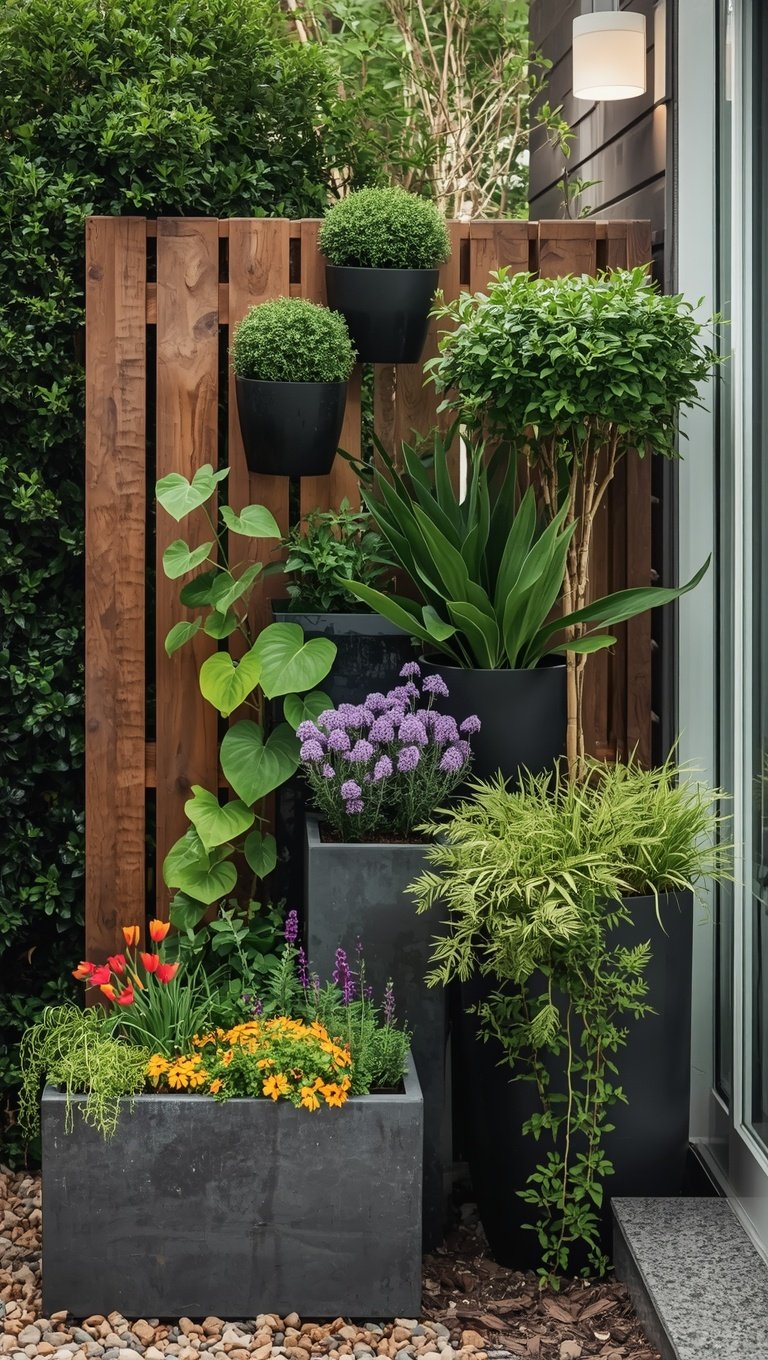
Then I added a simple vertical planter with pockets for herbs and trailing vines, and suddenly the whole yard felt taller, softer, more alive.
Vertical gardening is honestly the cheat code for small spaces.
You’re not losing an inch of floor space, but you’re gaining all this lush, layered greenery at eye level.
I love mixing textures up there, something feathery like ferns next to something structural like a snake plant.
If I had a narrow side yard, this is the very first thing I’d do.
A cute variation is a ladder shelf leaned against the wall instead of a mounted planter, it feels a little more cottage, a little less hardware store.
The emotional payoff is real too.
Green walls make a space feel enclosed and private, like a little hug, instead of exposed and bare.
My tip: start with plants that forgive you for forgetting to water them, because you will forget sometimes.
Pothos, spider plants, and creeping thyme are basically unkillable and they still look intentional and pretty.
Build One Tiny, Truly Cozy Seating Spot

You do not need a whole patio set.
You need one chair that makes you want to sit down.
When I redid my own backyard, I skipped the matching furniture set entirely and just bought one oversized outdoor chair with a deep cushion.
It sounds small but it changed how I used the space completely.
Before, I never went outside because there was nowhere that felt like mine.
After, I was out there every morning with coffee, just existing.
That’s the whole point of a sanctuary, it’s not about square footage, it’s about having a spot that pulls you in.
If your space is tiny, look for a single egg chair or a cozy loveseat instead of a full dining set.
Add a small side table just big enough for a mug and a book.
Layer in a throw blanket even if you think you won’t use it, because on that one chilly evening, you will.
And here’s the emotional part nobody talks about enough.
A single, well-loved seat says “this space matters” way louder than a full furniture set that never gets used.
Quality over quantity, always, especially outside.
Let String Lights Do the Emotional Heavy Lifting

I’m obsessed with what lighting does to a small space, genuinely obsessed.
During the day my backyard is fine, cute even.
But at night, with warm string lights zigzagged overhead, it turns into something that feels kind of magical.
There’s a psychological thing that happens with warm, low light.
It makes edges soften, makes a small space feel intimate instead of cramped.
I strung mine from the fence to a single hook on the house, nothing fancy, just a few dollars of hardware and an hour of my Saturday.
Solar-powered ones are great if you don’t want to deal with an outdoor outlet.
For something a little moodier, try little lanterns along the ground instead of overhead lights.
I do a mix now, string lights up high and a few flickering lanterns down low near the seating.
It creates this layered glow, almost like candlelight but safer.
My honest tip, buy warm white, not cool white.
Cool white light makes everything feel clinical, like a parking garage.
Warm light makes you feel like you’re being wrapped in something soft.
That’s the whole vibe we’re going for here.
Container Garden Everything, Even the “Big” Plants

I used to think you needed actual garden beds to grow anything worthwhile.
Turns out, pots can hold almost anything if you pick the right size.
I’ve grown tomatoes, dwarf citrus, and even a small hydrangea in containers on my patio.
The trick is choosing dwarf or patio varieties bred specifically for container life.
They still give you that lush, established look without needing roots to spread for miles.
I love grouping pots in odd numbers, like three or five, in varying heights.
It creates this natural, layered look instead of a flat row of identical planters.
Terracotta feels warm and classic to me, but if you want something more modern, matte black or sage green pots look really elevated.
A little hack I picked up, put your tallest plant in the back or center and let smaller trailing plants spill over the front edges.
It mimics the look of an actual garden bed, just contained.
Also, and I cannot stress this enough, drainage holes are non negotiable.
I lost a beautiful little lemon tree because I fell in love with a pot that had none.
Containers give you total flexibility too, you can rearrange your whole “garden” in an afternoon whenever the mood strikes.
Plant For Your Nose, Not Just Your Eyes

Nobody tells you to garden for scent and I think that’s a mistake.
The first time I planted jasmine near my back door, I didn’t expect much.
Then one evening I stepped outside and just stopped, because the whole air smelled sweet and a little dreamy.
That’s when I understood gardens aren’t only visual.
Scent is what makes a space feel like a memory instead of just a backdrop.
Lavender, jasmine, gardenia, and rosemary are some of my favorites for small yards.
They’re compact enough for pots or narrow beds, and they do double duty as pretty, textured plants even when they’re not blooming.
I like planting fragrant herbs like rosemary or mint right along a walking path.
Every time you brush past them, they release this little burst of scent, it feels almost accidental and lovely.
If you’re in a coastal or humid climate, gardenias are incredible but can be a little fussy about drainage.
Lavender, on the other hand, is basically drought proof and thrives on a little neglect.
My tip, plant your most fragrant things near where you actually sit or walk, not just wherever there’s empty space.
You want to smell it, not just admire it from across the yard.
Create Privacy Without Building a Fortress

Small backyards often come with the added joy of nosy neighbors or a direct sightline into someone’s kitchen window.
I dealt with this for two years before I finally did something about it.
Instead of a big, expensive privacy fence, I used a mix of tall potted bamboo and a simple lattice panel with climbing vines.
It’s softer looking than a solid wall and honestly more charming.
Within one growing season, the vines had filled in enough that I genuinely couldn’t see my neighbor’s window anymore, and they couldn’t see me sunbathing badly on a Tuesday.
Clumping bamboo in large containers is a favorite of mine because it grows fast but stays contained, unlike the running kind that takes over everything.
Star jasmine, clematis, and climbing hydrangea are gorgeous options if you want flowers along with your privacy screen.
A lattice panel is such an easy weekend project too, you can find them pre-made at most hardware stores.
The emotional shift here is bigger than people expect.
Once you’re not worried about being watched, you actually relax outside instead of tensing up every time you sit down.
Privacy isn’t just practical, it’s what lets a space feel like it’s truly yours.
Add the Sound of Water, Even in Miniature

I resisted this idea for so long because I assumed water features meant big koi ponds and complicated pumps.
Then I found a tiny tabletop fountain, the kind that’s barely bigger than a large bowl, and it changed the whole feeling of my patio.
There’s something about the sound of trickling water that instantly lowers my shoulders.
It also does this magic trick where it masks street noise or a neighbor’s loud TV, which makes the space feel more private and calm without you even realizing why.
You don’t need plumbing or an expensive installation for this.
Solar powered mini fountains exist now and they’re honestly kind of perfect for small spaces.
I put mine on a little side table near my seating chair, and it’s become my favorite sound in the whole house, not just the yard.
If you want something a bit more sculptural, a simple bubbling urn fountain looks elegant and takes up barely any floor space.
My tip, place it somewhere you’ll actually hear it from your seat, not tucked into a corner you never walk past.
The sound is the whole point, so don’t hide it away.
Even a small water feature signals to your brain, almost instantly, that you’ve entered a calmer space.
Choose Furniture That Works Twice As Hard

Small space living taught me that every single piece needs a job, sometimes two.
A storage bench was one of the best purchases I made for my backyard, it gives you a place to sit and a place to stash cushions, tools, or string light extras.
I also love a little folding bistro table that can tuck flat against the fence when you need the floor space back for something else.
Ottomans with hidden storage are another sneaky favorite of mine.
They double as extra seating when friends come over and then hide all your gardening gloves the rest of the time.
If you’re working with a truly tiny patio, look for furniture on wheels so you can rearrange easily depending on the day.
Sometimes I want an open, yoga-mat kind of space, other times I want it set up cozy for two.
Multi-functional furniture makes both of those moods possible without buying two separate setups.
A little personal note, I avoided buying “real” outdoor furniture for way too long because I thought I needed the perfect big set.
Turns out, one smart piece did more for my space than five mismatched ones ever could have.
Give Your Feet a Path, Even a Tiny One

This one surprised me the most.
I added a short, curved path of flat stepping stones through a patch of gravel, and it made my postage-stamp yard feel like an actual destination instead of just a patch of dirt outside the door.
Paths do something sneaky to your brain, they suggest movement, exploration, like there’s somewhere to go even if it’s only four steps away.
I used reclaimed stone because I liked the slightly worn, storied look, but pavers or even mulch paths work just as well.
Curving the path instead of making it a straight line is a little trick that makes a small space feel bigger than it is.
Straight lines show you the whole yard at once, but a curve hides part of it, so your mind imagines there’s more.
I lined mine with low creeping thyme, which releases a soft herby scent every time you step on it.
That tiny sensory detail makes the whole walk feel intentional, almost ceremonial, even though it’s a ten second stroll.
If budget is tight, even a simple gravel path bordered by bricks does the trick.
My honest advice, don’t skip this step just because your yard feels too small for “landscaping.”
A path is less about size and more about creating a sense of arrival.
Find Room For a Little Fire, Even a Small One

There’s something primal and comforting about a flame outside, I don’t think that ever goes away no matter how old you get.
I have a small tabletop fire bowl, the kind that runs on a little canister of gel fuel, and it’s become the centerpiece of every backyard evening I have.
You genuinely do not need a big built-in fire pit for this feeling.
A compact tabletop version gives you that same flicker, that same “gather around” energy, in a fraction of the space.
Friends come over and instinctively pull their chairs a little closer once it’s lit, every single time.
If you have slightly more room, a small steel fire bowl on a stand is another lovely option, and it still packs away easily when you’re not using it.
Always check your local rules on open flames before you commit to anything, some areas are strict about it.
My tip, keep a small tray or heat-safe mat under any fire feature, it protects your patio and gives the whole setup a more finished look.
The emotional pull of fire is honestly underrated in small space design.
It slows people down, it invites conversation, and it makes even a fifteen-minute hangout feel like an event.
Grow What You’ll Actually Cook With

My herb garden is probably my proudest small space win, and it started as an accident.
I planted basil, thyme, rosemary, and mint in a few pots by my back door mostly because I was tired of buying plastic-wrapped herbs at the store.
Now I genuinely can’t imagine cooking without stepping outside first.
There’s something so satisfying about snipping fresh basil for pasta thirty seconds before you eat it.
It makes cooking feel a little more special, a little more like something you’re doing with love instead of just checking off a to-do list.
Herbs are also perfect for small yards because most of them thrive in pots and don’t need much space to be productive.
Mint especially should always stay contained, it will happily take over an entire bed if you let it.
I keep mine in its own pot, slightly separated from the others, learned that one the hard way.
A cute variation is a little wooden crate herb garden right on your kitchen windowsill or back step, so it’s basically part of your kitchen.
My tip, plant what you actually cook with regularly, not what looks prettiest in photos.
You’ll use it more, and using it is honestly the whole joy of growing it.
Let the Seasons Show Up In Your Color Choices

I made the mistake early on of planting only spring flowers, and then wondering why my yard looked sad by August.
Now I think about color in waves, something blooming in nearly every season, so the space never feels static or forgotten.
In spring I lean into soft pastels, tulips and pale hyacinths mostly.
Summer gets bolder, warm terracotta zinnias and deep purple salvia that thrive in the heat.
By fall I swap in mums and ornamental kale, which sounds funny but honestly looks gorgeous in a pot.
Even winter gets a little love from me, evergreen branches and a few berry-covered stems tucked into containers near the door.
This kind of seasonal layering keeps the whole yard feeling cared for, like someone actually lives there and pays attention.
It also gives you little excuses to go outside and change things up throughout the year, which I didn’t expect to love as much as I do.
My tip, pick one or two “anchor” colors you love and let the seasonal blooms rotate around them.
For me it’s soft blush and sage green, no matter what’s blooming, those tones tie everything together.
It keeps a small space from feeling chaotic even as the plants themselves are constantly changing.
Add the Personal Touches That Make It Undeniably Yours

This is the part people skip, and it’s honestly the most important one.
Plants and furniture create the bones of a sanctuary, but the little personal details are what make it feel like a hug instead of a showroom.
I have this slightly chipped ceramic bird my grandmother gave me tucked between two planters, and it means more to me than anything I bought new.
A worn cushion in a pattern you love, a little wind chime that sounds just right, a small stack of stones you collected somewhere meaningful, these things matter more than people think.
I also love adding a piece of art outside, something weatherproof like a small metal sculpture or a ceramic piece tucked into the greenery.
It signals that this space was designed with the same care as the inside of your home, not treated like an afterthought.
Candles in hurricane glasses are another favorite of mine for evening ambiance, soft and a little romantic without trying too hard.
My honest tip, resist the urge to make everything match perfectly.
A little bit of imperfection, a little bit of “this doesn’t go with anything else but I love it,” is what makes a space feel like you instead of a catalog page.
Your sanctuary doesn’t need to impress anyone.
It just needs to feel like exhaling.