
My honey oak cabinets came with the house.
Warm, golden, slightly orange when the afternoon light hit them wrong.
For a long time I just worked around them, buying a rug here, painting a wall there, basically trying to distract people from noticing the cabinets at all.
Then I stopped fighting the wood and started pairing it with countertop surfaces that actually understood it — and the whole kitchen changed.
Not “renovated,” just right.
That’s what I’m going to walk you through.
Stick around, because the soapstone and concrete sections alone might make you rethink your whole plan, and the laminate section at the bottom is for anyone who thinks budget options can’t look good.
They absolutely can.

I’ve tried a lot of these combinations, made a few expensive mistakes, and done enough standing in tile showrooms holding cabinet door swatches to have real opinions.
What follows isn’t a list of things that technically work.
It’s the stuff I’d actually tell a friend who just bought a house with honey oak and texted me for help.
Granite First — Because It’s Still the Best Pairing and Here’s Why

I know granite feels like a 2005 answer.
I tried to talk myself out of it twice.
But honestly, it’s still one of the strongest pairings for honey oak, and the reason comes down to one thing: the flecking.
Granite slabs with warm undertones — golds, soft browns, a little rust — pick up exactly the same frequency as oak.
The wood doesn’t compete with the stone.
They just agree with each other.
Santa Cecilia and Venetian Gold are the two I keep recommending because they’re both warm without being matchy, which is the goal.
You want cohesion, not a costume.
Tan Brown is another one I love if your cabinets lean more orange.
The deep brown and garnet tones in that slab actually cool the oak down visually.
It sounds counterintuitive but it genuinely works.
Practically speaking, granite is one of the more forgiving materials if you actually cook.
I set a cast iron skillet directly on mine regularly (I’ve stopped apologizing for this).
No damage.
It needs sealing once or twice a year, which takes maybe 20 minutes and a $12 bottle of sealer from the hardware store.
That’s not a chore, that’s a Saturday afternoon.
Polished granite catches kitchen light in a way that feels alive.
If harsh overhead lighting is your nemesis (and it is mine — I will go to my grave hating overhead lighting), a honed granite finish cuts the glare significantly and reads as more modern.
My neighbor did honed Tan Brown with her oak cabinets and it looks like a magazine kitchen.
I’m still a little bitter about it.
Resale value-wise, granite still tests well with buyers.
If you’re planning to sell in the next few years, it’s a safe material choice that checks a box people are actively looking for.
Soapstone: The Dark Horse That Makes Honey Oak Look Intentional


I did not expect to love soapstone this much.
I saw it in a kitchen on a home tour a few years ago and just stood there longer than was probably polite.
There’s a softness to it that photographs genuinely can’t capture.
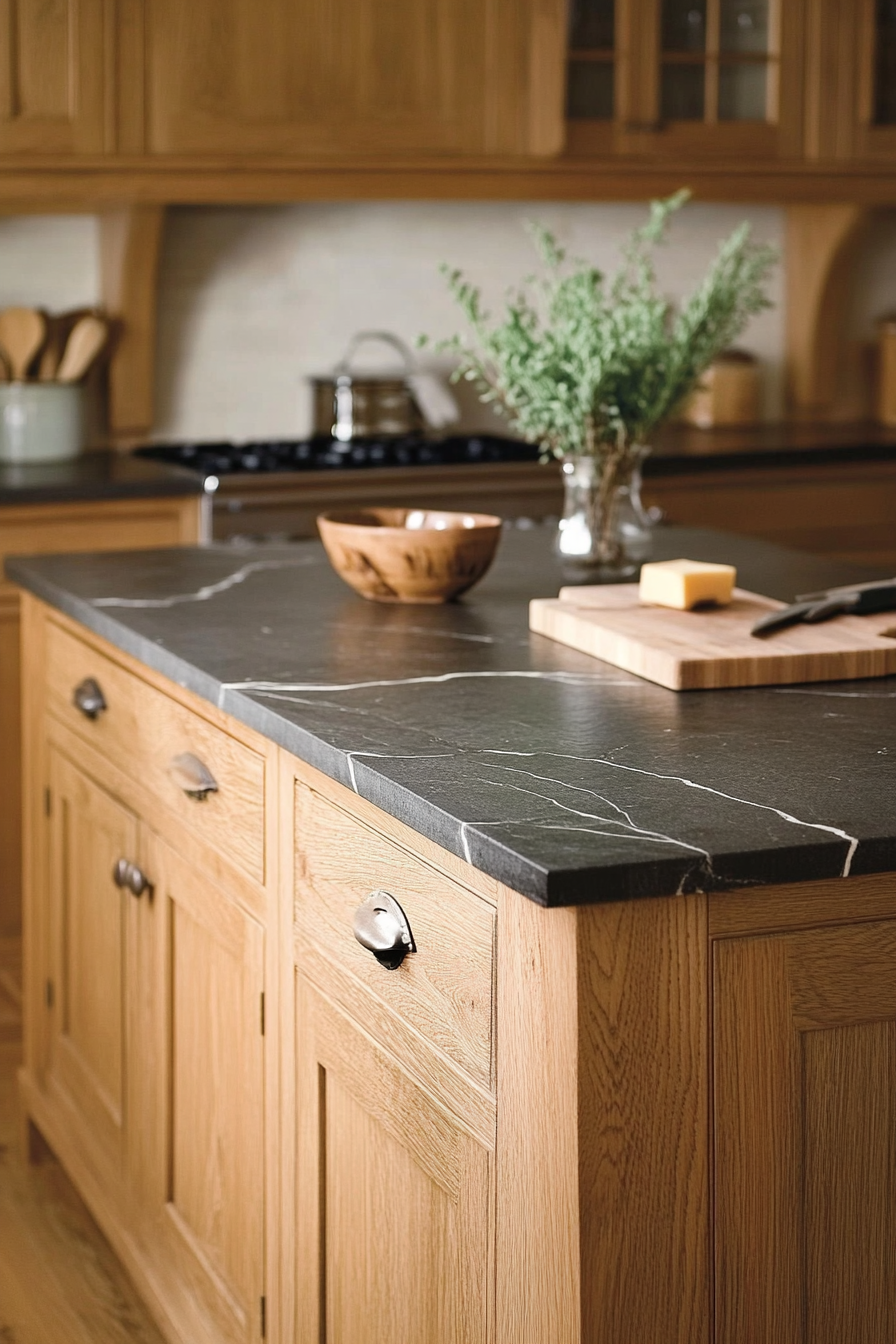
Soapstone is dense and dark, usually a charcoal or slate gray with hints of blue or green moving through it.
Against honey oak, that contrast is really something.
The cool, deep tones of the stone make the warm gold of the wood pop in a way that feels sophisticated rather than trendy.
Not a moment, a decision.
One thing I love about soapstone is that it ages.
Genuinely ages well.
It develops a patina over time that darkens slightly and becomes more beautiful the longer you have it.
You can rub mineral oil into it to accelerate that process or just let it happen naturally.
Either way, it’s a surface that looks better at ten years than it did on day one.
That’s the opposite of most things in a kitchen.
Heat resistance is excellent.
Hot pans go directly on soapstone without a trivet.
It doesn’t require the same sealing schedule as granite — mineral oil a couple of times a year is genuinely all it needs.
The honest drawback: soapstone scratches.
It’s softer than granite or quartz, and a sharp knife or a dropped utensil will mark it.
But here’s the part I find oddly charming: you can sand those marks out with fine-grit sandpaper.
I know a woman who sands her soapstone counters every six months as part of her kitchen refresh routine.
She says it takes 20 minutes and the surface looks brand new afterward.
That’s not a negative in my book.
That’s just maintenance with a satisfying ending.
For a Rustic Farmhouse Kitchen with honey oak, soapstone is probably my first recommendation overall.
It’s warm in feeling even though it’s cool in color.
It fits a kitchen that’s supposed to look lived-in and loved.
Concrete Countertops Are Way Warmer Than You’re Picturing

I know.
“Concrete” and “warm kitchen” feel like they don’t go together.
I thought the same thing until I saw a concrete countertop with honey oak in person and immediately wanted to tear my kitchen apart and start over.
Concrete is customizable in a way no other countertop material is.
You pick the color (pigments go in during mixing), you pick the finish, the texture, the edge profile.
If you want a warm tan that echoes your oak cabinet tones, you can get exactly that.
If you want a cool pale gray for contrast, that’s available too.
No other material gives you that range.
Earthy shades are the sweet spot with honey oak.
Warm beige, sand, or a light mushroom gray.
These tones settle in next to the wood rather than competing with it.
The matte surface of concrete also plays beautifully against the gloss of a stained oak cabinet door, giving you textural contrast that feels very deliberate.
You can get polished concrete if you want a subtle sheen that bounces more light around.
Or keep it matte for something that reads more artisan and handmade.
Both work.
I’d probably go matte with oak personally, but I lean toward that finish for everything and that’s a me thing.
Heat resistance is real.
Concrete handles hot pots without complaint.
Scratch resistance is solid.
It does need periodic sealing to prevent staining — acids and red wine will absolutely penetrate an unsealed surface — but a quality penetrating sealer applied once or twice a year handles that without much effort.
What makes concrete actually special, and not just “different,” is the handcrafted quality.
Every slab is custom poured and finished, which means subtle variations in texture and color that no two countertops share.
Tiny air bubbles.
Slight trowel marks.
Natural texture.
It has personality in the same way the wood grain in your oak cabinets has personality.
They come from the same visual world.
Concrete can also be molded into any shape, which matters if you have an unusual kitchen layout or want an integrated sink.
It’s one of the most flexible options for custom kitchens, and the flexibility doesn’t cost extra the way it would with stone.
Quartz: The Low-Maintenance Answer That Actually Delivers

Quartz was my second countertop (I replaced my first one after a regrettable laminate experiment I’ll get to shortly).
I went with a warm creamy white from Caesarstone and it was the right call for that kitchen.
Here’s what makes quartz work with honey oak specifically: the engineered consistency.
Because quartz doesn’t have the dramatic veining of marble or the heavy pattern of some granites, it gives the oak room to breathe.
The cabinets become the focal point.
The countertop just supports them without competing.
For honey oak, I’d steer toward warmer whites and creams rather than stark, cool whites.
Anything with a slightly yellow or beige undertone is going to feel cohesive.
Caesarstone Buttermilk, Cambria Torquay, Silestone Blanco Maple.
All of these lean warm without looking yellowed.
If you want contrast, soft gray quartz does something really interesting next to honey oak.
It cools the warmth just enough to feel intentional.
I’ve seen it in a few kitchens and it reads as designer-chosen, not accidental.
The practical case for quartz is hard to argue with.
No sealing.
Ever.
You wipe it down with dish soap and water and that’s genuinely it.
I have a dog named Biscuit who somehow sheds on every surface in my house including my countertops, and quartz wipes clean in about four seconds.
For anyone with kids, or pets, or just a life, that matters more than most specifications.
Quartz is non-porous, which means no bacteria working into the surface, no wine stains if you forget to wipe immediately, no coffee rings that need scrubbing.
I spilled an entire pot of tomato sauce on mine once and wiped it up the next morning with zero consequences.
Granite would’ve needed immediate attention.
Quartz just waited.
One honest caveat: quartz can look slightly artificial up close if you choose a pattern that’s trying too hard to mimic marble.
The vein repetition gives it away.
I’d go for more subtle, low-pattern options with oak cabinets anyway.
Keep the drama somewhere else in the room.
Butcher Block: The Wood-on-Wood Combo That Shouldn’t Work But Does


Wood on wood sounds like a mistake.
I was convinced it would just look like one big smear of brown.
I was wrong, and I admit that freely.
Butcher block with honey oak cabinets works because of contrast within the same material family.
You’re not matching the wood, you’re playing against it.
The goal is choosing a species and tone that’s either meaningfully darker or meaningfully lighter than your cabinets.
Either direction works.
Matching exactly is the thing to avoid — that’s where it goes wrong.
Walnut butcher block is a combination I’m genuinely obsessed with.
The deep, rich brown with the purplish undertones sits beautifully next to honey oak.
The contrast is significant enough that your eye reads it as a designed choice.
It feels warm, a little luxurious, and very kitchen-forward in the best way.
Maple goes the other direction.
Lighter, more subtle grain, almost blonde.
Against honey oak it brightens the space and feels Scandinavian in the best way.
If your kitchen is on the darker side or you want to add visual lightness, maple butcher block is a genuinely great call.
For everyday use, butcher block is kind to your knives.
Actual prep work feels good on wood in a way it doesn’t on stone.
If you bake, or chop a lot, or just like the tactile experience of cooking on a surface that feels natural, this material delivers that.
Maintenance is the part that gives some people pause.
Butcher block needs oiling.
Mineral oil or a food-safe cutting board oil, applied regularly at first and then a few times a year once it’s seasoned.
You also need to be thoughtful around the sink area — standing water is the enemy.
I’d recommend sealing the section near your sink with a waterproof finish and leaving the main prep area oiled for that food-safe surface (I learned the water damage thing the somewhat expensive way).
Scratches and small gouges?
Sand them out.
A light sanding with 120-grit followed by re-oiling and you’re back to looking new.
That restorable quality is something I find really reassuring in a kitchen that actually gets used hard.
Marble: The Most Beautiful Pairing — With Real Conditions Attached

Marble is the one I have complicated feelings about.
I love it.
I respect the maintenance reality of it.
And I think it’s genuinely one of the most beautiful pairings possible with honey oak — when you choose the right slab.
The cool white-and-gray veining of Carrara marble against warm honey oak is a classic that earns that description.
The contrast between cool stone and warm wood creates a visual tension that feels elegant without trying.
Calacatta, which has bolder and more dramatic veining than Carrara, makes more of a statement and works especially well if your cabinets are a more muted, less orange oak tone.
Emperador marble goes in a completely different direction.
Dark brown with gold veining, rich and almost jewel-like against honey oak.
If you want your kitchen to feel opulent rather than bright, this is the path.
The maintenance reality though: marble is porous and acid-sensitive.
Citrus, tomatoes, vinegar, wine, and coffee will all etch or stain an unsealed or under-maintained surface.
Sealing every 6-12 months is not optional.
Wiping spills immediately, especially anything acidic, is just part of owning marble.
If you cook adventurously and don’t love babysitting your surfaces, marble will genuinely stress you out.
Honed marble is more forgiving than polished for everyday kitchens.
It shows fewer etches, hides minor scratches better, and feels a little more casual while still being beautiful.
I’d choose honed for any kitchen that actually gets used.
Budget-wise, you’re looking at roughly $60-$150 per square foot installed.
If that’s more than your full kitchen allows, consider marble on the island only, or as a dedicated baking station.
The cool surface is genuinely ideal for pastry work, and even a small section of marble makes a kitchen feel special in a disproportionate way.
One thing I’d strongly recommend: bring your actual cabinet door to the stone yard.
Don’t rely on photos or small samples.
Full slabs read completely differently in person, and seeing your oak door against a full slab of marble in daylight is the only reliable way to know if the veining and undertones are actually going to work together.
I’ve seen people pick a slab from a photo and regret it.
Don’t be that person.
Stainless Steel: Sounds Wrong, Looks Right

Stainless steel with honey oak cabinets is one of those combinations that shouldn’t make sense and keeps looking great anyway.
I don’t fully understand the physics of it but I’ve seen it enough times to trust it.
The silver-cool of stainless against the warm gold of oak creates a contrast that reads as contemporary and intentional.
It’s the kitchen equivalent of mixing metals in jewelry.
Done confidently, it looks designed.
Done hesitantly, it looks accidental.
Going all in is the whole move here.
If you’re doing stainless countertops, go brushed finish over mirror polish.
Brushed is more forgiving of fingerprints (stainless and fingerprints have a complicated relationship), reads as softer and more residential, and ages better without looking dingy.
Mirror polish is stunning in photos and requires significantly more upkeep in a real kitchen.
Cost runs roughly $75-$150 per square foot installed for custom fabrication.
Not cheap.
But stainless is typically fabricated to exact specification, which means a completely seamless surface including integrated sinks.
That seamless quality looks extremely expensive and is a genuinely practical benefit for cleaning.
Maintenance is simpler than most people expect.
Soft cloth, mild cleanser, always wiping in the direction of the grain.
Bar Keepers Friend for any stubborn spots.
Don’t use steel wool.
That’s basically the whole rulebook.
Heat-proof, bacteria-resistant, and durable enough that professional kitchens use almost nothing else.
If you cook seriously, that’s not a small thing.
You can set a searing hot pan directly on the surface without a second thought.
Honest caveat: stainless scratches with regular use and develops a working patina over time.
Some people love this look.
Some people find it distressing.
Know which kind of person you are before committing.
There’s no fixing it once it’s in.
Reclaimed Wood: Warmth With a History Behind It

I have a thing for materials that come from somewhere.
Reclaimed wood countertops are the ultimate version of this.
Old barn siding, factory flooring, salvaged timber from a demolished building.
Each piece has nail holes, weathering, saw marks, and grain patterns that took decades to develop.
You genuinely cannot fake this quality.
With honey oak cabinets, the wood-on-wood consideration applies here too.
Go darker for contrast — walnut or cherry reclaimed wood sits beautifully next to honey oak.
Or go for different character within the same tone — a heavily weathered oak countertop next to a smooth-finished oak cabinet creates interesting texture without a color conflict.
The environmental case is real, not marketing language.
You’re giving existing material a second life.
For people who care about that, it’s a genuine benefit.
Sealing is non-negotiable with reclaimed wood in a kitchen.
Mineral oil alone isn’t sufficient for surfaces near a sink or in heavy prep areas.
Waterlox — a tung oil-based penetrating finish — is what I’d recommend.
It’s food-safe once cured, soaks into the wood rather than sitting on top, and provides serious water resistance.
Apply it properly at installation and recoat every year or two.
What reclaimed wood does that other materials genuinely can’t is warmth accumulation.
A kitchen with honey oak cabinets and reclaimed wood countertops feels like it’s always been there.
Not dated.
Rooted.
The way light catches on old grain and saw marks and nail scars — that’s not replicable with engineered materials at any price point.
Cost typically runs $60-$100 per square foot installed.
Genuinely rare or unusual reclaimed wood goes higher.
For an island accent or a dedicated baking section, even a smaller investment goes a long way aesthetically.
And live-edge options, where the natural tree edge is preserved on one side, are worth considering for an island.
It’s dramatic and completely unique to your kitchen.
Tile Countertops and Backsplash: More Current Than You Think


Tile countertops get dismissed as old-fashioned, and I understand why.
Old tile countertops with grout that hadn’t been cleaned since 1987 haunt a lot of people.
But tile done right — large-format porcelain in a muted, contemporary color — is a genuinely different conversation.
With honey oak, subway tile in cream or very light gray works well on the backsplash because it’s neutral enough to step back and let the cabinets breathe.
The classic 3×6 subway tile is fine.
But the larger format tiles, 4×12 or even 4×16, read as more updated and the reduced grout lines make a real visual difference.
Less grid, more slab.
Sage green tile is having a real moment right now and it pairs surprisingly well with honey oak.
The green pulls out the warm undertone in the wood without clashing.
I’ve seen it in a few kitchens recently and it feels fresh without being trendy in a way that’ll look silly in three years.
That’s a rare combination.
For countertop tile specifically, large-format porcelain is your best bet.
Durable, heat-resistant, and the reduced grout lines make cleaning much more reasonable.
The grout maintenance is the real enemy of tile countertops, and the less grout you have, the better your daily life is.
Grout color matters more than people realize.
Light grout shows staining and requires active maintenance.
Medium gray grout hides almost everything and still looks clean.
Epoxy grout resists staining better than cement grout and is worth the slight price premium in food prep areas — it’s not a marketing upgrade, it actually performs differently.
The backsplash is honestly where you can have the most fun in the whole kitchen.
Glass tile in blue or green tones behind honey oak cabinets does something really pretty — it pulls the warm yellow undertone in the wood toward something that feels coastal and bright.
Mosaic patterns let you bring in multiple colors that connect your cabinet and countertop choices without being too literal about it.
One thing I’ve learned the hard way: always bring tile samples home and hold them against your actual cabinet doors in your actual kitchen light before ordering.
Colors shift dramatically between a tile showroom and a home kitchen.
The 3pm sun that comes through my west-facing window makes certain tiles look completely different than they did in the store.
I’ve made this mistake.
It’s an annoying and avoidable one.
Laminate: Stop Sleeping on This (I Had To Change My Own Mind First)


I promised I’d tell you about the regrettable laminate experience.
The first time around, I bought cheap laminate in a color I can only describe as “cafeteria tan” and installed it myself in about four hours.
It looked exactly as bad as it sounds.
I was devastated.
And also the one who picked it, so.
That was not a laminate problem.
That was a color and quality problem.
Because current laminate is genuinely not what it used to be.
Wilsonart and Formica both make surfaces that mimic stone with high-resolution photography and textured finishes.
Some of their slate and concrete looks are almost impossible to identify as laminate unless you’re pressing your face against them.
And with honey oak cabinets, a slate gray or charcoal laminate creates a crisp, modern contrast that looks like an intentional design decision.
White laminate with subtle veining is another strong option.
It brightens the whole kitchen, lets the oak be the star, and gives you the marble-adjacent aesthetic without the marble price tag or the marble maintenance anxiety.
I’ve seen Formica’s White Calacatta in person and it photographs beautifully for something in this price range.
Pricing is the obvious draw.
You’re typically looking at $20-$50 per square foot installed, versus $50-$150 or more for natural stone.
On a full kitchen, that difference is real money.
Money that could go toward lighting, hardware, or honestly anything else that moves the needle more than the countertop brand name will.
No sealing required.
No special cleaners.
Mild soap and water and you’re done.
If you’re the kind of person (like me) who forgets to seal granite every six months and then catastrophizes about it quietly for two months, laminate removes that whole mental category entirely.
The edge profile matters more with laminate than with almost any other material.
A basic square edge can look budget.
A beveled edge, a rounded bullnose, or a built-up waterfall edge adds visual weight that makes the countertop look more substantial.
It’s not an expensive upgrade but it changes how premium the finished product reads by a surprising amount.
Matte finish over gloss.
Always.
The glossy laminate that was popular in the ’90s is what earned laminate its bad reputation.
Matte finishes hide minor scratches, read as more sophisticated, and photograph better.
Non-negotiable opinion on this one.
I will not be argued out of it.
Wood Laminate: The Budget-Smart Middle Ground Worth Knowing About

Wood laminate is different from standard laminate and it’s worth making that distinction clearly.
Where regular laminate mimics stone or solid colors, wood laminate mimics wood grain specifically through high-resolution printing and embossed texture.
The result, at least with the better manufacturers, is surprisingly convincing in person.
The reason this works with honey oak is tonal flexibility.
You can get wood laminate in a deeply dark mahogany tone that creates a rich contrast, or a very light blonde maple that brightens the space.
Either direction achieves something that random wood-matching doesn’t.
You’re working the contrast intentionally rather than hoping it works out.
Installation typically costs $25-$60 per square foot.
Most wood laminate countertops are also DIY-friendly, which brings that number down further if you’re handy.
I’ve done laminate installations myself and the post-form pieces — the ones with the backsplash and edge already integrated — are genuinely manageable for a capable DIYer with a circular saw and some patience.
Emphasis on the patience.
No sealing.
No oiling.
No conditioning.
You wipe it.
That’s the maintenance plan in its entirety.
The weak points are real though.
Wood laminate doesn’t tolerate heat well.
Don’t set a hot pan directly on it without a trivet unless you want a permanent reminder of that moment permanently pressed into your counter.
And around the sink area, moisture can work into any exposed edges and cause swelling over time.
Make sure edges are properly sealed during installation and keep standing water off the surface.
For eco-conscious renovators, some manufacturers now offer wood laminate with recycled core materials and low-VOC adhesives.
There are actual certifications to look for — CARB2 compliance is one — and it’s genuinely a more responsible option than it used to be.
One underrated asset: the consistent coloration of wood laminate actually works in your favor in kitchens where your oak cabinet color varies slightly between sections.
This happens more than people admit, especially in older kitchens or cabinets sourced from different lots at different times.
A uniform countertop tone ties the variation together and makes the whole kitchen read as more cohesive than it actually is.
That’s using the material strategically, and I’m very much in favor of that approach.