
I used to have this one corner in my living room that I just avoided.
It wasn’t big enough for a chair.
It wasn’t small enough to ignore.
And every single time I walked past it, I felt this tiny flicker of annoyance, like my room was silently judging me.
So I did what I always do when a space is bugging me — I stood in it, coffee in hand, and just stared for way too long.
That’s when it hit me.
The corner wasn’t the problem.
I was trying to fill it with furniture when what it actually needed was light.
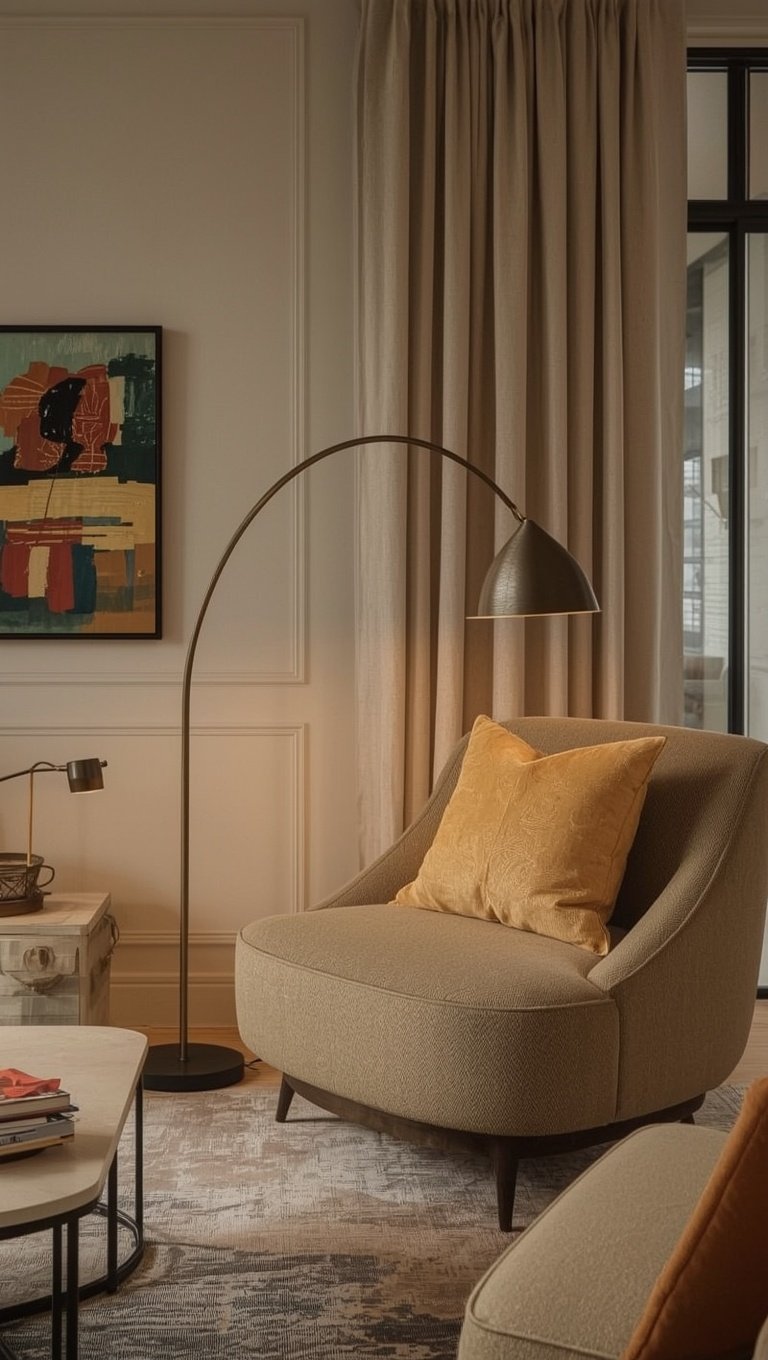
An arc floor lamp, the kind with that long, sweeping curved neck, ended up being the fix I didn’t know I was looking for.
It doesn’t need its own floor space the way a table lamp does.
It reaches over from a few feet away and just glows down into the corner like it belongs there.
If you’ve got a corner like that too, the one you kind of pretend isn’t there, I want to walk you through everything I’ve learned.
Why Arc Lamps Exist (And Why They’re Not Just A Trend)

Okay, so first, a tiny bit of context, because I think it helps.
Arc lamps aren’t new.
Designers have been using that curved silhouette for decades because it solves a very specific spatial problem.
A regular floor lamp needs its own patch of real estate.
It sits there, base and all, taking up square footage you might not have.
An arc lamp, though, works differently.
Its base sits back, often behind a sofa or a chair, and the arm swoops forward and down.
So the light lands exactly where you need it, without the lamp itself hogging the space.
That’s the whole trick.
It’s basically lighting that respects your floor plan instead of fighting it.
And once you see it that way, you start noticing how many awkward little zones in a home are crying out for exactly this.
The dead corner behind an armchair.
The gap beside a sofa that’s too narrow for a side table.
The nook by a window that gets amazing daylight but goes completely dark at night.
I’m kind of obsessed with how one lamp shape can quietly solve so many different layout headaches.
It’s not flashy.
It’s just smart.
And honestly, smart is my favorite kind of pretty.
My Own Awkward Corner Story
I mentioned my living room corner already, but let me back up a little.

That room used to be my guest room before I turned it into a proper living space last year.
The corner in question sat between two windows, at this weird diagonal angle that made every furniture arrangement feel off.
I tried a small bookshelf first.
It looked cramped and honestly kind of sad.
Then I tried a plant, a big one, hoping it would soften things.
It just made the corner feel busier, not better.
I sat with that half-finished feeling for months, which if you know me, is very unlike me.
I don’t love unfinished spaces.
They nag at me.
So one weekend I finally ordered an arc lamp on a whim, more out of desperation than confidence.
I set the base behind my reading chair, angled the arm toward the corner, and turned it on that first night.
And I actually gasped a little.
The light pooled low and warm right where the emptiness used to be.
Suddenly the corner had a job.
It wasn’t awkward anymore, it was atmospheric.
That’s the moment I became a believer.
How To Tell If Your Corner Needs This Fix

Not every corner needs an arc lamp, and I want to be honest about that.
But there are a few signs that tell me it’s a good candidate.
First, is the corner too small for real furniture, but too big to feel intentional as empty space?
That in-between size is the exact zone arc lamps were built for.
Second, does the corner sit near seating, like a sofa or an accent chair, without a natural spot for a side table?
That’s a strong yes for me.
Third, and this one’s sneaky, does the corner just feel dark and forgotten at night, even if it looks fine during the day?
Lighting can transform a space that furniture alone never could.
I always tell people, before you buy another piece of furniture for an awkward spot, try light first.
It’s reversible, it’s flexible, and it almost always makes the space feel more finished than an extra chair ever would.
If I had a small hallway corner or a reading nook that felt flat, this is genuinely the first thing I’d reach for.
It’s low commitment with a surprisingly big payoff.
Getting The Measurements Right
This part matters more than people expect, so let’s talk logistics for a second.

Arc lamps have a base, an upright pole, and then that curved arm reaching out and down.
You need to measure the full reach of the arm, not just the height of the lamp.
Most arc lamps extend anywhere from about twenty five to over seventy inches horizontally, depending on the design.
So measure from where you’d place the base to where you actually want the light to land.
Give yourself a little buffer too, because you don’t want the shade brushing against a wall or a curtain.
Ceiling height matters as well, especially in older homes with lower ceilings.
Some arc lamps stand close to eighty inches tall at their peak, which can feel massive in a cozy room.
I learned this one the hard way, actually.
My first apartment had these low, sloped ceilings, and I almost bought a dramatic seventy inch arc lamp before catching myself.
I sized down to a shorter, more compact arc style instead, and it fit the room so much better.
So please, grab a tape measure before you fall in love with a photo online.
It saves you from a lamp that dominates the room instead of complementing it.
Choosing A Base That Won’t Tip
Nobody warns you about this one enough, so I will.

Arc lamps are top heavy by design, since so much of the fixture extends outward from the base.
That means the base itself needs real weight to keep everything stable.
Marble bases are gorgeous and also genuinely functional here, because the density keeps the lamp grounded.
Weighted metal bases work well too, especially the wider, disc shaped ones.
I’d gently steer you away from anything with a slim, lightweight base if you’ve got kids or pets running around.
I have a cat who treats every tall object like a personal climbing challenge, so stability was non negotiable for me.
Before buying, I always check the base diameter and the listed weight if it’s available.
A base under ten pounds paired with a long reaching arm makes me nervous, honestly.
You want that heavier, grounded feeling, both for safety and because a sturdy base just looks more intentional in a room.
It reads as quality the second you see it.
And a wobbly lamp, no matter how pretty the shade is, will always feel a little cheap.
Weight is where the luxury feeling actually lives.
Picking A Finish That Feels Like You

This is the fun part, if we’re being honest.
Matte black arc lamps have this moody, editorial feeling that I love in a room with Warm Wood Tones.
Brushed brass or gold leans a little more glam, a little more old Hollywood.
Polished chrome feels crisp and modern, great in a space that’s already leaning minimal.
And then there’s the marble base combos, which honestly feel like a little piece of art on their own.
I tend to pick finishes based on what’s already happening with my hardware, my cabinet pulls, my faucet, little details like that.
Matching those finishes throughout a room creates this quiet sense of cohesion you feel before you can even name it.
In my own space, I went with a soft brushed brass because my other lighting had warm gold accents already.
It just felt like it belonged, like it had always been part of the room’s story.
My tip here is small but it matters.
Bring home a fabric swatch of your shade color if you can, or at least a close photo in your actual lighting.
Shade color affects the glow so much, and warm cream shades throw a completely different light than stark white ones.
Cream feels like candlelight.
White feels more clinical.
Choose based on the mood you’re chasing, not just what looks nice in a listing photo.
Where To Actually Place It

Placement is where the magic either happens or completely falls apart.
The base typically goes behind or beside your seating, tucked out of the main walking path.
The arm then swoops forward, positioning the shade above and slightly in front of where you sit or read.
For a sofa, I like the base sitting just behind one end, with the light landing over the opposite armrest.
For a single reading chair, center the light almost directly over your shoulder when you’re seated.
You want illumination on your book or your lap, not glare straight into your eyes.
I always test this by actually sitting in the chair while a partner or friend adjusts the lamp, if that’s possible for you.
If you’re doing it solo, sit down first, then walk around and eyeball where the shade would need to hang.
One mistake I made early on was placing the arm too far forward, so it hovered awkwardly into the middle of the room.
It looked like it was reaching for something instead of settling into the space.
Pull it back closer to the seating than feels natural at first.
It almost always looks better tucked in than stretched out.
Bulb Choice Changes Everything

I cannot say this one enough, so forgive the repetition throughout this post.
The bulb you choose will completely change how your arc lamp feels in the room.
Warm white, somewhere around twenty seven hundred kelvin, gives you that cozy, golden glow most living rooms want.
Cooler bulbs, closer to four thousand kelvin, feel more energizing, more like a workspace than a hangout spot.
For a corner meant to feel relaxing, I always go warm.
Dimmable bulbs are worth the tiny extra cost too, in my honest opinion.
Being able to lower the light for movie nights and raise it for reading makes one lamp feel like three different fixtures.
I use a soft warm bulb on a dimmer in my own arc lamp, and I switch the brightness depending on the hour, almost without thinking about it now.
Bulb shape matters a little too, since the arm often leaves the bulb somewhat visible depending on the shade style.
A pretty filament style bulb can actually become part of the look, especially with open or drum shades.
Don’t just grab whatever’s cheapest at the store.
This is a small swap that makes a genuinely big difference in how finished the whole corner feels.
Common Mistakes I See (And Made Myself)
Let’s talk about what not to do, because I’ve made a few of these mistakes myself.

Mistake one is buying based on looks alone, without checking the reach or the height against your actual room.
Mistake two is skimping on the base weight to save money, which almost always backfires.
Mistake three is choosing a stark white or blue toned bulb for a space meant to feel relaxed.
Mistake four is placing the lamp so the arm crosses right through a walking path, which becomes a real hazard fast.
Mistake five, and this one’s sneaky, is forgetting about the cord.
Arc lamps often need to plug in somewhere near the base, which might be further from an outlet than you’d expect.
I’ve genuinely seen people run cords across an entire room because they didn’t think this through first.
A cord cover or a nearby outlet extension solves it, but plan for it before delivery day, not after.
Mistake six is choosing a shade that’s too small for the scale of the arm.
A tiny shade on a long dramatic arm looks a little silly, kind of like a hat that doesn’t fit.
Balance the shade size to the overall scale of the piece, and the whole thing reads so much more intentional.
Budget Picks Versus Splurge Picks

I like having options at every price point, because not every corner needs a designer piece.
On the budget end, look for simple black or brushed nickel arc lamps with a basic marble looking resin base.
They still deliver that swooping silhouette and the functional light placement, just without the premium materials.
They’re a great starting point if you’re not sure arc lighting is even your thing yet.
On the splurge end, real marble bases and solid brass arms feel noticeably different in person, heavier, cooler to the touch, more substantial.
If lighting is a long term investment for you, the way it is for me, this is a category worth spending a little more in.
I personally believe lighting fixtures earn their keep for years, sometimes decades, so the cost per use ends up being tiny.
My honest advice is to start with a mid range option if you’re testing the waters.
Something with a metal base and a nice fabric shade, nothing too fancy, nothing too flimsy either.
Live with it for a season.
If you fall for the format the way I did, upgrading later feels like a treat rather than a necessity.
And if you don’t love it, you haven’t overspent on a lighting experiment.
Layering It With Your Other Lighting

An arc lamp should never be the only light source in a room, and I say this with love.
Good lighting design is about layers, not a single dramatic source doing all the work.
Think overhead lighting for general brightness, task lighting for specific activities, and accent lighting for mood.
Your arc lamp usually plays the accent or task role, depending on where you place it.
Pair it with a dimmable overhead fixture so you can bring the whole room up when you need full brightness, like cleaning or hosting.
Then let the arc lamp carry the evening glow on its own once things wind down.
I also love adding a small table lamp or candles somewhere else in the room, just to avoid one single glowing spot pulling all the attention.
Balanced light across a few different points always feels more intentional than one bright zone in an otherwise dark room.
In my own living room, I’ve got the arc lamp in that corner, a small lamp on my console table, and warm overhead can lights on a dimmer.
Each one gets used depending on the moment, the hour, my mood.
That layering is honestly the difference between a room that feels styled and one that feels merely furnished.
Small Space And Apartment Adjustments

If you’re working with a smaller space, a few tweaks make arc lamps even more useful.
Look for compact arc styles, sometimes labeled as mini arc lamps, with a shorter reach around twenty five to forty inches.
These give you that same swooping visual without overwhelming a petite room.
Renters, this one’s for you especially, since arc lamps require zero drilling or mounting.
You get designer style lighting placement without touching a single wall.
I lived in a tiny one bedroom for a few years, and an arc lamp was honestly one of my favorite lighting solutions during that stretch.
It let me light a reading corner without sacrificing floor space for a bulky side table.
When you’re tight on square footage, look for slim profile bases too, the kind that tuck close against furniture rather than sprawling out.
A narrow oval base can slide almost flush against a sofa leg, saving precious inches.
If storage is also tight, some arc lamps fold down or come apart for easier moving, which is worth checking if you know a move is coming.
I always recommend measuring your doorways too, since a long arm can be surprisingly awkward to maneuver through a narrow apartment hallway.
Small space living rewards flexible, multi purpose choices, and an arc lamp genuinely earns its spot in that category.
My Favorite Personal Hacks For Styling One
Okay, a few little extras I’ve picked up along the way that I want to pass along.

Okay, a few little extras I’ve picked up along the way that I want to pass along.
Add a small stack of books or a low side table beneath the arc, just to give your eye a resting point under all that height.
I do this in my own space, and it keeps the corner from feeling too tall or too empty at the base.
Tuck a plant near the lamp’s base, low and leafy, to soften the transition between the pole and the floor.
Use a smart bulb if you can, so you can adjust warmth and brightness from your phone without getting up.
I do this most nights, honestly, dimming the corner slowly as I wind down for bed.
If your shade is fabric, dust it gently every couple weeks with a soft brush attachment, since fabric shades collect dust faster than you’d think.
Rotate your lamp’s angle every few months too, just slightly, to keep the light pattern from feeling stale in the same spot forever.
And here’s a tiny one that surprised me, try placing a small mirror nearby on an adjacent wall.
It bounces the warm light around and makes the whole corner feel even more glowy in the evening.
Little touches like these are what take a functional fix and turn it into a corner you actually love looking at.
Related read: Things I Wish I Knew Before I Decorated My First Home — Instant PDF + Kindle download. Secure checkout by Stripe