
I used to sit on my rental couch and feel like I was just… camping in someone else’s beige box.
Nothing matched.
Nothing felt like mine.
And honestly, I think a lot of us feel that weird guilt about “decorating too much” when we don’t own the walls.
But here’s the thing I learned after three rentals and way too many trips to the hardware store: intentional doesn’t mean permanent.
It means every single piece in the room looks like you chose it, not like it was just… there.
So grab your coffee, because I’m walking you through the exact things I did in my own tiny living room to make it stop feeling temporary and start feeling like home.
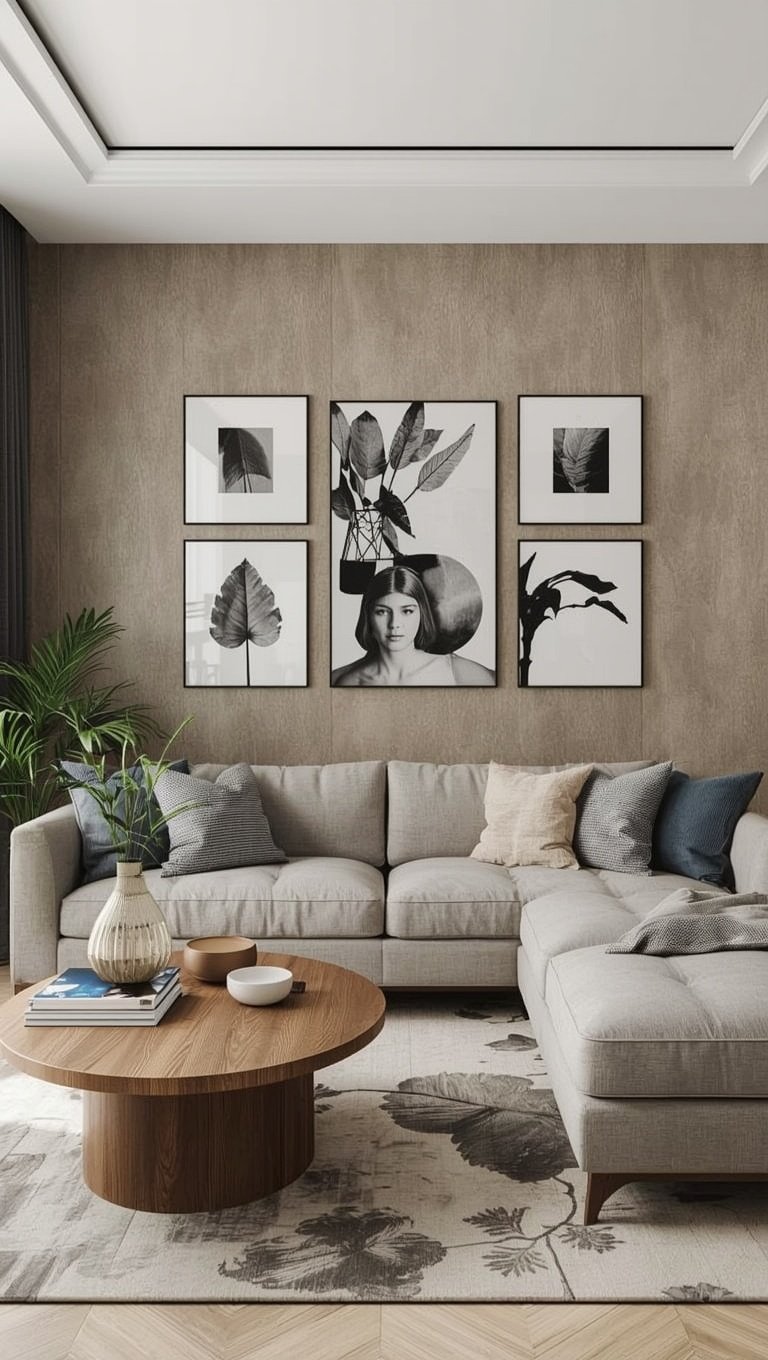
Choosing a Statement Rug to Anchor the Space

Okay, this is where I always start, no exceptions.
A rug is the one thing that instantly makes a rental room feel grounded.
Builder-grade carpet or that sad little strip of laminate flooring does nothing for the soul, I’m sorry.
When I moved into my first solo apartment, I threw a big vintage-style rug down on day one, before I even unpacked my kitchen boxes.
And the whole room just… clicked.
It didn’t match anything else yet, but it gave everything a reason to exist around it.
My tip: go bigger than you think you need, because a too-small rug is the fastest way to make a living room look like an afterthought.
I like layering a jute rug underneath a smaller patterned one for texture, but a single oversized rug works beautifully too.
Vintage-inspired or Persian-style patterns hide stains like a dream, which, real talk, matters when you’ve got a glass of red wine in your hand most evenings.
If your budget is tight, a washable printed rug can genuinely look expensive from a few feet away.
The emotional reason this works is simple: your eye needs somewhere soft to land, and a rug does that instantly.
Skip this step and everything else you buy will feel like it’s floating.
Layering Lighting Instead of Relying on the Overhead Fixture

Can we talk about how most rental overhead lights feel like an interrogation room?
Harsh, cold, and doing absolutely nothing for your skin tone or your mood.
The very first thing I do in a new place is turn that light off and never touch it again.
Instead, I bring in at least three other light sources.
A floor lamp in the corner, a table lamp by the couch, and maybe some plug-in sconces if I’m feeling fancy.
When I did this in my current apartment, my sister walked in and asked if I’d gotten new furniture, and I hadn’t touched a single piece.
It was just the light.
Warm bulbs are non-negotiable for me, anything labeled “soft white” or around 2700K.
Cool white bulbs make a cozy room feel like a dentist’s office, and I will die on this hill.
If you’re renting and can’t hardwire anything, plug-in sconces with adhesive hooks are a total game changer, and you can take them with you when you leave.
A little dimmer switch that plugs into the wall also lets you shift the whole vibe of the room depending on the time of day.
Lighting is honestly the cheapest, fastest way to make a space feel expensive, and it costs way less than people expect.
Curtains That Frame the Windows Properly

Landlord blinds are fine, I guess, but they are not the moment.
Hanging your own curtains changes the entire proportion of a room, and most people don’t realize how much.
The trick I always tell friends is to hang the rod as close to the ceiling as you can, way above the actual window frame.
It tricks the eye into thinking your ceilings are taller, which, in a lot of rentals, they desperately need.
When I did this in my old apartment with the low ceilings, the whole room suddenly felt like it could breathe.
I use tension rods so I never have to drill into the wall, and they hold up curtain panels just fine.
Linen curtains are my personal favorite because they let light filter through in this soft, hazy way that just feels calm.
If you want a cozier, more closed-off feeling in the evenings, a heavier blackout curtain layered behind a sheer one works beautifully.
Go floor length always, pooling slightly at the bottom if you can.
Curtains that stop awkwardly above the windowsill are one of my biggest pet peeves, sort of a decorating crime in my book.
The emotional payoff here is real: soft fabric moving in the breeze just makes a space feel lived in and loved.
It’s a small swap, but it might be the one that gets the most compliments.
Command Hooks and Removable Wallpaper for Personality

This is the hack that saved my sanity as a serial renter.
Blank white walls make me feel a little unhinged if I’m being honest.
Removable wallpaper on one accent wall completely transformed my last living room, and I got my full deposit back when I moved.
I went with a soft botanical print behind my couch, and it made the whole space feel like it had been designed on purpose.
Command strips are also your best friend for hanging anything heavier than a single frame.
I’ve hung mirrors, shelves, and even a small floating console using the heavy-duty ones, and nothing has ever fallen.
My tip is to always press the strips firmly for thirty seconds and let them cure for an hour before hanging anything.
If wallpaper feels like too much commitment, even a large piece of fabric stretched over a frame can give you that same punch of pattern.
Peel-and-stick tile can also transform a boring fireplace surround if you have one, and it’s a weekend project at most.
The reason this matters emotionally is that texture and pattern make a space feel curated instead of just furnished.
A plain wall says “I’m just passing through.”
A styled one says “I live here, and I love it.”
Furniture Arrangement That Creates Flow

I genuinely believe most rental living rooms are arranged wrong, and it’s not even really anyone’s fault.
We tend to push everything against the walls because that’s what feels safe in a small space.
But pulling your furniture in just a little, even six inches, creates this cozy, conversational feeling instead.
When I rearranged my own living room this way, it suddenly felt like a place people wanted to sit and stay, not just pass through.
Try floating your sofa slightly away from the wall if your room allows it.
Angle a chair instead of squaring it off, because a little asymmetry makes a room feel more relaxed and less like a showroom.
If your space is really tight, a small round side table can replace a bulky coffee table and open up walking paths.
I also like to create a soft boundary with the rug rather than furniture, so the seating area feels defined without feeling boxed in.
One personal hack: stand in your doorway and look at the room as if you’re a guest walking in for the first time.
You’ll notice things you’ve stopped seeing, like a lamp cord crossing the walking path or a chair blocking the natural flow.
Good flow is the difference between a room that feels effortless and one that feels like an obstacle course.
Mixing Textures with Throw Pillows and Blankets

I have a slight obsession with textures, and I’m not even sorry about it.
A room full of smooth, matching fabrics just feels flat to me, kind of like a furniture showroom.
My go-to combo is a chunky knit throw, a linen pillow, and something with a little shine, like velvet.
When I layered these on my thrifted couch last winter, it suddenly looked like it cost three times what I paid.
The trick is odd numbers, so three or five pillows instead of an even, matchy set.
Mix sizes too, because a big square pillow next to a smaller lumbar one creates visual interest instead of symmetry.
I like to keep a slightly rumpled, lived-in look rather than perfectly fluffed pillows, because honestly, who has time for that every single day.
A faux fur throw draped over the arm of a chair adds warmth you can practically feel just by looking at it.
Seasonal swaps are an easy win too, cozier textures in the winter and lighter linen ones in the summer.
This is one of the cheapest upgrades you can make, and it has one of the biggest visual payoffs.
Texture is what makes a room feel like you could sink into it, and that feeling is really what “cozy” actually means.
Choosing a Sofa That Feels Custom Without Commitment

The sofa is the piece everyone stresses over the most, and I get it, it’s usually the priciest item in the room.
But here’s my honest take: a slipcovered sofa is one of the smartest choices for a rental.
I bought a simple, budget-friendly sofa and then invested in a well-fitted slipcover, and it completely changes the vibe when I want it to.
Machine washable covers have saved me more times than I can count, especially with a dog who thinks the couch is hers.
If buying new isn’t in the cards right now, a secondhand frame with a fresh cover can look surprisingly high-end.
I found mine on a local marketplace app for almost nothing, and after a cover and some new legs, nobody would guess.
Speaking of legs, swapping the little wooden feet for a brass or black metal option is such an underrated trick.
It sounds tiny, but it changes the whole silhouette of the piece.
A low-profile sofa also tends to make small rooms feel more open, since it doesn’t block sightlines across the space.
My honest opinion is that a sofa should feel like it could move with you to your next place, not like it’s stuck to this one.
That mindset alone takes so much pressure off the decision.
Coffee Table Styling That Feels Curated Not Cluttered

I’ll be honest, I used to just throw a candle and a remote on my coffee table and call it done.
But styling it properly makes such a bigger difference than I expected.
My rule of thumb is one tray, one stack of books, and one organic element like a small plant or a bowl of dried florals.
The tray part is key, because it corrals everything so it looks intentional instead of scattered.
When I started doing this, my coffee table actually became a spot people commented on, which felt kind of silly but also really nice.
I like to pick books with interesting spine colors, since they add a little pop without trying too hard.
A stack of two or three, slightly offset, looks so much better than one lonely book lying flat.
Candles in a neutral vessel are a staple for me, both for the styling and for that soft flicker in the evening.
If you have kids or pets, a woven basket underneath the table is a lifesaver for hiding remotes and chargers fast.
Rotate a few small objects seasonally, like swapping dried florals for a little pumpkin in the fall.
It keeps the space feeling fresh without spending much money at all.
The goal is a table that looks like it happened naturally, even though every piece was chosen on purpose.
Bringing in Greenery for Life and Warmth

A living room without a single plant just feels a little sad to me, I can’t help it.
Plants add color, life, and honestly, they make a space smell and feel fresher too.
I am absolutely not a plant expert, and I’ve killed my fair share, so don’t worry if you’re in the same boat.
A pothos or a snake plant has never once let me down, even during my most neglectful months.
I like grouping plants in odd numbers at different heights, using a little wooden stool to elevate one and letting another trail off a shelf.
When I added a big leafy plant in the corner of my living room, it filled a dead space that never quite knew what to be.
If you’re worried about your track record with real plants, a high-quality faux plant can genuinely fool people from across the room now.
I mix a couple of realistic faux pieces with my real ones, and nobody has ever guessed which is which.
Terracotta and woven baskets as planters add another layer of that natural texture I’m always chasing.
The emotional reason greenery works so well is that it softens hard edges, like a bare corner or a plain window ledge.
It makes a rented space feel like something is actually growing there, which, in a weird way, makes it feel more like home.
Gallery Walls Without Damaging Walls

I used to think gallery walls were only for people who owned their homes, but that’s just not true anymore.
Command strip hanging kits designed specifically for frames have completely changed the game for renters like us.
I planned mine out on the floor first, moving frames around until the layout felt balanced, before a single strip touched the wall.
That step alone saved me from about four extra holes I definitely would have made otherwise.
Mixing frame sizes and a couple of finishes, like a black frame next to a natural wood one, keeps it from feeling too matchy.
I like including one or two things that aren’t photos at all, like a small mirror or a woven wall hanging, just to break it up.
When I finished my first gallery wall in my old apartment, I stood back and actually got a little emotional, which sounds dramatic, but it felt like proof I lived there.
My tip is to keep the spacing between frames consistent, somewhere around two to three inches, so the eye reads it as one cohesive piece.
Adhesive strips also mean you can rearrange things as often as you want without any commitment.
If you move out, most of these leave zero marks when removed slowly and correctly.
A gallery wall is honestly one of the most personal things you can add to a living room, because it’s literally your memories on display.
Hiding the Ugly Stuff (Cords, Thermostats, Radiators)

Every rental has that one ugly thing you didn’t choose and can’t remove.
Mine was an old radiator painted a weird beige color right under the window.
I found a simple wooden cover for it, and suddenly it looked like a built-in bench instead of an eyesore.
Cords are another huge one for me, because nothing kills a cozy vibe faster than a tangle of cables behind the TV stand.
I use a simple cord channel that sticks to the wall and paint it to match, and it basically disappears.
A cute little basket behind furniture can also hide a power strip and extra cords in about thirty seconds flat.
If you’ve got a boxy thermostat you can’t stand looking at, a small framed piece of art hung just slightly in front, on a hinge, can hide it completely.
Router blinking away on a shelf?
Toss it in a decorative box with a few holes drilled for airflow, and it becomes part of the decor instead of an interruption.
I know these feel like small, silly details, but they’re the things your eye catches even if you can’t name why a room feels off.
Fixing even two or three of these annoyances made my whole living room feel noticeably calmer.
It’s not glamorous work, but it’s some of the most satisfying.
Scent and Sound: The Sensory Layer

This one gets overlooked constantly, and it might be my favorite tip in this whole post.
A room isn’t just what you see, it’s what you feel and smell the second you walk in.
I keep a candle burning most evenings, something warm like amber or vanilla, and it instantly makes the space feel inviting.
When friends come over, the very first thing they mention half the time is how good the apartment smells, before they even comment on the decor.
A small diffuser works just as well if you’re not into open flames, and it’s honestly safer if you’ve got pets running around.
Sound matters too, and I don’t think we talk about it enough.
A little speaker playing something soft in the background changes the entire energy of a room the second you walk in the door.
I have a playlist I only play at home, and hearing the first song instantly puts me in a relaxed mode.
Even the sound of a small tabletop fountain, if that’s your thing, adds this subtle calming layer underneath everything else.
These sensory details are what make a space feel emotionally finished, even after all the visual work is done.
It’s the difference between a room that looks nice in photos and one that actually feels good to be in.
Small Furniture Swaps That Change Everything

Sometimes the biggest transformation comes from the tiniest change, and I mean that.
Swapping boring builder-grade cabinet knobs or drawer pulls, if your setup allows it, is such a sneaky good upgrade.
I did this with a cheap console table I already owned, and it suddenly looked like a totally different, much pricier piece.
Lamp shades are another one people skip over constantly.
A plain white shade from a big box store instantly looks more expensive with a linen or pleated shade swapped on top.
I did this to two lamps I already had for under thirty dollars total, and the difference honestly stunned me.
Even something as small as swapping a plastic outlet cover for a brass one near your entertainment console adds a tiny, unexpected detail people notice without knowing why.
I also like adding felt pads under furniture legs, partly to protect rental floors, but also because it lets me experiment with rearranging without any stress.
A vintage frame around a plain mirror is another favorite swap of mine, since it takes something generic and gives it a story.
None of these changes cost much, and none of them require a single conversation with your landlord.
But together, they’re often the difference between a room that looks rented and one that looks chosen, piece by piece, with a little bit of love.
Related read: Things I Wish I Knew Before I Decorated My First Home — Instant PDF + Kindle download. Secure checkout by Stripe