
I stepped on a tiny plastic dinosaur at eleven o’clock at night and I screamed.
Not a cute little yelp either, a full horror-movie scream that woke my husband up.
That was the night I decided our living room needed a serious toy storage glow-up, but I refused to turn our pretty space into a daycare center.
So I went on a mission.
And what I found changed everything, sort of like discovering you can have both a beautiful room and a functional one at the same time.
If you’re standing in your living room right now staring at a pile of stuffed animals wondering how it got this bad, I feel you.
I’ve been there.
I basically lived there for a solid year.
These are the ideas that actually worked for me, the ones that made guests ask where I bought my “decor” instead of realizing it was a toy bin in disguise.
The Ottoman That Doubles as a Toy Bin

This was my first purchase and honestly my gateway drug into blended storage.
I got a soft, oversized linen ottoman with a lift-off top.
It sits right in front of my sofa like any normal coffee table substitute.
But inside, it swallows an embarrassing number of stuffed animals and puzzle pieces.
I love that guests just see a cozy, neutral piece of furniture.
They have no idea it’s basically a toy vault.
My tip here is to go a size bigger than you think you need.
I underestimated mine at first and it filled up in about two weeks.
If you have a small living room, this is the very first thing I’d add.
It gives you a footrest, extra seating when people come over, and hidden storage all in one piece.
The emotional win is huge too, because clutter just disappears with one motion.
No sorting, no fuss.
You just lift, toss, and close.
An easy variation is choosing a woven rattan ottoman if your style leans more boho or coastal.
I’ve also seen tufted velvet ones that look downright luxurious.
Either way, the trick is picking a color that matches your existing furniture so it reads as intentional design, not a storage bin wearing a costume.
Baskets: My Ride-or-Die Storage Trick

Baskets are the unsung heroes of my whole system.
I have three sitting along the base of my bookshelf right now.
They’re chunky, textured, and honestly kind of beautiful on their own.
When my daughter was going through her building block phase, I tossed a basket right next to the couch and it saved my sanity.
Toys went in the basket instead of scattered across the rug.
It felt so simple but it genuinely worked.
I’m partial to seagrass or jute because the natural texture adds warmth to a room instead of feeling sterile.
A woven basket just feels like it belongs, even sitting in a formal-ish living room.
My favorite hack is layering a soft neutral throw over the top of a full basket.
It hides the mess completely and adds a cozy, lived-in texture at the same time.
If you want variation, try a few different basket sizes stacked or grouped together.
It creates this effortless, styled look instead of one giant bin.
The emotional reason this works so well is that baskets don’t scream “storage.”
They whisper “cozy home.”
And that distinction matters more than people think when you’re trying to keep a space feeling elevated.
A Console Table With Secret Storage

Behind my sofa sits a long console table, and it looks completely ordinary from the front.
But it has two cabinet doors on the bottom that hide an entire world of chaos.
When I tackled my own cluttered living room last fall, this piece became my secret weapon.
Board games, art supplies, even a bin of dress-up costumes all disappeared behind those doors.
I styled the top with a lamp, a little tray, and a stack of books, so visually it reads as a design piece.
Nobody walking in would guess what’s tucked inside.
My personal tip is to measure your bins before buying the console.
I learned the hard way that not every cabinet fits a standard storage bin, and I had to return mine once.
A great variation is a console with open shelving on top and closed doors below.
That way you get styling space and hidden storage in the same piece.
Why this works emotionally is simple.
You get to keep a piece of “grown-up” furniture in your living room while still solving a very kid-related problem.
It doesn’t feel like a compromise.
It feels like you found a loophole, and honestly, that feeling is kind of addictive once you start noticing pieces like this everywhere.
The Coffee Table Toy Chest Swap

I used to have a glass coffee table.
It was gorgeous and also a total liability once toddlers entered the picture.
So I swapped it for a wooden toy chest with a flat, sturdy lid instead.
It functions exactly like a coffee table now, holding coffee cups, remote controls, the whole thing.
But lift the lid and it’s an entirely different story underneath.
I chose a chest in a warm walnut tone so it still felt like real furniture, not a giant plastic bin with a lid slapped on.
This swap solved two problems at once for me, the toy chaos and the constant fear of shattered glass.
My tip is to add a soft cushion or tray on top so it still feels finished when it’s closed.
I toss a stack of coffee table books and a little candle on mine most days.
A fun variation is choosing a chest with woven front panels instead of solid wood, which softens the whole look.
The emotional payoff here is real, because coffee tables sit right in the center of your living room.
When that centerpiece works double duty, the whole room feels less cluttered by default.
It’s honestly one of the most satisfying swaps I’ve made in this whole process.
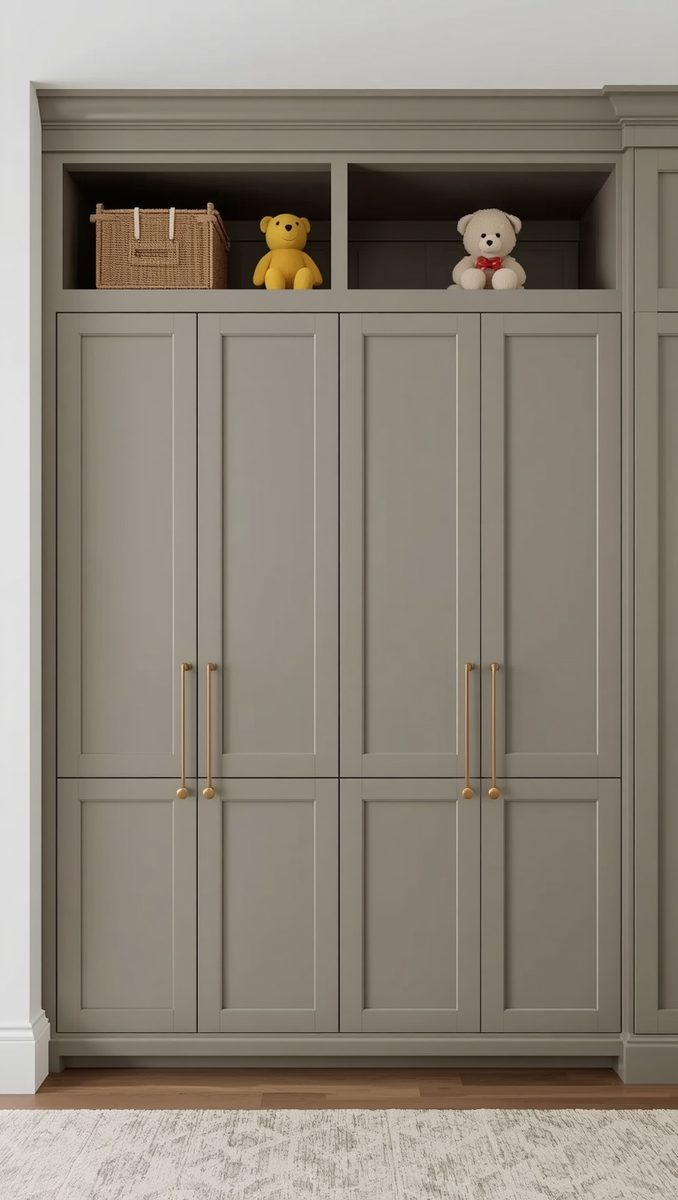
Built-In Cabinets With Doors That Just Close

If your living room has any kind of built-in shelving, this tip is for you.
I dedicated the bottom two cabinets of ours entirely to toys.
The open shelves above stayed for books, framed photos, and pretty little objects.
But the bottom, closed section became a total dumping ground in the best way.
I’m not kidding when I say it’s the single easiest system I’ve ever used.
Toys go in, doors close, done.
No baskets to arrange, no bins to match.
My tip is to use these lower cabinets specifically for the loud, plastic, colorful stuff that’s hardest to style around.
Save your open shelves for the pretty things.
A variation I love is adding a small chalkboard label or a cute tag to each cabinet door if you have multiple kids sharing the space.
It turns cleanup into a little game instead of a chore.
Why this works so well emotionally is that closed doors create instant visual calm.
Your eyes just skip right over them.
There’s something so soothing about a living room where the mess literally cannot be seen, even though you know it’s all still there, just a few feet away, patiently waiting to be dumped out again tomorrow.
Color-Coordinated Bins (My Sanity Saver)

I know, I know, this sounds like a small detail.
But hear me out because it changed everything for me.
I switched every single toy bin in our living room to the same neutral palette, cream, soft sage, and a warm terracotta.
No more mismatched primary-colored plastic bins fighting with my decor.
The toys are the same toys.
But visually, the room feels ten times calmer.
It’s such a small shift and honestly kind of a sneaky one.
My tip is to hit up storage sections that carry canvas or felt bins in neutral tones, they blend beautifully with almost any style.
I also label mine with simple fabric tags instead of anything plastic or bright.
A fun variation is picking one accent color instead of going fully neutral, so the bins tie into a specific accent pillow or throw you already own.
The emotional reason this one matters so much is that color creates visual noise, even when the amount of stuff hasn’t changed at all.
Swapping colors alone made my living room feel more put-together without me buying a single new piece of furniture.
It’s proof that sometimes the fix isn’t more organizing, it’s just better looking containers for the organizing you already did.
The Bench By the Window

We have a window seat area that used to just collect junk mail and random clutter.
I added a long storage bench with a cushioned top, and it completely transformed that corner.
Now it’s extra seating when we have people over, and underneath, it’s stuffed with board games and puzzles.
I topped it with a few throw pillows in colors that match my curtains.
Honestly, it looks like it was always meant to be there.
My tip is to measure your space carefully before buying, because a bench that’s even a few inches too long can throw off the whole flow of a room.
I learned that one the hard way too.
A cozy variation is adding a soft sheepskin throw over the cushion, it makes the whole nook feel extra inviting.
Kids actually want to sit there now instead of just dumping toys and running off.
The why behind this one is simple but powerful.
When storage doubles as seating, it earns its place in the room twice over.
It’s not just hiding clutter, it’s actively contributing to how the space functions and feels.
And there’s something so satisfying about a piece of furniture that pulls double duty without you even having to think about it.
Rotating Toy Bins – Out of Sight, Out of Mind

This one isn’t a furniture piece, it’s more of a system, but it belongs on this list.
I keep two identical bins, but only one lives in the living room at a time.
The other stays tucked away in a closet, fully loaded with a different set of toys.
Every couple of weeks, I swap them.
It sounds so simple, almost too simple, but the effect is real.
Fewer toys out at once means less visual clutter and, weirdly, my daughter plays with each toy more intentionally when it’s not buried in a giant pile.
My tip is to use matching bins for both sets so the swap feels seamless and doesn’t disrupt your styling.
I keep both in the same neutral canvas so nothing looks different when I switch them out.
A variation that works well is rotating seasonally instead of weekly, especially if you’re not up for swapping bins that often.
The emotional reason this trick works goes beyond just tidiness.
There’s a kind of freshness that comes with toys reappearing after a break, almost like new gifts.
It keeps the living room feeling lighter, and it keeps playtime feeling a little more special too.
A Cozy Reading Nook That Hides the Chaos

I carved out a small corner near our bookshelf and turned it into a reading nook.
A soft rug, a little floor cushion, a few picture books tucked into a low basket.
It became the designated “quiet corner” of our living room almost by accident.
And here’s the sneaky part, that basket of books absorbs so much of what would otherwise be scattered everywhere.
It’s storage that doesn’t even feel like storage, it feels like a cozy little world.
My tip is to keep this zone visually soft and low, with muted colors and natural textures, so it reads as a design feature rather than a kid zone.
I added a small string of warm fairy lights above ours and it instantly felt more intentional.
A variation I really love is adding a floor lamp with warm lighting to make the nook feel extra inviting in the evenings.
Why this works emotionally is that it gives toys, or in this case books, an actual home with a purpose.
Things that have a designated spot get put back far more often than things just floating around the room.
And there’s something so peaceful about walking past a corner that feels curated instead of chaotic.
Wall-Mounted Ledges for Books and Small Toys

Floating ledges were a total game for our awkward blank wall.
I installed three of them in slightly varied lengths, staggered at different heights.
Now they hold favorite picture books, a few small figurines, and some sentimental little toys that deserve to be seen instead of buried in a bin.
It freed up so much floor level clutter just by moving things vertically instead.
My tip is to rotate what’s displayed every so often, treating it almost like a tiny gallery wall.
It keeps things feeling fresh and gives your child a sense of ownership over what gets “shown off.”
I try to swap mine out every month or so.
A variation that looks beautiful is mixing in a few decor pieces, a small plant, a framed print, right alongside the toys.
It blurs the line between decor and storage in the best possible way.
The emotional payoff here is honestly about pride.
When a child’s favorite things are displayed nicely instead of shoved in a bin, it feels a little more special, a little more valued.
And for you, it means using vertical space you were probably wasting anyway, which always feels like a small win in a living room that’s already working hard.
The Five-Minute Reset Basket

This is less about furniture and more about a ritual, but it belongs here because it saved me.
I keep one soft, oversized basket by the couch specifically for the end-of-day reset.
Every evening before bed, everything gets swept into that one basket, no sorting required in the moment.
It’s not the “forever home” for the toys, it’s just a landing pad.
The next morning, or whenever I have five extra minutes, I sort it properly.
My tip is to make this basket big enough that a full sweep actually fits, because a too-small basket just creates a pile next to it instead.
I learned this one through trial and error, mostly error.
A cozy variation is choosing a basket with handles so you can carry the whole thing to another room in one trip if needed.
The why behind this trick is honestly about lowering the bar for yourself.
Some nights you don’t have the energy for a full, organized cleanup, and that’s okay.
Having one simple catch-all means the living room still looks calm at the end of the day, even if the real sorting happens later.
It’s a small mental relief that adds up more than you’d expect.
Textiles and Throws That Soften the Look

Sometimes the smallest details make the biggest difference, and textiles are one of my favorite sneaky tools.
A soft throw draped over a full basket, a cushion propped in front of an open bin, these little layers visually soften storage so it blends instead of stands out.
I do this constantly without even thinking about it anymore.
My tip is to keep your throws and pillows in the same tonal family as your bins and baskets.
It creates this cohesive, layered look instead of a hodgepodge of textures fighting each other.
I lean toward creams, warm neutrals, and the occasional dusty rose.
A fun variation is using a textured knit throw in the colder months and swapping to a lighter woven cotton one when it warms up.
It keeps the room feeling seasonal and fresh, and it gives you an easy excuse to refresh your styling twice a year.
The emotional reason this one matters is subtle but real.
Soft textures make a room feel warm and lived-in rather than sparse or overly staged.
And in a home with kids, that lived-in warmth is exactly the vibe you want, cozy and welcoming, not a showroom that feels off-limits to actually enjoy.
Seasonal Toy Rotation – My Secret Weapon

This is the big one, the tip I recommend to literally everyone who asks me about toy clutter.
A few times a year, I go through everything in the living room and pack away toys that haven’t been touched in weeks.
They go into labeled bins in a closet, completely out of the living space.
Months later, when they reappear, it’s like Christmas morning all over again.
My tip is to be honest with yourself during this process, if a toy hasn’t been touched in a month, it probably won’t be missed if it disappears for a while.
I used to feel guilty doing this, but now I see it as an act of care for the room and for my own peace of mind.
A variation that works well is rotating by category instead of randomly, swapping out all the building toys one season and all the pretend-play toys the next.
It keeps things feeling organized even in storage.
The emotional core of this tip is really about abundance versus overwhelm.
A living room with fewer toys out doesn’t mean less play, it usually means more focused, more joyful play.
And a lighter room means a lighter feeling every single time you walk into it, which honestly might be my favorite part of this whole system.
Related read: The IKEA Kallax Bible — Instant PDF + Kindle download. Secure checkout by Stripe