I used to think my front porch just had bad bones.
Like it was missing some architectural feature I couldn’t afford.
Turns out it was missing height.
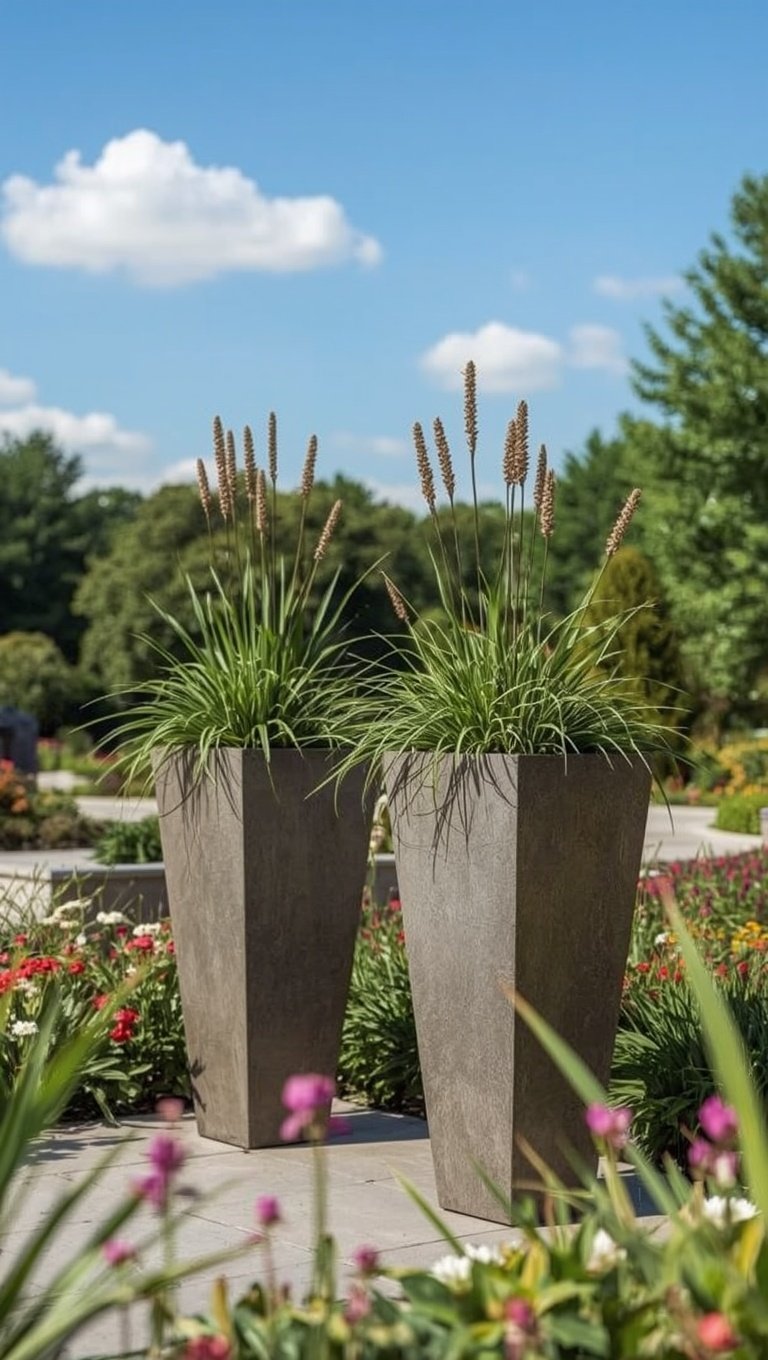
The second I swapped my squatty little pots for two tall planters by the door, my husband walked up the driveway and said “whoa, did you redo the porch?”
I didn’t.
I just made it taller.
That’s the whole secret, you guys, and once you see it you can’t unsee it.
So grab your coffee, because I’m walking you through every single thing I’ve learned about tall outdoor planters.
The good, the “why didn’t I do this sooner,” all of it.
Why Height Changes Everything

Here’s the thing nobody tells you about small spaces.
It’s not that they’re small.
It’s that everything in them is the same height.
When every pot on your porch sits at knee level, your eye has nowhere to travel.
It just flatlines.
But the moment you add a tall planter, even just one, your eye starts climbing.
Up toward the door, up toward the porch light, up toward the whole facade of your home.
That’s why designer porches feel so dramatic even when the flowers are simple.
It’s not the blooms doing the heavy lifting.
It’s the verticals.
I learned this the hard way after years of buying “one more cute little pot” from the garden center.
My porch looked busy, not pretty.
So I donated half my collection and invested in two good tall ones instead.
And honestly, less really was more.
If you only do one thing from this whole post, let it be this.
Add height before you add anything else.
It’s the cheapest design trick in the whole gardening world, and it works every single time.
Picking the Right Material for Your Climate

Okay, real talk about materials, because this part trips people up.
Terracotta is gorgeous, but it cracks in a hard freeze.
I lost two beautiful terracotta planters my second winter here and I still think about them.
Fiberglass is my go-to now, and I’m kind of obsessed with it.
It’s lightweight, it doesn’t crack, and it comes in those deep matte finishes that look like stone but weigh nothing.
Concrete planters are stunning too, moody and substantial, but be ready to recruit a strong friend to move them.
Resin is the budget-friendly option and honestly some of it looks shockingly good now.
If you’re in a freeze-thaw climate like mine, skip anything ceramic unless you’re bringing it in for winter.
And if you’re somewhere warm and dry, terracotta will reward you with that gorgeous weathered patina over time.
My tip, always check the drainage hole situation before you buy.
So many beautiful planters come with one tiny hole that just isn’t enough.
I drill extra holes myself with a masonry bit, it takes five minutes.
Your roots will thank you, I promise.
Choosing Plants With Real Drama

A tall planter deserves a plant with personality.
This is not the place for a shy little petunia.
I want something that spills, something that spikes, something that makes a statement.
My favorite formula is thriller, filler, spiller, and I use it every single year.
The thriller goes in the center, something tall and architectural like a dracaena spike or a small ornamental grass.
The filler fluffs around it, think trailing verbena or sweet potato vine.
And the spiller cascades over the edge like it’s trying to escape, which honestly is the whole point.
When I did this on my own front steps last spring, neighbors started stopping to ask what it was.
It wasn’t anything rare.
It was just height plus movement plus a little bit of chaos, in the best way.
For shadier spots, ferns and caladiums do the same dramatic job.
Don’t be afraid to let things get a little wild and overgrown by midsummer.
That lush, slightly untamed look is so much warmer than anything clipped and perfect.
Cozy beats manicured, every single time, in my book.
Styling a Front Entry That Stops People in Their Tracks

Your front door is basically a stage.
And tall planters are the best supporting actors you could ask for.
I always recommend a pair, one on each side of the door, for instant symmetry.
There’s something so grounding about that mirrored look, it just feels intentional.
If your porch is narrow, go with slimmer cylinder shapes so you’re not blocking the path.
Wider porches can handle those big bellied urn shapes, the ones that feel a little Mediterranean.
When I redid my own entry, I matched the planter color to my door instead of my house.
That one decision tied the whole look together in a way I didn’t expect.
It’s a small trick but it reads as so polished.
Add a low layer too, like a seasonal wreath or a doormat with texture.
The contrast between the tall planters and that low layer is what makes the whole entry feel curated.
Lighting matters here too, even a simple solar stake tucked behind the planter adds glow at night.
I’ll be honest, this is the corner of my house I’m proudest of.
It cost less than people assume and it photographs like a magazine page.
Clustering Planters of Different Heights

One tall planter is good.
A trio at staggered heights is where the magic really happens.
I think of it almost like flower arranging, but with the pots themselves.
Tall in the back, medium in the middle, short tumbling in front.
It creates this little visual staircase that your eye just wants to follow.
When I did this along my side gate last summer, it transformed a totally dead corner into the spot guests actually compliment.
You don’t need three different planters either, you can fake the height with a sturdy upside down crate underneath a shorter pot.
Nobody will ever know, I promise you.
Odd numbers work best, so go with three or five rather than two or four.
It just feels more natural, less like a matched set from a catalog.
Mix your textures too, a smooth fiberglass next to something more rustic and woven looking.
That contrast is what keeps a cluster from feeling stiff.
If I had a tight little side yard right now, this is exactly where I’d start.
It’s such a small footprint for such a big visual payoff.
Coordinating Color With Your Home’s Exterior

This is the step people skip, and it shows.
Your planter color should talk to your house, not compete with it.
If your siding is a warm white, a charcoal or matte black planter adds the prettiest contrast.
If your home leans more neutral and beige, I love a deep terracotta or sage tone instead.
When I painted my own front door a soft clay color, I picked planters in a creamy off white to balance it out.
It felt cohesive instead of matchy, which is exactly the vibe I wanted.
A little trick I use, I take a paint chip from my exterior straight to the garden center.
It sounds extra but it saves you from a color regret purchase.
And trust me, an off planter color is so noticeable once you see it.
Metallics are having a moment too, a soft brushed bronze planter looks incredible against greenery.
So if you’re feeling a little bold, that’s a fun place to experiment.
Just keep your plant colors a touch more muted if your planter itself is a statement piece.
Let one element lead, and let the other one support it quietly.
Budget-Friendly DIY Tall Planter Hacks

Tall planters can get pricey, I won’t pretend otherwise.
But here’s my favorite secret, you don’t need to fill them with soil all the way up.
I fill the bottom third with empty plastic nursery pots turned upside down, or even crushed cans.
It saves so much potting soil and the planter is still plenty stable.
For an even cheaper option, I’ve turned old wine barrels into tall planters by stacking one on a sturdy plant stand.
It’s rustic, it’s charming, and it costs almost nothing if you already have the barrel.
Thrift stores and reuse stores are secretly goldmines for tall ceramic vases too.
I found a gorgeous floor vase for eight dollars once and drilled a drainage hole myself.
It’s been holding a fiddle leaf fig look alike on my patio for two summers now.
Another hack, large concrete drain pipes from the hardware store make incredibly chic modern planters.
Just have them cut to your desired height and seal the inside.
It sounds kind of unconventional, but it photographs like a designer piece.
My honest advice, spend your money on one or two really good planters instead of five mediocre ones.
It always reads as more intentional that way.
Drainage and Weatherproofing You Actually Need

Nobody wants to talk about drainage, I get it, it’s not glamorous.
But it is the difference between a planter that thrives and one that rots out by July.
Always elevate your planter slightly off the ground with little pot feet or even flat stones.
This lets water escape instead of pooling underneath and staining your porch.
Add a layer of gravel or broken pottery at the bottom before your soil goes in.
It keeps the drainage hole from clogging with compacted dirt over time.
If you’re in a freezing climate, empty ceramic and ferrous planters before the first hard freeze.
Trapped moisture expands when it freezes and that’s exactly what cracks them.
Fiberglass and resin can typically stay out year round, which is honestly half of why I love them.
For wood planters, a simple exterior sealant once a year keeps rot from creeping in.
I do this every spring as part of my little garden refresh ritual.
It takes maybe twenty minutes per planter and saves you from replacing them early.
A little maintenance now is so much easier than starting over later.
Trust me, I’ve learned this one the expensive way.
Using Tall Planters for Privacy

This might be my favorite use for tall planters, honestly.
A row of them can do the job of a fence without any of the permits.
I lined three tall planters along my patio edge facing the neighbor’s side yard.
Filled them with tall ornamental grasses and ahh, instant privacy and it sways so beautifully in the wind.
It’s soft, it’s green, and it never feels like a barrier the way a fence sometimes can.
Bamboo in a planter is another favorite for fast, dramatic height.
Just keep it contained in the pot, because bamboo roots are notoriously sneaky in open ground.
Arborvitae works beautifully too if you want something more structured and evergreen.
For a patio table that feels a little too exposed, two tall planters flanking it changes everything.
Suddenly it feels like its own little room instead of an open platform.
This is the upgrade I’d recommend to anyone who loves their outdoor space but feels watched while using it.
It’s such a simple fix for something that actually affects how relaxed you feel out there.
And unlike a fence, you can rearrange it whenever the mood strikes.
Lighting Your Tall Planters at Night

Daytime curb appeal is one thing, but nighttime is where the magic really lives.
A tall planter without light just disappears the second the sun goes down.
I tuck a simple uplight at the base of mine, angled up through the foliage.
The shadows it throws against my siding are honestly one of my favorite things about my whole porch.
Solar stakes are the easiest no-fuss option, just push them into the soil and forget about them.
For something a little more elevated, warm white string lights woven through the plant itself feels so cozy at dusk.
I do this every fall and it makes my porch feel like it’s glowing from within.
Avoid cool blue toned bulbs if you want that warm, inviting feeling.
Warm light is what makes a space feel like a hug instead of a parking lot.
If your planters flank your front door, matching lanterns on either side ties the whole look together beautifully.
This is such a small investment for how much evening ambiance it creates.
Honestly, some of my favorite porch moments happen after dark now, just sitting there enjoying the glow.
Seasonal Swaps That Keep Things Fresh

Your tall planters shouldn’t look the same in July and December.
That’s the trick that keeps a porch feeling alive instead of stagnant.
In spring, I go soft, pastel tulips or ranunculus with a trailing ivy spilling over the edge.
Summer calls for drama, tall grasses, bold tropical leaves, anything that can handle the heat.
Come fall, I swap in ornamental kale, mums, and dried wheat stems for that cozy harvest feel.
And in winter, evergreen clippings, magnolia branches, and a few twinkle lights carry the planter through the cold months.
The structure of the planter stays the same, only the contents change with the seasons.
This is honestly one of my favorite little rituals throughout the year.
I treat it almost like decorating, except outside.
My tip, keep a small notebook of what worked each season so you’re not guessing next year.
I wish I’d started that years ago, it would’ve saved me so much trial and error.
Switching things up seasonally also means your planters never get that tired, overgrown look.
There’s always something new growing in, and that feels so satisfying to walk past every day.
Placement, Balance, and the Symmetry Rule

Where you actually put your tall planters matters just as much as what’s in them.
Symmetry feels formal and calm, which is why it works so well by front doors.
Asymmetry feels relaxed and a little more romantic, which I love for side gardens and patios.
My rule of thumb, formal entries get matched pairs, casual spaces get an odd, staggered grouping.
I made the mistake once of putting a single tall planter dead center on my patio.
It looked like it was floating there, totally disconnected from everything else.
Moving it to one corner and adding a shorter planter beside it fixed the whole feeling instantly.
Anchor points matter too, think about what’s near a doorway, a step, a corner where two walls meet.
Tall planters love those transition points, they help define where one space ends and another begins.
If you’re staring at a planter and something feels slightly off, it’s usually placement, not the planter itself.
Walk away, come back in ten minutes, and look again with fresh eyes.
You’ll usually see immediately what needs to shift.
My Favorite Combos and Final Little Hacks


Okay, here are the combos I keep coming back to, because they just never fail me.
Black matte fiberglass planter with white trailing petunias, it’s so crisp and it goes with literally any house color.
Aged terracotta with rosemary and trailing nasturtium, it smells incredible every time you walk past.
Concrete planter with a single sculptural agave, so minimal and so chic for a modern facade.
My biggest hack of all, buy your planters one size bigger than you think you need.
A too small planter dries out constantly and stresses your plants, I learned this the hard way more than once.
Bigger pots hold moisture longer and honestly look more substantial from the curb too.
Another tip, water tall planters at the soil line, not overhead, so you’re not wasting water on leaves.
And don’t be afraid to let one planter be the star while the others play backup.
Not everything needs to be in full bloom at once, some quiet greenery in between is what makes the colorful pieces pop.
This is the kind of project that costs an afternoon and pays you back every single time you pull into your driveway.