
I almost gave up on my front porch garden after my third summer of watching plants wilt by July.
Everything looked so promising in May.
And then the heat hit — that relentless, midday, full-sun kind of heat — and my containers turned into little terracotta ovens.
It wasn’t until I stopped choosing plants I loved the look of and started choosing plants that loved my conditions that everything changed.
My porch finally looked like something out of a garden magazine.
Lush, colorful, alive — all summer long.
So if you’ve been fighting your sun-drenched patio or balcony every season, I want to share exactly what worked for me.
Start With the Right Container — It Changes Everything

I used to think a pot was just a pot.
Honestly, I grabbed whatever was cute at the garden center without thinking twice.
But when you’re dealing with full sun all day long, your container choice is sort of the foundation of everything else.
Dark-colored pots — those deep blacks and rich navies that look so gorgeous — absorb heat like crazy.
And that heat transfers straight to the roots.
I switched to light-colored containers, terracotta with a whitewash finish, or thick resin pots that insulate better, and my plants stopped stress-wilting by noon.
If I had a small sunny balcony to redo right now, the very first thing I’d splurge on is a set of pale, wide-mouthed planters — wider than you think you need.
Wider containers hold more soil, which means more moisture retention, which means happier plants during those brutal August afternoons.
And honestly?
They just look more lush and intentional.
A deep container also gives roots room to breathe downward instead of cooking near the surface.
My personal tip: go at least 12 inches deep for flowering annuals, and 16+ for anything with a woody stem or substantial root system.
Lantana Is the Sun-Loving Hero You Didn’t Know You Needed

Let me just say it plainly — lantana changed my summer container game completely.
It’s tough, it’s colorful, and full sun is basically its love language.
I planted a trio of multicolor lantana in a large urn on my south-facing porch steps, and those things bloomed from late spring straight through the first frost without complaint.
The flowers shift from yellow to orange to pink as they age, which means the same plant looks different week to week.
It’s like getting multiple plants in one, which I’m very much here for.
Butterflies are obsessed with it too, which adds this whole magical, living-garden energy I didn’t expect.
Lantana is also incredibly drought-tolerant once established, which is a huge deal in full sun containers that dry out so fast.
My hack?
I water deeply every morning rather than a little bit twice a day.
That trains the roots to go down deep into the soil where it stays cooler and more consistently moist.
If you tend to forget watering (zero judgment, I’ve been there), lantana is genuinely one of the most forgiving full-sun plants you can grow in a container.
Portulaca Is My Secret Weapon for Tiny Pots

Okay, portulaca doesn’t always get the attention it deserves, and I want to change that.
It’s sometimes called moss rose, and it is stunning in small to medium containers where other plants just cook and give up.
The blooms are jewel-toned — hot pink, coral, yellow, white — and they open up in full sun and close at night, which is just the most charming little thing.
I tucked portulaca into some smaller terracotta pots lining my garden wall, and they looked absolutely dreamy all season with almost zero fuss.
And I mean almost zero.
These plants genuinely thrive on neglect in hot, sunny spots.
They want well-draining soil, strong sun, and occasional watering.
That’s it.
I actually planted them in a gritty cactus mix blended with regular potting soil because they hate soggy roots more than anything.
If I had a sunny windowsill or a hot apartment balcony with very little square footage, I’d fill every small container I owned with portulaca in mixed colors.
The low-water requirement alone makes them perfect for busy summers when you’re traveling or just, you know, living your life.
The “Thriller, Filler, Spiller” Formula Actually Works

I resisted this classic container gardening formula for years because it sounded so basic.
And then I finally tried it, and now I can’t stop.
The idea is simple: one tall dramatic “thriller” plant in the center, bushy “filler” plants around it, and trailing “spiller” plants that cascade over the edge.
For full sun containers specifically, my go-to thriller is a purple fountain grass — that deep burgundy color is so rich and it sways beautifully in summer breeze.
For filler, I love a mix of zinnias and marigolds because they’re cheerful, heat-hardy, and bloom like they have something to prove.
And for my spiller?
Sweet potato vine in chartreuse or deep purple.
It grows fast, drapes dramatically, and makes the whole pot look wildly intentional.
The visual weight is balanced, the colors play off each other, and everything has a job to do.
When I put together my first thriller-filler-spiller combo for my back patio, I genuinely stood back and felt proud in a way that surprised me.
It looked like I knew exactly what I was doing.
Even when it was mostly a happy accident.
Zinnias Are the Workhorses of My Summer Containers

I plant zinnias every single summer without fail, and I will never stop.
They are cheerful, ridiculously heat-tolerant, and they just keep blooming the more you cut them.
Which means the more flowers you bring inside for little vases on your kitchen counter, the more the plant produces outside.
It’s kind of the best deal in gardening.
For containers, I lean toward the shorter, more compact zinnia varieties — ‘Zahara’ is a personal favorite — because tall zinnias can get leggy and floppy without enough root support.
I plant them densely in a big, wide pot and deadhead them every few days, and honestly the color payoff all summer is unreal.
Hot pink, tangerine, cherry red, creamy white — sometimes all in the same pot.
My tip here is to always start with transplants rather than seeds in containers, unless you’re starting early indoors.
Direct-seeded zinnias in hot containers can struggle to establish before summer really kicks in.
Transplants give you a head start and blooms faster, which, in a full sun situation, is genuinely the move.
Succulents and Sedums for the Truly Forgetful Gardener

Not everyone wants to water their containers every single morning — and that is completely valid.
If your memory for watering is kindda hit or miss (mine was for years), let me steer you toward succulents and sedums for your sunny containers.
They are practically designed for full sun and low water situations.
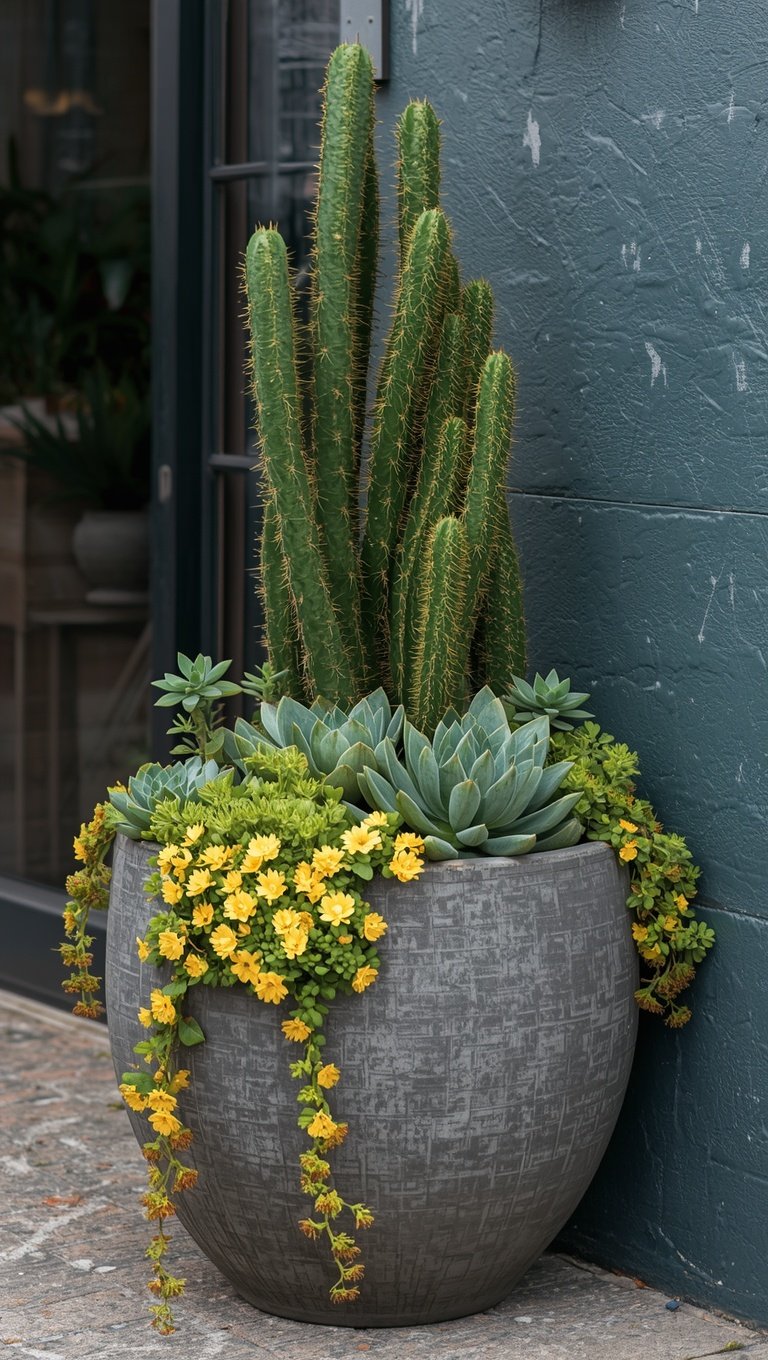
I have a long, shallow trough planter on my sunniest garden ledge filled entirely with a mixed succulent arrangement — hens and chicks, sedum ‘Autumn Joy’, echeveria rosettes — and it has asked almost nothing of me since I planted it.
The textures are incredible.
Spiky, rosette-shaped, smooth, ruffled — all in one pot, all in shades of blue-green, dusty rose, and silver.
It looks like a living sculpture more than a garden planter, honestly.
The one thing I’ll warn you about: drainage is everything with succulents in containers.
If your pot doesn’t have drainage holes, skip it entirely or drill some yourself.
Soggy soil in a hot container is the fastest way to lose a succulent, and it’s so easily avoidable.
I also add a layer of gravel at the bottom of my succulent pots for extra drainage insurance.
Marigolds Deserve Way More Credit Than They Get


I know, I know — marigolds feel a little old-fashioned, a little grandma’s-garden.
But hear me out, because I’ve fully come back around on them and I’m not embarrassed about it.
Marigolds are elite full-sun container plants.
They bloom all summer in the warmest, richest shades — deep orange, buttery yellow, rusty red — and they essentially laugh at heat and drought.
I planted a big terracotta pot of African marigolds near my vegetable containers last summer, partly for the color and partly because they deter certain pests.
That pot was the most low-maintenance thing on my entire patio.
I watered it, I deadheaded occasionally, and it rewarded me with nonstop blooms for months.
The scent is polarizing — some people love it, some people really don’t — but I find it sort of grounding and earthy in a way that feels like summer.
If you want to make a bold statement with a single large container on a hot porch, fill it with giant African marigolds in mixed warm tones and I promise you it will stop people in their tracks.
Sometimes the old-school classics are classics for a very good reason.
My Watering Routine That Actually Keeps Containers Alive

Full sun containers need water — more than you probably think, and more consistently than in-ground plants.
This is honestly the number one reason container gardens fail in summer.
Not the plant choice, not the pot, not the soil.
The watering.
When I finally got serious about my watering routine, everything shifted.
I water every morning before the heat of the day kicks in.
Morning watering means the water actually reaches the roots before it evaporates, and the foliage has time to dry before evening, which reduces disease risk.
I also use a moisture meter — a small, inexpensive tool I’m genuinely obsessed with — to check soil moisture before I water rather than guessing.
It takes the anxiety out of the whole thing.
For larger containers, I sometimes use self-watering inserts or water-retention crystals mixed into the soil to extend the time between waterings.
That has been a total lifesaver during weeks when I’m busy or traveling.
My honest tip: if your container dries out so fast that daily watering isn’t enough, try grouping your pots together.
Clustered containers create a little microclimate of shared humidity that slows moisture loss significantly.
It sounds almost too simple — and it really works.
Soil Mix Makes or Breaks a Full Sun Container

Regular garden soil in a container is sort of a recipe for frustration, especially in full sun.
It compacts, it drains poorly, and it heats up in ways that suffocate roots.
I learned this the hard way before I understood what a proper container mix actually does.
A good container mix is lightweight, well-draining, and moisture-retentive all at once — which sounds contradictory but isn’t.
My personal blend is a high-quality potting mix (not garden soil) combined with perlite for drainage and a scoop of coconut coir for moisture retention.
I mix it right in the pot before planting, which sounds fussy but takes about three minutes and makes a real difference.
For drought-tolerant plants like succulents or lantana, I lean heavier on the perlite.
For thirstier plants like zinnias or petunias, I go heavier on the coconut coir.
Slow-release fertilizer granules mixed into the soil at planting time are also something I never skip.
Full sun containers are actively growing all summer, which means they’re actively depleting nutrients.
A slow-release fertilizer works quietly in the background, feeding your plants over months without you having to think about it.
And honestly, anything that works quietly in the background while I’m enjoying my porch with an iced coffee?
Yes, always.
Vinca — The Bloom That Refuses to Quit

Vinca — sometimes called annual vinca or periwinkle — is one of those plants I recommend to everyone who tells me their sunny containers keep failing.
It is stubborn in the best possible way.
Heat, humidity, drought, full blasting sun — vinca genuinely does not care.
It just keeps producing those cheerful little pinwheel blooms in shades of white, lavender, hot pink, and deep red all season long without skipping a beat.
I planted vinca in a long window box on my sunniest windowsill a few summers ago as sort of an experiment, expecting it to struggle.
It was the star of my entire front yard by July.
Neighbors asked me what it was.
One of my favorite things about vinca in containers is that it doesn’t need deadheading.
The spent blooms just fall away cleanly, and new ones keep coming.
For someone who doesn’t always have time for high-maintenance garden tasks mid-summer, that self-cleaning quality is genuinely such a gift.
Pair white vinca with deep purple sweet potato vine spilling over the edge of a container, and you have something that looks effortlessly elegant with almost zero effort behind it.
Fertilizing Is the Step Most People Skip — Please Don’t

Here is something I wish someone had told me much earlier in my container gardening journey.
Container plants need to be fed regularly throughout the growing season — full stop.
Unlike in-ground gardens where roots can travel to find nutrients, container plants are working with a fixed amount of soil.
And in full sun, they’re growing and blooming at full speed, which burns through nutrients fast.
I feed my full sun containers every two weeks with a balanced liquid fertilizer during peak summer.
I’ve also switched to a fertilizer with a slightly higher phosphorus content (the middle number on the label) specifically for my flowering containers, because phosphorus supports bloom production.
And the difference in bloom quantity since I made that swap?
Really noticeable.
If you’re someone who always forgets liquid fertilizing (totally me before I put a reminder in my phone), the slow-release granule approach I mentioned in the soil section is a genuinely solid option.
You mix it in at planting and it handles feeding through the season with minimal input from you.
My tip: even with slow-release granules in the soil, I still do one liquid feed mid-summer as a little boost.
Think of it as a summer pick-me-up — for your plants and honestly sort of for your gardening motivation too.
Creating a Color Story With Your Full Sun Containers

This is the part I love most — the actual design of a container garden.
Because once you know your plants will survive the summer, you get to have fun with how everything looks together.
I approach my full sun containers like I’m decorating a room.
I pick a color palette first and then choose plants that fit within it, rather than grabbing everything that looks pretty at the nursery and hoping for the best.
My current porch palette is warm and saturated — deep orange, hot coral, rich burgundy, and touches of chartreuse for contrast.
Every plant I choose, from the thriller to the spiller, fits somewhere within that story.
The result feels intentional in a way that a random mix of colorful plants just doesn’t.
If you’re not sure where to start with a color palette, look at your home’s exterior colors and pull from there.
A white farmhouse porch calls for soft pastels or a classic red-white-blue.
A warm brick exterior looks gorgeous with orange, rust, and yellow.
A modern dark exterior is stunning with white blooms and deep green foliage — so crisp and unexpected.
Your containers are an extension of your home’s personality.
And getting that color story right is honestly one of the coziest, most satisfying creative things you can do all summer.