

If you’ve been holding up your Galaxy phone to see whether a rug or a bookcase will fit, here’s the news.
Samsung is ending new downloads and updates for its Quick Measure app after December 31, 2026.
Don’t delete it yet, though.
Really, hang on to it for now.
The app doesn’t vanish from your phone at midnight, and whether the change matters to you depends on what you were measuring in the first place.
And for blinds, or a sofa that has to clear a doorway, I’d want a real tape whatever app you use.
What Actually Ends on December 31

After December 31, 2026, Samsung stops new downloads of Quick Measure and stops updating the copy you already have.
If it’s on your phone, you can keep using it, with a warning that some features may not work properly.
So come January, the copy on your phone is the last version you’ll get.
Samsung also won’t keep the app compatible with future OS updates, so if a big phone update breaks something in it down the road, nobody is coming to fix it.
And if it isn’t on your phone now, don’t plan around it, since new downloads end with the year.
Samsung says it plans to come back with improved services in the future, but it hasn’t named a replacement yet, and I wouldn’t wait on one.
A Phone Measure Is a Sketch, Not a Cut List

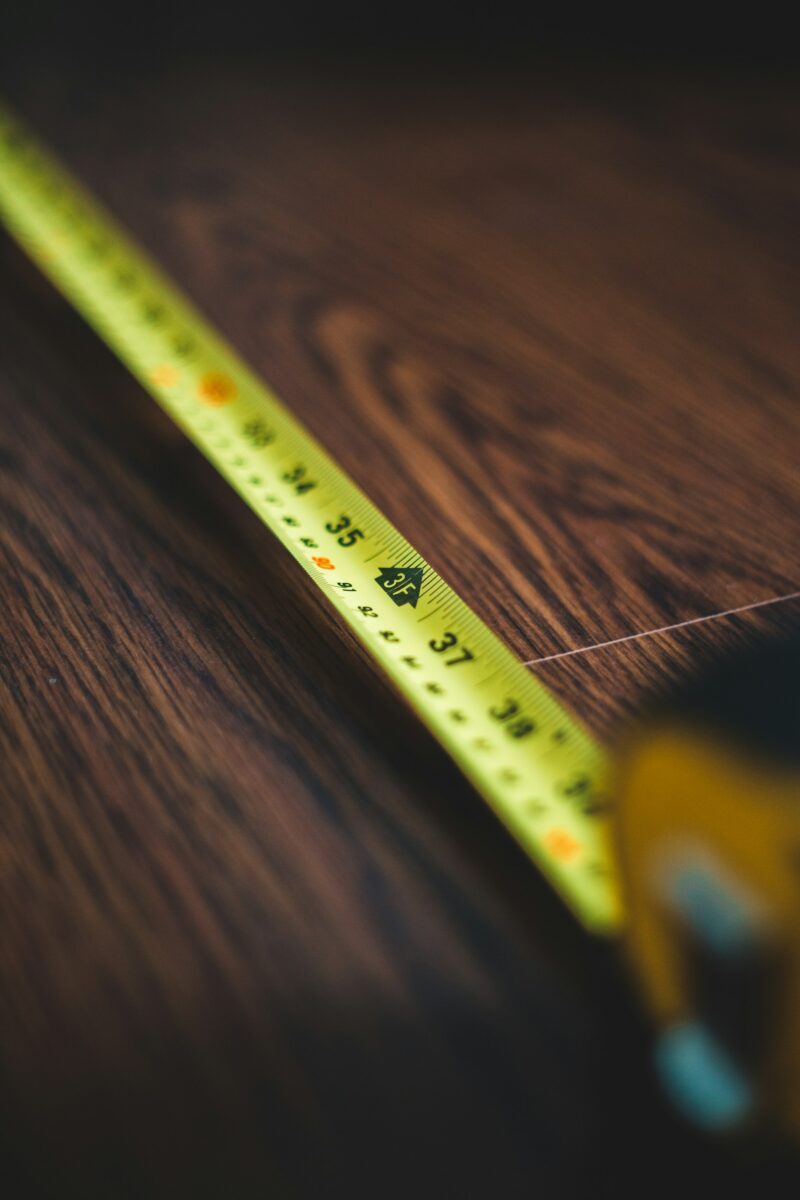
A tape has a hook on one end and the lengths printed right on it.
A phone has neither.
It works out distance from what the camera sees as you move it around (plus a depth sensor, on phones that have one), so every number it hands you is an estimate.
Often a good estimate, too.
Google’s own depth tools for Android AR apps are most accurate when the phone is about half a meter to five meters from what you’re measuring.
That’s roughly 20 inches to 16 feet.
Their readings also come out better when you keep the phone moving.
So a phone is great at “will a 9-by-12 rug work in here?” and bad at “cut this shelf to 31 3/8 inches.”
If a number decides money you can’t get back, like a custom blind or an order you can’t return, take it off a real tape.
For everything else, the phone is fine.
Where a Phone Is Plenty

Most decorating questions are “roughly how big” questions, and that’s where a phone earns its spot in your pocket.
Rugs are the classic one, and honestly the job I’d hand a phone every time.
You want to know whether your living room takes an 8-by-10 or a 9-by-12, and whether the front legs of the sofa land on it.
A phone gets you close enough to decide, and our rug size calculator turns the room and the furniture into the standard size to shop for.
Paint is another, and it’s kind of the easy one.
It comes in gallons and quarts, so a few inches either way on a wall rarely changes what you carry home.
Rough wall sizes go straight into our paint calculator for the gallon count.
Then there’s the Facebook Marketplace dresser.
Will it fit the wall by the closet?
A phone number is plenty to decide whether it’s worth the drive.
Bring a tape to the pickup, though.
Measure the dresser itself before any money changes hands.
The size in a thrift or Marketplace listing came off somebody else’s tape, or their guess.
Where Only a Tape Will Do

Blinds and shades are the big one.
For an inside mount, measure the width inside the window frame in three places, top, middle and bottom, and keep the narrowest, so the blind can open and close without catching.
Height gets three readings too, and there you keep the longest, since a blind that’s too short lets light in.
Our blinds size calculator takes those six numbers and gives you the size to order.
Getting a sofa through a doorway is next.
You measure the sofa’s length and height, then its diagonal: from the bottom of one front leg to the head cushion on the opposite side.
Then you measure the door’s width and its diagonal.
If the sofa’s diagonal is bigger than the door’s, you could have trouble getting it through, and that’s when the legs come off (most come off with pliers, a wrench or a screwdriver).
This is a measurement where one inch matters, which is exactly where a phone’s guess lets you down.
Anything you cut is a tape job, full stop.
Trim, shelves, a new cabinet door, the plywood back of a bookcase.
If the saw comes out, so does the tape.
Flooring sits in both camps.
A phone is fine for a first guess at the square footage, and our flooring calculator turns that into boxes, extra for cuts included.
The cuts along the walls need a tape.
So does any order you can’t send back.
What I’d Measure With After December 31

Keep Quick Measure if you have it. Nothing makes you delete it on January 1.
Just don’t let it be the only measuring thing in the house, since it won’t get updates.
A plain 25-foot tape measure. Honestly, this is the one I’d get first if your house doesn’t have one.
It lives in a kitchen drawer, it never needs a charge, and it’s the tool those blind and sofa steps above are written for.
A laser measure. If you measure whole rooms or ceilings a lot, this is the upgrade.
You hold it at one end and point it at the other, so there’s no walking a tape across the room alone or climbing up and down a ladder for a curtain rod.
It doesn’t sag over a long run the way a tape can, either.
Another measuring app. Fine for the sketch jobs, and I’d happily use one for those.
Before you trust one, I’d want it to tell me how sure it is about each reading, not just show a confident number.
Spanwick. Spanwick is our own app, made by the team behind Dreamy Home Style.
It’s a tape measure for Android phones that tells you how far off it may be.
Spanwick, the Measuring App We Made

We built it around one idea: a measurement should come with its margin.
Each length prints its likely error right beside it, something like “9′ 10″, about ± 5″”, so you can see which numbers to lean on.
When the phone isn’t sure, the app says so and asks you to measure again from closer.
And if you type in one wall’s real length from a tape, every reading in that room corrects itself.
Walk around the room and the outline draws itself, with each wall’s length and its likely error.
From there you can open our paint or flooring calculator in your browser with the room’s sizes already filled in.
There are no ads and no account.
The tape runs on Google’s ARCore, and the first screen tells you what your phone can do.
Phones without ARCore still get the level and a photo measure, where you put a sheet of paper or a card in the picture for scale.
It won’t pretend to be a tape, either.
Check anything that matters with a real one before you cut or buy.

How to Measure a Room So the Numbers Hold Up

Whatever you measure with, the method is what saves you, so do a room in this order:
- Sketch the room first, just a rough box on paper, with the doors and windows marked. Write each number on the sketch the moment you read it.
- Measure wall to wall along the floor, and write it down in feet and inches, not “about 12 feet.”
- Measure every doorway on the way in, since that’s where furniture gets stuck.
- Long wall and nobody to hold the other end? That’s the laser’s moment.
- Measure everything twice. If the two numbers don’t match, go for a third.
Do it on a weekend morning with your coffee, when nobody’s rushing you, and keep the sketch somewhere you’ll find it the next time you shop.
Samsung, Galaxy and Quick Measure are trademarks of Samsung Electronics.
Dreamy Home Style and Spanwick are not affiliated with or endorsed by Samsung.
Android, Google Play and the Google Play logo are trademarks of Google LLC.
Related read: Things I Wish I Knew Before I Decorated My First Home — Instant PDF + Kindle download. Secure checkout by Stripe