
Patio door window treatments have a job no regular window asks for.
They have to get out of the way every time someone walks through — and with a dog in the house, that’s a lot of times.
The first thing to ask of any covering option for a patio door is simple.
Where does it go when the door is open?
Color and price come after that.
The latest trend can wait.
Floor-to-Ceiling Curtains That Clear the Door


Curtains are the softest of the patio door window treatments.
I’d mount the rod high, close to the ceiling, so the fabric runs in one long line down to the floor.
The usual spot for the rod is 4 to 6 inches above the door frame (higher if you want the door to look taller).
Most sliding glass doors are 80 inches tall, so 84-inch panels are the usual size, made for a rod about 4 inches above the frame.
Hang the rod closer to the ceiling and you’ll need longer panels.
Width is the bigger deal.
Curtains still take up room when they’re open.
That bunch of fabric is called the stack-back, and on a door it should sit on the wall beside the frame, not over the glass you walk through.
A good place to start is a rod that reaches about 12 inches past the door frame, then adjust from there.
A traverse rod is worth it on a door this wide, because the rings glide all the way across, while a center support bracket on a regular rod can stop the curtains halfway.
For fullness, the flat curtain width should be 1½ to 2 times the rod, stack-back included, and a curtain size calculator turns that into a rod length, a curtain length and a panel count.
Hems matter more here than on a window, because you step past them every day.
Curtains that just graze the floor (or stop half an inch above it) mean you’re less likely to step over bunched-up fabric on the way out.
Grommet or pinch-pleat tops slide easily.
Rod pockets don’t.
On a west-facing door that bakes in the afternoon, I’d pick fabrics with a blackout or thermal lining and hang sheers behind them for daytime.
Sliding Panel Tracks: The Modern Minimalist’s Pick


If you’d rather not have curtains on a patio door at all, sliding panels are the window treatment I’d look at first.
They’re flat, wide panels of fabric that hang from a track and slide across the opening the same way the door does.
Nothing to raise.
Nothing to tie back.
You choose whether they slide to the left or the right, or split from the center to both sides.
On a sliding door, I’d stack them on the side that doesn’t open, so the half you walk through stays clear.
Pick blackout or light-filtering fabric depending on how much daylight you want (solar fabric is another option).
In a house with a shedding dog, a vinyl or solar fabric that wipes clean with soapy water is way better than one you’d have to take down and wash (pet hair genuinely gets on everything).
The panels open with a wand, a continuous cord loop or a motor.
I’d take the wand.
A cord loop has to be pulled tight and anchored to the floor or wall with a tension device, and cordless is the safest choice in a home with young children.
Between 1996 and 2012, about 184 infants and young children died from strangling in window cords.
Plus, a fabric-wrapped valance or a cornice over the top hides the track if you don’t love how it looks.
Vertical Blinds, Reimagined for a Door You Use


Vertical blinds are the classic patio door covering, and for a good reason.
They open sideways, in the same direction as the door.
They come in PVC, faux wood or fabric, so they don’t have to look like the plastic strips in an old office.
S-shaped slats interlock when closed, which blocks more light.
Some light can slip through the slats at certain angles, so the privacy won’t be as complete as with other coverings.
You choose whether they stack to the left, to the right or split down the middle.
I’d stack them on the fixed side of a sliding door, because walking through a curtain of slats gets old fast.
Measure the depth first.
The track and the wide slats need more mounting depth than most blinds, so check the minimum before you order.
PVC and faux wood only need a wipe with a clean cloth.
With care, verticals can last 10 to 20 years, even opened and closed several times a day.
If yours open on a looped chain, keep it pulled tight and anchored with a tension device, the same as a cord loop.
Then there are sheer vertical shades, which join vinyl vanes to one big piece of sheer fabric (you tilt them open or closed like regular verticals).
Cellular Shades: The Energy-Efficient Pick for Glass


Cellular shades, also called honeycomb shades, are pleated fabric folded into cells.
The cells trap air inside them and between the shade and the glass.
Compared with bare glass, cellular shades can cut heating energy by up to 20% and total heating and cooling energy by up to 15%.
They save more heat than ordinary vinyl blinds, too.
For a patio door, the one to look at is the vertical cellular shade.
The pleats run up and down, and the shade slides sideways.
You press a button on the side rail to move it, and the fabric folds down to just a few inches at the side of the door.
Regular up-and-down cellular shades can work well on French doors and fixed glass panels, though they’re not ideal for a door you use a lot.
On a slider, you’d have to raise them all the way every time you go out.
Comparing two shades?
Check for the AERC energy label, which certified ones carry, to see how each one rates in your climate zone.
They come cordless or motorized (which takes care of the cord question).
The catch is dirt.
A door that pets and kids use all day can soil the fabric.
Honestly, I’d spend the budget on these for a door that mostly stays shut through the winter, and pick something wipeable for the busy one.
No-Sew Roman Shades for a Door, Without the Hassle


Roman shades are a soft window treatment for a door, and you can make a no-sew version from a cheap mini blind.
The mini blind does the lifting.
The fabric gets glued to a handful of its slats, and those slats become the folds (five evenly spaced slats, five folds).
Cut the fabric to the glass measurement plus 2 inches on every side, then glue those edges under for a clean hem.
Fabric glue or a generous line of hot glue holds the rails, and iron-on binding tape tidies the cut edges.
Cut the ladder strings and slide off the extra slats, keeping only as many as you want folds.
Leave the lift cords alone!
I’d buy a cordless mini blind as the base, so no pull cord hangs down.
The lift cords still run loose up the back of the fabric, though, and a child can pull a loop out of them, so I’d skip this one in a home with babies or young kids.
Any fabric you love works, and I’d check the thrift store’s linens before buying anything new (old curtains and tablecloths count).
Then mount the brackets on the door at the top of the glass, the same way you’d hang the mini blind on its own.
The thing is, a raised Roman shade still hangs in folds at the top.
Hung over a doorway without extra height above it, it can make tall people duck on the way out.
I’d put them on French doors or the fixed side of a slider, one shade per door, and leave the panel you walk through to something that slides.
Shutters on a Track: The Timeless Solution


Shutters are the timeless patio door window treatment, and on a sliding door they run on a track instead of hinging off the frame.
Bypass shutters have panels that slide past each other, lined up with the door so you can walk in and out.
Bi-fold shutters fold up accordion-style, and some systems fold flat against the wall so the panels don’t stick out into the room.
In the usual two-panel track setup, half of the door stays covered all the time (unless the track runs onto the wall beside it).
The louvers tilt for light and privacy.
Close them before you slide the panels.
No dangling cords, either.
They still need dusting.
Use a dry cloth on real wood, and a damp one on faux wood or composite.
PVC shutters won’t warp in hot, humid rooms and wipe down with soapy water, which is why they suit a beach house.
They’re custom-made to the door’s exact measurements, and wood ones can be painted or stained to match the room.
Because they’re built to fit one door and nothing else, I’d save shutters for a house I plan to stay in.
Macramé Panels: Boho Privacy for Fixed Glass


Macramé is a knotting craft, and a macramé panel on a patio door gives you filtered light and a little privacy instead of a solid sheet of fabric.
It’s traditionally made with cotton or hemp rope.
Cotton is the easy one to knot, since it’s soft and won’t stretch out over time.
A 4 to 6 mm three-ply cotton cord works for most home decor pieces.
A beginner curtain mostly uses two knots, the lark’s head to hang each cord from the rod and the square knot for the pattern.
It takes a lot of cord.
One beginner macramé curtain about 1 by 2 meters is cut from 51 cords, each 4.5 or 5 meters long.
Add those up before you buy string (it comes to about 235 meters of 5 mm cord)!
I’d hang macramé on the glass of a door that swings or on the fixed panel of a slider, where nobody walks through the fringe.
On a door you open a lot, a tieback keeps the fringe from swinging in the way.
It’s see-through (that’s the charm).
I’d treat it as decoration and keep a shade behind it for night.
A secondhand macramé wall hanging can save you all that knotting, and I’d look for one before buying a single meter of cord.
Trim the ends to the length you want.
A knot or two near the bottom of each cord keeps it from unraveling.
Privacy Film for the Glass Itself


Privacy film goes right on the glass, which makes it the one patio door covering that pretty much never has to move out of the way.
Static cling film goes on and comes off easily, and you can reuse it after a rinse.
For a rental, that’s my pick.
Opaque film, which you can’t see through from either side, gives you privacy day and night.
One-way films and dark tints give privacy only in the daytime, because they work when it’s brighter outside than in (light and medium tints barely give any).
At night, with lamps on inside, the effect flips and people outside can see in.
On a door that faces the street, I’d pair one-way film with a shade or curtain for the evening.
Before you buy, look for a film-to-glass chart on the film’s product page.
It shows which kinds of glass the film is safe on, and the wrong film on the wrong glass can crack it or make a double-pane seal fail.
Plus, some films aren’t meant for dual-pane glass at all, since they absorb heat the inner pane can’t get rid of.
Cover a whole pane rather than part of it.
Uneven heat puts the glass under stress, and curtains or blinds hung tight against the glass add to that.
Gila’s smoke and black static cling films (Glare Control Smoke and Privacy Control Black) shouldn’t go on frosted, etched, leaded or cracked glass, on deeply scratched or otherwise flawed glass, on glass with holes, or on glass more than 40 years old.
They go on glass between 45 and 90°F, out of direct sun, and on a sealed dual-pane door they go on the outside of the glass (it helps to have someone hold the film by its edges while you spray).
Bamboo Blinds That Bring the Outdoors In


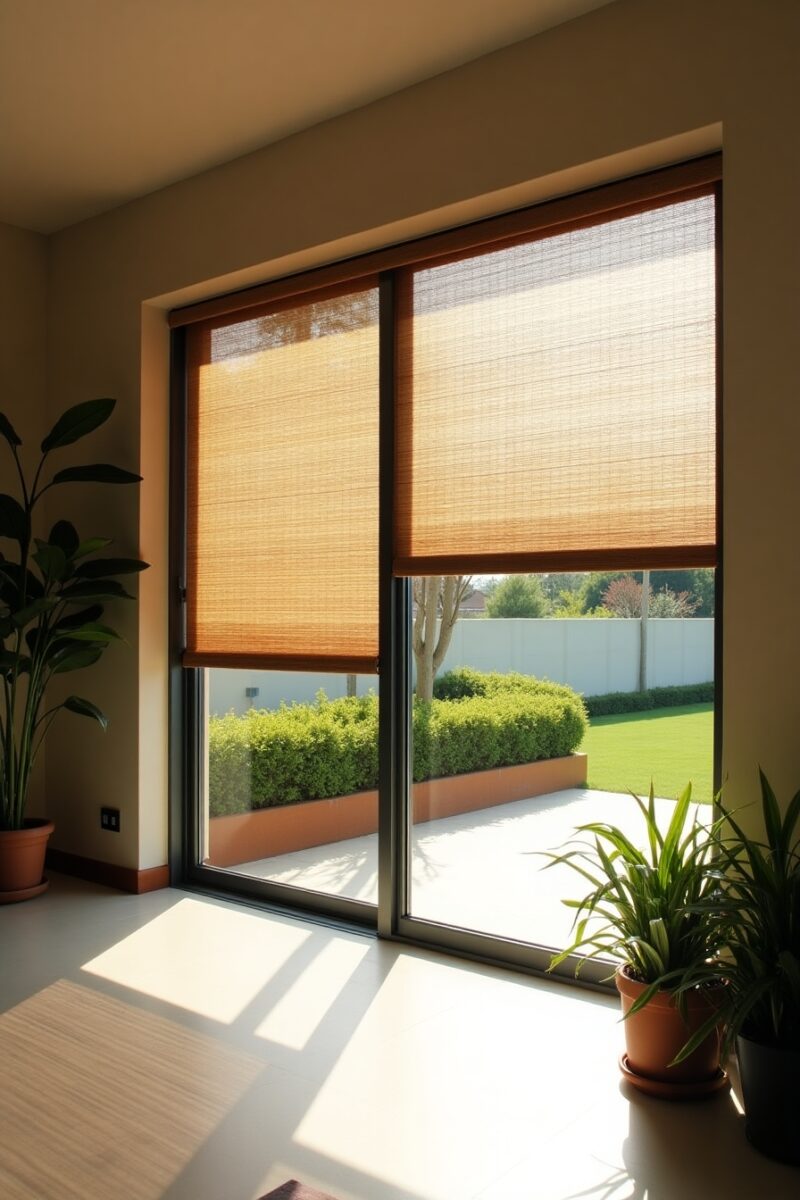
Woven bamboo shades bring warm, natural texture to a patio door, and the weave filters the light instead of blocking it.
Many are woven with other fast-growing fibers too (grasses and reeds, even paper).
Unlined, they give soft light and moderate daytime privacy.
At night, with the room lit, people outside may see shapes through an unlined shade.
I’d add a liner.
A privacy liner still lets some light through while blocking the view, and a blackout liner blocks up to 99% of the light.
Like Roman shades, woven wood shades have a big stack at the top when they’re raised.
I’d mount them well above the door frame and order extra height, so the raised shade clears the opening.
They lift with a continuous loop or a motor, or with no cord at all.
The cordless and motorized ones get rid of dangling cords.
If yours has a continuous loop, keep it pulled tight and anchored to the floor or wall with a tension device.
Keep every cord out of children’s reach and move furniture away from the door, so nobody climbs up to them.
With young children at home, I’d go cordless or motorized.
Dust them with a microfiber cloth or a vacuum brush, and spot-clean with a damp cloth and mild soap.
Never soak them.
Repurposed Vintage Screens, Used With Care

A vintage folding screen is my favorite budget idea for covering a patio door, because it isn’t fixed to the door at all.
Stand it beside the glass when you want privacy.
Fold it away when you want the view.
Thrift stores and estate sales are where I’d look first, then Facebook Marketplace.
An old room divider or a sturdy garden trellis works too, as long as it stands steady on its own.
I’d keep it on the fixed side of the door, out of the path you walk.
Check the paint first (this one matters).
Lead paint was sold for homes until it was banned in 1978, and about three-quarters of American homes built before then still have some.
Worn paint on things that rub, like doors and window sills, turns into chips and dust.
I’d treat any painted piece older than that as if it might have lead, and never dry-sand it.
Fix a small damaged patch (under 6 square feet) without sanding.
If you must sand, wet it first and sand as little as you can, then clean up thoroughly.
Don’t try to strip all the old paint off yourself.
A home lead test kit won’t settle it, because those kits aren’t considered reliable on consumer products.
Whichever covering you pick, picture walking through the door with a coffee in one hand.
If you’d have to wrestle it out of the way, keep looking.
Related read: Things I Wish I Knew Before I Decorated My First Home — Instant PDF + Kindle download. Secure checkout by Stripe