
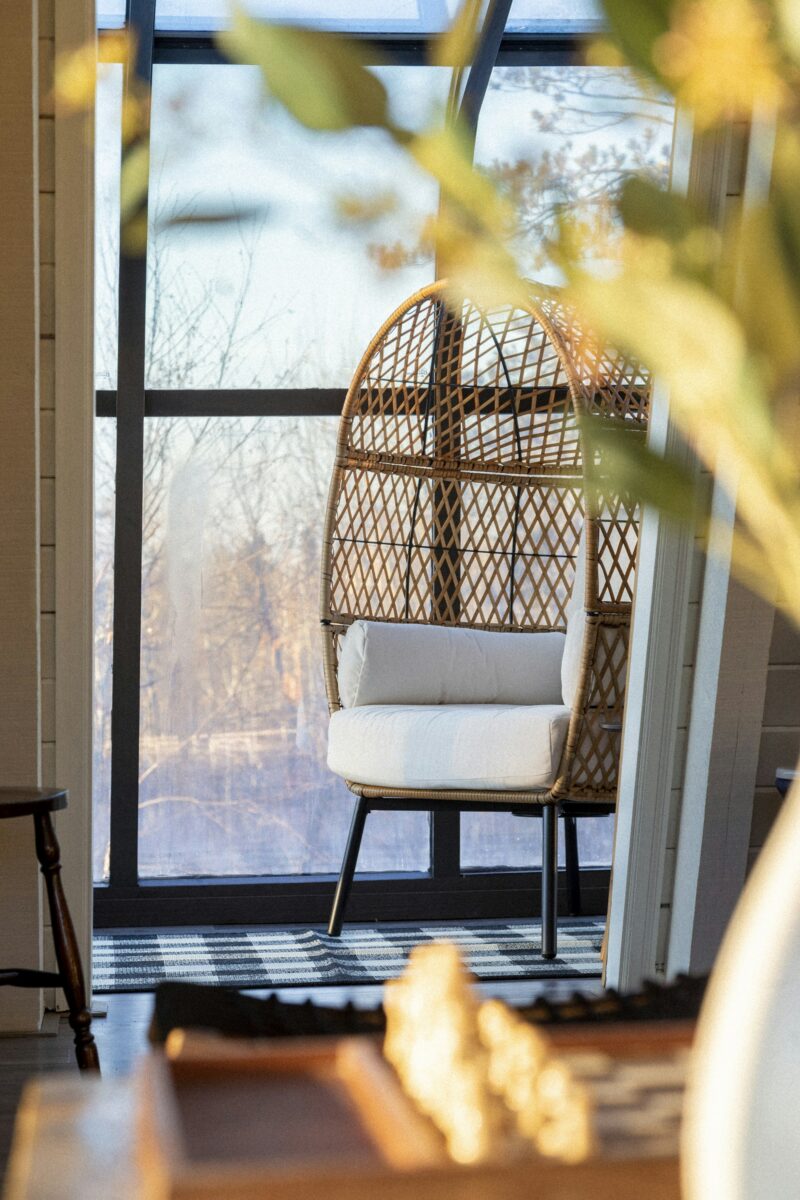

A sunroom is the best room in the house for a few months a year.
The rest of the time it’s where stuff goes to wait.
Folding chairs from the cookout, a box of returns, three plants that looked sad inside, a yoga mat, the dog’s spare leash, a stack of mail somebody meant to deal with on the weekend.
There’s a reason it happens.
A sunroom usually sits between the house and the yard, it has no closet, and nobody ever had a real plan for it.
Whatever doesn’t have a home lands there.
And because the walls are glass, you see every bit of it from the kitchen.
The fix isn’t a bigger bin.
It’s deciding what the room is for, choosing storage that can handle heat and hard sun, and keeping the glass clear so the room still feels like a sunroom and not a storage unit with a view.
None of it needs a contractor, and most of it works in a rental too.
Pick Two Jobs for the Room, Then Say No to Everything Else

A cluttered sunroom is almost always trying to do six things at once.
It’s a plant nursery, an office, a guest overflow room, a kids’ craft table, a mudroom and a gym.
Each job brings its own gear, and none of it has a place to go.
So pick two.
My favorite pair is morning coffee and reading.
Plants and a small work spot is another.
A play corner and a place for guests to sit works if you have kids.
Write the two down if that helps, because the rest of this gets easy once you know what you’re saying no to.
Then give each job its own zone.
A rug and a chair with a side table is a reading zone.
A shelf and a watering can is a plant zone.
The zones don’t need walls, they just need edges your eye can find, and a rug is the cheapest edge there is.
The job most sunrooms quietly take on is “storage,” and that’s the one I’d refuse first.
If your living room already has the TV and the big sofa, the sunroom doesn’t need to copy it either.
Let it be the calm room.
That’s the whole appeal.
Keep the Furniture Low and the Glass Clear

The light is the point of the room.
Anything tall parked in front of a window wall blocks it, and it also makes the space look smaller from outside and from the kitchen.
A bookcase in front of glass is the fastest way to turn a sunroom into a hallway.
Most sunrooms have one solid wall, the one they share with the house.
That’s where the tall pieces go: a cabinet, a bookcase, the plant ladder if it’s a big one.
On the glass walls, keep the furniture under the windowsill.
Sofa backs, benches and side tables that sit low let the view run right over them.
Legs help more than you’d think, and I’d take them over a matching set every time.
A chair or a cabinet on legs shows floor underneath it, and seeing floor reads as space.
Skirted, boxy pieces that sit flat on the ground look heavier, even when they’re the same size.
And for the evening, skip the ceiling fixture.
Overhead lighting is a crime in any room, but in a sunroom it turns the glass into a black mirror that bounces the whole messy room back at you.
Two lamps at sitting height, plus a string of warm bulbs if you like them, keep it cozy after dark.
If you’re still choosing pieces, these small sunroom ideas are sized for rooms where every foot counts.
Storage That Can Live With Sun and Heat

Here’s what makes a sunroom different from any other room: it bakes on a sunny afternoon and can get cold at night, and the light hits everything in it for hours.
Plenty of ordinary storage handles that badly.
Things fade, things warp, and electronics don’t love it.
Start with the fabric.
Cushions and pillows in a sunroom take more sun than anything else in the house, so I’d cover them in an outdoor-grade fabric.
Sunbrella, for one, is 100% solution-dyed acrylic, which means the color and UV-stabilized pigments go into the fibers before they’re spun into yarn.
The color runs all the way through, so it holds up far better than a print that sits on the surface.
The newer outdoor fabrics are soft enough for indoor seating, so you’re not stuck with anything crunchy.
Then put the things that fade behind a door or a lid.
Books with colored spines, framed photos, paper, the throw you love: a cabinet with doors or a storage bench with a lid keeps them out of the light.
A lidded bench does double duty as seating under a window, and you can find solid wood ones on Facebook Marketplace for much less than new.
Baskets are great for the soft stuff you grab often, like blankets and dog toys.
Give each one a single job so it doesn’t become a junk drawer with handles.
Electronics are the part people forget.
An iPhone or iPad is built for rooms between 32°F and 95°F, and a sunroom on a hot afternoon or a winter night can sit outside that range.
So the tablet, the speaker and the charging station belong just inside the house, not on the sunroom windowsill.
If the room fades everything you put in it, a clear UV-blocking window film is worth a look.
The clear ones are rated to block 99% of UV, and many are made to peel off later, which matters if you rent.
I’d try one window first and live with it for a week before doing the whole room.
Film cuts down fading but won’t make a room fade-proof, so the lids and doors still earn their keep.
One Plant Shelf Beats Plants on Every Surface

Plants are the reason a lot of people love their sunroom, and they’re also the reason a lot of sunrooms look messy.
One pot on a sill turns into twelve pots on every sill, the floor and the coffee table, each with a saucer and a little ring of dirt.
Corral them.
A tiered shelf, a ladder shelf or a couple of plant stands of different heights gives every plant light and gives the room one green corner instead of forty green dots.
Group them by how much water they need and watering day takes ten minutes instead of a lap around the room.
There are good options for every budget in these plant shelf ideas, including a few that work against a window without blocking it.
Keep the shelf near the glass but not touching it.
Leaves pressed against a cold pane in winter can get damaged, and the window ledge is usually the coldest spot in the room at night.
Temperature matters more than people think, and it turns out houseplants are fussier about it than about light.
Most do best with days of 65 to 75°F and nights of 60 to 65°F, and temperatures below 50°F, or quick swings, can harm some of them.
A sunroom can hit all three of those problems in a single day, which is why the plant zone does best on the side of the room closest to the house.
Give the Stuff That Wanders In a Real Home

Some clutter isn’t really sunroom clutter.
It’s mudroom clutter that found the nearest door.
Shoes, bags, leashes, pool towels, the kids’ outdoor toys, a package that needs to go back.
If your sunroom opens to the yard, it’s going to collect all of it unless something stops it at the threshold.
That something can be small, and I’d start cheap.
A row of hooks by the door for leashes and bags.
A boot tray for shoes.
One lidded bin for outdoor toys, and when it’s full, something goes.
A thrift-store crate or a vintage tray for the mail keeps paper from spreading across the table.
Anything that isn’t a sunroom job goes back where it actually lives.
The yoga mat goes to the bedroom, the returns go in the car, the folding chairs go to the garage.
It sounds obvious.
I’d still bet it’s the step that clears half the room.
A built-in or a long bench under the windows can swallow a surprising amount, too.
If you’ve been eyeing one, look at these window seat ideas for the kinds with drawers or a lift-up lid underneath.
What Comes Out of the Sunroom for Winter

If your sunroom is heated like the rest of the house, you can skip this part.
A lot of them aren’t, though.
Three-season rooms and older porch conversions can get cold enough in January that some things simply shouldn’t stay.
The tropical plants come in first, since below 50°F is where some of them start to suffer.
The electronics come in too.
Cushions you won’t use for a few months go into a lidded bin so they’re clean in spring, and the rug can roll up if the floor gets damp.
What stays is what doesn’t care: the furniture made for outdoor use, the hardier plants, a throw or two in a basket for a sunny afternoon.
A cold sunroom with one chair, one blanket and a mug of coffee in a patch of February sun is honestly one of the best spots in the house.
It just doesn’t need the whole summer setup to get there.
The 10-Minute Weekly Reset

Organizing the room once is the fun part.
Keeping it that way is a habit, and I’m convinced it only works if it’s short, because a long one is a total pain and nobody keeps it up.
Ten minutes, once a week, on the same day every week.
Start at the door and carry out everything that isn’t a sunroom job.
Then fluff the cushions and fold the throws back into their basket.
Water the plants and turn each pot a quarter turn so they don’t all lean toward the glass.
Clear the side tables down to a lamp and one thing you like.
Last, open the blinds all the way.
That’s it.
No new bins, no weekend project.
If the reset ever takes longer than ten minutes, that’s your sign that something new has started living in the room, and it needs a home somewhere else.
If I could only give one piece of advice, it’d be this.
Before you buy a single basket, do the free part: pick the two jobs, clear the glass, and carry out what doesn’t belong.
Then sit in the room for a morning and see what you actually miss.
Whatever you reach for twice gets a home.
Everything else probably never needed to be there.
Related read: Things I Wish I Knew Before I Decorated My First Home — Instant PDF + Kindle download. Secure checkout by Stripe