
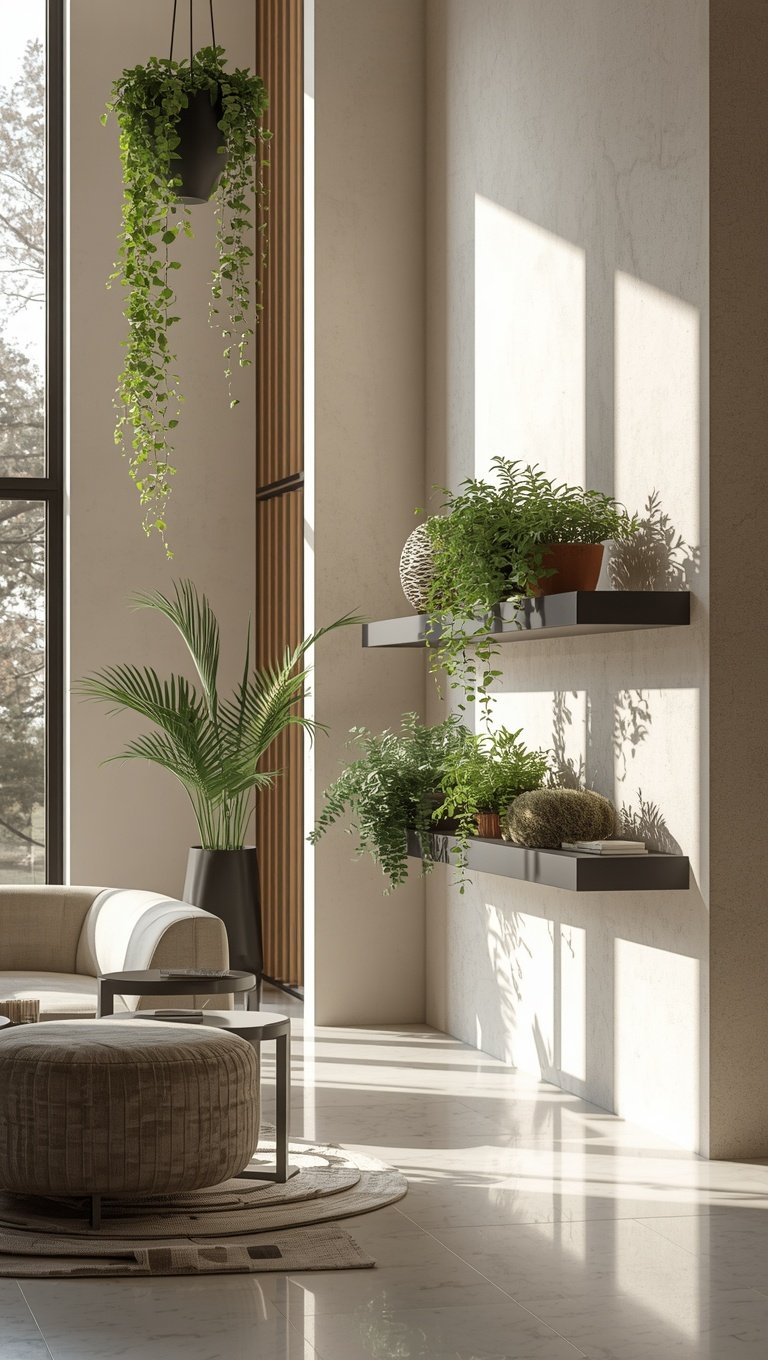

When I did my first hanging plant, I picked the spot I looked at most, which was the reading nook by my window.
I didn’t overthink the plant either, just grabbed a pothos because it forgives basically everything.
And watching it settle in over a few weeks taught me so much about the light in that corner, the way the vines wanted to grow, the rhythm of watering it.
That knowledge made every hook after it so much easier.
If I had to do it again, I’d still start with one.
Because one thoughtful hook beats five rushed ones, every time.
It gives you room to actually notice what’s working.
And it gives your space room to breathe instead of feeling instantly crowded.
My tip: use a simple ceiling hook with a weight rating higher than you think you need.
Plants get heavier once they’re watered and grown in, and nobody wants a midnight crash.
Corners Are Your Best Friend

The corners of a room are basically wasted real estate in most homes.
Nobody puts furniture flush into a corner, so there’s always this awkward little triangle of nothing.
That’s exactly where a hanging plant wants to live.
In my old apartment, I had this one corner behind the couch that always felt unfinished, kind of sad, honestly.
I hung a trailing philodendron there and it filled the emptiness in the softest way, without taking a single inch of floor.
The trick is picking a plant with some drama in its trail, something that spills instead of just sitting there.
English ivy does this beautifully, and so does string of hearts if you want something more delicate.
I love how it makes even a totally unused corner feel intentional.
It’s such a small move, but it makes the whole room look considered.
My favorite part is watching the vines get longer every season, like the room is slowly filling in on its own.
Optional variation: cluster two plants of different heights in the same corner for depth.
It reads like a little indoor garden without asking for anything from your floor.
Windows Deserve More Than Curtains

Your window is already doing double duty as your best light source, so why not let it do triple duty.
I hang plants directly in front of my windows, just off to the side so they don’t block the view.
The first time I did this, I used a macrame hanger with a spider plant, and the way the light filtered through those thin leaves in the afternoon actually stopped me in my tracks.
It’s such a specific kind of glow, warm and green at the same time.
Now I genuinely look forward to that time of day.
If your window has a curtain rod already, some tension rods can hold a light hanging plant without any drilling at all, which I love for renters.
Just be mindful of weight and always check the rod’s rating first.
For something with a little more texture, try a string of pearls or a small fern with delicate fronds.
They catch light in a way that heavier leaves just can’t.
My tip: rotate the plant a quarter turn every week so it grows evenly toward the light.
It sounds fussy, I know, but it takes two seconds and keeps everything looking full and balanced instead of leaning awkwardly to one side.
Kitchens Can Go Green Too

I never thought my kitchen needed plants until I hung one over my sink.
There was this dead zone above the window there, just blank wall doing nothing.
I put up a small hook and hung an herb planter with trailing thyme and a bit of oregano.
Now when I’m doing dishes, I get this little waft of herby smell every time I brush past it, and it genuinely makes a chore feel nicer.
That’s the emotional part nobody talks about — it’s not just decoration, it changes how a task feels.
Herbs are perfect for kitchens because they want bright light and good airflow, which most kitchens already have near a window.
If you’re not into cooking herbs, a pothos or a snake plant vine works just as well and asks for way less maintenance.
Just keep hanging plants away from direct heat sources like your stove, since the fluctuating warmth stresses them out.
My hack: use S-hooks so you can swap plants in and out seasonally without redrilling anything.
I switch mine out depending on what’s thriving, and it keeps the kitchen feeling alive instead of static.
It’s a small thing, but it made my least favorite room in the house one of my favorites.
Bathrooms Are Secretly Perfect for This

People forget bathrooms have the best humidity in the whole house, and plants love that.
I hung a Boston fern in mine, right by the shower but out of direct water spray.
The first time I noticed how full it got after just a month, I actually said “wow” out loud to an empty bathroom.
That’s the kind of humidity most other rooms just can’t offer naturally.
If your bathroom has a window, even better, but mine barely gets light and the fern still does fine because ferns are forgiving about brightness as long as the moisture is there.
Pothos and philodendron also thrive in this environment if ferns feel like too much commitment.
I love walking in now and having it feel like a tiny spa instead of just a functional little room.
The green softens all those hard tile edges in a way I didn’t expect.
My tip: hang it a few feet from the water source so it gets steam, not soak.
And check the hook’s grip occasionally, since humidity can loosen certain adhesives over time.
It’s such an underused spot, and honestly one of my favorite hanging plant homes in my whole house.
Layer Different Heights for a Jungle Feel

If you only take one thing from this post, let it be this — height variation is everything.
When all your hanging plants sit at the same level, the room can feel oddly flat, almost like a display shelf instead of a living space.
I learned this the hard way in my hallway, where I hung three pothos at the exact same height and it just looked repetitive, kind of boring honestly.
So I adjusted the chains, staggered them by about eight to ten inches each, and suddenly that same hallway felt layered and lush.
It’s such a simple fix but it changes the whole mood of a space.
Try mixing a low trailing vine with a taller, more upright plant like a hanging fern for contrast.
The eye naturally travels up and down instead of stopping flat.
I also like alternating leaf shapes, something broad next to something delicate and thin.
It mimics how plants actually grow in nature, all tangled and uneven in the best way.
My hack: adjustable macrame hangers or chain links let you change heights without buying new hardware.
I move mine around seasonally depending on what feels right, and it’s honestly one of my favorite ways to refresh a room for free.
Small Rooms Need Small-Leaf Plants
Not every plant works when your ceiling is doing all the heavy lifting.

Big, broad-leafed plants like monstera can look amazing on a shelf but feel heavy and overwhelming when hung in a tight space.
I made this mistake in my old studio apartment, hanging a pothos with huge leaves in a hallway that was maybe three feet wide.
It brushed against my shoulder every time I walked through, which sounds charming but got old fast.
So I swapped it for a string of pearls, and the whole hallway instantly felt lighter and less cluttered, even though there was technically the same amount of green.
Small leaves and thin vines read as delicate instead of crowding, which matters so much in tight homes.
String of hearts, dainty pothos varieties, and small ferns all do this beautifully.
The emotional shift is real — a small-leaf plant feels like a whisper, while a big-leaf plant feels like a shout.
In a no-floor-space kind of home, you usually want the whisper.
My tip: hold a leaf sample up in the space before committing, just to gauge scale.
It sounds silly but it saves you from a plant that technically fits but visually overwhelms.
Use Vertical Lines to Trick the Eye

Hanging plants aren’t just decor, they’re basically a design trick for making rooms feel taller.
When you hang something from ceiling to about eye level, your eye naturally follows that vertical line upward, and the whole room reads as more spacious.
I noticed this so clearly in my living room, which has kind of low ceilings honestly, nothing dramatic.
After I hung two trailing plants near the same wall at different points, guests actually commented that the room felt bigger, which cracked me up because nothing about the square footage changed.
It’s all perception, but perception is basically everything in small-space design.
The trick is consistency — hang plants at a similar general zone, like near a wall or window line, rather than scattering them randomly across the ceiling.
Randomness reads as clutter, while intentional vertical lines read as design.
I also like pairing this with a tall, thin mirror nearby to double the illusion.
It’s a little bit of a magic trick, honestly, and I love that it costs nothing but a hook and some patience.
My hack: step back and photograph the room before and after.
Seeing it through a camera lens helps you notice the vertical flow way more than just standing in the room does.
Lighting Matters More Than You Think

I’ll be honest, I killed more hanging plants in low light than I want to admit before I understood this.
Ceilings, especially in the middle of a room, often get way less natural light than you’d assume standing under them.
I learned this with a fiddle leaf fig I tried hanging near my hallway ceiling, and within weeks it was dropping leaves left and right.
Turns out that spot barely got any indirect light at all, poor thing never had a chance.
Now I actually stand under a spot for a few minutes at different times of day before committing a plant there.
If natural light is limited, pothos, ZZ plants, and certain philodendrons handle low light incredibly well and still trail beautifully.
For brighter spots, string of pearls and spider plants really show off.
Matching the plant to the actual light, not the light you wish you had, saves so much heartbreak.
And if a spot is really dim but you love it visually, a small clip-on grow light tucked discreetly near the hook works wonders.
I use one in my hallway and honestly forget it’s even there.
My tip: rotate plants seasonally between brighter and dimmer spots if your home gets uneven light throughout the year.
It keeps everything thriving instead of slowly fading in a spot that just wasn’t right for it.
Hardware Is Not the Place to Cut Corners

I get the temptation to grab the cheapest hook at the store, truly, I’ve been there.
But this is one spot where spending a little more really does matter.
Early on, I used a flimsy adhesive hook for a decently heavy pothos, and one morning I woke up to soil all over my rug and a very confused cat.
Since then, I only use ceiling hooks rated for at least double the weight of the plant once it’s fully watered.
Toggle bolts or proper anchors are worth the extra five minutes if you’re drilling into drywall.
For renters, tension rods and over-the-door style hooks are lifesavers since they need zero permanent damage.
I also swap out flimsy string for sturdy macrame or chain, since some materials stretch and sag over time in ways that genuinely surprised me.
Checking your hooks every few months only takes a second and gives you so much peace of mind.
My hack: keep a small notepad or note on your phone listing what plant is on what hook and its rough weight.
It sounds excessive, but it’s saved me from overloading a hook I forgot was already holding something heavier than I remembered.
Safety first, always, especially when there’s a rug or a cat underneath.
Mix Real and Faux Without Shame

I used to feel almost guilty admitting some of my hanging plants are faux, like it wasn’t allowed somehow.
But real talk, some spots in a home just don’t get enough light or attention for a real plant to survive, and that’s okay.
I have a beautiful faux trailing pothos above my closet door, a spot with zero natural light, and it’s honestly stunning, no upkeep needed.
Nobody has ever guessed, not once, and I’ve stopped feeling weird about mentioning it.
The high-quality faux plants now have such realistic texture and matte finishes that they blend in seamlessly with the real ones nearby.
I like layering one faux plant near a cluster of real ones so the eye reads them as a cohesive group instead of picking out which is which.
It’s such a relief for spots above stairwells or high corners where watering would be a genuine hassle anyway.
My tip: dust faux plants every so often, since dust is the one thing that gives them away instantly.
And avoid glossy plastic finishes, they catch light in a way that looks fake even from a distance.
Matte and slightly textured leaves are always the more convincing choice.
Let the Plants Talk to Your Other Decor
Hanging plants shouldn’t feel like an afterthought floating separately from the rest of your room.

I like connecting them visually to something else nearby, like a piece of art, a light fixture, or a curtain color.
In my bedroom, I hung a trailing plant right beside a woven wall hanging, and the tones of the macrame and the plant’s pot just talk to each other so nicely.
It makes the whole corner feel styled instead of like a random plant got plopped in.
Pot color matters more than people think here — a warm terracotta pot against cool-toned walls, or a soft ceramic white against wood tones, both do so much quiet work.
I also love matching the hanger material to other textures in the room, like pairing a jute rope with a woven rug nearby.
It creates this thread that ties a whole corner or even a whole room together.
My tip: before hanging a new plant, hold the pot up near your existing decor first.
It takes thirty seconds and saves you from a color clash you’ll notice every single day afterward.
Small coordination like this is honestly what makes a space feel curated instead of thrown together, and it costs nothing extra to think about.