
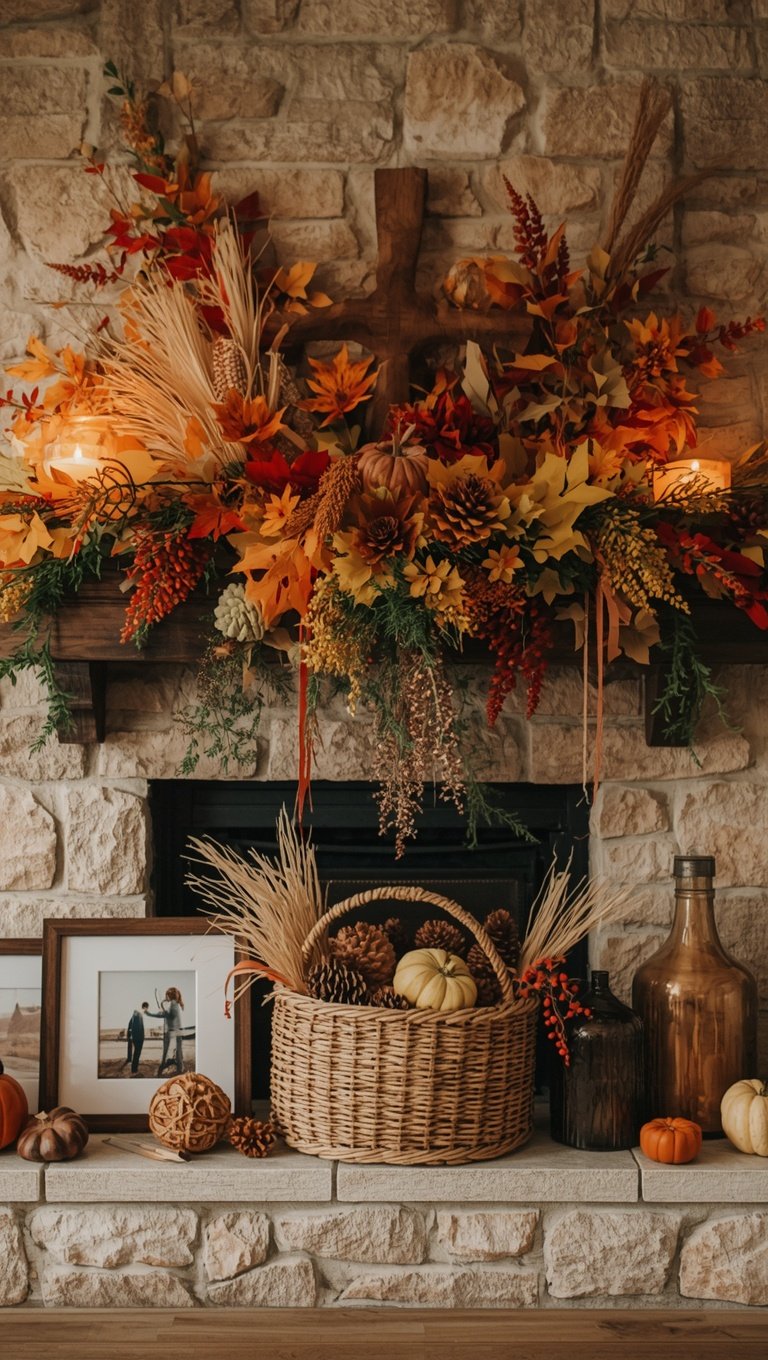

I almost cried a little the year I took down my Halloween mantel the day after trick-or-treating.
It felt so wasteful.
All that styling, gone in an afternoon, just to start over for Thanksgiving.
So a few years back I stopped doing that to myself.
Now I build one mantel that flows from spooky season straight into turkey season without a full teardown.
And honestly, it’s become my favorite decorating trick in the whole house.
If you’re tired of the two-week decor sprint every October, come sit with me for a minute.
I promise this is easier than it looks.
Start With a Neutral Base You Can Build On

Okay, so the very first thing I do is ignore the orange and black completely.
I know that feels backwards for October.
But hear me out.
I start with a base of creams, warm woods, and soft ivory candles.
That’s it.
That’s the whole foundation.
When I redid my own mantel two falls ago, I kept the base almost boring on purpose.
Boring is good here, I promise.
Because a neutral base means you’re never fighting your own decor later.
You’re not un-decorating and re-decorating, you’re just adding and subtracting a few pieces.
Think of it like a capsule wardrobe, but for your fireplace.
I usually start with two ceramic vases, a stack of linen-bound books, and one long taper candle holder in brass.
Nothing screams “holiday” yet, and that’s the point.
Then in October, I layer in the moodier, spookier accents on top.
In November, I just lift them off.
The neutral pieces stay exactly where they are the whole time.
Honestly, this one shift saved me so much money and so much stress.
I used to buy separate decor for every single month.
Now I buy three or four transitional pieces a year, tops.
If you only take one tip from this whole post, let it be this one.
A good base is everything.
Layering Textures That Feel Like a Warm Hug

This is the part I get a little obsessed with every single year.
Texture is what makes a mantel feel warm instead of just “seasonal.”
I’m talking chunky knit runners, velvet pumpkins, smooth ceramic, and rough dried wheat all sitting together.
When you mix textures like that, your eye just wants to linger.
It’s the same reason a cozy sweater feels better than a stiff one.
Last October I added a mohair throw draped along the edge of my mantel, just kind of pooling off one side.
It looked effortless, but I fussed with that drape for a solid ten minutes.
Worth it though.
My favorite combo right now is rough linen, warm brass, and something a little sparkly, like mica or mercury glass.
The sparkle keeps it from feeling too rustic or too “farmhouse cliché.”
And if you have a small mantel, less is more here.
Pick three textures max, not seven.
I learned that one the hard way.
My first attempt at this had way too much going on, and it just read as cluttered instead of cozy.
So now I ask myself, does this texture add warmth or does it just add stuff.
If it’s just stuff, it goes back in the bin.
One little hack: felt ball garlands are a genius texture layer, and they’re inexpensive too.
I tuck one along the very back of the mantel so it peeks out between other pieces.
It’s such a small detail, but it makes the whole thing feel intentional.
Choosing a Color Palette That Bridges Two Months

Color is where most people trip themselves up, in my opinion.
They go full pumpkin-orange for October, then panic-swap to gold and burgundy in November.
I get it, that’s the traditional playbook.
But there’s a softer way to do this.
I build my palette around rust, olive, cream, and warm brown, and I let those four colors carry me through both months.
Orange pumpkins can absolutely stay on the mantel in November, they just need a few gold or burgundy friends to shift the mood.
Nobody’s mantel needs a hard color reset every four weeks, honestly.
When I did my dining room mantel last year, I used a burnt sienna candle set as my one true “October color,” and everything else stayed neutral around it.
Come November, I swapped that single candle set for a deep burgundy one.
That was it.
One swap, completely different feeling.
I love this approach because it respects your budget and your sanity.
You’re not buying two full color stories a year.
You’re buying one story with a plot twist in the middle.
If I had to pick a single color to invest in, it’d be a good rust or terracotta.
It reads as fall without being a caricature of Halloween, and it flows into winter so easily.
Cream is your best friend here too, it softens everything and keeps things from feeling too heavy or too dark.
Candlelight: The Secret Ingredient Nobody Talks About

I don’t think people give candlelight enough credit in mantel styling.
It’s not just decor, it’s mood.
A mantel with great objects and bad lighting still feels flat somehow.
But a mantel with mediocre objects and beautiful candlelight?
It feels like a whole moment.
I use varying candle heights, always, no exceptions anymore.
One tall taper, one medium pillar, one squat votive, grouped in odd numbers.
Odd numbers just look more natural, I don’t totally know why, but it works every time.
When my husband complains the house feels dark in the evenings, this is genuinely my fix.
I light the mantel candles and turn off one overhead light, and suddenly the whole room feels intimate instead of dim.
For scent, I lean into warm spice or smoky sandalwood in October, then shift to something like clove and orange peel for November.
Small swap, big emotional impact.
If you’re worried about real flames near dried florals, and you should be a little worried, flameless LED candles have gotten so good lately.
I use real candles up top and flameless ones tucked near anything dried or delicate.
Nobody can tell the difference from across the room, I promise you that.
One little tip: cluster your candles slightly off-center rather than dead middle.
It feels more collected, more “gathered over time” instead of showroom-perfect.
That’s the whole vibe I’m chasing, always.
Garlands and Greenery That Don’t Scream Halloween

A draped garland is honestly the backbone of my whole mantel every year.
It softens all those straight lines and gives everything a sense of movement.
I use a mixed greenery garland with just a little dried wheat and eucalyptus woven through it.
No fake orange leaves, no glittery skeletons tangled in there.
Just soft, natural texture that feels like it belongs in any month from September through December.
When I first started decorating seriously, I used a garland covered in plastic autumn leaves.
It looked fine in photos, but up close it just felt cheap and a little sad.
Real or good-quality faux greenery changes everything.
I drape mine so it dips low in the center and climbs slightly at both ends, like a soft smile shape.
It’s such a small styling trick, but it makes such a difference.
For November, I simply tuck in a few sprigs of dried pampas grass or extra wheat stems into the same garland.
I’m not buying a new garland, I’m just adding accents to the one I already have.
That’s the whole trick to this transitional approach, over and over again.
If your budget only allows for one splurge item this season, I’d put it toward a really good faux garland.
You’ll reuse it for years, and it truly elevates everything else around it.
Cheap garland is one of those things you can spot from across a room, unfortunately.
Spend a little more here if you can.
My Take on Pumpkins and Gourds (Real vs Faux)

I have strong feelings about this, so buckle up a little.
I do a mix, always, both real and faux, and here’s why.
Real mini pumpkins add that slightly imperfect, organic charm that faux just can’t fully replicate.
But real pumpkins also rot, and nobody wants a soft, sad pumpkin on their mantel by mid-November.
So my real pumpkins live at the base of the mantel, or on a side table nearby, and I refresh them every few weeks.
My faux velvet pumpkins and ceramic gourds are the ones that actually sit up on the mantel long-term.
When I did this for the first time, I felt almost silly buying fake pumpkins.
It felt very “not authentic” to me at first.
But three years in, I’m fully converted, and I’m not going back.
Velvet pumpkins in deep rust and warm mustard tones look expensive and cozy at the same time, honestly.
I like grouping them in clusters of three, different sizes, kind of like a little pumpkin family.
For November, I swap any bright orange ones out for deeper burgundy or chocolate-brown velvet pumpkins.
Same shape, different mood entirely.
It’s such a small thing, but it shifts the whole feeling from “Halloween” to “Thanksgiving gathering” without much effort at all.
If you want one hack here, thrift stores are goldmines for ceramic gourds, especially right after Halloween when people are already moving on.
I’ve found some of my favorite pieces that way, for practically nothing.
Vintage and Thrifted Pieces That Add Soul

New decor is fine, but vintage pieces are what make a mantel feel like yours.
I have this small brass candlestick from my grandmother’s house, and it’s been on every single mantel I’ve styled since she passed.
It doesn’t match anything else technically.
But it means everything, and honestly, it just works anyway.
Thrifted pieces carry a kind of soul that brand-new decor just can’t fake, in my opinion.
A slightly chipped ceramic pitcher, an old wooden bowl, a mismatched candlestick with some tarnish on it.
These things read as collected, not curated, and that’s exactly the feeling I want.
When I’m at a thrift store, I look for texture and shape over “matching my color scheme perfectly.”
I can always tie a piece into my palette with a candle or a ribbon later.
But the shape and the character, you can’t manufacture that after the fact.
My favorite thrifted find last fall was an old wooden dough bowl, and I filled it with mini pumpkins and dried florals.
It sits at the base of my mantel every single October now, it’s basically tradition at this point.
If thrifting isn’t your thing, that’s okay too, no judgment at all.
But I’d gently encourage you to mix in at least one imperfect, well-loved piece.
It softens the whole display and keeps it from feeling like a catalog spread.
That’s the difference between decor that photographs well and decor that actually feels like home.
Books as Styling Tools (Height and Story)

Books are secretly one of the best styling tools you own already.
I stack them under vases, under candlesticks, under little bowls of pinecones, constantly.
Height creates visual interest, and books are the cheapest way to build height that I know of.
I like using warm-toned or linen-bound books specifically, so the spines don’t clash with my palette.
If your books are all bright, colorful paperbacks, that’s okay, just turn them so the pages face out instead of the spines.
Instant neutral base, no cost involved at all.
When I styled my mantel last October, I used a stack of three books under one pumpkin and a single book under a candlestick on the other side.
That little height variation is what makes a mantel feel styled instead of just lined up in a row.
Symmetry is fine, but total sameness gets boring fast, at least to my eye.
My little hack here, and I use this one constantly, is tucking a small sprig of dried greenery under the ribbon or twine around a book stack.
It looks like it took real effort.
It took about eight seconds, honestly.
For November, I don’t touch the books at all, they stay exactly where they are.
I just swap what’s sitting on top of them.
This is the beauty of using books as your height tool, they’re completely season-neutral and endlessly reusable.
I’ve used the same five books on my mantel for three years running now, and nobody’s ever noticed but me.
Mirrors, Art, and What Goes Above It All

What you hang above your mantel sets the tone for everything below it.
I use a large, simple wood-framed mirror above mine, and I genuinely never change it seasonally.
That consistency gives me so much freedom with everything underneath.
A mirror also bounces candlelight around the room, which sounds small but genuinely changes the whole feeling in the evening.
If you’re using art instead of a mirror, I’d lean toward something warm-toned or botanical rather than anything overtly “Halloween” themed.
A pumpkin-print piece of art is cute, sure, but it locks you into one narrow month.
Something more timeless above the mantel means your seasonal styling can live entirely in the smaller pieces below it.
When I helped my sister style her first house’s mantel, she wanted to hang a giant paper skeleton print above hers.
I gently, lovingly talked her out of it.
We used a simple landscape print instead, and she was able to keep it up from September clear through January.
That’s the kind of longevity I want for everyone, honestly.
One small tip: lean your art or mirror against the wall instead of hanging it perfectly straight and centered.
A slight, intentional lean feels more relaxed, more “gathered,” less showroom.
It’s a tiny thing, but it changes the whole energy of the space.
Small Mantel? Here’s How I’d Style It

If I had a tiny mantel, and I have had one, here’s exactly what I’d do first.
I’d resist the urge to fill every single inch of it.
Small spaces need breathing room even more than large ones do.
I’d pick one hero piece, maybe a cluster of pumpkins or a single tall candle arrangement, and let that be the star.
Everything else becomes supporting cast, nothing else competes for attention.
When I styled a friend’s studio apartment mantel last year, we used just three elements total: a short garland, one grouping of candles, and a small stack of books with a single pumpkin on top.
It looked intentional, not sparse, and that distinction matters so much.
Cluttering a small mantel just makes the whole room feel smaller too, unfortunately.
I’d also lean into a slightly taller, narrower vase or candle holder on a small mantel, since height reads as impact without taking up much width.
Vertical elements are your friend in tight spaces.
And skip the garland if your mantel is really shallow, it can look like it’s about to slide right off the front edge.
A tray works beautifully instead, it grounds everything and keeps the whole vignette feeling curated rather than crammed.
If you take nothing else from this section, just remember that in small spaces, fewer, better pieces always beat more, mediocre ones.
Budget Swaps That Look Expensive

I’ve decorated fall mantels on a real budget and on a much bigger one, and honestly, the cheaper versions sometimes looked better.
The secret is always in the details, not the price tag.
Dried orange slices threaded onto twine make a garland that looks so expensive, and they cost almost nothing to make yourself.
I did this one fall when money was tight, and I still use that same garland every single year.
Pinecones foraged from your own yard, sprayed lightly with a matte gold paint, look just as good as the ones from a home decor store charging fifteen dollars each.
Thrifted candlesticks in mismatched heights, spray-painted one uniform color, look like a designer collection.
I did exactly this with three completely different candlesticks I found for a dollar each.
Nobody has ever guessed they weren’t bought as a matching set.
Old glass jars filled with dried beans, lentils, or cinnamon sticks make gorgeous, texture-rich fillers for practically free.
I used cinnamon sticks in an old mason jar last year, and it made the whole mantel smell incredible too, which was an unexpected bonus.
My biggest budget tip, though, is this: buy one or two higher-quality “hero” pieces, and fill in everything else with what you already own or can thrift.
You don’t need twelve new things.
You need two or three good things and a lot of creativity with the rest.
Scent Pairing for the Ultimate Cozy Vibe
A mantel isn’t just something you see, it’s something you feel walking into the room.

Scent does so much heavy lifting here, more than people realize.
I keep a candle or two burning right on the mantel itself, so the scent feels like it’s radiating from the whole display.
In October, I lean into warmer, spicier notes, think clove, cinnamon, and a little smoky cedar.
By November, I shift toward something slightly sweeter, like fig, amber, or roasted chestnut.
It’s such a subtle change, but it genuinely affects how the whole room feels when you walk in the door.
When I hosted a small gathering last November, three separate people asked what smelled so good, and it was just a single candle sitting on my mantel.
That’s the power of getting this detail right.
I’d avoid anything too fruity or beachy up there, it just clashes with the whole visual mood you’re building.
Stick to warm, woodsy, or spiced scents specifically for this space.
One little hack: if you’re worried about a candle scent being too strong, place it slightly behind other decor instead of right at the front edge.
It diffuses more gently that way, and it still does its job beautifully.
How I Transition Mine From October to November Without Redoing Everything

Okay, this is the part everyone actually wants to know, so let’s get into it.
My whole system relies on the neutral base staying completely untouched.
The garland stays.
The books stay.
The candlesticks stay.
What changes is smaller than people expect, honestly.
I swap out any bright orange velvet pumpkins for deeper burgundy or chocolate-brown ones.
I switch my candle scent from something spicy to something a little sweeter and warmer.
I add a few stems of dried wheat or pampas grass into the existing garland, nothing dramatic.
And I remove anything overtly Halloween-coded, like little black cats or anything glittery and spooky.
That’s genuinely the whole transition, it takes me about twenty minutes total.
When I did this for the first time a few years ago, I couldn’t believe how much better it felt than my old approach of ripping everything down and starting fresh.
It felt calmer, honestly, less like a chore and more like a gentle little refresh.
My tip for you, if you try this approach this year, is to buy your neutral base pieces first and treat your seasonal accents as small, swappable extras.
Think of the mantel as a wardrobe with great basics and a few statement accessories.
You change the accessories, not the whole closet.
That’s the whole secret, and it’s saved me so much time, money, and stress every single fall since I figured it out.