
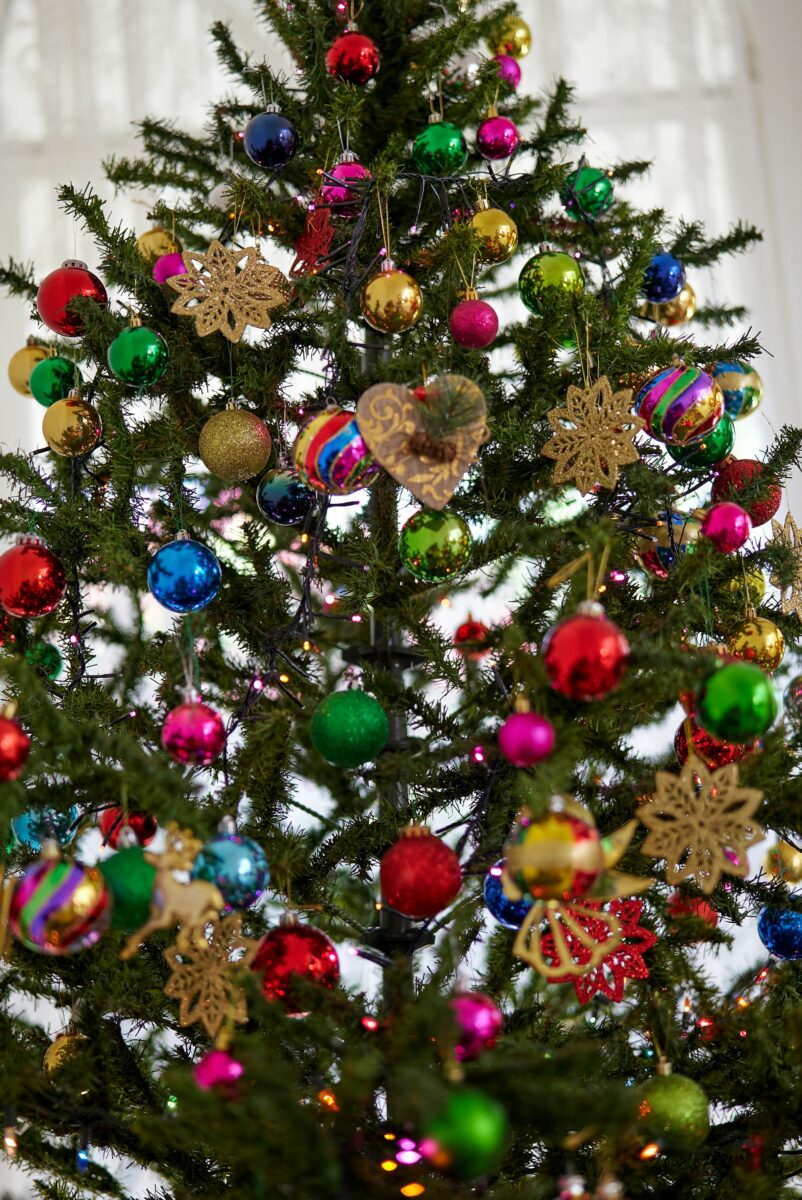

For 6 years I did the matching tree.
Gold and white one year.
Silver and blue the next, with every ornament from the same store aisle so nothing could possibly clash.
It looked nice.
It also looked like the lobby of a dentist’s office.
Then my sister dumped a shoebox of mismatched ornaments on my couch, stuff from our grandma’s house and three different thrift runs, and said “just hang them.”
I did.
Honestly, it was the first tree I ever sat and stared at with my coffee going cold.
So this one’s for you if you’re tired of one-color trees but scared of the “toddler decorated it” look.
A colorful tree can look planned.
You just need a few rules, and most of them are about counting, not taste.
Rainbow Order Is Easier Than It Looks

A rainbow tree sounds like the hardest version.
It’s actually the easiest, because the colors already know where to go.
Sort your ornaments into piles on the floor first: red, orange, yellow, green, blue, purple.
Pink can join red (sorry, pink).
It took me about 20 minutes with a coffee, and it’s the step that makes the rest fast.
Then pick a direction.
You can do horizontal bands, red at the top and purple at the bottom, or a slow spiral that wraps around the tree like a candy stripe.
I like the spiral better.
Bands make the tree look like a layer cake from across the room, and you notice right away if one band is thinner than the others.
A spiral hides that.
If your yellow pile is tiny, the eye just slides past.
One tip that saved me a lot of rehanging: put a few ornaments of each color into the neighbor’s band.
A couple of oranges in the yellow, a couple of greens in the blue.
The edges blur, and it reads as a rainbow instead of six stripes.
Jewel Tones for a Moody Living Room

If a full rainbow feels like too much, go deep instead of bright.
Think emerald and sapphire.
Ruby.
Maybe amethyst, with a bit of gold to warm it up.
These colors look rich at night, which is when you’ll actually be looking at your tree.
Jewel tones love a dark room or a room with lots of wood.
My living room has a brown leather couch I got off Facebook Marketplace and an old pine bookshelf, and a jewel tree sits in there like it was always meant to be.
A bright pastel tree in the same spot looked kinda lost.
Shiny glass is your friend here.
A deep red glass ball throws a little glow back at the lights.
Matte ornaments in dark colors can disappear into the branches, so keep them up near the tips where the light hits them.
Candy Colors and Pastels Without the Baby Shower Vibe

Pink, mint, butter yellow, baby blue.
A pastel tree is so pretty, and it can tip into gender reveal territory fast.
The fix is contrast.
Add one strong color that isn’t a pastel, like a hot pink or a cherry red, and use it sparingly.
Maybe one in every ten ornaments.
That little punch tells people it’s a choice, not a nursery.

Pastels also look better on a white or flocked tree than on a dark green one.
If you’ve got a white tree in the garage from some other year’s theme, this is its moment.
And if you’re working with a tiny rental and a small budget, a little pastel tree on a side table gives you the whole mood for very little money.
Multicolor Lights Never Really Went Away

Here’s a fun one.
The very first electric Christmas tree was colorful.
In December 1882, Edward H. Johnson, who worked with Thomas Edison, hand-wired 80 red, white and blue bulbs onto his tree at home in New York.
Each bulb was about the size of a walnut.
Then in 1895 the White House got its first electrically lit tree, with over a hundred multicolored lights.
Most families were still using candles, though.
Electric lights didn’t become the normal choice until about 1930.
So when someone tells you warm white is classy and colored lights are tacky, you can tell them colored lights got there first.
I’m only kind of joking.
Real talk, though.
Multicolor lights plus multicolor ornaments can turn into noise.
If your ornaments are already doing a full rainbow, warm white lights calm it down.
If your ornaments are jewel tones or pastels, multicolor lights look fantastic.
Pick one of the two to be loud.
Count Before You Hang Anything

This is the part nobody tells you.
A messy colorful tree is almost never a color problem.
It’s a numbers problem.
One red ball, three greens, a single lonely purple: that’s what looks random.
Our Christmas tree lights calculator uses about 100 lights per foot of tree height and about 20 ornaments per foot for a classic look.
So a standard 7 ft tree takes 700 lights and about 140 ornaments.
Mini lights usually sit 4 inches apart, so a set of 100 gives you about 33 ft of lit strand.
That’s why two boxes never cover a real tree.

Now do the rainbow math.
Seven colors into 140 ornaments is 20 of each.
Twenty of a color is plenty to repeat it all over the tree, so every color shows up everywhere you look.
That’s the whole trick to a colorful tree looking planned.
Sizes matter too.
The calculator splits those 140 ornaments into 28 large ones, 4 inches and up, then 56 medium and 56 small.
Put the big ones deep in the branches near the trunk, and save the small ones for the tips.
Big ornaments out on the tips make a tree look flat and kind of cheap, because you see every one of them at once from the couch.
Tucked in, they give it depth, and the small ones out front catch the light.
I rearranged mine twice last year before I believed this, and the second time I just pulled every large ball in by about 6 inches.
Night and day.
If you can’t get 20 of a color, drop the color.
Six strong colors beat seven where one is a ghost.
Thrift Store Glass Makes It Look Collected

I’ll be honest, my favorite colorful trees all have some old glass on them.
Faded pinks, a slightly dull teal, a red that’s gone almost orange.
New ornaments can’t fake that.
Colored glass ornaments have been an American thing for a long time.
Woolworth’s started selling glass ornaments from Lauscha, Germany, in 1880.
Then in 1937 Max Eckardt started Shiny Brite with Corning, which turned its light bulb machines toward making glass balls.
Those were the ornaments on a lot of grandma trees.
Here’s a fun thrift trick.
During World War II, metal was short, so Shiny Brite swapped the metal cap for a cardboard tab, and you hung it with a bit of string.
If you find a glass ball with a little cardboard tab at the top, it likely dates to the early 1940s.
Mix old with new.
I use the vintage glass in the middle of the tree at eye level, where people actually look, and fill the rest with cheap shatterproof balls in matching colors.
Biscuit has knocked the bottom row off twice already (tail, not malice), so nothing fragile goes below my knee.
One Ribbon Ties the Whole Tree Together

If your colorful tree still feels busy after all that, add one thing that repeats from top to bottom.
Usually that’s ribbon, and there are two ways to use it.
The loud way: cut short scraps of ribbon in every one of your colors and knot them onto the branch tips all over the tree.
Up close it’s a party.
From the couch it reads as one soft, ruffly texture, and it fills the gaps between ornaments for very little money.
Grab ribbon ends from a thrift store craft bin for this, nobody will know.

The calm way is one long ribbon.
Pick one that’s either neutral, like gold or cream, or one of your colors in a stripe or check.
Then wind it the same way all the way down, in a loose spiral like this one.
That steady line gives the eye a path, and suddenly 140 ornaments in seven colors look like they belong to each other.
Order matters here.
Lights go on first, then the garland or ribbon, then the ornaments.
I did it backwards one year and spent 3 hours on a Saturday night unhooking glass balls to feed ribbon behind them.
Don’t be me.
If you’d rather have a warmer, two-color version of this idea, my gold and red Christmas tree post walks through it.
Let the Kids’ Ornaments In

Here’s where a colorful tree really wins.
On a matching tree, a lopsided felt star or a salt dough handprint sticks out.
On a colorful tree, it just fits.
My niece made me a pipe cleaner candy cane 4 years ago.
It’s bent, it’s sparkly, and it goes front and center every year.
Honestly, it gets more compliments than anything I paid for.
If you want ideas for easy ones, my roundup of Christmas ornaments for kids has plenty.
Bright felt, painted wood and beads all match a rainbow tree without trying.
Keep the Topper and the Skirt Simple

With this much color on the branches, the topper and skirt should calm down.
A plain gold or silver star works with every palette above.
So does a big bow in your ribbon.
Measure before you buy a tall one, though.
You want at least 6 inches between the top of the tree and the ceiling for the topper.
Under an 8 ft ceiling, that makes a 7.5 ft tree the tallest that fits, and a big star needs even more room.
Same with the skirt.
A plain cream knit, a basket collar or a simple burlap wrap lets the tree be the star.
A patterned skirt plus a rainbow tree is where it starts looking like a toy store.
And please, once it’s all up, turn off the overhead lighting.
A colorful tree under a ceiling light looks like a craft store aisle.
In a dark room with one lamp on, those colors glow.
That’s the tree you’ve been picturing.
Want something a little more retro?
My tinsel Christmas tree ideas pair really well with a colorful palette, especially with old glass.
Related read: Things I Wish I Knew Before I Decorated My First Home — Instant PDF + Kindle download. Secure checkout by Stripe