
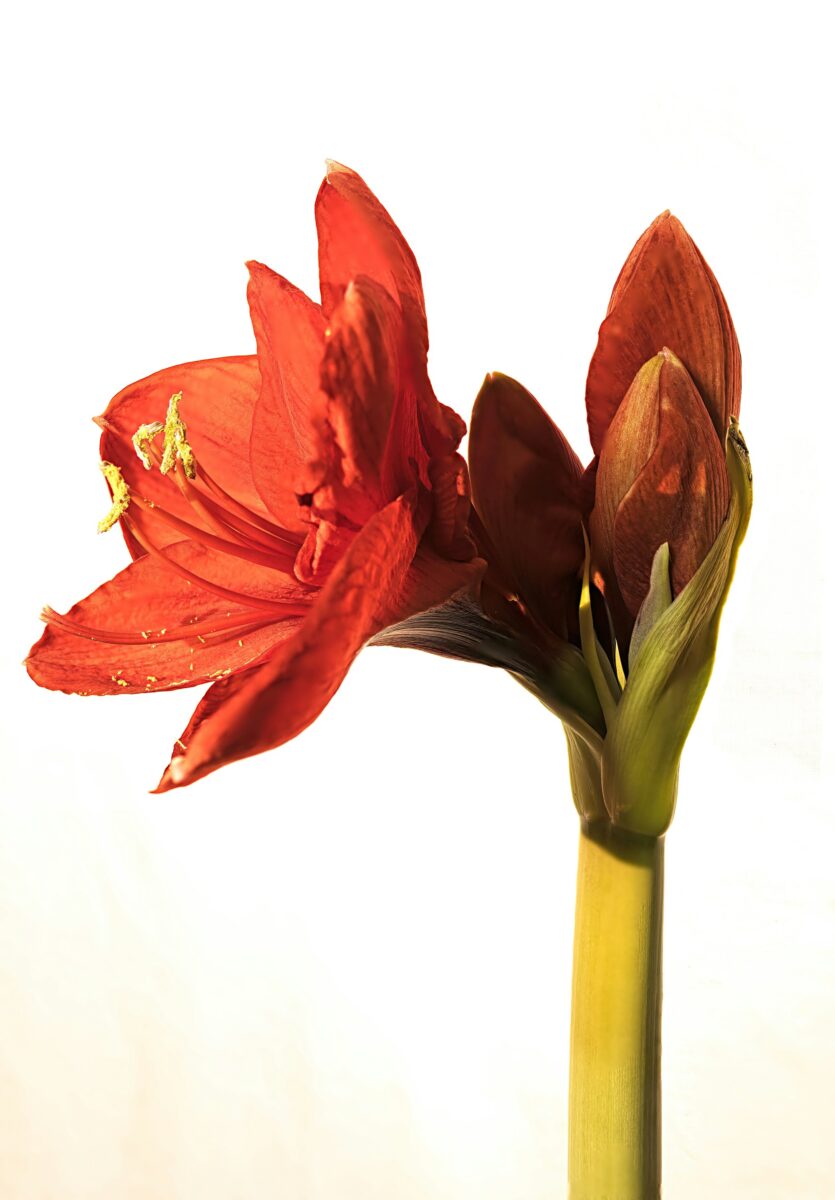

Amaryllis is the one Christmas flower you grow yourself, and it’s kind of a race against the calendar.
A bulb potted in the third week of November usually opens its first flower somewhere between mid-December and mid-January.
Christmas sits in the early part of that window.
Possible, not promised.
Luckily, nearly everything that decides which end of the window you hit is in your hands: the bulb you buy, the pot, the warmth of the room and how much sun it gets.
Here’s how I’d stack the odds, plus a backup plan so you’re not staring at a green stalk on Christmas morning.
The Calendar Math for a Christmas Bloom

Most amaryllis bulbs bloom four to eight weeks after you pot them up.
The flower stalk shows up first, and the buds take the rest of that time to fatten up and open.
Count from the day it goes into soil and gets its first drink.
A bulb sitting in its box on the counter is still dormant, so those days don’t count.
Pot one on November 21 and the early end of that range is December 19.
The late end is January 16.
That’s why I’d plant one now and a second one the first weekend of December.
The first has a real shot at Christmas, and the second one carries the table into January, when the house feels kinda bare after the tree comes down.
Already into December?
Then skip the bare bulb and buy a potted one with the stalk up and the buds already showing color.
Garden centers and grocery stores sell them ready to bloom around the holidays, and that plant has done most of its growing for you.
No shame in that.
Buy the Biggest Bulb Your Budget Allows

Amaryllis bulbs are sold by size, measured around the middle in centimeters, and that number is basically a promise about flowers.
A bulb that measures 30 to 32 cm usually sends up two stalks with three or four flowers on each.
A bigger one is a year older and can push up three stalks with four or five blooms apiece.
So I’d rather spend the budget on one giant bulb than on three small ones.
One big pot with two tall stalks on your coffee table looks like it came from a florist.
Three skinny ones look like a science project, and not the fun kind.
Give it a squeeze before you buy.
A healthy one feels firm and dry, like a good onion (odd comparison, but it works), with no mold, soft spots or cuts.
If you can peek under a dry outer layer, look for red streaks deep inside, because that can mean red blotch, a fungus that leaves the stalk weak and easy to snap.
A bit of red on the papery outside skin is usually just surface marking.
A Snug, Heavy Pot With Half the Bulb Showing

Amaryllis likes a tight pot.
Pick one only an inch or two wider than the bulb at its widest point, with a drainage hole in the bottom.
A slightly cramped root ball is exactly what this plant wants, and a big pot full of wet soil is how bulbs rot.
It feels wrong, I know.
Trust it anyway.
Go heavy, too.
A stalk with four open flowers on top gets surprisingly top-heavy, and a light plastic pot will tip right off a windowsill.
This is my favorite thrift store job: a chunky ceramic or stoneware pot for a few dollars.
No hole in it?
Slip a plastic nursery pot inside and you’re set.
Set the bulb so the top third to half of it sits above the soil, and leave about an inch between the soil and the rim so water has somewhere to go.
Keeping that neck dry helps keep red blotch away.
Any well-drained potting mix is fine, and if you’re mixing your own, half peat and half perlite is the classic.
Water Once, Then Wait a Week

Right after planting, water it well and let it drain completely.
Then leave it alone for a full week.
A bulb with no leaves can’t use much water yet, and soggy soil is the fastest way to lose the whole thing.
No splash every morning, no “just a little.”
Not even on day three, when the top of the pot looks bone dry.
After that first week, keep the soil barely moist and empty the saucer every single time.
Once the buds open it drinks more, and watering once or twice a week, whenever the top of the soil feels dry, is about right.
Hold off on plant food, too.
I know, it’s tempting.
Feeding a bulb before it has leaves can burn the brand-new roots.
Once it’s growing, a liquid houseplant food mixed at the strength on its label, once or twice a month, is plenty.
Real Sun, Not Your Overhead Lighting

Overhead lighting is a crime in general, and for an amaryllis it’s flat-out useless.
This plant wants at least four hours of direct sun a day, so the best spot is a south-facing window, with east or west as a solid second choice.
A lamp in the corner of your living room isn’t going to cut it.
If your windows are dim all winter, these plants for a dark room will be a lot happier there.
Give the pot a quarter turn every few days.
The stalk grows toward the light fast, and if you forget for a week it leans like it’s trying to see out the window.
Warmth is the other lever you control.
Keep the room somewhere between 65°F and 75°F while it grows, and the warm end moves things along.
Push it much hotter and you get a weak, floppy stalk with smaller flowers.
So don’t park it on the radiator to beat the calendar, and keep it away from heaters and air vents.
Stake It Before It Flops

Those stalks get tall, anywhere from one to three feet depending on the bulb.
Put the stake in while the stalk is still short, so you’re not spearing roots later, and tie it loosely with soft twine as it grows.
A plain green bamboo stake does the job.
A thin birch branch or a straight twig from the yard looks a lot prettier (and costs nothing).
Tuck a little moss over the soil and the whole pot reads as styled instead of “bulb in dirt.”
If a stalk bends too far anyway, don’t toss it — cut it and stand it in a vase of water.
The flowers keep opening, and a single amaryllis stem in a tall glass bottle is gorgeous on a mantel.
For more ways to work it in with greenery and berries, these Christmas flower arrangements go well past the usual poinsettia.
Make the Flowers Last Through the Holidays

The moment the first flower opens, move the pot somewhere cooler and out of direct sun.
Around 60°F to 65°F makes the blooms last noticeably longer.
An entry table near the door or a cool guest room works great, and since each flower can be about 6 inches across, even one stalk fills the spot.
A pot of them is a lovely start to a Christmas entryway table.
Pinch off each flower as it fades, along with the little swollen green bit right under it.
That way the plant isn’t wasting energy on seeds.
Don’t touch the stalk itself until it’s turning yellow.
One safety note if you share your home with a dog or a cat: amaryllis is toxic to both, and the bulb is the worst part.
Put it somewhere a curious nose can’t reach, and call your vet if you think they’ve chewed on it.
Plan B: A Bulb in Water or a Waxed One
No pot?
You can grow one in water.
Fill the bottom of a tall clear vase, like a hurricane glass, with about 3 inches of pebbles, set the bulb on top, and add more pebbles around its sides so the top third still shows.
Keep the water about an inch below the bulb so it never sits in it.
Honestly, watching the roots snake through the pebbles is half the fun.
The catch is that a bulb grown in water won’t bloom in water again.
Pot it up after it flowers, or think of it as a one-season thing.
Waxed bulbs are the zero-effort version.
They come dipped in colored wax with everything they need already stored inside, so you never water them.
They’ll still want light and warmth, and you’ll usually get about two stalks.
They’re meant to be thrown out after they bloom, which is why I’d treat one as a hostess gift and grow a potted bulb if you want flowers again next year.
Keep the Bulb for Next Christmas

This is the part almost nobody does, and it’s the best budget move with this plant.
The same bulb can flower again next winter, and it gets a little bigger every year.
When the flowers are done, cut the stalk a few inches above the neck of the bulb but keep every leaf.
Move it back to your sunniest window and feed it once a month.
Water whenever the top of the soil dries out.
Those leaves are what’s building next year’s flowers.
After your last frost, it can spend the summer outside, in shade at first and then in six or more hours of full sun.
Then comes the rest, which is honestly the easiest part, since you mostly do nothing.
Bring it in before any frost, stop watering and feeding, and park it somewhere cool and dark, like a closet or a basement at 45°F to 55°F, for 8 to 10 weeks.
Once it comes back into the light and gets water again, flowers usually follow in four to six weeks.
Count back from December 25 and the whole cycle takes 12 to 16 weeks, so the rest should start sometime in September.
Put a reminder in your phone this weekend, because “I’ll remember in September” is how good bulbs end up in the trash.