
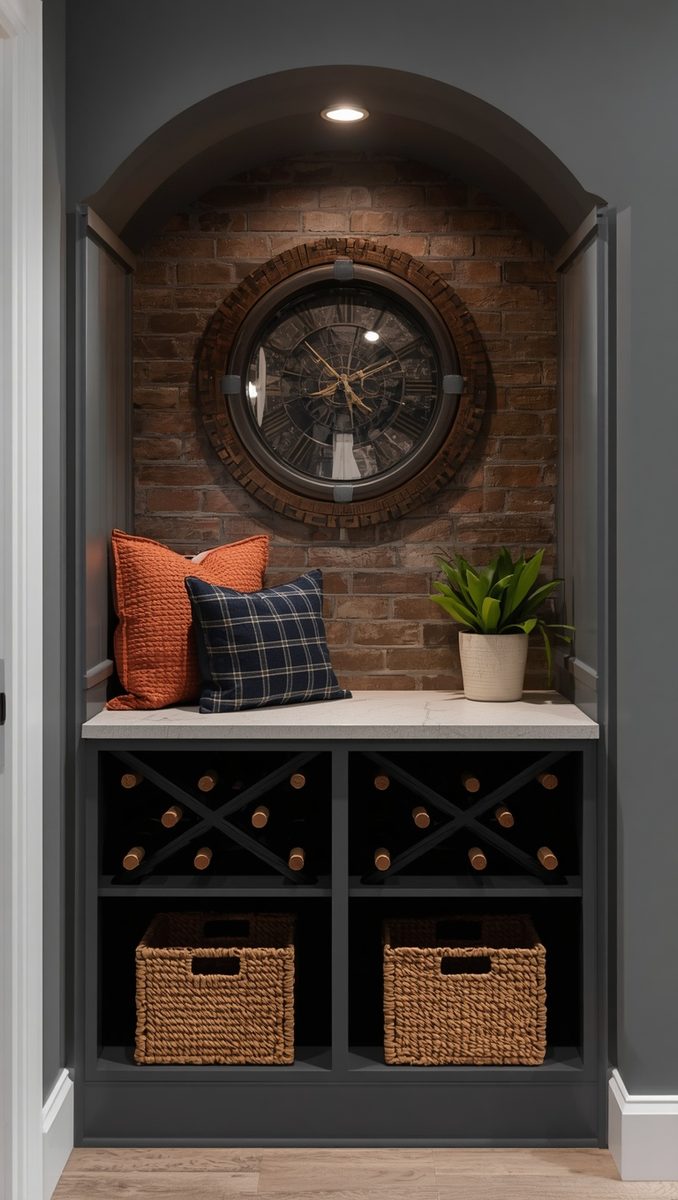
I used to feel a tiny pang of jealousy every time I saw one of those moody, stone-walled wine cellars on someone’s home tour.
My house has zero basement, zero extra room, and definitely zero space for rows of dusty bottles behind glass.
So for years I just shoved my wine in a kitchen cabinet next to the cereal boxes, and honestly, it made me kind of sad.
Then one Tuesday I got tired of that sad little cabinet and decided my wine deserved a real spot, even a small one.
What I found out is that you do not need a cellar to make your wine feel special.
You just need one cozy corner and a little bit of intention.
So grab your favorite bottle, pour a glass, and let me walk you through the nooks that changed my whole relationship with wine storage.
Tuck It Under the Stairs

If your home has a staircase, you are sitting on hidden gold and you might not even know it.
That little triangle of space under the stairs is almost always wasted, usually filled with shoes or forgotten holiday decor.
When I finally cleared mine out, I found enough room for a slim wine rack and two glasses hanging upside down.
It felt like discovering a secret room in my own house.
The reason this works so well is that it is already enclosed, so it naturally feels tucked away and a little bit special.
My tip here is to add a small warm bulb or a strand of little lights inside.
It turns a storage spot into a moment, something you actually want to walk past and glance at.
You can go moody and dark with deep green paint, or keep it bright and airy with white shelving.
Either way works, it just depends on the vibe of your entryway.
If your stairs are open underneath instead of closed, you can still do this with a simple wine cabinet slid right into that triangle.
I am kind of obsessed with how finished it makes an awkward space look.
It is one of those fixes where guests ask “wait, was this always here?”
And that reaction alone makes it worth the weekend project.
Give the Kitchen Counter a Bar Cart Moment

Not everyone has room for a built-in anything, and that is totally fine.
A bar cart is honestly the easiest wine nook there is, because it rolls, it is affordable, and it takes zero construction.
When I got mine, I put it in the corner near my kitchen window where the afternoon light hits it just right.
There is something so soft and pretty about sunlight catching a wine glass, it genuinely makes we want to sit down and stay a while.
I load the top shelf with two or three bottles standing up, plus a small dish for a corkscrew and a cute little coaster stack.
The bottom shelf holds glasses and a cloth napkin or two, folded loosely, not fussy.
A bar cart works because it is flexible, you can roll it to the living room for movie night or park it by the door for a party.
My favorite variation is a vintage brass cart, it feels a little old world and glamorous without trying too hard.
If brass is not your thing, a matte black cart feels more modern and moody.
A wood cart feels warmer and more farmhouse, softer somehow.
Whatever you choose, keep it a little imperfect, a slightly crooked napkin or an uneven bottle placement makes it feel lived in.
That lived-in feeling is honestly the whole point.
Turn a Wall Niche Into a Mini Display

A lot of homes have these strange little wall niches that nobody knows what to do with.
Mine used to hold a sad fake plant and some mail I kept forgetting to deal with.
So I cleared it out and added two thin floating shelves, just wide enough for a bottle to lay on its side.
Now it is the first thing people notice when they walk into my dining room.
The reason a niche works so beautifully is that it already has built-in architecture, so it feels intentional instead of like an afterthought.
I lined the back of mine with a soft grasscloth wallpaper in a warm oatmeal tone.
That little texture change makes the whole nook feel expensive, even though the wallpaper scrap cost me almost nothing.
My tip is to keep the shelf spacing tight, you want it to feel curated, not like a random display.
Three or four bottles max, plus maybe one small piece of art or a candle.
If your niche is deeper, you could add a tiny bistro-style shelf and a couple of stemless glasses.
I love that variation for a more casual, easy-breezy feel.
Either way, this is one of those ideas where the space was already there, waiting for you to notice it.
Build a Nook Around Your Wine Fridge

If you already own a small wine fridge, you might be tucking it somewhere random, and that breaks my heart a little.
Mine used to just sit on my kitchen floor like an appliance nobody invited to the party.
Then I built a slim wood frame around it, added a shelf on top, and suddenly it looked like custom cabinetry.
The transformation honestly shocked me.
The reason this matters is that a wine fridge on its own feels utilitarian, but framed in, it feels designed.
I added a floating shelf right above mine for glasses and a small vase of dried flowers.
That little vase changes everything, it softens the whole look and makes it feel like a real vignette instead of an appliance corner.
My tip is to match the wood tone to your existing cabinets if you can, even a light stain will tie it together.
If you rent and cannot build anything permanent, a simple wooden crate turned on its side works as a stand-in frame.
It is not fancy, but it gets you eighty percent of the cozy factor for almost no effort.
I love this option because it solves two problems at once, you keep your wine at the right temperature and you get a pretty little feature in the same breath.
That is a win in my book.
Style the Space Above Your Fridge

This one feels a little unexpected, but I promise it works.
The awkward gap above a kitchen fridge is almost always wasted, usually collecting dust or random boxes nobody opens.
I cleared mine out and added a slim floating shelf just for wine.
Now it is one of those little details that makes my kitchen feel finished, even though it barely took any effort.
The reason it works is that it uses height you already have, so you are not sacrificing counter space or floor space at all.
I keep three bottles lying on their sides up there, plus a small strand of dried eucalyptus draped along the edge.
That little greenery softens the hard edges of the appliance below it.
My tip is to keep the shelf shallow, you do not want bottles feeling like they might tip.
A shallow lip or a tiny raised edge on the shelf gives you peace of mind.
If your ceilings are lower, skip this one, you do not want it feeling cramped or bumping your head.
But if you have that extra breathing room, it is such an easy, almost invisible upgrade.
It is the kind of detail nobody notices right away, but everybody feels.
Dress Up a Dining Room Sideboard

A sideboard is one of those pieces that quietly does a lot of work in a room.
Mine sits against my dining room wall and used to just hold placemats and candles, which is fine, but a little boring.
So I cleared one end and dedicated it to a small wine station, bottles, a few glasses, a little tray for the opener.
It instantly made my dining room feel like a place people wanted to linger in.
The reason this works so well is that a sideboard already reads as furniture, not storage, so it elevates whatever you put on it.
I added a woven tray underneath the glasses to keep the surface from feeling scratched or messy.
That tiny styling choice makes cleanup so much easier too, you just lift the whole tray.
My favorite variation is adding a small mirror above the sideboard, it bounces light around and makes the glass sparkle a little at night.
If you host often, keep a linen napkin folded nearby, it makes wiping a drip feel effortless instead of frantic.
I genuinely look forward to pouring a glass from this spot after a long day.
There is something so grounding about a little ritual like that.
Add a Ledge in an Awkward Hallway

Hallways are so underrated, and mine used to feel like pure dead space.
It was just a stretch of wall between my kitchen and living room, nothing on it, nothing happening.
So I added a narrow ledge, barely six inches deep, just wide enough for two or three bottles to lean against the wall.
It completely changed how that hallway feels to walk through.
The reason a ledge works in tight spots is that it barely eats into your walking space, so it feels like a bonus, not a squeeze.
I leaned a small framed print next to the bottles, tilted slightly, very casual.
That slight tilt is what makes it feel curated rather than staged.
My tip is to keep the ledge thin and simple, a chunky shelf in a narrow hallway can feel heavy and closed in.
If your hallway gets any natural light at all, even a sliver, put the ledge there.
Watching the light hit the glass in the afternoon is such a small, quiet joy.
It is the kind of detail that makes a hallway feel like part of your home instead of just a pass-through.
Convert a Corner of the Pantry
If you are lucky enough to have a pantry, even a small one, there is probably a corner being wasted on random appliances or extra bags.

Mine had a weird gap next to my baking sheets that never really held anything useful.
I added a slim vertical wine rack right into that gap, and it fit like it was made for it.
The reason this works is that pantries are already climate controlled and a bit dim, which is actually kind of ideal for wine.
I keep my everyday bottles here, the ones I grab on a random Wednesday, not the special-occasion ones.
My tip is to label a small shelf tag if you like to keep reds and whites separated, it saves you from digging around.
If your pantry has a door, even better, it keeps the whole thing feeling hidden and tidy.
A cute vinyl label or a chalkboard tag adds a little personality without much effort.
This is such a low-key option, but I love how it frees up actual kitchen counter space.
It just quietly does its job in the background.
And honestly, that is sometimes exactly what a home needs.
Turn an Old Armoire Into a Wine Cabinet

I found an old armoire at an estate sale a few years back, and it sat empty in my garage for way too long.
One weekend I finally hauled it inside and turned it into a full wine cabinet, shelves, glass racks, the whole thing.
It became one of my most complimented pieces almost overnight.
The reason an armoire works so well is that it has real presence, it does not read as storage, it reads as a statement piece.
I painted mine a soft sage green and swapped the hardware for simple brass pulls.
That small hardware change made it feel brand new without a full renovation.
My tip is to add a strip of battery-powered lights inside, so when you open the doors, it glows just a little.
It is such a small touch, but it makes opening it feel like an event every single time.
If painting feels like too much commitment, a simple wood stain refresh does wonders too.
A vintage armoire like this also hides so much, cords, extra glasses, even a small ice bucket if you want to go all in.
I love that it looks like an heirloom, even though mine cost me next to nothing.
Sometimes the best pieces are the ones nobody else wanted.
Use a Bay Window Ledge

If your home has a bay window, you already have one of the coziest little display spots built right in.
Mine sits in my living room and used to just hold a lonely potted plant.
I added a slim wooden tray, two glasses, and a bottle resting at an angle, and it transformed that whole corner.
The natural light pouring in makes the glass and the liquid inside almost glow in the late afternoon.
The reason this spot works so well is that it is already a little architectural feature, so anything you place there feels intentional.
My tip is to keep it minimal here, one bottle, two glasses, maybe a small candle.
Too much clutter on a window ledge blocks the light and takes away the whole magic of it.
If you have deep window seat cushions, this becomes the ultimate little wind-down spot after a long day.
I have spent so many quiet evenings right there, just me, a glass, and the last bit of daylight.
It is such a simple setup, but it feels like a whole mood.
That is the kind of thing I chase in my own home.
Style a Basement Landing Nook

Even without a full cellar, a lot of homes have a landing or a small flat spot at the bottom of basement stairs.
Mine was just an empty corner for years, kind of forgotten and a little dark.
I added a small round table, a single shelf on the wall, and a warm little lamp, and it became an actual destination.
Now it is where I keep the bottles I am saving for something special.
The reason this spot works is that basements naturally run cooler, which is honestly great for wine even without full cellar conditions.
My tip is to add a small rug underneath, it keeps the space from feeling cold or unfinished.
A warm-toned lamp does so much heavy lifting here too, it turns a dim corner into something inviting instead of gloomy.
If your landing gets zero natural light, lean into a moodier vibe, dark walls, warm bulbs, maybe a small piece of art.
I actually love how that moodiness makes the wine feel a little more special, like it is being saved for a reason.
This nook is proof that even the most overlooked corner of your house can become something you genuinely love.
You just have to give it a little attention.
Create a Tiny Nook With a Wall-Mounted Rack

Sometimes the smallest solution is the best one, and a simple wall-mounted rack is about as small as it gets.
I added mine to a blank strip of wall in my kitchen that had nothing else going on.
It holds four bottles at a slight angle, and that is genuinely all the space it needed.
The reason this works so well for tiny homes is that it takes up almost no depth, just a few inches off the wall.
My tip is to hang it at eye level, not too high, so it actually feels like a feature and not an afterthought stuck near the ceiling.
I chose a matte black rack because it felt sleek against my white kitchen wall.
A wood version would feel warmer if your kitchen leans more farmhouse or cottage style.
If you want to dress it up, add one small shelf above it for a candle or a little framed print.
That tiny addition makes the whole thing feel finished instead of just functional.
This is the option I recommend to anyone who tells me they truly have no space at all.
Because if you have four inches of blank wall, you have room for this.
And that is kind of the whole point of everything I just shared with you, so go find your little corner and make it yours.