

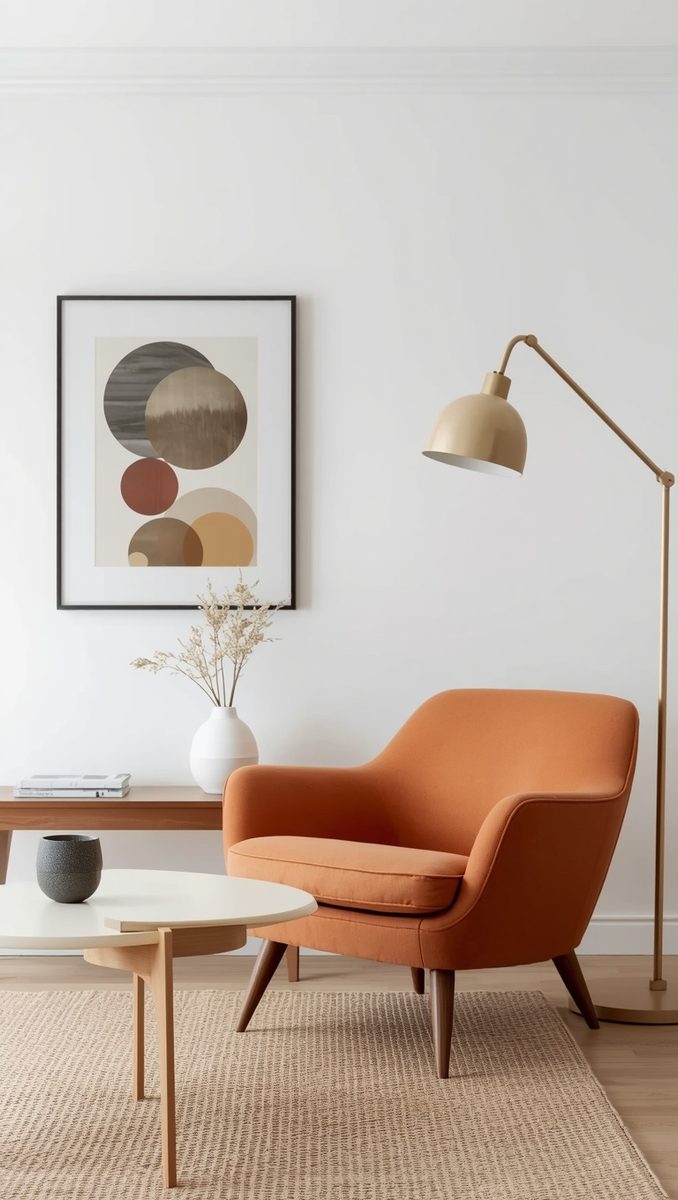
I used to think minimalism meant white walls, a single gray couch, and absolutely nothing on the shelves.
And for about six months, I lived exactly like that.
My living room looked like a furniture showroom nobody wanted to sit in.
It photographed beautifully.
But every time I walked in after a long day, I felt this weird flatness in my chest, like the room didn’t want me there.
That’s when I realized something nobody tells you about minimalism: empty is not the same thing as calm.
Calm has warmth in it.
Calm has texture, a little clutter of the good kind, a candle that’s always half burned down because you actually light it.
So I slowly rebuilt my space around a new rule, less stuff, but more soul.
And that’s exactly what I want to walk you through today, room by room, feeling by feeling.
Start With Texture, Not Emptiness

Here’s the thing I got wrong first.
I thought minimalism meant subtracting until there was nothing left.
But a bare room isn’t peaceful, it’s just bare.
The rooms that actually calm you down have layers, a chunky knit throw, a nubby linen pillow, a wood bowl with some weight to it.
When I added a raw-edge wool throw to my “perfect” empty couch, the whole room exhaled.
I’m not kidding, it was that immediate.
Texture is what your eye and your hand both crave, even if you can’t name why.
So my rule now is simple: if a surface is flat, smooth, and shiny with nothing else nearby, it needs one textured friend.
Think boucle, raw wood, unglazed ceramic, linen with visible slub.
My favorite cheap trick is a vintage-style ceramic vase, even empty, it catches light in a way that plastic or glass never does.
If I had a small apartment living room right now, this is the very first thing I’d fix.
Not the paint color.
Not the furniture.
Just texture, layered in slowly, one piece at a time.
You don’t need to buy it all at once either.
Honestly the slow build is part of what makes a home feel lived-in and loved, not staged.
Let Warm Light Do the Emotional Heavy Lifting

Cold minimalist rooms almost always have one thing in common, harsh overhead lighting.
You know the kind, that flat white glow that makes everything look like a dentist’s office.
I switched every single overhead bulb in my house to warm white, and it changed the mood of every room instantly.
But bulbs alone aren’t the whole story.
Lamps matter so much more than people think.
I have at least one lamp in every room now, sometimes two, placed low, at seating height, not up high.
There’s something about light coming from below eye level that feels like a hug instead of an interrogation.
My favorite is a small rattan or linen-shade lamp on a side table, it softens everything around it.
And candles, don’t skip candles, even unlit ones sitting on a tray add warmth just by existing.
If your room still feels sterile after decluttering, check your lighting before you buy another single thing.
It’s honestly the cheapest fix with the biggest emotional payoff.
I promise you, dim the overhead light tonight and just sit with a lamp on instead.
You’ll feel the difference in your shoulders before you can even explain why.
Choose a Warm Neutral Palette, Not Just White

White walls became the unofficial uniform of minimalism, and I get why.
They photograph clean, they feel “safe,” they go with everything.
But stark white can read cold, clinical, almost unfinished if you don’t layer warmth around it.
When I repainted my hallway from bright white to a soft warm greige, I actually gasped a little at how much cozier it felt.
Same furniture, same layout, completely different emotional temperature.
My go-to palette now is warm neutrals only, think oat, sand, terracotta, warm taupe, soft cream.
These colors have a little yellow or red undertone hiding in them, which is what makes them feel sunlit even on a gray day.
If you’re not ready to repaint, start with textiles.
A warm ochre pillow or a rust-colored throw can shift a whole white room without touching a wall.
I also love a creamy off-white instead of bright white for trim, it’s such a small change but it softens every corner of a room.
Cool grays and true whites have their place, sure.
But if your goal is “calm,” warmth almost always wins over crispness.
Trust your gut here, if a paint chip makes you feel a tiny bit hugged just looking at it, that’s usually the one.
Keep Surfaces Curated, Not Cleared

There’s a difference between “curated” and “cleared,” and it took me way too long to learn it.
Cleared means nothing on the counter, nothing on the shelf, nothing anywhere.
Curated means a few meaningful things, arranged with intention, breathing room around each one.
My kitchen counter used to be completely bare, and honestly, it felt unfinished, like I’d just moved in and forgotten to unpack.
Now I keep one wooden cutting board leaning against the backsplash, a small plant, and a ceramic crock with my favorite cooking utensils.
Three things.
That’s it.
But it makes the whole kitchen feel like someone actually lives there and loves it.
The trick is odd numbers and varied heights, one tall item, one short, one in between.
I also love grouping by material, wood with wood, ceramic with ceramic, so nothing feels random or thrown together.
If a shelf feels sterile, try this: put half as many items but let them each have a story.
A bowl from a trip.
A candle someone gave you.
A stack of two or three books you genuinely reread.
Curated says “I chose this on purpose.”
Cleared just says “I removed everything and gave up halfway through.”
Bring In Living Things, Even Fake Ones Count

I’ll admit it, I’ve killed more plants than I care to count.
But even one plant, real or a really good faux one, changes a room’s whole personality.
There’s something about a green, living shape that softens hard edges and straight lines instantly.
My entryway had this awkward empty corner for months, just dead space that made the whole area feel unfinished.
I put a tall fiddle leaf fig there, faux, because I have zero faith in my plant parenting, and suddenly that corner became my favorite part of the house.
Plants add movement too, even a fake one sways a little when you walk by, and that tiny bit of motion makes a room feel alive instead of staged.
If you’re a real-plant person, pothos and snake plants are famously hard to kill, and they still give you that lush, soft texture.
I like mixing a few different plant heights on a windowsill instead of one lonely pot.
It reads more like an actual home and less like a furniture catalog page.
Even dried stems in a simple vase count here, they’re low maintenance and add that same organic softness.
The goal isn’t a jungle.
It’s just proof that something is growing, breathing, alive in the space you spend your life in.
Layer Rugs Instead of Leaving Floors Bare

Bare floors are a classic minimalist move, and I used to think they were the “correct” choice.
But cold floors, literally and emotionally, are one of the fastest ways to make a room feel unfinished.
A rug does something magical, it defines a space, softens footsteps, and adds warmth underfoot in a way nothing else quite does.
When I added a jute rug under my coffee table, the whole living room suddenly felt anchored, like it finally knew what it was trying to be.
My rule now is simple, if you can see more than half the floor in a seating area, it probably needs a rug.
Natural fibers like jute, sisal, or wool keep that earthy, warm minimalist feeling without looking busy or overdone.
I also love layering a smaller vintage-style rug over a larger neutral one, it adds a lived-in, collected feeling instantly.
If budget is tight, a rug is honestly where I’d spend money before almost anything else.
It affects how a room feels under your bare feet every single morning.
And that’s such an underrated part of comfort.
Cold hardwood under your toes at 6am hits so differently than a soft, warm rug.
Small detail, but I promise you’ll notice it daily.
Mix Old and New So Nothing Feels Showroom-Perfect

Here’s a confession, my first minimalist attempt looked like I’d bought every single item from one store, on the same day.
It felt sterile because, well, it basically was.
Nothing had history, nothing had a story, nothing looked like it belonged to an actual person’s actual life.
The fix was mixing in vintage or secondhand pieces alongside newer things.
I found a slightly worn wooden side table at a flea market, and it instantly made my very “new” living room feel grounded and real.
Perfect, matchy furniture sets can look impressive in photos, but they rarely feel warm in person.
A little imperfection, a scuff, an uneven finish, a piece that’s clearly lived a life before you, adds so much soul.
My favorite combo is one or two statement vintage pieces mixed with simple, newer basics around them.
It keeps the space from feeling like a catalog spread while still staying clean and calm.
Thrift stores, estate sales, even a family hand-me-down all work here.
If you inherited a slightly outdated dresser, don’t rush to replace it.
Sometimes a little sanding, new hardware, or just leaving it as-is is exactly the character your room was missing.
Perfection is what makes a space feel cold.
Imperfection, chosen thoughtfully, is what makes it feel like home.
Let Every Room Smell Like Something

This one surprised me the most, honestly.
Scent is so tied to feeling, and a room with no scent at all can feel strangely sterile, almost clinical.
I started keeping a simple wood-wick candle burning in the evenings, and it changed how the whole house felt the second I walked through the door.
Warm scents work best for this cozy-minimalist vibe, think vanilla, sandalwood, amber, warm cedar.
Avoid anything too sharp or clinical, like strong citrus or that “clean linen” smell that honestly just smells like a hospital to me.
A diffuser with a warm woody oil works if candles aren’t your thing.
Even simmering cinnamon and orange peel on the stove for twenty minutes does something to a room that I can’t fully explain, it just feels inhabited.
My personal hack is scenting one main room, usually the living room, so that walking in feels like a little emotional reset every time.
I don’t need every room to smell like something.
Just one, consistently, is enough to set the tone for the whole house.
Scent gets remembered by your brain in this deep, emotional way that visuals don’t quite match.
So if your home still feels a little cold after all the visual changes, this might be the missing piece.
Choose Furniture With Curves, Not Just Straight Lines

Straight lines and sharp angles are everywhere in modern minimalist design, and on their own, they can feel a little harsh.
I noticed this most with my old glass coffee table, all edges, all angles, zero softness.
When I swapped it for a rounded wood coffee table, the whole room’s energy shifted, it felt gentler almost immediately.
Curves mimic natural, organic shapes, and our brains respond to that with a sense of ease.
I’m not saying every piece needs to be round.
But mixing in even one or two curved elements, a rounded mirror, an arched doorway shape, a curvy vase, softens a whole room full of straight-edged furniture.
My favorite is a curved-back accent chair, it becomes this little sculptural moment in an otherwise simple room.
If you’re furniture shopping, try to picture the silhouette against a plain wall.
Sharp and boxy reads modern but cold.
Soft and rounded reads modern but warm.
Small shift, big emotional difference.
I promise once you start noticing this, you’ll see it everywhere, in the homes that feel like a warm hug versus the ones that feel like a museum.
Don’t Skip the Bedroom, It Sets Your Whole Day’s Tone

We spend so much energy on living rooms and kitchens, and then completely neglect the bedroom.
But your bedroom is the first and last space you experience every single day.
If it feels cold and sterile, that’s genuinely how you start and end every day, whether you notice it consciously or not.
I used to have an all-white bedroom, crisp sheets, bare walls, very “minimalist magazine.”
It looked amazing in photos and felt oddly lonely to actually sleep in.
I added a warm wool throw at the foot of the bed, linen curtains instead of the plain white blinds, and a small lamp with an amber-toned bulb on my nightstand.
Tiny changes, but the whole room suddenly felt like it was holding me instead of just containing me.
My best tip here, layer your bedding in at least two or three warm tones instead of one flat color.
A cream duvet with a rust-colored throw and a woven cream pillow instantly feels richer than an all-white bed.
And please, get a warm bedside lamp.
Overhead lighting in a bedroom at night is such a mood killer.
This room deserves the softest version of everything you’ve done throughout the rest of the house.
Use Baskets and Boxes to Hide, Not Just Store

Minimalism gets a bad reputation because people assume it means having nowhere to put your actual stuff.
But real life has stuff, chargers, remotes, mail, that one drawer of mystery items we all have.
The trick I use now is woven baskets and lidded boxes, placed intentionally, doing double duty as both storage and texture.
A large woven basket next to my couch holds blankets, and it looks like a styling choice, not clutter control.
A lidded rattan box on my console table hides remotes and random mail, while still looking like a decor piece.
This is honestly the secret to keeping a warm minimalist home functional instead of just pretty and impractical.
I like natural materials here specifically, rattan, seagrass, woven wood, because they add that same organic texture we talked about earlier.
Plastic bins do the same job but they kill the whole warm vibe instantly.
My rule of thumb, if you can see it from the main seating area, it should be a material that adds warmth, not just function.
Everything that needs hiding still gets hidden.
It just gets hidden beautifully instead of shoved in a closet you’re embarrassed to open.
Personal Photos and Art Are Not the Enemy of Minimalism

I think this is the biggest myth in all of minimalist design, that photos and personal art make a space too busy.
An empty gallery wall is not more peaceful, it’s just more empty.
What actually calms us is seeing evidence of a life we love, faces we recognize, places we’ve been.
I kept one large piece of art in my living room, and one small cluster of three family photos in simple matching frames near the entryway.
That’s genuinely all it took to make the whole space feel like mine instead of a hotel lobby.
The trick to keeping it minimal is consistency, matching frame colors, similar sizes, one clear grouping instead of scattered pieces everywhere.
I also love a single oversized art print instead of a bunch of small mismatched ones, it makes more of an emotional statement with way less visual noise.
If you have kids, one small rotating frame just for their art keeps it from taking over every surface.
The goal isn’t zero personality.
It’s edited personality, a few things, chosen with real intention, instead of everything you’ve ever collected.
Your home should tell people who lives there.
A truly empty space doesn’t tell anyone anything at all.
Give Yourself Permission to Add Things Back Slowly

If you’ve already gone full minimalist and now everything feels a little too stark, please don’t panic and buy a whole new house’s worth of decor at once.
I made that mistake, overcorrecting hard after my sterile-living-room phase, and ended up with a different kind of overwhelm, just cluttered instead of empty.
The better approach is slow, one warm layer at a time, living with each change for a week or two before adding the next.
Start with texture, then lighting, then a rug, then personal pieces.
Let your home evolve the way a real life actually does, gradually, imperfectly, with pieces that mean something instead of a single big shopping trip.
I promise the warmest homes I’ve ever been in weren’t decorated all at once.
They were built slowly, over months or years, by someone paying attention to how each addition actually felt to live with.
So if your space still feels a little cold right now, that’s okay.
You’re not behind, you’re just in the middle of it.
Add one warm thing this week.
See how it feels.
Then add the next.
That’s genuinely the whole secret, and it’s so much simpler than it sounds.
Related read: Things I Wish I Knew Before I Decorated My First Home — Instant PDF + Kindle download. Secure checkout by Stripe