
I’ll be honest.
My first garden looked like a yard sale for dirt.
I had four random wooden boxes in four random spots, and I’d convinced myself it was “organic charm.”
It wasn’t.
My neighbor kindly asked if I was still “in the middle of a project.”
Ouch.
But that moment sent me down a rabbit hole of trial, error, and a lot of lumber.
Now my backyard feels calm, sort of storybook, like someone with a master plan lives here.
So let me share what actually worked, you know, the stuff I wish somebody had told me before I started.
Start With One Clean Shape

I always tell my friends to pick one shape and stay loyal to it.
When I built my second garden, I went with simple rectangles.
Just rectangles.
And suddenly everything looked intentional.
Your eye loves repetition, even when you don’t notice it.
Mixing squares, triangles, and a random hexagon makes a yard feel busy and a little chaotic.
If I had a tiny backyard, this is what I’d do first.
I’d lay out two matching rectangles side by side with a walkway in between.
That’s it.
It reads as a design choice right away.
You can always add more beds later, but the first ones set the tone.
I love how a clean shape makes even a patch of weeds feel like it has a plan.
Choose One Material and Stick With It

Here’s my confession.
I once combined cedar, cinder blocks, and old pallet wood in one yard.
It looked like a hardware store exploded.
Now I choose one material per space, always.
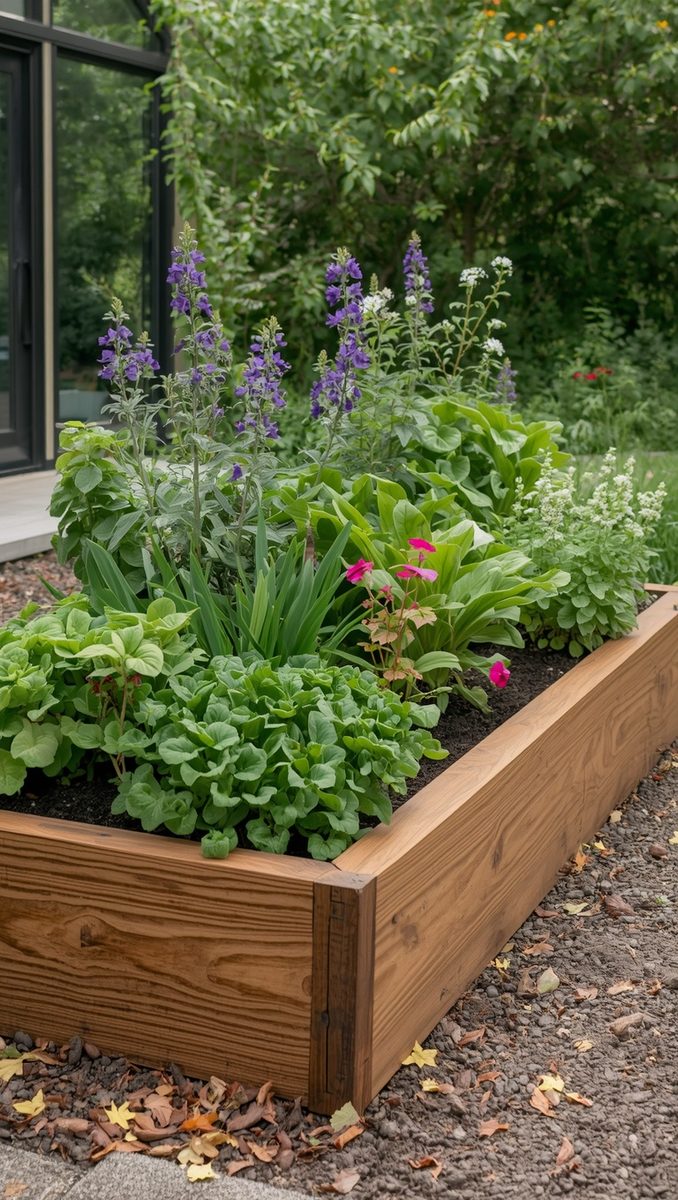
Cedar is my favorite because it weathers into this soft silvery-honey color that feels so warm in the late afternoon.
It smells amazing when you first cut it, too.
If cedar’s out of your budget, pine works beautifully with a food-safe sealant.
Just keep every bed the same.
Same wood, same stain, same finish.
That consistency is what whispers “I meant to do this.”
And honestly, it saves you from second-guessing every weekend.
Paint Them a Deep, Moody Color

I wasn’t sure about painted beds until I tried one.
I used a deep charcoal-black, and wow.
The green of the leaves practically glows against it.
Dark beds also sort of disappear into the landscape, so your plants become the stars.
If black feels too bold, try a deep forest green or a muted navy.
I’m obsessed with how those shades feel cozy, almost like a velvet sofa for your garden.
Use exterior paint that’s safe for edibles, and paint only the outside.
I learned that one the hard way.
Give it two coats and let it cure fully before you add soil.
It’s a small Saturday project with a big payoff.
Get the Height Right

Low beds can look a little flat.
I discovered that around eighteen to twenty-four inches feels just right.
It gives the yard real structure, and your back says thank you.
When I raised my herb bed to that height, I started actually using my herbs, because snipping basil felt effortless.
Taller beds also catch the light differently.
They create these soft shadows in the morning that I could stare at forever.
Here’s my little hack.
Add a wide cap rail along the top, flat boards, about six inches across.
You can perch there with your coffee and watch the bees.
That one detail turns a plain box into a place you want to be.
Try Metal for a Modern Edge

If your home leans modern, metal beds might be your thing.
I helped a friend install weathered steel ones last spring, and I couldn’t stop touching the rusty, velvety surface.
The color is this gorgeous burnt orange that deepens over time.
Against green foliage, it looks like art.
Metal beds also hold crisp, clean lines, which is exactly what makes a yard feel designed.
A word of caution, though.
Metal heats up in strong sun, so I’d plant sturdier things like lavender or rosemary near the edges.
And line the inside if you’re growing delicate roots.
It’s pricier than wood, sure.
But if you want a sleek, sculptural look, it’s so worth saving for.
Fill the Paths Like You Mean It

Here’s something nobody tells you.
The space between the beds matters as much as the beds.
I used to leave bare dirt, and every rainstorm turned it into a muddy mess.
Not cute.
Now I lay down landscape fabric and cover it with fine pea gravel.
That crunchy sound underfoot makes me so happy, you know?
Mulch works too, especially if you love a softer, woodsy feel.
Keep the paths wide enough for a wheelbarrow, roughly three feet.
I also like edging the paths with a thin strip of steel or stone so the gravel stays put.
Clean paths frame the beds like a picture frame frames a painting.
Suddenly the whole yard looks finished.
Lean Into Symmetry

I’m not a rules person, but symmetry is a cheat code for looking intentional.
When I mirrored my beds on both sides of a center path, my yard went from “random” to “wow, who did this?”
Even a simple two-by-two grid does the trick.
Place a pot, a birdbath, or a little bench at the center to anchor it.
If symmetry feels too formal, you can loosen it up with your plants.
Let one side get tall, wispy grasses and the other get fluffy blooms.
The bones stay balanced, but the personality still shines through.
I love that mix of order and softness.
It feels sort of like a tailored blazer over a messy bun.
Use the Fence Line

Don’t ignore your fences.
I used to leave mine bare, and it felt like wasted space.
Then I built a long, narrow bed along the back fence, and it instantly made my yard look wider.
Narrow beds are perfect here, about two feet deep.
You can tuck in tall sunflowers, climbing beans, or cut flowers that peek over the top.
I’m kinda in love with how it wraps the yard in a leafy hug.
If your fence is a little tired, don’t stress.
Plants hide a lot, and a coat of fresh paint helps too.
Long, low lines along the edges also calm a yard down.
Everything feels contained, like the garden has a boundary and a purpose.
Plant a Soft Border Around the Edges

This is my favorite trick.
Plant something low and pretty right around the base of each bed.
I use alyssum, thyme, and a few marigolds, and they spill over the edges like lace.
That little flourish softens the hard lines of the wood.
It also keeps weeds from sneaking in, which my lazy side adores.
If I had to choose one, I’d pick creeping thyme.
It smells heavenly when you step on it.
And it blooms tiny purple flowers that the bees go absolutely nuts for.
The result is that cottage-garden feeling without the chaos.
Your beds look grounded, like they’ve always belonged there.
Add Height With Trellises

Flat gardens can feel a little sleepy.
So I add vertical interest everywhere.
A simple arched trellis over one bed gave my yard a focal point I never knew I needed.
I grow sweet peas on it in spring, and the scent is unreal, like a perfume counter in the fresh air.
Obelisks are another favorite of mine.
They’re tall, elegant, and they make even a small bed feel grand.
Cucumbers, pole beans, and clematis all climb beautifully.
Match the trellis color to your beds so it feels cohesive.
I went with black, and it looks so crisp against all that green.
Height is what takes a garden from nice to “oh my gosh.”
Light It Up at Night
I resisted lighting for ages.

Then one evening I strung warm solar lights along the cap rail, and I actually gasped.
The beds glowed like little lanterns.
Soft light makes your garden feel like an extension of your living room.
I’d skip anything harsh or blue-toned.
Warm white is the way to go, so it looks cozy, not like a parking lot.
Small stake lights tucked among the plants add gentle pools of glow too.
And if you love dinner outside as much as I do, you’ll be so glad you did it.
My backyard looks completely different after dark.
It feels dreamy, kind of magical, honestly.
Mix Edibles and Flowers

I used to keep my veggies and flowers apart.
Big mistake.
Now I tuck zinnias between my tomatoes and nasturtiums beside my lettuce.
It looks so much prettier, and the flowers lure pollinators to help the veggies along.
Plus, you get bouquets for the kitchen table.
I love walking out with a basket and coming back with dinner and a handful of blooms.
If you want a tidy look, repeat the same few plants across all your beds.
Repetition is what ties it all together.
I like three or four favorites, nothing more.
Too many varieties can look scattered, and we’re going for calm here.
Finish With One Perfect Seat

This is the final touch I swear by.
Place a bench, a pair of chairs, or even a sturdy stool near your beds.
Give yourself a reason to sit and soak it all in.
When I added a little weathered bench at the end of my center path, the whole yard clicked.
It said, “this space is meant to be enjoyed.”
I drink my morning coffee there now, watching the dew sparkle on the leaves.
Some mornings I just sit and do nothing.
And that, to me, is the real point of a garden.
So build your beds, plant what makes you smile, and leave a spot to rest.
Your backyard is going to look beautiful, and I can’t wait for you to see it.
Love always…