I didn’t plan to fall in love with the Tuscan aesthetic.
It just sort of… happened.
I was scrolling one evening, wrapped in a blanket, half-asleep — and then I stopped on a photo of a room.
Stone walls.
Terracotta floors.
A heavy linen curtain catching a warm afternoon breeze.
A bowl of lemons on a worn wooden table.
And I felt something shift in my chest.
Like a memory of a place I’ve never actually been.
That ache — that warm, golden longing — is exactly what the Tuscan aesthetic does to you.
It doesn’t shout.
It doesn’t try.
It just quietly wraps around you and makes you feel like home in the deepest, most unhurried way.
And right now?
It’s taking over interiors everywhere — and I am here for every single second of it.

What the Tuscan Aesthetic Actually Means (In Simple, Real Terms)

I think a lot of people hear “Tuscan” and immediately picture something overdone.
Fake grapevines.
Rooster decorations.
That very specific early 2000s kitchen situation.
But the Tuscan aesthetic that’s having a moment right now is something completely different.
It’s quieter.
More refined.
More deeply felt.
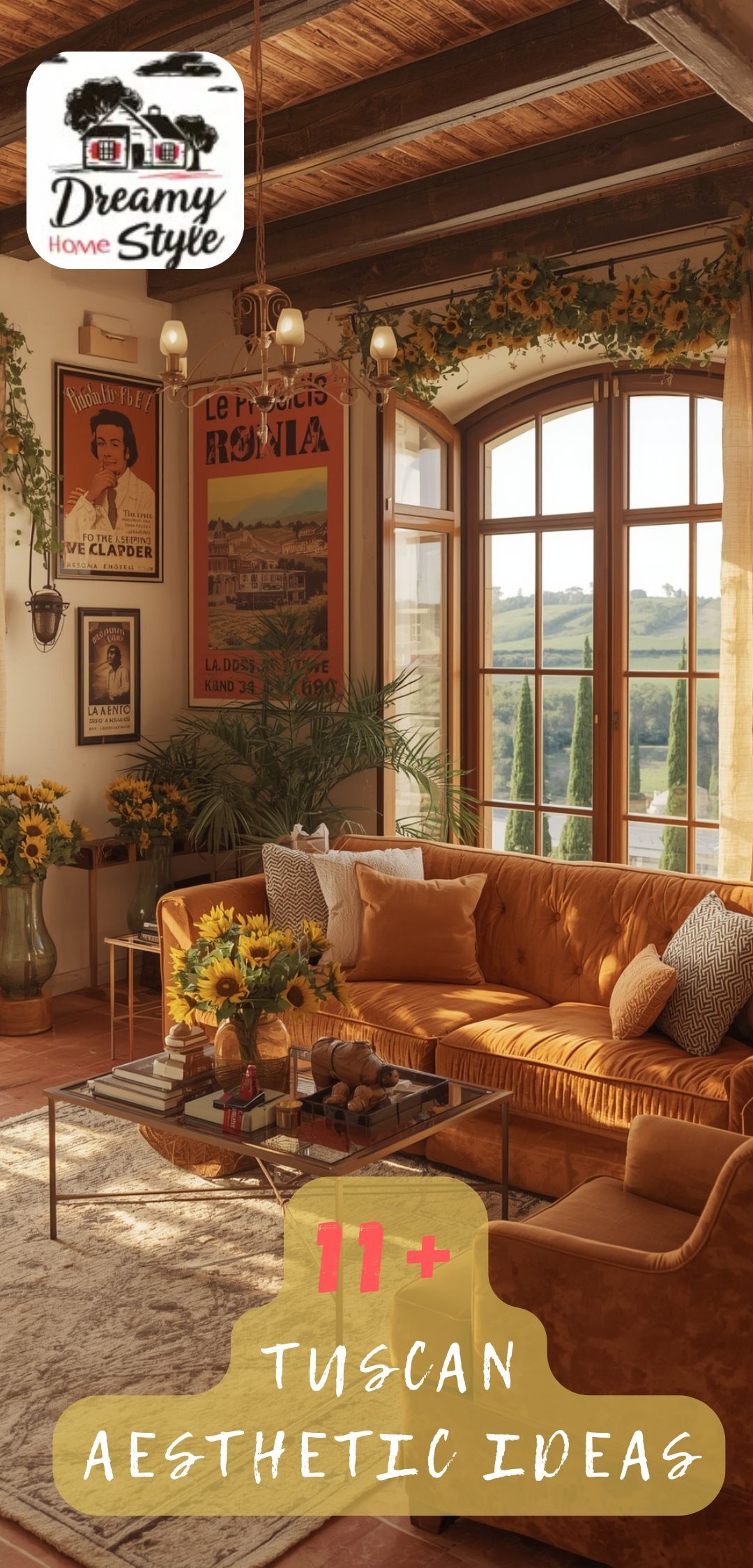
It’s about capturing the spirit of a centuries-old Italian farmhouse — the warmth of sun-baked plaster walls, the texture of hand-thrown pottery, the softness of aged linen, the weight of a stone floor beneath bare feet.
It’s the feeling of slowing down.
Of a long lunch that stretches into the afternoon.
Of a home that has lived in it, beautifully.
The modern Tuscan interior isn’t trying to replicate Italy literally.
It’s drawing from the emotional palette of Tuscany — warmth, texture, age, organic beauty — and weaving it into everyday home spaces.
Think less “decorative rooster” and more “hand-plastered walls in a warm amber tone with a worn linen sofa and a cluster of earthenware on the shelf.”
That’s the version I fell for.
That’s the version I want to help you fall for too.
The Color Palette That Makes Everything Feel Instantly Tuscan


If I had to describe the Tuscan color palette in one feeling, it would be this: the last hour of golden sunlight before it disappears behind a hill.
Warm.
Amber.
A little dusty.
Deeply beautiful.
The palette lives in terracotta, warm ochre, aged cream, sun-bleached linen, dusty olive, clay, burnt sienna, and soft mushroom.
These are all colors that feel like the earth — because they basically are.
They’re inspired by sun-baked roof tiles, dry fields of grain, old stone walls, and the olive groves that seem to go on forever.
When I started pulling this palette into my own home, the thing that surprised me most was how calming it felt.
Cool greys and crisp whites have a certain energy — clean, alert, modern.
But warm ochre walls and a terracotta floor and a dusty olive linen sofa?
That combination makes you want to take your shoes off and stay a while.
You don’t need to paint every wall — even one warm, plaster-toned wall in a living room will shift the entire energy of the space.
Start small if you’re nervous.
A terracotta throw pillow here.
A warm ochre candle there.
You’ll feel the difference almost immediately.
Textured Walls — The Single Most Impactful Tuscan Move You Can Make


I am going to be very direct with you here: textured walls are the heart of the Tuscan aesthetic.
Nothing else will transform your space as quickly or as dramatically.
Smooth, flat, perfectly painted drywall is the opposite of everything Tuscan.
Tuscany is about age.
About imperfection.
About walls that have absorbed centuries of warmth and have the texture to prove it.
The good news is you don’t need to replaster your whole house to get this feeling.
There are textured paint techniques — like Venetian plaster or limewash — that you can apply yourself or hire someone to do, and the results are genuinely breathtaking.
I had one wall in my living room done in a warm limewash finish in a color somewhere between antique cream and pale amber.
And I stood in front of it for a long time after it dried.
The way the light moves across it throughout the day — catching the high points, pooling in the low ones — it feels alive.
It feels like a wall with a history.
And that is exactly the Tuscan feeling I was chasing.
If limewash feels like too big a commitment, even a simple sand-textured paint in a warm tone will give you more of that aged, organic quality than a flat finish ever could.
Terracotta Everything — Floors, Pots, Tiles, and More


I could honestly write an entire post just about terracotta.
I’m that obsessed.
Terracotta is the single most Tuscan material you can introduce into your home — and I love it because it works in so many different forms.
Terracotta floor tiles are the dream, obviously.
That warm, slightly matte, hand-made quality underfoot — especially in a kitchen or entryway — is incomparable.
Every time you walk across them barefoot in the morning, you’ll feel a little like you’re in a sun-soaked Italian farmhouse.
But you don’t need to retile your floors to bring terracotta in.
Terracotta pots — those classic, simple clay ones — clustered on a windowsill or piled in a corner with trailing plants are incredibly evocative of the aesthetic.
Terracotta tiles used as a backsplash.
A terracotta-toned throw blanket draped over a chair.
Even a small terracotta bowl on your kitchen counter holding garlic or lemons does something to the energy of a room.
The color and material together carry so much warmth and history.
When I added a cluster of terracotta pots to my kitchen window last summer, the whole room immediately felt more alive.
More grounded.
More like home in that deep, unhurried Tuscan way.
Linen, Linen, and More Linen — The Fabric Soul of Tuscan Interiors

If terracotta is the body of the Tuscan aesthetic, linen is absolutely the soul.
And I mean that with my whole heart.
There is no fabric that captures the warmth, the softness, and the slightly undone elegance of Tuscan living like natural linen.
It wrinkles beautifully.
It softens with every wash.
It comes in the most perfect range of warm, earthy neutrals.
Natural linen, oatmeal linen, warm grey-linen, aged white linen — every single tone works within this palette.
My sofa is slipcovered in a natural linen and I genuinely love it more every single season.
It looks effortlessly beautiful even when it’s not perfectly styled.
Especially when it’s not perfectly styled, actually — because a slightly rumpled linen sofa with a terracotta throw tossed over one end looks exactly like a Tuscan afternoon nap waiting to happen.
Beyond sofas, I love linen curtains that pool slightly on the floor.
The way they catch and soften the light is so gorgeous.
Linen napkins.
Linen table runners.
Linen pillowcases.
Once you start introducing linen into a space, it sort of takes over — in the best possible way.
It just makes everything feel more lived in, more warm, more real.
The Magic of Aged and Artisan Pottery in a Tuscan Home

This is one of my very favorite parts of building a Tuscan-inspired interior — the pottery.
And I love it because it’s one of the easiest and most affordable ways to completely change the feeling of a room.
We’re talking about hand-thrown, slightly imperfect, beautifully aged-looking ceramics.
Chunky vases with uneven glazing in warm cream, terracotta, and dusty earthy tones.
Simple bowls with a raw, matte quality.
Pitchers that look like they’ve been used for generations.
The imperfection is the whole point.
Mass-produced, perfectly uniform ceramics have their place — but they don’t carry the soul that a hand-thrown piece does.
And the Tuscan aesthetic is entirely about soul.
When I started swapping out my more modern, shiny ceramics for artisan pottery pieces in warm, earthy tones, my shelves suddenly felt like stories.
Each piece had a weight and a quality that made you want to pick it up and look at it more closely.
If you’re not sure where to start, I’d begin with a simple hand-thrown vase in a warm terracotta or cream glaze and place it somewhere you’ll see it every single day.
Then watch how your eye keeps going back to it.
That quiet beauty is so distinctly Tuscan.
Bringing the Outdoors In — Olive Branches, Herbs, and Living Greenery

The Tuscan countryside is deeply, effortlessly lush.
And that connection to the natural world — to growing things, to the smell of herbs in the garden — is something that translates so beautifully into a Tuscan-inspired interior.
My favorite Tuscan-inspired greenery tip?
Dried or faux olive branches in a large terracotta or earthy ceramic vase.
Olive branches have this incredible quality — their silvery-green leaves and gnarled, twisting form feel ancient and organic and impossibly beautiful.
A tall vase of olive branches in a corner, or on a dining table, immediately anchors a room in that warm Mediterranean world.
Fresh herbs in terracotta pots on a kitchen windowsill are another one I’m completely in love with.
Rosemary, thyme, basil — they look beautiful and they smell incredible and they make a kitchen feel so incredibly warm and alive.
I had a little collection of herb pots going on my kitchen windowsill for a while and every single person who came over commented on how the kitchen felt different.
Cozier.
More alive.
They couldn’t always name why.
But I knew.
Add some dried lavender in a simple vase, a bowl of lemons on the counter, a trailing vine on a high shelf — nature is a core ingredient in the Tuscan aesthetic, not an optional extra.
Warm Wood and Wrought Iron — The Architectural Soul of the Look

The Tuscan home is built on natural materials.
And the two that come up again and again — the ones that give the aesthetic its particular weight and warmth — are aged wood and wrought iron.
Heavy, dark, slightly rough-hewn wood.
Beams across a ceiling.
A thick farm table with visible grain and the occasional mark.
A wooden stool that looks like it’s been in a kitchen for fifty years.
That kind of wood has a character and a presence that polished, lacquered furniture simply doesn’t.
And wrought iron — in cabinet hardware, light fixtures, stair railings, candle holders — adds this beautiful, old-world handcrafted quality that feels so distinctly Italian.
When I swapped out some of my more modern brushed nickel hardware for simple, matte black wrought iron pulls, the whole kitchen suddenly felt warmer and more considered.
More intentional.
More Tuscan, honestly.
If you have exposed ceiling beams — even if they’re painted white right now — consider going warmer.
A deep walnut stain or even just a warm wood tone can completely transform the character of a room.
And if you don’t have beams, wooden shelving with visible grain is a beautiful alternative that brings that same warmth and substance to a space.
Candlelight and Warm Lighting — How to Nail the Tuscan Glow

A Tuscan interior without the right lighting is sort of like a beautiful painting in a dark room.
The bones are there, but you can’t quite feel it.
Lighting is everything in this aesthetic — because so much of what we love about Tuscany is that golden, honeyed, late-afternoon glow that seems to saturate everything.
Replicating that indoors means warm bulbs (always warm — 2700K or lower), dimmers on every possible light, and candles.
So many candles.
I have a collection of simple church-style candles in varying heights that I cluster on my dining table and on a wooden tray on my coffee table.
When they’re all lit in the evening, the whole room shifts.
The plaster walls glow.
The terracotta catches the light.
The linen softens.
Everything becomes richer and warmer and more beautiful.
Lantern-style light fixtures — wrought iron with amber glass, or simple cage-style pendants — are a gorgeous way to bring the Tuscan feeling into your overhead lighting.
And if you have a fireplace?
Use it.
Nothing — absolutely nothing — completes a Tuscan-inspired room like actual firelight casting that warm, dancing glow across textured walls and pottery and all that beautiful linen.
The Tuscan Kitchen — My Favorite Room to Style This Way

If there’s one room where the Tuscan aesthetic truly lives, it’s the kitchen.
And I think it’s because Tuscan culture is so deeply rooted in food, in gathering, in the simple ritual of cooking and eating slowly and well.
A Tuscan-inspired kitchen isn’t a sleek, high-gloss, chef-style space.
It’s warm and worn and deeply practical in the most beautiful way.
Think open shelving lined with handmade pottery, ceramic mixing bowls, and glass jars of dried pasta and grains.
A worn wooden cutting board propped against the backsplash.
A bunch of fresh herbs hanging to dry from a beam.
Copper pots catching the light above the stove.
When I started styling my kitchen with this aesthetic in mind, the first thing I did was clear out some of the cabinet space and open it up — letting the pottery and the everyday items become part of the visual story.
It sounds simple.
It is simple.
But seeing those stacked terracotta-toned bowls and that cluster of herb pots and that big ceramic pitcher every morning when I come in to make coffee?
It makes me genuinely happy.
It makes the kitchen feel like a place where something good is always about to happen.
And that is the most Tuscan feeling of all.
Layering Textiles for That Deeply Lived-In Tuscan Feel

The Tuscan aesthetic is not a minimal one.
It’s layered.
Tactile.
Rich with texture and softness.
And textiles are how you build that feeling from the ground up.
I’m talking about layering rugs — a worn, faded vintage-style rug over terracotta tile, for example, is one of the coziest and most beautiful combinations I’ve ever seen in a real home.
Throw blankets in warm terracotta, dusty olive, or aged cream draped loosely over sofas and chairs.
Linen cushions in varying tones of warm neutral — not perfectly matched, not all the same size, just beautifully layered together.
A heavy woven tablecloth in natural linen on the dining table.
Napkins that look like they’ve been used and loved.
The key feeling to chase here is that the textiles look chosen rather than decorated.
Like they’ve accumulated over time, each one picked up because it was beautiful or useful or both.
When I layered a worn-looking jute rug under my dining table over the existing flooring, and then added mismatched linen napkins and a cluster of candles to the table — the whole dining area suddenly looked like it had always been there.
Settled.
Warm.
Deeply inviting.
That “always been there” feeling is the whole goal of the Tuscan aesthetic.
And textiles are one of the fastest ways to get it.
How to Start Your Tuscan Transformation Without Overwhelming Yourself

The thing I love most about the Tuscan aesthetic — besides pretty much everything — is that you don’t have to do it all at once.
You don’t need to replaster your walls, retile your floors, and buy all new furniture in one weekend.
You can build it slowly.
Layer by layer.
And honestly, building it slowly is kindda the most Tuscan approach anyway.
Start with the palette.
Bring in one warm, earthy tone — a terracotta pillow, an ochre throw, a cream linen curtain.
Let yourself live with it for a bit.
Then add a piece of artisan pottery.
Then maybe swap out some hardware.
Then try a textured paint technique on one wall.
Each small addition shifts the room a little further toward that warm, sun-soaked, deeply beautiful feeling.
When I started my own Tuscan-inspired styling journey at home, I began with literally just three terracotta pots, some olive branches, and a new warm bulb in my main living room lamp.
And I stood in that room at 7pm with the lamp glowing and the olive branches casting soft shadows and the terracotta catching the light —
And I felt it.
That quiet warmth.
That slow, golden, deeply contented feeling.
That is Tuscany, brought home.
And once you feel it, you’ll understand completely why this aesthetic is here to stay.