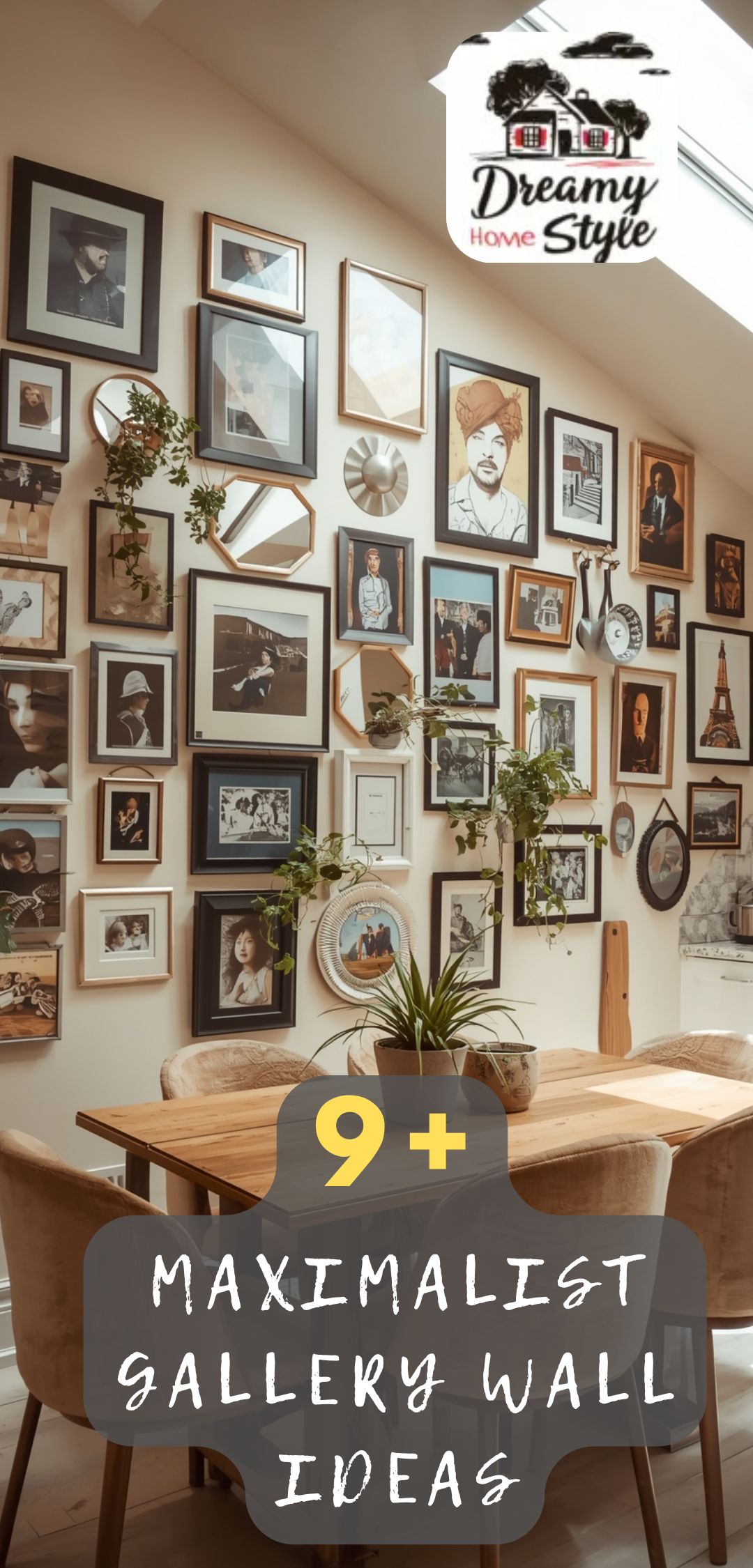

A maximalist gallery wall is basically the opposite of that one lonely print I mentioned.
It’s layered, full, and intentional — even when it looks a little wild.
Think frames of every shape and size, mixed with mirrors, maybe a small shelf, a woven piece, a vintage clock, a child’s drawing you framed because you loved it that much.
It’s the wall that stops people mid-conversation.
The one they point at and say, “Wait — can you tell me about all of this?”
And that’s exactly why I love it.
It tells a story.
Your story.
Minimalism is beautiful, don’t get me wrong — but maximalism is alive.
It breathes, it grows, it makes a room feel like someone actually lives there and loves their space deeply.
When I finally committed to my own gallery wall in my living room, the whole energy of the space shifted.
It went from “nice room” to “wow, this feels like her.“
That’s the goal.
That’s what we’re building together.

Start With a Vibe, Not a Plan


Here’s the thing nobody tells you: don’t start with measurements.
Start with a feeling.
Ask yourself — when you walk into this room, how do you want to feel?
Cozy and nostalgic?
Bold and maximalist-romantic?
Eclectic and a little bohemian?
For my living room, I wanted it to feel like a Parisian apartment mixed with a vintage bookshop.
Warm, golden, layered, a little bit literary.
Once I had that vibe locked in, every decision after that became so much easier.
Does this piece fit the feeling?
Yes?
It goes on the wall.
No?
It lives somewhere else.
Pull inspiration images — from magazines, saved photos on your phone, anywhere — and look for the common thread.
Is it the warm tones?
The mix of black and gold frames?
The balance of photography and illustration?
Find your thread, and pull it through every single piece you choose.
That’s sort of the secret to a maximalist gallery wall that feels curated and not just… cluttered.
My Favorite Frame Mixing Trick


Okay, this one changed everything for me.
I used to think all my frames needed to match — same finish, same style, same vibe.
Wrong.
Mixing frames is where the magic happens.
But here’s my trick: pick one unifying element and let everything else go wild.
For me, it was warm metallics.
Gold, brass, antique bronze — all different frame styles, but that golden thread ran through everything.
So even though I had chunky vintage frames next to slim modern ones next to ornate baroque ones, the whole wall felt cohesive.
You could also unify by color — all black frames in wildly different shapes feel incredibly chic.
Or unify by material — all natural wood frames in different sizes and stains give a really warm, organic feel.
If I had a brand new collection of art and zero frames to start with, I’d go straight for a mix of brass and matte black.
It’s warm, it’s modern, it’s timeless.
And it works with basically everything.
Don’t be afraid of the mix.
The mix is the point.
The Art of Mixing Art


This is my favorite part.
A maximalist gallery wall should never be just prints.
Or just photography.
Or just paintings.
Mix it all up.
I have original oil paintings on my wall alongside framed vintage maps, a watercolor I did myself (badly, and proudly), black and white family photos, a typographic print, and a small abstract piece I found at a flea market.
The variety of what is on the wall is just as important as how it’s arranged.
Think about mixing:
Photography (Black and White is stunning and versatile)
Illustration and fine art prints
Textile pieces — a small macramé, a woven tapestry, a fabric swatch you love
Mirrors (they add depth and light, which is chef’s kiss)
Three-dimensional objects — a decorative plate, a shadow box, a small mounted sculpture
The goal is for someone to stand in front of your wall and keep discovering things.
There’s always another layer, another little surprise.
That’s maximalism doing its job.
How to Layout Without Putting Holes in Your Wall First


When I tackled my own gallery wall, I made the rookie mistake of just starting to hammer.
Please don’t do that.
Here’s what I do now, and it saves so much patching and repainting.
Lay everything out on the floor first.
Literally pull every piece you’re considering and arrange them on your floor in roughly the shape of the wall space.
Live with it for a day.
Move things around.
See what feels balanced.
Then — and this is the hack I swear by — trace each frame onto kraft paper or newspaper, cut out the shapes, and tape them to your actual wall with painter’s tape.
Step back.
Look at it.
Adjust the paper cutouts until you’re happy.
Then hammer your nails.
Right through the paper templates.
The paper tears away easily and your nails are perfectly placed.
I’ve used this method on every gallery wall I’ve styled and it’s never let me down.
It takes a little extra time upfront and saves you so much frustration.
The Magic of Odd Numbers

This sounds like a design school rule, and it kind of is — but it works so beautifully in practice.
When you’re grouping items on your gallery wall, aim for odd numbers.
Three frames grouped together.
Five in a cluster.
A grouping of seven.
Odd numbers feel dynamic and interesting.
Even numbers feel static, almost like they’re waiting for one more thing.
On my own wall, I have a cluster of three small frames in the upper left corner that anchor the whole arrangement.
Then a larger piece as a focal point.
Then smaller groupings of five and three radiating outward.
It sounds very calculated, but honestly when you’re working with it in real life, it just feels right.
You’ll know when something’s off because it’ll look “done” too soon — like it stopped breathing.
Odd groupings keep the eye moving, which is exactly what you want.
And the movement is what makes maximalism feel intentional rather than overwhelming.
Color — Should Everything Match?

Short answer: no.
Longer answer: absolutely not, but you need a plan.
Full color chaos is hard to pull off without it looking, well, chaotic.
My approach is to pick two or three anchor colors that repeat throughout the wall.
On my gallery wall, that’s warm cream, deep terracotta, and that gorgeous muted sage green I’m kindda obsessed with right now.
Not every piece contains all three.
But most pieces have at least one.
It creates this visual rhythm — your eye hops from one warm tone to the next and everything feels like it belongs together even when the styles are completely different.
If you’re starting from scratch, I’d honestly suggest pulling your room’s existing color palette first.
What colors are in your sofa?
Your rugs?
Your throw pillows?
Echo those on the wall and the whole room will feel designed, not decorated.
You can always add one wild card — a pop of something unexpected — but root it in what already exists in the space.
That grounding is what keeps maximalism from tipping into mess.
Texture Is Your Secret Weapon

People always focus on what’s in the frames.
But texture — the physical dimension of your gallery wall — is what makes it truly stunning.
I added a small round mirror with a chunky rattan frame.
A woven textile piece in cream and terracotta.
A framed piece of handmade paper with visible fibers in it.
And suddenly the wall had this incredible depth that you could almost feel from across the room.
Texture catches light differently throughout the day.
In the morning my rattan mirror has this soft warm glow.
In the evening, the woven piece looks almost three-dimensional with the lamp light behind it.
It’s that kind of sensory richness that makes a room feel genuinely luxurious.
You don’t have to spend a lot for this.
A vintage wooden frame has texture.
A canvas print has texture.
Even the mat inside a frame adds a layer of visual softness.
Think about the physical feel of each piece, not just the image inside it.
What to Do With Empty Corners and Edges

Here’s something I didn’t expect: the edges of your gallery wall matter just as much as the center.
When I first laid out my arrangement, the edges felt abrupt.
Like the wall was cut off mid-sentence.
The trick is to let the gallery wall breathe and fade at the edges rather than end sharply.
Use smaller pieces toward the outside of your arrangement.
Let the spacing between frames grow a little wider as you move toward the edges.
Add a trailing element — a single small frame that floats a few inches away from the main cluster.
It creates a sense of expansion, like the wall is growing organically rather than being installed.
I also love adding a small ledge shelf at the edge of a gallery wall.
It lets me swap in a little vase, a trailing plant, a small candle — things that soften the transition between the wall art and the room itself.
And honestly?
That little shelf has become my favorite spot in the whole arrangement.
I change it seasonally and it keeps the whole wall feeling fresh.
Lighting Your Gallery Wall

This one is so underrated and I wish someone had told me earlier.
A gallery wall without good lighting is like a beautiful meal with no seasoning.
It’s fine, but it’s not what it could be.
The warm glow of a picture light mounted above a key piece is just everything.
It gives the whole arrangement an almost gallery-like quality.
And it makes the colors in your art richer and deeper.
I added a small plug-in picture light above my largest piece and genuinely couldn’t believe the difference.
The room felt instantly more elevated.
If you don’t want to commit to a permanent fixture, string lights woven gently around the outer edges of a gallery wall can be incredibly cozy.
It’s a softer, more whimsical approach that works beautifully in bedrooms.
For living spaces, I’d lean toward warmer, more directional lighting — a sconce on one side, a floor lamp angled toward the wall.
Let the light reveal your wall rather than just illuminate it.
That distinction is subtle but it makes all the difference.
Personal Objects vs. Prints — Finding the Balance

This is the section I want you to save and come back to.
Because it’s the thing that separates a beautiful gallery wall from a meaningful one.
Personal objects — framed kids’ drawings, a postcard from a trip that changed you, a pressed flower from your grandmother’s garden — are what make a gallery wall irreplaceable.
Anyone can buy the same prints from the same shops.
Nobody else has your grandmother’s flower.
On my wall, I have a tiny framed note my best friend wrote me years ago.
It’s not pretty in a conventional way.
But it stops me every single day.
And I love it more than any expensive print I own.
The balance I suggest: roughly 70% curated art and prints, 30% personal objects.
Enough polish to feel intentional.
Enough personal to feel real.
When someone looks at your gallery wall, you want them to see you — your travels, your people, your taste, your humor.
Give them that.
It’s braver than it sounds and so worth it.
My Biggest Gallery Wall Mistake (So You Don’t Make It)

I saved this for last because I want it to stick.
My biggest mistake was playing it too safe at first.
I kept the frames all the same size.
I kept the spacing perfectly even.
I chose prints that were beautiful but sort of… beige.
Inoffensive.
The wall looked fine.
Like a display in a furniture showroom.
And I hated it.
It wasn’t until I ripped it all down and started over — going bigger, going bolder, going weirder — that I got the wall I actually loved.
So my advice to you is this: buy the oversized piece that makes you nervous.
Frame the weird, quirky thing.
Put the mirror where it doesn’t “belong.”
Add one more thing after you think you’re done.
Maximalism rewards courage.
It rewards the person who says yes to the thing they love even when they’re not sure it “goes.”
Because in the end, the walls that feel the most alive are the ones that reflect someone who wasn’t afraid to fill them.