
A long summer dinner outside is really three dinners.
It starts in daylight, slides into golden hour, and ends in the dark, a little cooler, with a moth doing laps around the candles.
Most outdoor table ideas get judged at the first one, because that’s when the photos happen.
Set the table for the third one.
That’s when people decide whether to stay.
So plan for the whole evening: what goes out first, what changes when the sun drops, and how to keep food, flames and wiring safe.
Eating inside instead?
We have a separate post of dining room centerpiece ideas for that.
Size the Table by Elbows, Not by Looks

Before anything pretty goes on it, count chairs.
Give each person 24 inches of table edge at the least and 30 inches to be comfortable (our Dining Table Size Calculator does the sums).
On a rectangle, both long sides count, plus one person at each end.
Run that on a 72-inch table and you get three a side at 24 inches, so eight people with the ends.
At 30 inches it’s two a side, so six.
For a long evening, I’d plan on the 30.
Nobody minds a squeeze for one course.
But by the third hour, elbows matter.
I like round tables for four to six people, since everybody can talk to everybody and nobody’s stuck at the far end.
If you’re leaning that way, we have a whole post of round table dining room ideas.
A long table is the other way to go.
With eight chairs, three a side and one at each end, the far ends turn into their own little parties.
That’s half the fun.
Use a Runner and Cloth Napkins, and Plan for the Breeze

A runner gives you color down the middle and leaves the tabletop showing, which is half the charm of a good outdoor table.
Got a marble-look top worth showing off?
Our post on marble dining table designs has plenty more.
Sizing it is easy.
A runner should hang 6 to 12 inches over each end (our tablecloth and runner calculator does it for you), so its length is the table’s length plus 12 to 24 inches.
It should be about a third of the table’s width wide, which is 12 to 14 inches on most tables.
So a 72-inch table takes a 90-inch runner.
Outside, though, a runner is kinda a sail.
Any breeze grabs the part hanging over the end first.
I’d keep your overhang near the short end of that range and park something heavy on the runner, like the centerpiece or a full water pitcher (table clips work too).
Either way beats fishing it out of the hedge.
Cloth napkins make an ordinary weeknight feel like an occasion.
Outside, they have one more job, because paper ones blow away.
Napkin rings help, and so does tucking the napkin under the edge of the plate.
Mismatched is totally fine.
A mix of colors looks better than a perfect set.
Keep the Centerpiece Low, and Dry Stems Away From Flames

My centerpiece rule is simple.
If two people sitting across from each other can’t see each other’s eyes, it’s too tall.
A long dinner is mostly talking, so the flowers can’t sit in the middle of the conversation.
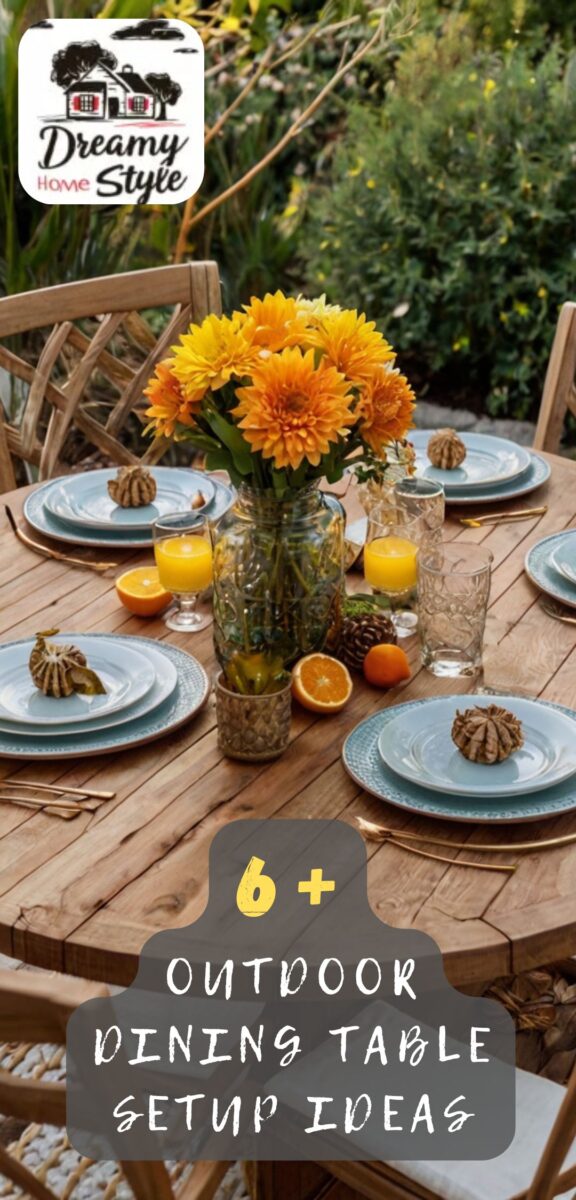
Low and loose wins: a few stems in small jars, a bowl of lemons, a cutting from the yard.
One low line of greenery and small white flowers lying down the middle does it too.
For other options, see our post of summer table centerpieces.
Then there’s the part nobody thinks about until a candle is lit.
Dried stems and pampas look great on a summer table, and they often end up right next to the tapers.
I’d be fussy about where those go, because over half of all candle fires start when something that can burn, like décor, paper or curtains, is too close to the candle.
Keep candles at least 12 inches from anything that can burn.
So if a pair of pillar candles is standing right up against the leaves, I’d move them a full foot away before lighting them, or go flameless.
Light It for After Sunset, Without the Floodlight

Golden hour does the lighting for free.
Then it ends, and your table needs a plan.
Overhead lighting is a crime.
One bright floodlight over a dinner table makes everybody squint at each other.
For the full rundown on softer options, our post on backyard patio lighting for night entertaining covers it.
Outside, string lights are my big exception.
They glow instead of glaring.
Indoors I’d chase the same low, layered feel, and our post on mood lighting goes deeper on that.
String lights are the easy version, and our post on deck lighting ideas shows how to hang them overhead on guide wires so they don’t sag.
For safety, I’d follow the same tips that go with holiday lights:
- Use only lights tested for safety by a recognized testing laboratory, and only lights with fused plugs.
- Check each set, new or old, for broken or cracked sockets, frayed or bare wires and loose connections, and throw out damaged sets.
- Check the label to be sure the lights are certified for outdoor use.
- Use no more than three standard-size sets of lights per extension cord, and make sure the cord is rated for the intended use.
- Fasten them securely to trees, house walls or other firm supports, so wind can’t damage them.
- Hold strings with insulated staples, never nails or tacks, or run them through hooks.
- For added shock protection, plug them into circuits protected by ground fault circuit interrupters (GFCIs).
- Turn them off when you go to bed or leave the house, since they could short out and start a fire.
One more, for the deck light itself.
Yellow “bug lights” (General Electric’s, for one) aren’t repellent, but they don’t attract mosquitoes the way other incandescent lights do.
Candles Where the Air Is Still, Flameless Where It Isn’t

Candles are the cheapest way to make a table look planned.
They’re also an open flame, and a candle can easily ignite anything that can burn.
The usual candle tips are written for the home, but I’d carry two of them right outside.
Keep candles at least 12 inches from anything that can burn.
Blow out all candles before you leave a room or go to bed.
So outside, the last person heading in does a candle check.
Flameless candles are the other way to go.
Outside, I’d use them anywhere a breeze can push a flame sideways, and near the edge of the table where napkins and kids hang out.
Lit candles tucked right into the greenery, much closer than a foot to the leaves, are a pretty look, but they break the 12-inch rule, so I’d do that with flameless pillars.
A little candle in a glass holder is closer to what I’d do outside, since the glass shields the flame from a breeze.
I’d still give it a foot of clear space all around.
Plates: Melamine for Serving, Not for Heating

I’d keep the good china inside.
Outside, plates get set on stone, balanced on knees and carried across the lawn.
Melamine is the usual answer, and it’s fine to serve food on it.
The catch is heat.
Food and drinks shouldn’t be heated on melamine dinnerware in the microwave, so heat things in ceramic or other cookware labeled microwave-safe, then serve them on the melamine.
More melamine can also move out of the plastic when highly acidic foods are heated to extreme temperatures, like 160°F or higher.
So the bubbling-hot tomato dish gets heated in ceramic labeled microwave-safe, and the melamine gets the salad.
For that hot dish, I’d also skip a thrifted or handmade bowl, because of lead.
Thrifting outdoor plates?
You can’t tell for sure whether a dish has lead just by looking, but some types are more likely to have it.
Watch for:
- Traditional glazed terra cotta ware made in some Latin American countries, such as Mexican bean pots. Unless one is specifically labeled lead-free (or sin plomo), cooking in it is especially hazardous and should be stopped at once.
- Highly decorated traditional dishes used in some Asian communities.
- Antique dishes handed down in families or found in antique stores, flea markets and garage sales, since they were made before lead in tableware was regulated.
- Home-made or hand-crafted dishes, unless you’re sure the maker used a lead-free glaze.
- Bright colors or decorations on the inside surfaces that touch food or drink, including the upper rim of a cup or bowl.
- Decorations on top of the glaze instead of beneath it. If you can feel the decoration when you rub a finger over the dish, it’s probably on top.
- Corroded glaze, or a dusty or chalky gray residue on the glaze after the dish has been washed. Those shouldn’t be used.
Lead is rarely found in plain white dishes, and the safest practice is not to use tableware you’re unsure of with food or drink.
A pretty plate you’re unsure about can still hang on the wall!
Glasses: Sturdy for Kids, and No Crystal Decanter

Real stemware looks gorgeous outside.
On a stone patio with kids running around, I’d still switch to acrylic or another plastic, at least at their end of the table.
Thrifted crystal has its own rule.
Occasional use of leaded crystal won’t expose you to large amounts of lead, unless liquids have been stored in it.
Children should never eat or drink out of leaded crystal, and food or alcohol shouldn’t be stored in leaded crystal decanters or containers.
The longer a drink sits in crystal, the greater the chance lead leaches into it.
That matters on a four-hour dinner.
So a vintage crystal decanter on my table would hold flowers, not the wine.
For a long night outside, I’d swap tall stems near the edge of the table for short tumblers.
Add one big pitcher of water, so nobody has to go find you for a refill.
Leave Room Behind the Chairs

Here’s a layout problem that only shows up once everyone sits down: chairs backed against a railing or a planter, so nobody can get up without the whole side shuffling.
Where nobody walks behind a seated diner, allow 32 inches from the table edge to a wall or anything else behind the seat.
If people need to edge past, allow at least 36 inches, and at least 44 inches to walk past.
I’d go a bit roomier outside: 36 inches to pull chairs out, 42 to be roomy, and 48 where people walk behind someone seated.
If your table shares a patio with a grill and a door, our post on outdoor patio layout draws the walking paths first.
A table out on open lawn has nothing behind the chairs to back into, which is what you’re after.
Just keep tall dried pampas out of the middle, and small votive holders away from dry stems.
And for a long sit?
The cushion matters more than the chair’s looks.
I’d pick chairs with real cushions and bring the cushions in when the night’s done.
Bring the Season In From Your Own Yard

The free centerpiece is the one you cut or pick up on the way out the back door.
A few herb stems, a branch of whatever’s flowering, pine cones, smooth stones.
From your own yard is the point.
On a walk through a park, leave rocks, plants and other natural objects as you find them.
The cut-it-yourself kind can be as simple as a loose mix in one vase and a low glass bowl of orange blooms beside it.
When the evening cools off, a stack of throws on the chair backs can keep people outside longer than any decor.
Food on a Clock: The Two-Hour Rule

This rule has nothing to do with looks.
On a long evening, it matters as much as anything here.
Never let picnic food sit in the “Danger Zone,” between 40°F and 140°F, for more than 2 hours, or 1 hour if it’s above 90°F outside.
Food left out longer gets thrown away.
Cold food stays in the cooler at 40°F or below until serving time.
Foods like chicken salad and desserts in individual serving dishes can go right on ice, or in a shallow container set in a deep pan filled with ice; drain the water as the ice melts and add more ice often.
Hot food stays at or above 140°F, wrapped well in an insulated container until serving.
And pack drinks in one cooler and perishable food in another, so the food cooler isn’t opened every time somebody wants a soda.
At a backyard dinner, that turns into a plan I like.
Serve in rounds: put out what’s being eaten now, keep the rest cold or hot until it’s needed, and set a timer on your phone when a platter goes out.
I’d leave the table empty of food until people sit down.
Bugs at Dusk: Try a Fan, Not Just a Citronella Candle

Golden hour is gorgeous.
It’s also bug o’clock.
Mosquitoes are usually most active at dawn and dusk, so the first tip is to avoid being out then if you can.
That’s right about when a long dinner hits dessert, so the rest of the list matters.
Dress in light, loose-fitting clothing, and since mosquitoes are relatively weak fliers, a large fan on your deck can be a low-tech fix.
For an evening family barbecue, a 10% DEET repellent is fine, and it helps protect from bites for about 90 minutes to two hours.
Family members over two months old can use DEET repellents of up to 30%, though physicians recommend no more than 10% DEET on children.
Apply it thoroughly, avoiding the eyes and mucous membranes, and reapply when necessary.
On a four-hour dinner, that probably means a second round.
Citronella candles have a mild repellent effect but don’t offer significantly more protection than other candles producing smoke.
In a 2008 indoor test in Israel, 5% citronella candles repelled mosquitoes at a rate of 29%, and 5% geraniol candles at 85.4%.
So would I still light a citronella candle?
For the smell, sure.
I just wouldn’t count on it, and the 12-inch rule applies to it like any other candle.
Where I’d Spend and Where I’d Thrift

If your budget only covers one real purchase, I’d put it into the table and chairs, since they carry the whole evening.
A sturdy table and woven chairs are what I’d save up for.
Everything on top can come cheap.
Thrift stores and Facebook Marketplace are where I’d look for napkins, wood boards and candle holders.
Thrifted plates and bowls are trickier.
You can’t tell for sure whether a dish has lead just by looking at it, so no list can clear one, and the safest practice is not to use tableware you’re unsure of with food or drink.
So a thrifted dish you can’t vouch for holds a candle or hangs on the wall, and the crystal decanter holds flowers.
Mason jars as vases, grocery store flowers split into small bunches, herbs from the yard.
None of it costs much, and none of it has to match.
For the patio itself, our post on budget patio ideas goes through cheap fixes and the catch in each one.
Sources
- National Fire Protection Association (NFPA)
- Consumer Product Safety Commission (CPSC), 2001 holiday lights release
- American Mosquito Control Association
- Journal of the American Mosquito Control Association, 2008
- American Academy of Pediatrics
- U.S. Food and Drug Administration (FDA)
- California Department of Public Health
- National Kitchen & Bath Association (NKBA) planning guidelines
- National Park Service, Leave No Trace