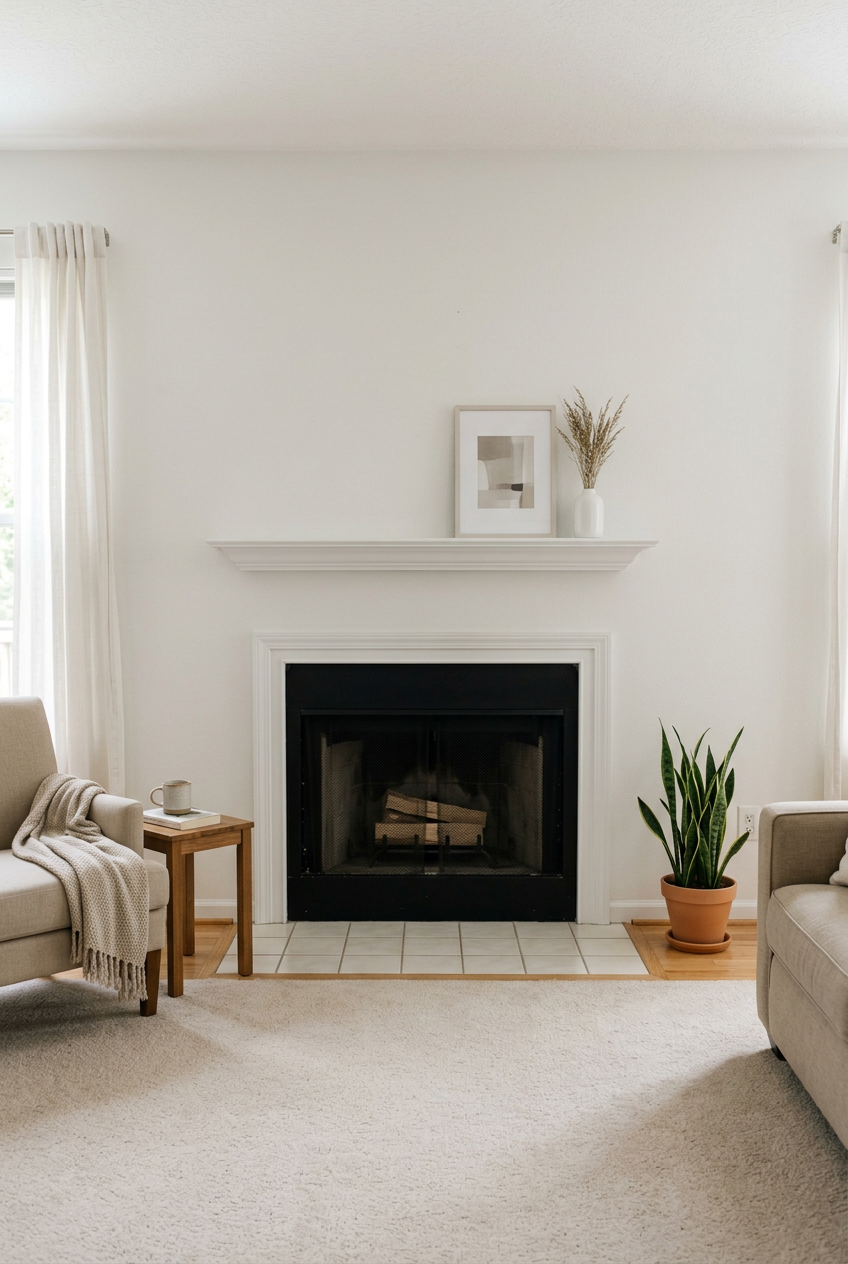

Okay, I have to be honest with you — for the longest time, my living room fireplace made me cringe a little every time I walked past it.
Flat white paint, a generic black surround, zero personality.
It looked like it came straight out of a contractor’s catalog, because, well, it did.
But here’s the thing: I wasn’t about to tear into walls or hire a mason.
So I got creative.
And now?
I genuinely stop and smile at it.
Let me show you exactly what I did.
Why Builder-Grade Fireplaces Feel So Blah (And You’re Not Alone)
Builder-grade fireplaces are designed to be functional and inoffensive.
Not beautiful.
Not memorable.
Just… there.
The surround is usually flat MDF or basic drywall.
The mantel is thin and proportionally awkward.
And that generic black firebox opening does nothing for the room’s personality.
When I finally admitted to myself that my fireplace was pulling the whole room down, I felt weirdly relieved.
Because naming the problem meant I could actually fix it.
And fixing it didn’t require a single contractor.
So many of us live with builder finishes longer than we should because we assume changing them is complicated or expensive.
It really, really doesn’t have to be.
The First Thing I Did: Painted the Whole Surround a Moody Color
I know, I know — painting sounds so simple it almost feels like cheating.
But color is genuinely transformative, and I was shocked by how dramatic the shift was.
I chose a deep, warm greige — sort of a sophisticated latte tone — and painted the entire surround, mantel shelf included.
Suddenly it looked intentional.
Weighty.
Considered.
The trick is going one shade darker than you think you should.
Light colors on a flat surround just highlight how basic the profile is.
Darker tones create shadow and depth where there isn’t any architecturally.
If I had a white-everything living room, I might have gone a soft charcoal instead.
Contrast is your friend here.
It makes the fireplace read as a real focal point.
Adding Peel-and-Stick Millwork Panels to Fake Architectural Detail
This is the move I’m most obsessed with, and I genuinely could not believe how custom it looked afterward.
Applied millwork panels — thin MDF strips in a grid or board-and-batten pattern — completely changed the surround’s visual profile.
I used peel-and-stick versions on the flat face of the surround.
They’re lightweight, they paint beautifully, and they don’t require any structural modification.
You’re adding dimension to something that previously had none.
When I tackled my own fireplace wall last fall, I did a simple grid pattern.
Two vertical panels flanking a center rectangle.
Painted the whole thing the same moody greige, and it looked like something from a high-end renovation show.
The light catches those little ridges and creates shadow lines.
That’s what gives it that expensive, custom-built feeling.
Texture does the heavy lifting.
Swapping Out the Fireplace Screen for Something With Real Personality
The original builder screen was so flat and forgettable.
Basic black mesh, zero style.
Replacing it was one of the cheapest and highest-impact changes I made.
I found an arched brass fireplace screen and I’m not exaggerating when I say it changed the whole vibe of the room.
The warm gold tone added warmth and a kind of romantic, old-world feeling I didn’t know I was missing.
You don’t have to spend a fortune here.
Antique stores, estate sales, Facebook Marketplace — that’s where the good ones live.
A beautiful screen feels like jewelry for your fireplace.
If brass isn’t your thing, matte black with a more interesting silhouette — an arch, a decorative top edge — still reads as so much more intentional than the flat rectangle that came with the house.
The Mantel Shelf Refresh: Thickening It Up With a Simple Wood Addition
Builder mantel shelves are famously thin and sad.
Like, almost insultingly thin.
Adding a thick wood slab on top of the existing shelf is the simplest fix and it looks completely custom.
I glued a three-inch thick piece of raw white oak directly onto my existing shelf.
Sanded it smooth, sealed it with a matte oil finish.
Instantly it looked like something a carpenter charged a lot of money to build.
The visual weight of a thicker shelf changes the whole proportional feel of the fireplace.
It grounds it.
Makes it look substantial.
Like it was always meant to be there.
You can find reclaimed wood, oak boards, even painted MDF if you prefer a painted look.
The thickness is what matters most.
Go at least two and a half inches if you can.
Styling the Firebox Opening Itself When It’s Not in Use
An empty black firebox in summer is kinda visually depressing.
But it’s also a beautiful opportunity to style something unexpected.
I love filling mine with a cluster of pillar candles in varying heights.
Some people do stacked logs for a cozy, rustic feel.
Others use a gorgeous arrangement of dried botanicals or sculptural branches.
When I first tried the candle approach, I used cream and ivory pillars in three different heights.
Lit them on evenings when we had people over.
The flickering light inside that dark box was honestly so romantic.
Even in winter when the fireplace is in use, styling the hearth area in front of the opening — with candle holders, books, a small plant — keeps it looking intentional year-round.
Creating a Mantel Gallery Wall That Feels Curated, Not Cluttered
Above the mantel is prime real estate and so many people either leave it blank or overcrowd it with random stuff.
I’ve done both, honestly.
What finally worked for me was treating the space above the mantel like a gallery wall with one anchor piece — a large, landscape-format artwork or mirror — and then layering smaller objects in front of it.
Leaning a large piece against the wall instead of hanging it gives a casual, lived-in feeling that I love.
It also lets you switch things out easily without patching nail holes.
Keep the color palette tight.
Two or three tones maximum.
When everything on the mantel shares a similar warmth — creamy whites, warm taupes, soft greens — it reads as styled rather than collected.
And resist the urge to fill every inch.
White space on a mantel is sophisticated.
It lets the pieces you do choose really breathe.
Bringing In a Hearth Rug to Anchor the Whole Space
This one sounds minor but it’s really not.
A hearth rug — a smaller accent rug placed directly in front of the fireplace — defines the zone and makes the fireplace feel like a destination.
I use a vintage-style, low-pile rug in warm terracotta and cream tones.
It layers beautifully over my main area rug and adds another texture to the space.
The key is proportion.
Too small and it looks like an afterthought.
You want it to extend at least a foot past either side of the firebox opening.
Natural fiber rugs — jute, sisal, wool — also work beautifully here.
They have that cozy, grounded quality that plays so well with the warmth of a fireplace.
Even in summer when the fire isn’t lit.
Adding Flanking Sconces to Frame the Fireplace Like a Real Feature
Okay, this one does involve a tiny bit more effort — but hear me out because it’s worth it.
Plug-in wall sconces on either side of the fireplace can be hung with a single nail and styled to look completely hardwired.
I used cord covers that I painted to match my wall color.
From across the room, you genuinely cannot tell they’re plug-in.
And the symmetry they create on either side of the mantel is so elegant.
The warm glow from flanking sconces at eye level creates that golden-hour feeling in your living room every night.
I’m obsessed with the way it makes everything look softer.
Choose a finish that complements your fireplace screen.
Brass sconces with a brass screen feel intentional and cohesive.
Matte black with matte black reads as modern and deliberate.
Using Tile Stickers on the Firebox Surround for a Completely New Look
If your builder fireplace has that sad beige or tan tile around the firebox opening — I see you.
Mine had the most forgettable sand-colored ceramic tile, and it made the whole thing look dated.
Peel-and-stick tile stickers designed for high-heat areas are a total revelation.
I went with a Moroccan-inspired pattern in deep navy and cream, and the transformation was honestly a little emotional.
They’re removable, they’re renter-friendly, and they look shockingly real.
From a normal conversational distance, nobody knows they’re not real hand-painted tiles.
Just make sure you’re sourcing ones specifically rated for fireplace surrounds.
Not all tile stickers are heat-safe.
But the ones that are?
Completely change the character of the firebox.
Suddenly my fireplace had a story.
A personality.
It looked like something someone had actually chosen, not just installed.
Building Out the Mantel Wall With Shiplap or Board-and-Batten (No Demo Required)
One of the most dramatic things I’ve seen — and eventually did myself — is extending the fireplace’s visual footprint by adding shiplap or board-and-batten to the entire wall it sits on.
This doesn’t touch the fireplace structure at all.
You’re just treating the surrounding wall as part of the composition.
And it makes even the most basic fireplace look like a designed architectural feature.
I did a simple floor-to-ceiling board-and-batten on my fireplace wall.
Painted it all one seamless warm white.
Suddenly the whole wall felt cohesive, planned, and magazine-worthy.
The fireplace sort of nestles into the wall treatment now.
Instead of floating awkwardly on a flat surface, it looks grounded and intentional.
Like someone actually thought about it.
Layering Candles, Plants, and Books for a Lived-In, Styled Hearth
The hearth itself — that little ledge or floor space directly in front of the firebox — is such a missed styling opportunity.
I used to leave mine completely bare.
Now I treat it like a little vignette.
A stack of linen-covered books, a tall pillar candle in a raw concrete holder, a small trailing pothos in a terracotta pot.
It feels lived-in but considered.
Cozy but not cluttered.
That balance is everything.
Varying heights are the secret.
Something tall, something mid-height, something low.
Your eye moves through the arrangement naturally and it feels intentional without being stiff.
Swap things out seasonally.
In fall, I bring in amber glass candle holders and small pumpkins.
In winter, pine branches and cream pillar candles.
It keeps the space feeling fresh and personal all year long.
The Final Look: Tying It All Together With Intention
Here’s what I want you to take away from all of this — you don’t need to demolish anything.
You don’t need a contractor or a budget that makes your eyes water.
Every single change I made to my builder-grade fireplace was additive, removable, or paintable.
Nothing was permanent.
And yet the transformation was completely real.
The trick is building up layers.
Paint first, then millwork, then the screen, then the mantel details, then the styling.
Each layer adds depth and intention, and together they tell a story.
My fireplace is now genuinely my favorite thing in the room.
I sort of can’t believe it’s the same structure I was cringing at before.
But that’s the magic of treating your space like it deserves to be beautiful.
Start with one thing.
Just one.
And then watch how it makes you want to do the next thing, and the next.
That momentum?
It’s the best feeling.