
I’ll never forget the first time I walked into a barndominium.
I expected cold metal and drafty corners, but instead I found this incredible space that somehow felt both massive and cozy at the same time.
The soaring ceilings made me want to twirl around like I was in some romantic movie, but the warm wood beams kept everything from feeling too industrial.
That’s when I realized—barndos aren’t just trendy, they’re actually genius.
You get all that open, breathable space without losing the warmth of a real home.
And honestly?
Designing one is like getting a blank canvas where you can finally do all those things regular homes won’t let you pull off!

Embrace Those Gorgeous Exposed Beams


Exposed beams bring rustic charm and architectural interest while adding depth when stained in rich, contrasting colors or left natural.
I’m sort of obsessed with how beams can completely change the vibe of a room.
When I see a barndominium with beautiful wooden beams stretching across the ceiling, my heart does a little happy dance.
Here’s the thing—you can go two totally different directions with them.
Stain them dark for that moody, dramatic look that makes everything feel intimate despite the high ceilings.
Or keep them natural and light if you want that airy, Scandinavian-meets-farmhouse feel.
My personal favorite?
I love when people paint the ceiling white but leave the beams in their natural wood tone.
The contrast is just chef’s kiss.
It draws your eye up and makes you appreciate the architecture without overwhelming the space.
And if you really want to get fancy, add some Edison bulb fixtures that hang down between the beams.
The warm glow against the wood creates this incredibly inviting atmosphere that makes everyone want to stay forever.
Create Zones in Your Open Floor Plan


The challenge with barndominium design is that it’s all one room, making it hard to feel like you have designated spaces, but you can trick your mind by creating “rooms” using direction changes, like a diagonal living room.
Okay, so this is where a lot of people get stuck.
You’ve got this massive open space, and suddenly you’re like… “Where does the living room end and the kitchen begin?”
I get it, believe me.
One trick I absolutely love is angling your furniture.
Instead of lining everything up against the walls, try placing your sofa diagonally or creating a cozy corner seating area.
It instantly makes that section feel like its own little world.
Rugs are your best friend here, too.
A big, plush area rug under your seating arrangement tells your brain, “This is the living room, honey.”
I also love using different lighting for different zones.
Maybe you have pendant lights over the kitchen island, a statement chandelier over the dining table, and floor lamps near your reading nook.
Each light source creates its own atmosphere and helps define the space without putting up a single wall.
You know what else works?
Bookshelves or open shelving units placed perpendicular to a wall can act as subtle dividers that don’t block light or airflow.
Go Big With a Floor-to-Ceiling Fireplace


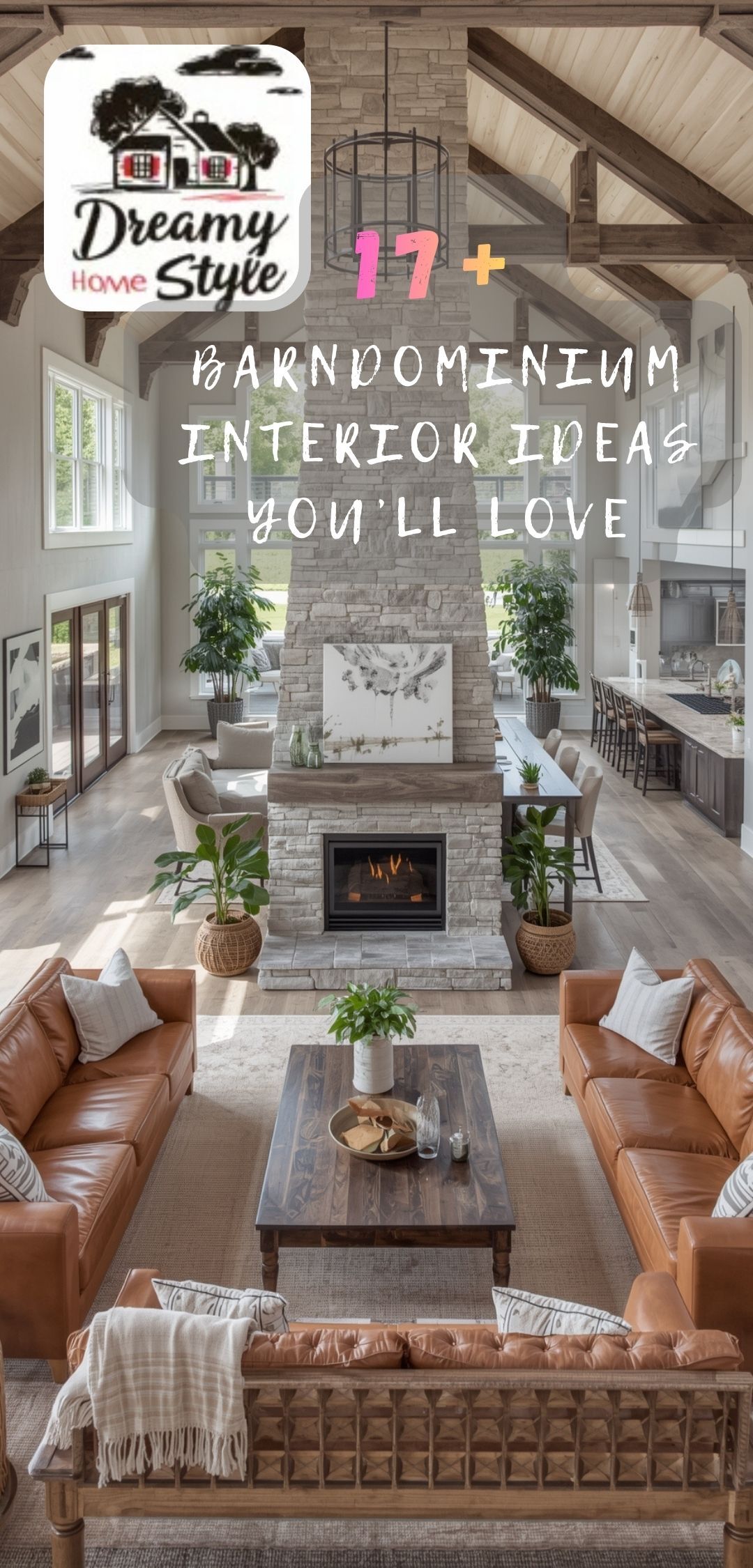
When you have such a tall space to fill, utilize it with a floor-to-ceiling fireplace, which is especially beautiful and effective when constructed from stone or brick.
If I could only pick one feature to splurge on in a barndominium, this would be it.
A towering fireplace becomes the heart of your entire home.
And I mean, when you have those crazy tall ceilings, why not use them?
Stone fireplaces are my weakness—they add so much texture and make the whole space feel grounded and earthy.
But brick works beautifully too, especially if you’re going for that industrial farmhouse vibe.
The best part about a floor-to-ceiling fireplace is that it becomes your natural focal point.
You don’t have to overthink the furniture arrangement because everything just naturally gravitates toward it.
I love adding a chunky wood mantel somewhere around eye level, even if the fireplace goes all the way up.
It gives you a spot for candles, family photos, or a little seasonal decor without breaking up the drama of the full-height stone.
And on chilly evenings?
There’s nothing cozier than curling up on the couch with that fire crackling away while you look up at those gorgeous beams.
Pure magic.
Install Massive Windows for Natural Light


Natural light enhances the sense of space and creates an inviting atmosphere, with large windows, skylights, and glass doors flooding the interior with sunlight throughout the day.
Let’s talk about windows for a second.
One of the most stunning things about barndominiums is how they handle light.
I’ve seen some with entire walls of windows, and honestly, it’s breathtaking.
The outside basically becomes part of your decor, which is such a dreamy concept.
If you’re building or renovating, think about where the sun rises and sets on your property.
You want those big, beautiful windows facing your best views and your best light.
Floor-to-ceiling windows make even a huge space feel somehow bigger and more connected to nature.
And if you’re worried about privacy, you can always do sheer curtains that let the light in but give you a little coverage.
I’m also a big fan of adding skylights if your roof situation allows it.
They bring in overhead light that changes throughout the day and creates these beautiful shadows and patterns on your floors.
Plus, less reliance on artificial lighting during the day means lower energy bills, which is always a win.
The key is to let as much natural light flood in as possible—it makes everything feel fresh, clean, and so alive.
Add Sliding Barn Doors for Functional Charm

Sliding barn doors offer a practical and stylish solution for dividing spaces, with large wooden doors on sturdy sliding tracks creating flexible room partitions while adding rustic charm.
I feel like barn doors are almost too perfect for barndominiums, right?
It’s literally in the name!
But seriously, they’re not just cute—they’re actually super functional.
In an open floor plan, you might want the option to close off a bedroom, bathroom, or office sometimes.
Barn doors let you do that without taking up the swing space that regular doors need.
I love oversized barn doors made from reclaimed wood with black metal hardware.
The contrast is just so good.
You can use them for closets, pantries, or even to separate a primary suite from the main living area.
And here’s a fun idea—use a barn door to hide a laundry area or mudroom.
When it’s open, everything flows together, but you can slide it closed when you have guests over and don’t want them seeing your laundry pile.
No judgment, we all have one.
The hardware is almost as important as the door itself.
Go for matte black or oil-rubbed bronze for that modern industrial look, or choose something with a bit of patina for more vintage vibes.
Incorporate Industrial Lighting Fixtures

Industrial or farmhouse style pendant lights, chandeliers, and sconces accentuate the barn aesthetic and create a cohesive look while adding character.
Lighting can make or break your entire design, and in a barndo, it’s even more important.
You’ve got all this vertical space to play with, so why not have some fun?
I’m completely in love with oversized industrial pendant lights.
You know the ones—with the metal shades and exposed bulbs that look like they came straight from a factory.
Hang a row of them over your kitchen island at varying heights for serious visual interest.
Chandeliers work beautifully in the dining area, especially if you go for something with a farmhouse twist.
Think wagon wheel chandeliers or wrought iron fixtures with Edison bulbs.
For ambient lighting, I love adding wall sconces in key spots like hallways or near reading nooks.
Black metal sconces with adjustable arms are both pretty and practical.
And don’t forget about statement floor lamps!
An arc floor lamp with a brass or copper finish can add warmth and a touch of glam to your space.
The goal is to layer your lighting so you have options for different moods and times of day.
Bright and energizing in the morning, soft and cozy at night.
Use Shiplap to Add Texture and Warmth

White walls create a crisp, clean look in large spaces, and when you have so much wall space, the added texture from shiplap prevents white walls from looking boring.
Shiplap has had such a moment in the design world, and honestly, I’m not mad about it.
In barndominiums especially, it’s kind of perfect.
White shiplap walls bring this clean, fresh feeling while still adding enough texture to keep things interesting.
And when you’re working with huge expanses of wall, that texture is everything.
I love using shiplap as an accent wall behind a bed or in the main living area.
It creates a focal point without adding color or pattern, which is great if you want to keep things calm and neutral.
But here’s where it gets really good—shiplap works as a bridge between different materials.
If you’ve got wood ceilings and wood floors, adding white shiplap walls in between keeps the space from feeling too heavy or dark.
You can also play with the direction you install it.
Horizontal is classic, but vertical shiplap can make your ceilings feel even taller.
And if you want to get a little adventurous, try a diagonal or herringbone pattern in a small space like a bathroom or mudroom.
Painting it in soft, warm whites keeps everything bright and airy.
Create a Statement Kitchen Island

A major part of barndominium design is a large kitchen, with long kitchen islands featuring butcher block counters and colorful bar stools promoting the idea of the kitchen being a communal space.
The kitchen island in a barndominium isn’t just for meal prep—it’s basically the social hub of your entire home.
And because you have all that space to work with, you can go big.
I’m talking like 8 to 10 feet long, with seating for at least four people.
Butcher block countertops on the island bring warmth and a handcrafted feel that contrasts beautifully with more modern finishes elsewhere.
Plus, they’re practical for chopping and food prep.
I love adding open shelving on one end of the island for cookbooks or pretty dishware.
And the bar stools?
This is your chance to inject some personality and color.
Maybe you go with leather stools for a rustic feel, or choose bright, upholstered ones for a pop of fun.
Storage is huge here, too.
Build in deep drawers, pull-out trash bins, and even a wine fridge if you’re fancy.
The island should be as functional as it is beautiful.
And consider adding pendant lights directly above—it defines the space and provides task lighting for cooking.
Trust me, your island will become everyone’s favorite hangout spot.
Incorporate a Cozy Loft Space

Barndominium interior ideas usually include vertical space to play with, with lofts or raised hallways that can be seen from the main living space, and drawing the eye upward with features like spiral staircases.
If you’ve got high ceilings, why not take advantage of that vertical space?
A loft is such a brilliant way to add extra square footage without expanding your footprint.
I’ve seen lofts used as reading nooks, home offices, guest bedrooms, or even cozy media rooms.
The cool thing about having a loft visible from the main living area is it adds architectural interest.
Your eye travels upward, making the space feel even more dynamic.
A spiral staircase leading up to the loft is not only practical but becomes a design feature in itself.
I love the look of metal spiral stairs—they’re industrial and elegant at the same time.
Or if you want something warmer, go for wood stairs with metal railings.
Up in the loft, you can create a completely different vibe from the main floor.
Maybe down below you have that open, airy farmhouse feel, but the loft is darker and moodier with deep colors and plush textures.
Just make sure you have good lighting up there since natural light might be limited.
String lights or wall sconces can make it feel magical.
Mix Metals for Modern Edge

Okay, so I know we’re told to pick one metal finish and stick with it, but honestly?
In a barndominium, mixing metals looks amazing.
The space is big enough and eclectic enough to handle it.
I love combining black metal light fixtures with brass cabinet hardware and maybe some copper accents in decor pieces.
It keeps things from feeling too matchy-matchy and adds depth.
The trick is to repeat each metal at least twice so it feels intentional rather than random.
If you have black metal window frames, echo that in your barn door hardware and maybe a black metal console table.
Then bring in brass with faucets, drawer pulls, and a brass floor lamp.
Copper can show up in smaller doses—maybe in planters, picture frames, or decorative bowls.
This mix of finishes gives your space a collected-over-time feel that’s way more interesting than everything being identical.
And it plays into that industrial farmhouse aesthetic that barndominiums do so well.
Don’t be afraid to experiment.
If you’re not sure, buy one piece in a new finish and see how you feel living with it for a week before committing to more.
Your gut will tell you if it works.
Bring in Tons of Texture

With so much open space, you need texture to keep things from feeling flat or echo-y.
And I mean layers of texture.
Start with your rugs—go for something chunky like a jute rug or a high-pile wool rug that feels amazing underfoot.
Add throw blankets in different materials—chunky knit, linen, faux fur.
I like to drape them over the back of the sofa or fold them in a basket nearby.
Pillows are another easy way to add texture.
Mix velvet with linen, add some leather accents, maybe a fun woven pillow.
Don’t forget about your walls, either.
Echo and noise in large open rooms can be handled by layering rugs, drapery, upholstered seating, and acoustic panels or wood slat baffles to absorb sound and quiet the space.
Wood slat accent walls or woven wall hangings add visual interest while also helping with acoustics.
Curtains in a natural linen or cotton bring softness and movement.
Even if your windows are huge, floor-to-ceiling curtains make the space feel finished and cozy.
Mixing textures is what makes a house feel like a home rather than a showroom.
It invites you to touch things, sink into things, get comfortable.
Design Zones With Different Flooring

Here’s a trick I don’t see enough people using—changing up your flooring in different areas.
In the main living and dining spaces, maybe you go with beautiful wide-plank hardwood floors.
Then in the kitchen area, switch to large-format tile or even polished concrete.
It’s a subtle way to define zones without putting up walls or barriers.
Plus, it’s practical—tile or concrete in the kitchen is easier to clean and more durable for high-traffic areas.
I love the look of really light, almost whitewashed wood floors throughout most of the space.
It keeps everything bright and makes rooms feel bigger.
Then in a primary bathroom or mudroom, you might do slate tile or even terrazzo for something unexpected.
The key is making sure your flooring choices still feel cohesive.
Stick to a similar color palette or undertone so the transitions don’t feel jarring.
And use rugs to help blend the different flooring materials together.
A big area rug in the living room can overlap both the wood and tile, creating a visual bridge.
It’s these little thoughtful details that make a space feel intentional and designed.
Related read: The IKEA Kallax Bible — Instant PDF + Kindle download. Secure checkout by Stripe