I cried a little the first night I slept in my one-bedroom apartment.
Not sad tears — just that overwhelmed, now-what kind of feeling.
The walls felt close.
The rooms felt stubborn, like they had no interest in cooperating with my vision.
And every decor idea I’d saved felt designed for homes three times the size of mine.
So I did what any design-obsessed girl does — I started experimenting.
Some things failed spectacularly.
Some things worked so well I stood back and just smiled at the room like a proud mom.
Over time, my little apartment stopped feeling like a limitation.
It started feeling like the coziest, most intentional space I’d ever lived in.
And I want that for you too.
These are my real ideas — the ones I actually lived with, tweaked, and genuinely love.

Start With a Light, Airy Color Palette


Color does something almost magical to a small room.
When I painted my living area in a soft warm white — not a stark, cold white, but that creamy, buttery kind — the whole space exhaled.
It felt bigger without a single piece of furniture changing.
Light colors reflect natural light, and that reflection is everything in a compact space.
Think soft whites, warm beiges, pale sage greens, or the softest dusty blues.
These shades make your walls feel like they’re gently stepping back, giving the room more visual breathing room.
If you love color (and I do), use it as an accent — a warm terracotta throw pillow, a blush ceramic vase, a single deep-toned bookshelf wall.
But keep your base palette airy.
My personal tip?
Test your paint color at three different times of day before committing.
Morning light, afternoon sun, and evening lamp glow will all read that color differently, and you want it to feel warm in every single one.
It’s a small step that saves you from a big “oh no” moment.
Choose Furniture That Earns Its Place


In a one-bedroom apartment, every single piece of furniture needs to work for you.
Not just sit there looking pretty — actually work.
When I tackled my own small living room, I swapped out my bulky sofa for a streamlined linen couch with legs.
And that tiny detail — the legs — completely changed the room.
You could see the floor underneath it, which made the whole space feel more open.
Furniture with visible legs creates a sense of flow and lightness that low, heavy pieces just can’t give you.
I’m also slightly obsessed with pieces that pull double duty.
An ottoman with hidden storage inside?
A bed frame with drawers built in underneath?
A dining bench that tucks fully under the table?
Yes.
All of it.
Yes.
These aren’t compromise pieces — they’re smart, intentional choices that free up floor space and reduce visual clutter at the same time.
If I had a tiny living room to style right now, the first thing I’d do is audit every piece of furniture and ask: does this earn its spot?
If the answer is no, it goes.
Use Mirrors Like Your Best Design Secret

Mirrors are honestly the most underrated decorating tool for small spaces.
I used to think they were just functional — something you glance at before walking out the door.
But a well-placed mirror?
It genuinely transforms a room.
I leaned a large, slightly arched mirror against the wall opposite my window, and the natural light just bounced around the entire space.
The room felt twice as deep.
It felt brighter, airier, and so much more intentional.
The rule I follow: place a mirror where it reflects either light or something beautiful — a plant, a piece of art, a window view.
Don’t place it where it reflects a cluttered corner or a plain blank wall.
You can also cluster smaller mirrors together for a more editorial, styled look.
I love a grouping of three mismatched vintage-style mirrors on a hallway wall.
It adds texture, personality, and that gorgeous sense of depth all at once.
And the best part?
Mirrors are one of the most budget-friendly ways to make a dramatic design impact.
Totally worth it.
Layer Your Lighting for a Cozy, Spacious Feel


Overhead lighting alone will make your space feel flat and kind of sad.
I know that sounds dramatic, but it’s true.
When I moved into my apartment, there was one ceiling fixture in the main room.
Just one.
And every evening it made the place feel more like a waiting room than a home.
The fix was layering.
I added a warm floor lamp in the corner of the living space.
I put small table lamps on either side of my bed.
I even tucked a little LED strip light behind my open shelving unit, and the soft glow it cast against the wall made everything feel warm and intentional.
Layered lighting creates visual depth, and depth is what makes a small room feel bigger.
My go-to combination: one ambient light source (like a floor lamp), one task light (bedside or desk), and one accent light (candles, LED strips, or a small decorative lamp).
That trio does everything.
It makes the space feel cozy in the evening and more expansive during the day.
And honestly, good lighting makes even the most budget decor look intentional and elevated.
Make Vertical Space Work Hard for You

When floor space is limited, the only place left to go is up.
And I mean that literally.
In my small bedroom, I had almost no room for a dresser.
So instead, I installed floating shelves all the way up to the ceiling and styled them with a mix of storage baskets, books, and a few pretty objects.
The result?
It drew the eye upward, made the ceilings feel higher, and gave me actual storage without taking up a single inch of floor space.
Tall bookshelves, floor-to-ceiling curtains, and vertically hung art all do the same thing.
They trick the eye into reading the room as taller and more expansive than it actually is.
My favorite curtain trick is to hang the rod as close to the ceiling as possible and let the panels fall all the way to the floor.
Even if your windows are small, this creates the illusion of grand, tall windows.
It’s one of those things that sounds too simple to matter — and then you do it and you’re like, wait, why didn’t I do this sooner?
Vertical styling is soft, effortless, and so effective.
Keep a Clean, Intentional Entryway

The entryway sets the tone for your entire apartment.
I used to completely ignore mine — it was just sort of a pile zone.
Shoes, bags, mail, a random umbrella.
It was chaotic, and it made the whole apartment feel that way too.
When I finally styled it, even though it was tiny, everything shifted.
I added a slim console table with a small drawer for keys and a little decorative tray on top.
I hung a mirror above it — there are those mirrors again — and added a minimal hook rail for bags.
Suddenly, walking into my apartment felt like arriving somewhere intentional.
Somewhere a little special.
For really small entryways, even just a single hook, a small tray for keys, and one beautiful object — a vase, a candle, a small plant — is enough.
You don’t need a grand foyer.
You just need one little moment that says: you’re home, and it’s lovely here.
That emotional shift is so worth the ten minutes it takes to style it.
Embrace Multi-Purpose Zones in Your Bedroom

In a one-bedroom apartment, the bedroom is often asked to do a lot.
Sleep, yes — but also work, get ready, maybe even relax with a book or watch something.
And that’s totally fine, as long as you zone it thoughtfully.
When I needed a little work-from-home corner in my bedroom, I didn’t want it to feel like an office invaded my sanctuary.
So I tucked a small, beautiful desk into the corner, added a cute little lamp, and hung a piece of art above it that felt personal and soft.
It looked like it belonged.
It didn’t disrupt the bedroom energy — it actually added to it.
The trick is keeping each zone visually distinct without using walls.
A small rug under the desk area.
A different lighting vibe in the sleep zone.
Even just the orientation of furniture can signal: this corner is for something different.
Your bedroom should feel like a retreat first, always.
Everything else layers in gently around that intention.
Use Rugs to Define and Warm the Space

A rug can completely change how a room feels — and I mean that on a sensory level.
There’s something about stepping onto a soft, warm rug first thing in the morning that makes a space feel genuinely cared for.
In my living area, I used a large, soft area rug to define the seating zone and anchor it.
Not a small rug tucked under the coffee table — a generously sized one where all the furniture could sit on it or at least touch it.
That size choice made the room feel pulled together and intentional.
In the bedroom, I love layering rugs — a neutral base with a smaller, textured or patterned one on top.
It adds depth, warmth, and that sort of effortlessly styled look that feels a little editorial.
If you’re decorating on a budget, a rug is genuinely one of the highest-impact purchases you can make.
It grounds the furniture, softens the acoustics, adds color or texture, and just makes the whole space feel more finished.
My personal favorite?
A vintage-inspired rug with soft, faded tones.
It adds character without overpowering a small space.
Declutter With Style — Not Just Minimalism

Here’s something I had to unlearn: decluttering doesn’t mean stripping your space of personality.
It means being intentional about what stays.
When I first started reading about small space design, everything felt so stark and cold.
All white walls, nothing on the surfaces, barely any softness.
And I just… didn’t want to live like that.
So I found my own version.
I kept the things that genuinely brought me joy — the little ceramic dish I found at a flea market, the stack of beautiful books on my coffee table, the single trailing plant on my windowsill.
I just edited out the stuff that was there out of habit, not love.
The difference is huge.
A curated space with personality feels abundant.
A cluttered space feels heavy, even when it’s full of things you love.
My method: every surface gets one hero item and one supporting item, max.
A lamp plus a candle.
A plant plus a small stack of books.
That’s it.
It creates that effortlessly styled look without making your home feel like a showroom.
Bring in Plants and Natural Textures

Plants do something for a space that no decor piece can replicate.
They add life — literally.
When I added a big, leafy pothos trailing from a high shelf in my living room, the whole corner came alive.
It felt warmer, softer, more breathing.
And natural textures work the same way.
Linen throw pillows, a chunky knit blanket, a woven basket, a wooden tray.
These materials add depth and tactile warmth that make a small space feel rich instead of sparse.
I’m kind of obsessed with mixing textures — pairing smooth ceramic with rough rattan, soft linen with a warm wood shelf.
That contrast is what gives a room that layered, collected-over-time feeling.
Even if you’re starting completely from scratch, investing in a few natural texture pieces makes your decor feel more elevated and intentional.
And plants?
Even if you don’t have a green thumb, there are so many low-maintenance options.
A pothos, a snake plant, a little succulent on your windowsill.
They bring so much life for so little effort, and honestly they make me happy every time I walk past them.
Style Your Bedroom Like a Boutique Hotel

There’s a reason boutique hotels feel so luxurious even when the rooms are tiny.
It’s all in the layering and the intention.
When I started thinking about my bedroom that way, everything changed.
I focused on the bed first — because in a one-bedroom apartment, the bed is the centerpiece of everything.
I invested in really beautiful, high-quality bedding in a soft, neutral tone.
Then I layered.
A duvet, throw pillows in two sizes, a folded knit blanket draped casually at the foot.
That layering creates texture and depth that makes a bed look genuinely luxurious.
I added two matching bedside lamps with warm-toned bulbs — the kind of glow that makes everything feel soft and golden.
A small tray on each nightstand with just a candle and a little plant.
Nothing extra.
Just intention.
The result feels like checking into somewhere special every single night.
And I think that’s what home should feel like — like a place you’re genuinely happy to return to.
That feeling is so available, no matter the size of your space.
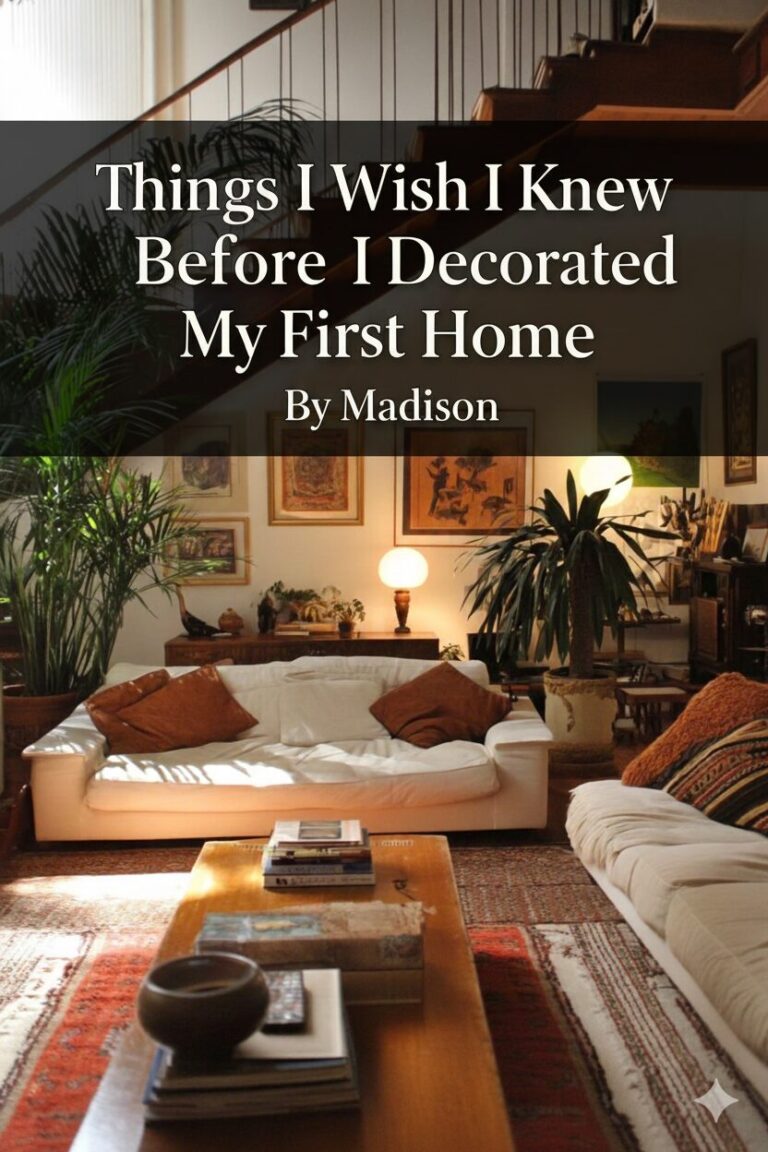
Related read: Things I Wish I Knew Before I Decorated My First Home — Instant PDF + Kindle download. Secure checkout by Stripe