This was the single biggest shift I made, and I wish someone had told me sooner.
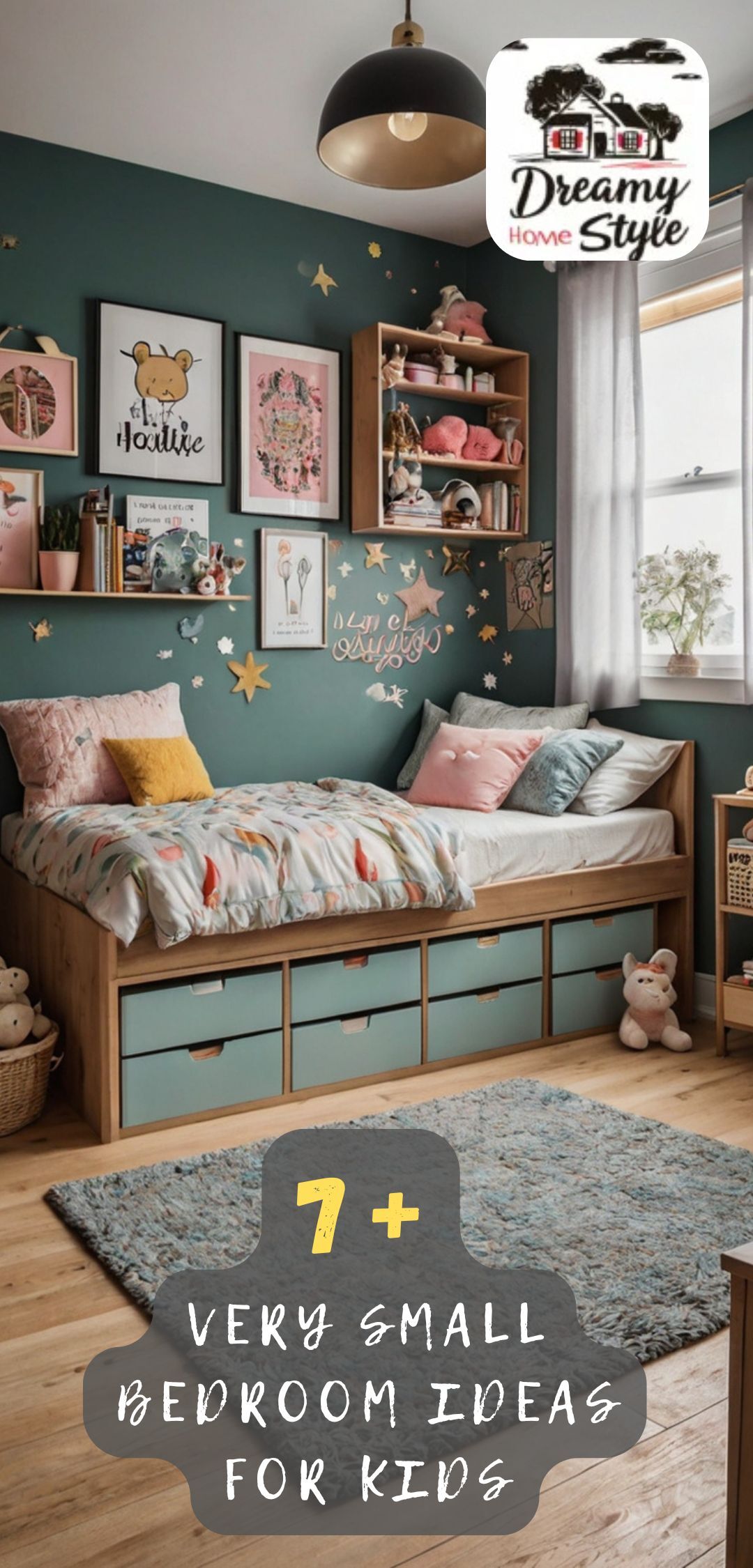
In a small kid’s bedroom, the bed is usually the biggest space-hog in the room.
And when you place it flat on the floor, taking up prime floor real estate — you’ve already lost the battle.
Going vertical changed everything for us.
A loft bed instantly freed up the entire area underneath.
That space became a little reading nook with a curtain and fairy lights, and my daughter acts like it’s her own private clubhouse.
It genuinely cost us less floor space and gave her more room to play.
If your child is young and a loft feels too high, a mid-sleeper — lower to the ground but still elevated — is a cozy, safer option.
And honestly?
The kids absolutely love the novelty of sleeping “up high.”
It adds a layer of fun that no flat bed on the floor can compete with.
If I had to do just one thing in a small kid’s room, this would be it.
Every.
Single.
Time.

Built-In Storage Is Your Best Friend (And Mine)


I’m a little obsessed with built-in storage, I won’t lie.
There’s something about a wall of built-ins that just makes a small room look intentional rather than cramped.
When we added a built-in unit along one wall of my daughter’s room, the transformation was honestly shocking.
Suddenly there was a place for everything.
Books, toys, art supplies, random collections of things only a kid could love — all of it had a home.
The trick is to build all the way up to the ceiling.
Most people stop at eye level, and that top portion of the wall just sits there doing nothing.
Use it.
Add baskets up high for seasonal items or things she’s not using right now.
Lower shelves can hold everyday books and small bins for easy access.
And if full built-ins aren’t in your budget — I totally get it — a combination of floating shelves and a simple wardrobe achieves almost the same feeling.
The goal is to get everything off the floor.
When the floor is clear, even a small room breathes.
It feels lighter, bigger, and so much calmer to be in.
Use the Wall Space Like It’s Prime Real Estate


Here’s something I wish I’d understood earlier: the walls in a kid’s small bedroom are not just for decoration.
They are functional square footage.
Every inch of wall space you ignore is storage potential you’re leaving behind.
Wall-mounted hooks near the door hold backpacks, jackets, and hats without taking up any floor space at all.
Pegboards — the kind you can customize with shelves, hooks, and little bins — are absolute magic in a small kid’s room.
My daughter has one above her desk area, and it holds her art supplies, her headphones, and a little succulent she named Gerald.
Wall-mounted bookshelves shaped like clouds or stars are another one I love.
They store books and double as the most charming wall decor.
And if your child is into displaying their artwork or collection — lean into that.
A simple ledge shelf along one wall lets them rotate their display without you having to repaint every six months.
It all feels curated rather than cluttered when it’s up on the wall versus piled on a dresser.
Think of the walls as a second floor.
Use them.
A Corner Desk Changes the Whole Game


My daughter needed a homework spot, and fitting a standard desk into her tiny room felt like a geometry problem I was not equipped to solve.
Then I discovered the corner desk.
I know it sounds simple, but honestly — it was a revelation.
Tucking a small L-shaped desk or even just a floating wall-mounted desk into the corner uses a space that typically gets wasted anyway.
And it leaves the rest of the room open for playing, stretching, just being a kid.
Wall-mounted desks are my personal favorite because when homework is done, you can fold it up or tuck the chair underneath and the room doesn’t feel like a home office anymore.
It goes back to being a bedroom.
A cozy, fun, kid-friendly bedroom.
If your child is young and doesn’t need a full desk yet, a small floating shelf at their height works perfectly as a drawing station.
Add a couple of small bins for crayons and paper, and they have their own little creative corner.
Something about having their own dedicated space makes kids so proud.
And honestly, watching that pride?
It’s the best part of the whole thing.
Light Is Everything — Don’t Sleep on This One


I used to think lighting was a finishing touch.
Like, you pick out your furniture, your storage, your decor, and then you think about lighting.
But working on my daughter’s small room taught me that light is actually a design tool.
A small room with bad lighting feels like a cave.
The same small room with layered, warm lighting feels cozy, magical, and so much bigger.
Start with a ceiling light that brightens the whole space evenly — ideally something with a dimmer so you can transition from playtime brightness to bedtime softness.
Then add layers.
A small bedside lamp for reading.
Fairy lights along the loft bed frame or tucked behind a headboard for that soft, dreamy glow.
A little plug-in night light that makes bedtime feel less scary and more like an adventure.
We added a LED strip light under my daughter’s loft, and she genuinely thinks it’s the coolest thing in the entire house.
It creates this warm amber glow underneath her reading nook and makes the whole room feel like a little world.
Warm white lights are always better than cool white in a kid’s bedroom.
Cool white feels clinical.
A Reading Nook Is the Secret Ingredient

I am so convinced that every small kid’s bedroom — no matter how tiny — has room for a reading nook somewhere.
Even if it’s just a corner with a floor cushion, a basket of books, and a string of lights.
That little setup does something emotionally for a child that I don’t think we talk about enough.
It gives them a retreat.
A quiet little spot that’s just for them.
Not for playing, not for sleeping — just for curling up with a book or their own thoughts.
When I created a nook underneath my daughter’s loft bed using a curtain and a couple of floor pillows, she started going in there voluntarily.
Like, choosing to go read instead of watch TV.
(I nearly cried.)
A canopy hung from the ceiling can create that same enclosed, tucked-in feeling even without a loft.
A teepee tent in the corner works beautifully too, and kids are wild about them.
The key emotional thing a nook does is give a child ownership over a small piece of their space.
It becomes theirs.
And that sense of ownership translates into them actually taking care of it.
Which is sort of a bonus for you too, let’s be honest.
Think in Zones, Not Just Furniture

This was a total mindset shift for me, and it made the whole room make more sense.
Instead of just thinking “where does the bed go, where does the dresser go” — I started thinking in zones.
Sleep zone.
Play zone.
Creative zone.
Even in a very small bedroom, you can define these areas with rugs, lighting, and furniture placement rather than walls.
A rug under the bed defines the sleep zone.
A small rug in the corner where the craft supplies live defines the creative zone.
A clear floor area — even if it’s just 4×4 feet — becomes the play zone.
When kids understand intuitively where things “live,” they’re also more likely to put things back.
It sort of gamifies tidying up, which I am one hundred percent here for.
Zone thinking also helps when the room needs to evolve as your child grows.
The creative zone might shift.
The play zone might shrink as they get older.
But the structure remains, and it keeps the small room feeling organized even through those messy, transitional years.
It’s kindda the secret framework behind every beautiful small kid’s room I’ve ever loved.
Color Can Make or Shrink a Room — Choose Wisely

I had a whole conversation with myself about whether to paint my daughter’s room her favorite color at the time — a very bold, very saturated cobalt blue.
Reader, I did not do it.
And I’m so glad.
In a small room, very dark or very intense colors can close the space in and make it feel heavy.
But that doesn’t mean you’re stuck with all white walls either.
Soft, muted tones are absolutely dreamy in a small kid’s room.
Sage green, dusty rose, warm terracotta, soft lavender — these shades add personality and warmth without making the room feel smaller.
If your child really wants a bold color (which they will), use it as an accent.
One feature wall.
A colorful bookshelf.
Painted furniture.
Bedding in their favorite color.
You can honor their personality without committing every wall to a shade that might feel overwhelming in tight quarters.
We did soft Warm White Walls with a dusty pink built-in bookshelf, and it is honestly one of the most charming things I’ve ever done in a home.
The contrast is subtle but so, so pretty.
It feels soft and intentional and so much more sophisticated than four blue walls ever would have.
Multi-Use Furniture Is Non-Negotiable

If a piece of furniture in a small kid’s room only does one thing, I want you to really think hard about whether it earns its place.
In a tiny space, every item should ideally pull double or even triple duty.
An ottoman that opens up to store toys inside.
A bench at the end of the bed that holds extra bedding in the base and provides a seat for putting on shoes.
A bookshelf headboard that acts as both storage and a headboard so you don’t need a separate one.
A daybed with a pull-out trundle that works as a sofa, a bed, and a sleepover solution all in one.
I replaced my daughter’s separate bookshelf and bedside table with one small built-in unit that did both jobs, and getting rid of that extra piece of furniture made the room feel genuinely like a different space.
The floor area we gained back was only about two square feet.
But visually?
It looked like we added ten.
That’s the magic of thoughtful, intentional furniture choices in a small room.
You’re not decorating.
You’re problem-solving.
And honestly, the creative challenge of that is something I find weirdly, deeply satisfying.
Make It Feel Fun — Because That’s The Whole Point

Here’s something I think gets lost in all the practical storage talk.
This is a kid’s room.
It should feel fun.
It should feel a little magical.
It should make your child run in there after school because it’s genuinely their favorite place.
You can have an organized, space-maximized room and a room that sparks joy.
These are not opposing things.
Hang a fun canopy over the bed.
Add glow-in-the-dark stars to the ceiling.
Get a projector night light that turns the ceiling into a little galaxy at bedtime.
Frame their artwork and hang it like it belongs in a gallery, because it does.
Let them pick one wild, colorful element — a patterned rug, a bright pillow, a fun lamp — that is fully theirs.
My daughter picked out the most wonderful little mushroom lamp and she talks about it constantly.
It costs almost nothing and it makes her feel so proud of her space.
The emotional function of a child’s bedroom is to make them feel safe, seen, and delighted.
The practical function is storage and sleep.
When you get both right?
Even in a tiny room?
That’s when the magic really happens.
Keep It Flexible — Kids Change Fast

One thing I’ve learned the hard way is that kids outgrow things so quickly.
What your five-year-old loves with her whole heart, your eight-year-old will think is deeply embarrassing.
So when you’re designing a small kid’s bedroom, try to build flexibility into the bones of it.
Invest in neutral furniture — white, natural wood, soft gray — and let the personality come through in things that are easy and inexpensive to swap out.
Bedding.
Pillows.
A rug.
Wall art.
These things can completely transform a room without touching the furniture, and when your child’s taste inevitably evolves, you’re not staring down a full room redo.
The loft bed we chose is a natural pine.
When my daughter was little, we dressed it with pink bedding and a fairy light canopy.
Now she wants it a little more “grown up” — so we swapped in some linen bedding and a simple string light and it looks completely different.
Same bones.
New personality.
That flexibility has saved us so much money and so much emotional energy.
Because in a small room, every change feels amplified.
Build a room that can grow with your child, and you’ll thank yourself for years.