
Nobody warned me that moving into a loft kitchen would feel like adopting a very beautiful, very complicated stray cat.
You want to love it immediately.
You do love it, sort of.
But it also scratches you a little and refuses to cooperate and you spend the first few weeks just staring at it going — what do you need from me?
The exposed pipes felt aggressive.
The concrete felt relentless.
And the brick, which I had romanticized completely, turned out to look less “cozy Parisian bistro” and more “abandoned warehouse” under bad lighting.
I remember calling my best friend on like day four and saying, very quietly, I think I made a mistake.
She told me to give it ninety days.
And somewhere around day sixty, something clicked.
A rug went down.
A warm bulb went in.
A plant showed up on a shelf.
And just like that — the kitchen started to feel like it was finally letting me in.

The Brick Wall Is Not Your Enemy — It’s Your Best Texture


I used to want to paint over the brick.
I know.
I cringe now too.
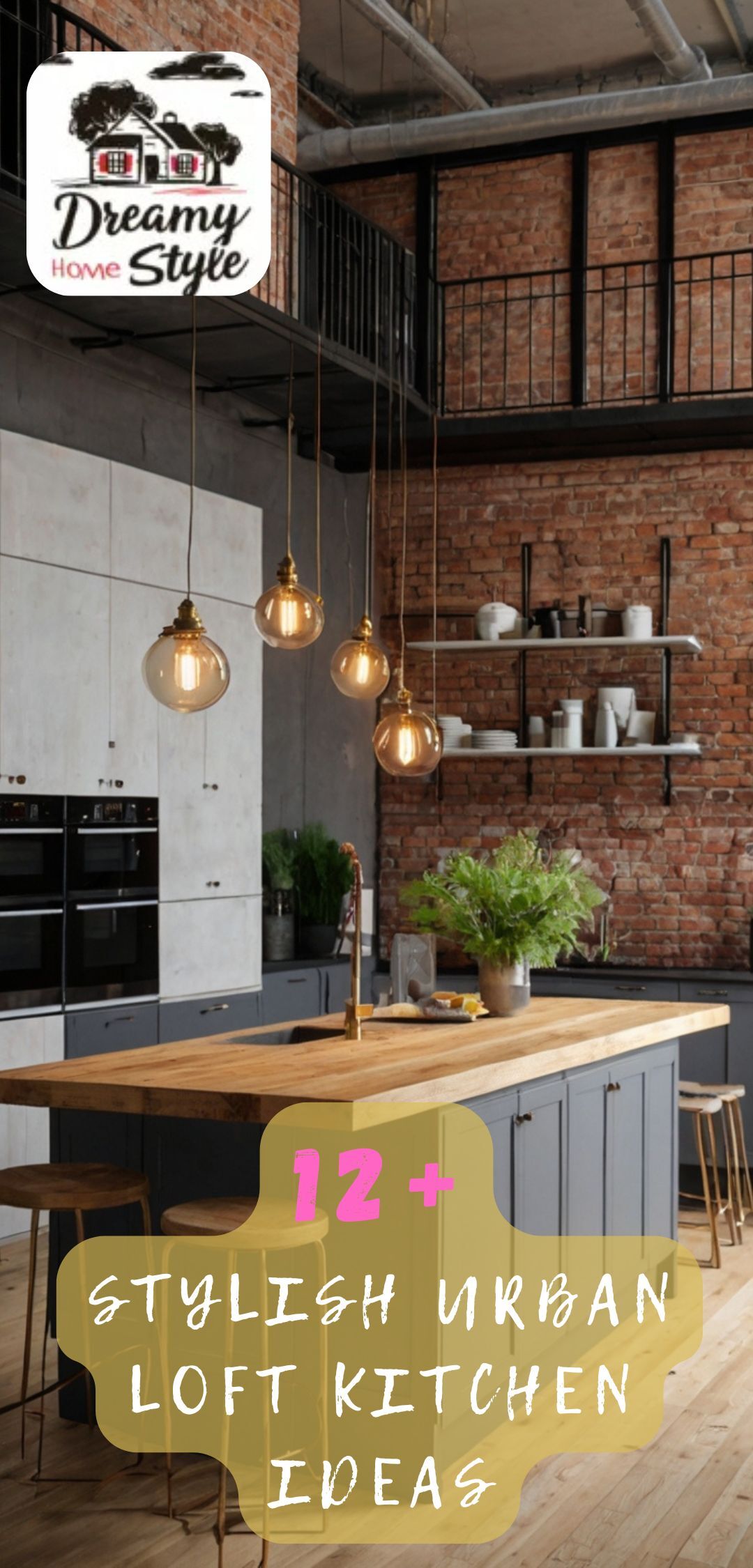
Because that exposed brick wall — all rough, warm, terracotta-toned and slightly uneven — ended up becoming the most photographed corner of my entire home.
The texture does something to a space that no wallpaper, no tile, no paint can quite replicate.
It gives the kitchen age.
It gives it soul.
What I did was simply clean it up with a dry brush, seal it lightly, and then let it breathe.
I pushed a floating dark walnut shelf right against it, styled it with a few ceramic canisters and a trailing pothos plant, and suddenly it looked like something out of a design magazine.
If I had a plain white kitchen and could add one thing for character, I would honestly choose brick every single time.
The warmth it adds — especially under warm-toned Edison lighting — is just chef’s kiss.
Don’t hide it.
Don’t paint it.
Work with it.
Open Shelving Is Everything (When You Do It Right)


Open shelving in a loft kitchen is one of those things that either looks incredibly intentional or incredibly chaotic.
And the difference?
It’s mostly about restraint.
When I first put up my open shelves, I over-styled them.
Like, embarrassingly over-styled.
Twelve things on one shelf, three different wood tones, mismatched everything.
It looked cluttered and sort of sad.
So I pulled everything off, took a breath, and started fresh with a rule: only things I genuinely love and use regularly get to live on these shelves.
My worn-in ceramic mugs.
My small cast iron skillet.
A little glass jar of sea salt.
A single trailing plant.
That’s it.
The visual breathing room that comes from less is what makes open shelving in a loft kitchen feel editorial instead of messy.
And honestly?
Styling your kitchen like that makes you feel so good every single morning when you walk in.
It’s cozy in a way that closed cabinets just never are.
The Island Situation — Why I Am Obsessed With a Butcher Block Top


If you are designing or rethinking your urban loft kitchen, please hear me on this one.
A butcher block island top will change your life.
I am not being dramatic.
I had cold, polished concrete counters throughout — which I love — but the island needed to feel different.
Warmer.
More touchable.
Butcher block gave me that contrast in the most beautiful way.
The grain of the wood, the slight imperfections, the way it develops this gorgeous patina over time — it feels alive in a way stone just doesn’t.
I oil mine every few weeks with food-safe mineral oil and it just keeps getting more beautiful.
Plus it is incredibly functional.
I chop directly on it.
I roll dough on it.
I set a hot pan down (carefully) and it holds up like a champ.
If you can’t do a full butcher block island, even a butcher block cutting board stationed permanently on a stone counter gives you that same warmth hit.
Small version, same cozy effect.
Industrial Lighting That Actually Feels Warm — My Picks and Why They Work


Lighting in an urban loft kitchen is where so many people get it wrong.
They go full industrial — stark, cold, warehouse-style pendants — and then wonder why the space feels unwelcoming.
The secret is to mix industrial shapes with warm bulbs.
I have matte black cage pendants hanging over my island.
The hardware is very raw, very loft-appropriate.
But inside each pendant?
A warm amber Edison bulb at about 2200 Kelvin.
The effect is magical.
It’s moody.
It’s warm.
It makes the kitchen feel like the kind of place where you want to pour a second glass of wine and just linger.
I also layered in under-cabinet lighting with the same warm temperature.
That little strip of light along the bottom of the upper cabinets hits the counters at a perfect angle and makes everything glow in the evenings.
Lighting is honestly the most underrated design tool in any kitchen.
Spend more on the bulb temperature than you think you need to.
Dark Cabinets in a Loft Kitchen — Scary at First, Stunning Forever

Dark cabinets felt risky to me.
My loft kitchen was not huge, and I genuinely worried it would feel cave-like.
But I went for it — a deep charcoal green — and I have not regretted a single day.
Here is the thing about dark cabinets in a loft space: they disappear into the background in the best possible way.
They let the brick, the shelving, the counters, the light all take center stage.
And they add this richness, this depth, that bright white cabinets just cannot touch.
If you are nervous, start with just the lower cabinets in a darker shade and keep the uppers light.
That combo — dark lowers, light or open uppers — is so stunning and gives you a bit of both worlds.
My personal tip: go with a matte finish, not gloss.
Matte just feels so much more editorial and sophisticated in a loft setting.
Gloss can veer into feeling a little cold and sterile.
Matte all the way.
Mixing Metal Finishes Like a Pro (Because Rules Are Made to Be Broken)

I was told once that you should pick one metal finish and stick to it in a kitchen.
And kindda… I ignored that entirely.
Mixing metals — when done with intention — is one of the most elevated things you can do in an urban loft kitchen.
My hardware is matte black.
My faucet is brushed brass.
My pendant cage details have a bit of antique bronze.
And it all works beautifully together because there’s a common thread: everything has a raw, non-reflective quality.
Nothing is overly shiny or polished chrome.
That’s the real rule.
Not “one metal only” — but rather “keep the finish family cohesive.”
Matte black + brushed brass + antique bronze all live happily in the same warm, industrial-leaning family.
Mix them freely.
Just avoid throwing in something very shiny and modern next to something very matte and raw.
That’s where it can start to look unintentional rather than curated.
Plants in the Kitchen — The Non-Negotiable I Will Never Compromise On

I genuinely believe a kitchen without a plant is a kitchen missing its soul.
That might sound dramatic.
But I stand by it completely.
In my loft kitchen, I have a big trailing pothos on my open shelf, a small rosemary pot on the windowsill, and a little fiddle leaf cutting in a terracotta pot on the island.
The green against the charcoal cabinets and the warm brick is just… so good.
It softens everything.
It brings life into what could otherwise feel like a very hard, industrial space.
And there’s something genuinely lovely about grabbing a sprig of fresh rosemary while you cook.
It makes you feel like you live in a dreamy little Italian farmhouse, even if you’re actually in the middle of a city.
My personal hack: terracotta pots only in a loft kitchen.
No plastic.
No shiny ceramic.
The raw, earthy tone of terracotta complements brick and wood in a way that feels totally effortless.
The Concrete Counter Situation — What Nobody Tells You

Concrete counters are gorgeous.
They are also high maintenance and slightly terrifying if you are not warned ahead of time.
I learned this the hard way when I set a lemon down on an unsealed section and came back to find a small etch mark.
Not the best afternoon.
Here’s what nobody talks about in all those beautiful loft kitchen photos: concrete must be properly sealed — and re-sealed regularly — to stay looking that smooth, moody, magazine-worthy grey.
Mine gets a fresh coat of penetrating sealer twice a year.
In between, I use a PH-neutral cleaner only.
No vinegar, no citrus-based anything.
With that routine, it has held up beautifully and still looks incredible.
If you love the look but want something lower maintenance, a concrete-look porcelain tile gives you about 90% of the aesthetic with about 10% of the upkeep.
Totally valid swap and honestly sometimes I kindda wish I had gone that route in certain areas.
Creating a Cozy Breakfast Nook in an Open Loft Kitchen

One of my favorite things I ever added to my loft kitchen was a tiny, cozy breakfast nook in the corner.
Just a small built-in bench along the wall, a narrow table, and two mismatched vintage-ish chairs.
It took what was essentially dead corner space and turned it into the most used, most loved spot in my home.
I piled the bench with a couple of linen cushions in warm terracotta tones.
I hung a little pendant light overhead — just one small brass cage pendant.
And I styled the wall behind it with a small gallery of framed botanical prints.
The whole thing cost me significantly less than I expected.
And it transformed the feeling of the kitchen from “functional space” to “place I actually want to be in.”
If I had a small loft kitchen with even one awkward corner, this is exactly what I’d do first.
Even if it’s just a bench cushion and a small table — make yourself a little nook.
You will use it every single day.
Storage That Doesn’t Look Like Storage — My Favorite Hidden Solutions

Urban loft kitchens are almost always a little short on storage.
That is just the reality of the layout.
But some of my favorite solutions are the ones that pull double-duty — functional and beautiful.
A big vintage-style bread box on the counter looks gorgeous and hides all the random pantry overflow.
Woven baskets on open shelves store snacks and look like intentional decor.
A Magnetic Knife Strip on the brick wall (yes, you can attach things to brick with the right anchors) keeps knives accessible and frees up an entire drawer.
A rolling cart — I have mine in a matte black finish — tucks under the island when not in use and pulls out as extra prep space when I need it.
And under-shelf hanging baskets for things like bananas, garlic, and onions?
Game changer for freeing up precious counter real estate.
You know, the trick is to never let storage look like a problem being solved.
It should always look like a design decision.
The One Rug That Made My Loft Kitchen Feel Like a Home

I almost did not put a rug in my kitchen.
I thought it would get ruined immediately.
I thought it would look out of place.
I thought it was just not a “kitchen thing.”
I was wrong on every single count.
A large, low-pile rug under the island area completely transformed the way the space felt.
It added warmth — visual and literal — to what had been a very cold concrete floor situation.
It muffled the sound (loft kitchens can be quite echoey, you know).
And it tied the whole space together in a way I couldn’t quite achieve without it.
I went with a faded, vintage-style kilim pattern in terracotta and cream tones.
Washable runner.
Non-negotiable.
Because yes, things spill.
And yes, you will spill them too.
But a good washable rug handles it all without you breaking a sweat.
If you’re on the fence — just go for it.
It’s the one change that got the most compliments from literally every single person who walked into my kitchen.