When I tackled my own front yard makeover, the very first thing I had to do was give myself permission to start small.
Because I kept waiting until I had the “perfect plan.”
And that plan never came.
What I realized pretty quickly is that simple front yard landscaping isn’t about doing everything at once.
It’s about doing the right things first.
So I walked to the curb.
I stood there and I just looked — like a stranger seeing my home for the very first time.
And what jumped out immediately was the lack of any visual anchor.
There was no focal point.
Nothing to draw the eye in.
Just a flat, forgettable stretch of grass.
If I had to pick one starting tip for anyone feeling stuck, it’s this: go stand at your curb first.
You’ll see exactly what needs attention — and it’ll be obvious.
Sometimes the best clarity comes from a simple shift in perspective.
Literally.
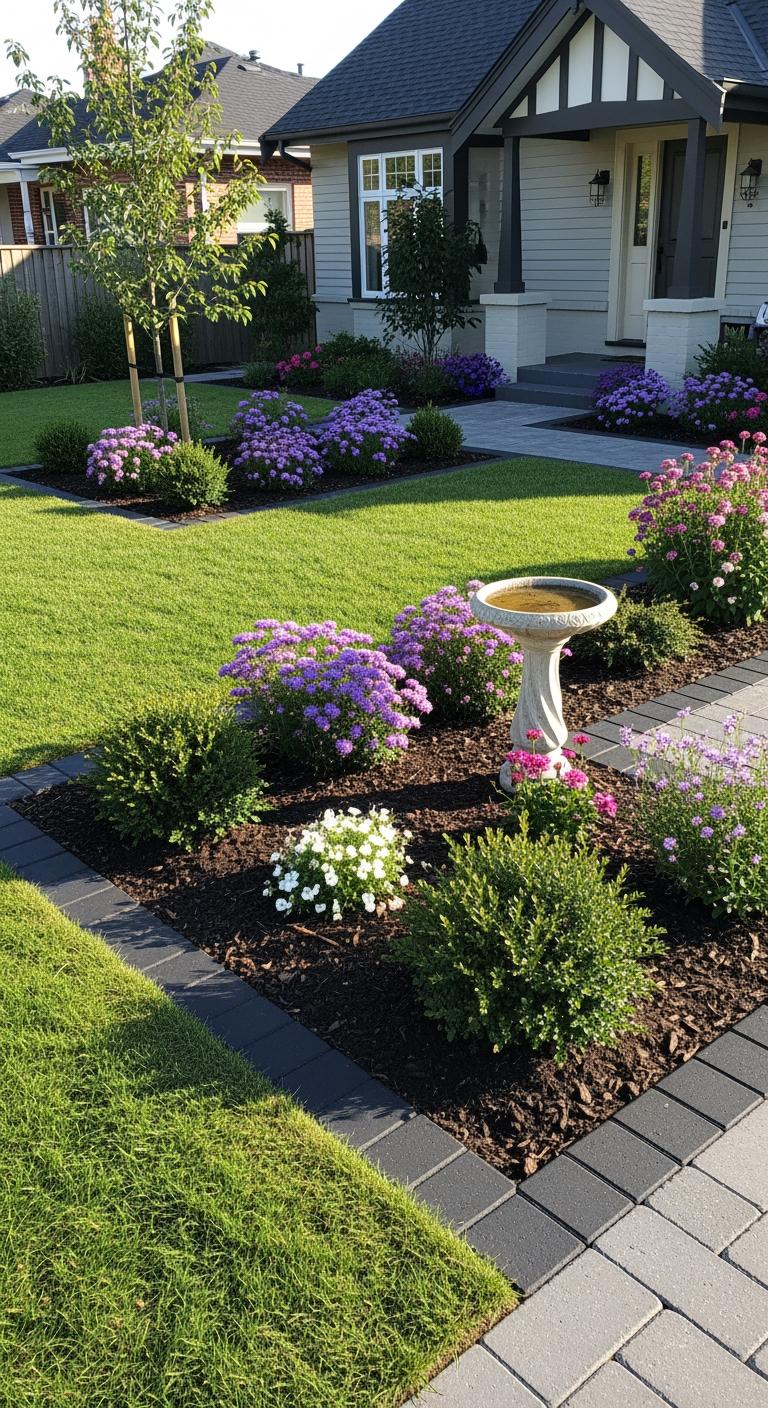
My Obsession With Defined Edges (And Why You Need Them Too)
Okay, so this one is kindda boring to talk about, but bear with me — because edging completely changed my yard.

Before I added clean edges along my lawn and garden beds, everything just sort of melted into everything else.
Grass crept into the flower beds.
Dirt spilled onto the path.
It looked tired and overgrown even right after I’d mowed.
Once I edged?
Whole different story.
The lawn looked intentional.
The beds looked purposeful.
And honestly, it looked like someone who actually cared lived there — which, surprise, is me.
You don’t need a fancy edging tool either.
A basic half-moon edger from any hardware store will do the job beautifully.
I’m obsessed with the way a clean line makes even the simplest planting look polished.
It’s that quiet kind of detail that people notice without knowing why the yard looks so good.
Think of edging like the eyeliner of your front yard.
It defines everything.
It sharpens the whole look.
And it costs almost nothing.
The Mulch Moment That Changed Everything

I want to talk about mulch for a second.
Because before I really leaned into it, I thought it was kind of… blah.
Just filler, you know?
But mulch is so much more than that.
When I finally spread a fresh, thick layer of dark brown mulch across my front beds, it was like someone turned up the contrast on a photo.
The plants popped.
The beds looked full and rich.
And weeds — my nemesis — slowed way down.
I love it so much I now refresh it every single spring.
It’s one of those things that costs maybe $30 to $50 in bags from the garden center and makes your yard look like you spent ten times that.
I go with a dark, natural hardwood mulch.
It photographs beautifully and it holds its color longer than the lighter shades.
Plus there’s something deeply cozy about that earthy, woodsy smell right after you spread a fresh batch.
If you do nothing else from my suggestions today, do the mulch.
It is the single highest-return thing you can do for a front yard.
Promise.
Choosing Plants That Don’t Require a Horticulture Degree

I am not a plant expert.
I just want to be really upfront about that.
I’ve killed plenty of things that were labeled “low maintenance” on the tag.
So when I was pulling together my front yard plan, I made myself one rule: only choose plants that are genuinely, notoriously hard to kill in my climate.
For me, that meant ornamental grasses, knockout roses, hostas for the shady corner, and lavender along the sunny front edge.
All forgiving, all beautiful, and all looking intentional without demanding my constant attention.
When I’m recommending plants to a friend who’s just starting out, I always say — visit your local nursery and literally ask them: “What grows in this neighborhood that I can basically ignore?”
They will tell you.
And it’ll save you so much heartbreak.
Also, go for varying heights.
Low groundcover at the front, medium shrubs in the middle, a taller element — maybe an ornamental grass or a compact flowering shrub — in the back.
That layering creates depth.
And depth is what makes a yard look professionally designed rather than randomly planted.
Symmetry Is My Best Friend (Even When It’s Imperfect)

There is something about symmetry in a front yard that just feels right.
Calming, even.
And you don’t have to be precise about it — this is a yard, not a geometry exam.
When I flanked my front door with two matching potted topiaries — just simple little spiral ones from the garden center — the whole entrance transformed.
It framed the door.
It created intention.
It made the house look like someone thoughtful lived there.
You can do this with matching planters, matching lanterns, matching shrubs on either side of your path, or even just two identical flower beds flanking your front steps.
The mirror effect is magic.
And what I love most about this approach is that even if everything else in your yard is slightly wild or imperfect, that visual symmetry at the entrance pulls it all together.
It signals: this is on purpose.
This was chosen.
And that shift — from “accidental” to “intentional” — is everything when it comes to curb appeal.
Even a little bit of symmetry goes such a long way.
My Favorite Trick: The Simple Pathway

If there’s one thing that adds instant character to a front yard, it’s a defined pathway.
Not necessarily a complicated one.
But something that says “this is how you get to my door.”
When I redid my front walk, I used simple stepping stones laid through the grass — staggered slightly, with creeping thyme planted between them.
The whole thing took one weekend and maybe $80 in materials.
And it made my yard feel like a cottage from a magazine.
The creeping thyme fills in the gaps, stays low, handles foot traffic, and releases the most gorgeous little scent when you brush it with your shoes.
I love it.
If you don’t want to do stones through grass, even a freshly edged concrete path lined with low border plants on both sides feels completely transformed from what it was before.
The path is an invitation.
It tells your guests: come this way, something lovely is waiting for you.
And that feeling — that warmth — is what curb appeal is really about.
It’s not just aesthetics.
It’s hospitality.
Working With What You Already Have

Here’s something I wish someone had told me earlier in my home-improvement journey: you probably already have more to work with than you think.
Before I spent a single dollar on new plants for my front yard, I walked around and took stock of what was already there.
I had a beautiful old hydrangea that was just being smothered by overgrown shrubs.
I had two azaleas that were perfectly fine — they just needed hard pruning and fresh mulch around them.
I had a Japanese maple in the corner that I had been completely ignoring.
Once I cleared out the dead stuff, the overgrown stuff, and the “why is this even here” stuff — what remained was actually lovely.
So before you buy a single new plant, do a good honest editing session first.
Remove what doesn’t serve the yard.
Prune what’s overgrown.
Expose what’s been hidden.
A lot of the time, a front yard doesn’t need new things.
It needs the existing things to have space to breathe and shine.
And that kind of editing?
Totally free.
The Power of a Focal Point (Even a Small One)

A front yard without a focal point feels kind of restless.
Your eye doesn’t know where to land.
It just wanders around and eventually gives up.
So when I was designing my space, I made sure to give the yard one strong visual anchor — and I built everything else around it.
For me, that was a large stone urn planter right at the base of my front steps.
Tall, dramatic, filled with trailing sweet potato vine and a spiky dracaena spike at the center.
It stopped you.
It made you look.
Your focal point doesn’t have to be expensive.
It could be a beautiful weather-resistant lantern.
A birdbath with a ring of perennials around it.
A simple sculpture nestled into a bed.
Even a really spectacular container planting on the front porch.
The point is — pick one thing.
Make it count.
And let everything else in the yard support it rather than compete with it.
Less is always more in a front yard.
Always.
Container Planters Are Honestly My Secret Weapon

I say this with full sincerity: container planters have saved me more than once.
Especially in those awkward zones where I didn’t want to dig up the ground, or where the landscaping needed a little something extra but I wasn’t sure what.
A gorgeous ceramic pot filled with a lush, trailing arrangement can fix almost any blank or boring corner.
I keep a pair of large cobalt blue planters flanking my front steps all spring and summer.
In fall, I switch them out for ornamental kale, mums, and decorative gourds.
In winter, I fill them with evergreen clippings, pine cones, and red berry branches.
Four seasons of beauty from the same two pots.
That’s what I call working smarter, not harder.
The key to a good container arrangement — and this is my personal formula — is the “thriller, filler, spiller” approach.
One tall, dramatic plant (thriller), one full, bushy plant (filler), and one trailing plant that spills over the edge (spiller).
It works every single time.
And it looks like you really know what you’re doing.
Even when you’re kindda figuring it out as you go.
Softening the Hardscape With Greenery

One thing that makes a front yard feel harsh and cold is too much hard surface with no softening around it.
The driveway, the path, the concrete edging — when these things sit bare and exposed with nothing growing near them, it can feel sterile.
And sterile is the opposite of welcoming.
What I started doing a few years back was intentionally planting along the edges of my hardscape.
Low, creeping plants along the base of the driveway.
Ornamental grasses flanking the mailbox post.
A little cluster of lavender softening the corner where the sidewalk meets the path.
It makes the hard elements feel anchored in the landscape rather than dropped on top of it.
And the contrast of soft, living greenery against stone or concrete is genuinely beautiful.
There’s a texture there that photographs so well — and more importantly, feels so much more cozy in person.
Like the yard is alive.
Like it’s been tended by someone who loves being home.
That feeling is the goal.
Always.
Low-Maintenance Doesn’t Mean Low-Personality

I think there’s this idea that if you want a simple, low-maintenance front yard, you have to sacrifice personality.
Like easy and beautiful are somehow opposites.
And that is just not true.
My entire front yard runs on about two hours of maintenance a month during the growing season.
And it has more character and warmth than some yards I’ve seen that are tended daily.
The trick is choosing the right plants, being intentional about your layout, and leaning heavily on things like mulch, edging, and containers that do a lot of the visual work for you.
I also love using ornamental grasses because they move.
There is something so alive and cozy about watching tall, feathery grasses sway in a breeze on a warm afternoon.
It feels intentional.
It feels personal.
And it looks beautiful in every single season — even winter, when the dried plumes catch the light like something out of a dream.
Low-maintenance is not lazy.
It’s strategic.
And strategic curb appeal is honestly the best kind.
The One Thing I Tell Every Friend Who Asks
Every time a friend texts me asking where to start with their front yard, I tell them the same thing.

Pick one thing.
Just one.
Because when you try to tackle everything at once, it becomes overwhelming, expensive, and you end up doing nothing.
But when you pick one thing — clean up the beds, add the mulch, get the planters — you finish it.
You step back.
You feel proud.
And then that pride is the fuel that gets you to the next thing.
My front yard didn’t happen in a weekend.
It happened in small, satisfying steps over a couple of seasons.
And every step made me love my home a little more.
That’s the real goal of curb appeal, if you ask me.
Not to impress the neighbors.
Not to boost the property value — though sure, that’s nice too.
But to feel something warm and good every single time you pull into your own driveway.
Because you deserve to love the home you come home to.
And a few simple, thoughtful changes to your front yard can actually make that happen.