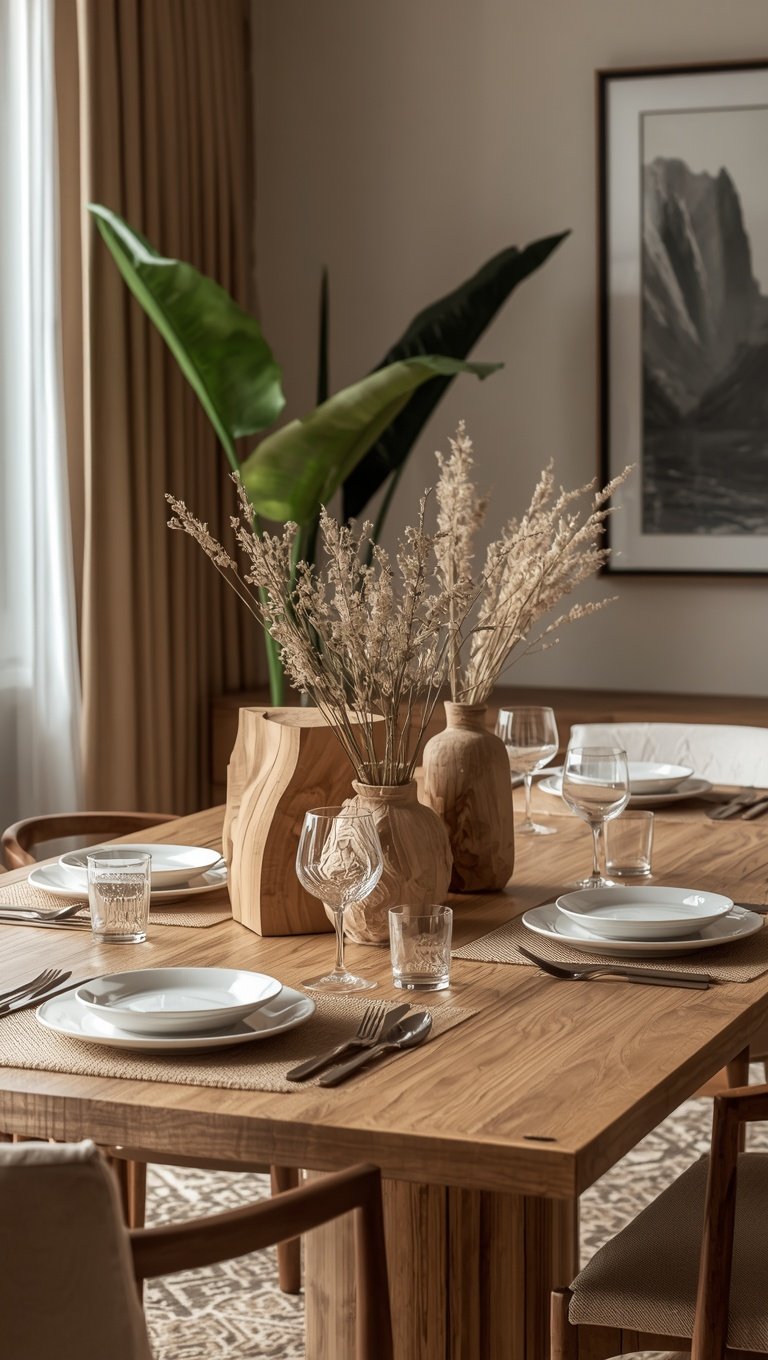

There’s this specific moment — you’ve just laid out the last linen napkin, placed a single sprig of eucalyptus near the water glasses, and you step back.
And the table just breathes.
I had that moment for the first time when I was hosting a small dinner in my apartment, and honestly, it changed everything about how I think about setting a table.
It wasn’t fancy.
It wasn’t expensive.
It was just natural, calm, and so quietly beautiful that my guests kept running their hands over the textures without even realizing it.
That’s the magic I want to share with you today.
Why Natural Materials Feel So Good at a Modern Table

There’s a reason you walk into certain homes and just exhale.
It’s usually because something natural is sitting on that table — a raw linen cloth, a stone dish, a little wooden board with nothing but some figs on it.
Natural materials carry this warmth that no shiny, perfect surface can fake.
When I first started moving away from stark white modern place settings, I honestly wasn’t sure it would feel “elevated” enough.
But here’s what I discovered — nature already has the most sophisticated color palette on the planet.
Warm taupes, sandy beiges, deep mossy greens, chalky whites.
When you let those tones lead, the table stops looking like a staged photo and starts feeling like a place.
A place where you actually want to sit down, pour some wine, and stay way too long.
That emotional pull is the whole point, you know?
Modern design doesn’t have to mean cold.
It means intentional.
And nothing is more intentional than choosing materials that feel alive.
My Linen Napkin Obsession (And Why You Need It Too)

I’m obsessed.
Truly, genuinely, embarrassingly obsessed with linen napkins, and I will not apologize for it.
When I swapped out my old cotton ones for washed linen, the entire table felt softer — even the air around it felt different.
Linen has this beautiful, slightly wrinkled texture that reads as effortlessly chic rather than messy.
It doesn’t try too hard.
That’s the thing about linen — it’s already perfect in its imperfection.
For a natural modern table, I reach for undyed or stone-washed linen in colors like warm oat, dusty sage, or deep terracotta.
Fold them loosely and tuck them under the fork, or just drape them softly over the plate like you didn’t overthink it.
(You did.
But they don’t need to know that.)
If I could give you one single upgrade for your table right now, it would be this.
Skip the paper napkins.
Skip the crisp white cotton.
Go linen, go natural, and just watch how the whole table transforms around it.
Choosing Earthy, Matte Ceramics Over Glossy Everything
Glossy white plates had their moment.

And I say that with so much love because I owned a full set for years.
But the second I brought home a set of matte, sand-toned ceramic plates, I understood what I’d been missing.
Matte ceramics absorb light instead of bouncing it back at you.
They make food look more intentional, more artisan, more cared for.
When I set my table with those warm, slightly imperfect bowls last Thanksgiving, the whole aesthetic shifted from “set table” to “gathered table.”
You know what I mean?
For a modern natural look, reach for ceramics with organic shapes — slightly uneven rims, handmade-looking textures, tones pulled from earth and stone.
Pair different pieces that share the same color family rather than a perfectly matched set.
Mix a deep charcoal plate with a creamy speckled bowl.
Layer a terracotta side dish next to a pale sage mug.
The variation is what makes it feel modern and real, not random and mismatched.
Trust the imperfections here.
They are the design.
My Approach to Wooden Elements on the Table

Wood on a table does something nothing else can.
It grounds the whole setting.
I first noticed this when I started using a thin wooden serving board as a centerpiece base — and suddenly everything placed on or around it had a reason to be there.
It’s sort of like wood gives the table a visual anchor.
For a modern natural table, I love thin, light-toned wood.
Think white oak, ash, or blonde acacia.
Avoid very dark, heavy woods if you want that airy, modern feel — they can make the table feel heavier than you want.
Small wooden details work beautifully too: a single wooden candle holder, little carved bowls for salt, a serving utensil with a wood handle resting across a dish.
If I had a small dining table and a limited budget, I’d start here.
One good wooden board changes the whole story of your table.
And it doubles as a cheese board, a bread board, a fruit arrangement surface — so you’re getting so much use out of one beautiful piece.
That’s the kind of investment I’m always here for.
Bringing Greenery In Without Making It Feel Like a Garden Party

There’s a fine line between “organic and lush” and “accidentally hosted a botanical garden dinner.”
I’ve been on both sides of that line.
What I’ve learned is that for a modern natural table setting, greenery should feel edited — not abundant.
A single stem of eucalyptus tucked beside each glass.
Three sprigs of rosemary laid across a folded napkin.
A small cluster of olive branches in a low, matte vase at the center.
That’s it.
You’re not building a garden — you’re borrowing a moment from one.
The scent alone of fresh herbs on a table changes the entire sensory experience of the meal.
When I placed rosemary sprigs at a small dinner I hosted, two guests reached out and ran their fingers along the stems before we even sat down.
That kind of sensory detail — that’s what makes a table memorable.
Go low and long with your greenery rather than tall and full.
Low arrangements keep the eye level open and the conversation flowing.
Modern design loves that horizontal, unobstructed visual line.
The Stone and Marble Details That Elevate Everything

Nothing whispers “modern luxury” quite like a piece of stone on the table.
And it doesn’t have to be a full marble slab — please, don’t stress about that.
Even a small marble trivet, a set of stone coasters, or a little alabaster tea light holder adds that weight and cool, smooth elegance that reads immediately as intentional.
I found a set of small stone pinch bowls at a market once and they’ve been on almost every table I’ve set since.
I use them for flaky salt, for little olives, for a handful of roasted nuts.
They’re functional and beautiful — which is the exact kind of multi-tasking I respect in a table element.
Stone and natural ceramics together create this gorgeous material conversation on the table.
Rough and smooth.
Warm and cool.
Organic and polished.
That tension is what makes a modern natural table feel designed rather than just decorated.
Start small if you’re new to this.
One stone piece is enough to shift the whole energy of your setting.
You’ll feel it the moment you place it down.
My Favorite Color Palette for a Natural Modern Table

Color on a natural modern table is less about choosing colors and more about letting nature suggest them.
My go-to palette is built from what I think of as “the quiet earth tones” — warm sand, aged linen, soft sage, dusty terracotta, and muted slate.
These colors never fight with each other.
They just settle in and coexist beautifully.
When I was putting together a fall table last year, I layered a warm oat linen runner over a raw wood table, added sage green ceramic plates, and finished with terracotta napkins.
The result was so warm and inviting that even before the food came out, the table felt like a meal.
For a modern edge, I love adding one deeper tone into the mix — a charcoal element, a near-black candle, a deep olive green.
It keeps the palette from feeling too sweet or too beachy.
That one dark anchor is what gives the whole table a modern spine.
Play with it.
Adjust until the table feels like a color exhale — quiet, grounded, and completely beautiful.
How Candlelight Changes the Whole Natural Aesthetic

I will never, ever underestimate the power of a candle on a table.
Candlelight does something no overhead light can touch — it makes everything feel warmer, closer, more golden.
And on a natural table setting?
It’s everything.
The flicker catches the texture of the linen.
It makes the matte ceramics glow softly.
It turns a simple wooden board into something that feels ancient and cozy and deeply beautiful.
For modern natural tables, I choose candles in earthy, muted tones — ivory, warm sand, beeswax yellow, smoked grey.
Taper candles in simple matte holders give a sleek, modern silhouette.
Pillar candles grouped at varying heights feel organic and abundant.
Small tea lights scattered between dishes add a casual, effortless glow.
My personal favorite move?
Two thin taper candles in mismatched, raw clay holders, slightly off-center from the middle of the table.
Not symmetrical.
Just placed, like they landed there naturally.
That little asymmetry is so modern, and so quietly stunning in candlelight.
Layering Textures: The Secret to a Table That Feels Designed

The difference between a table that looks “set” and one that looks designed almost always comes down to texture layering.
I learned this the hard way after years of single-texture, flat table settings that looked fine in person and completely forgettable in photos.
Texture layering means thinking in surfaces: the table itself, a runner or placemats, the plates, the napkin, the centerpiece.
Each layer should bring a different tactile quality.
Smooth stone plate on top of a rough linen placemat.
Soft draped napkin beside a hard ceramic vessel.
Glossy green olive leaves next to matte terracotta.
When I started thinking about my table like a textile collage, everything clicked.
The table suddenly had depth.
Visual richness that made you want to look at it the way you look at a really good painting.
You don’t need expensive pieces to achieve this.
You need considered ones.
Even a simple $12 linen runner from a home goods store, paired with the right ceramics, creates that layered, textured, designed feeling immediately.
Texture is free.
All it costs is intentionality.
My Centerpiece Philosophy: Less, But Richer

I used to pile things onto the center of my table.
Candles, flowers, a bowl of fruit, some decorative objects — all at once.
It was kindda a lot.
What I’ve moved toward is what I think of as “less, but richer” centerpiece design.
Choose one or two hero elements and give them space.
A low, wide ceramic bowl holding three fat figs and a sprig of dried lavender.
A single beautiful piece of driftwood with a tea light placed beside it.
A cluster of three mismatched matte bud vases, each holding just one stem.
The white space around the objects is part of the design.
Modern natural centerpieces don’t fill the table — they accent it.
If I had a long dining table, I’d run a low series of small elements down the center — a wooden bead strand, three low candles, two small stone bowls — rather than one large arrangement.
That linear, low, spread-out centerpiece feels so current and so effortlessly chic.
And it keeps sight lines open across the table, which is both practical and beautiful.
Simple wins, always.
Place Cards and Small Details That Feel Personal

The smallest details on a natural modern table are often the ones guests remember most.
A hand-lettered place card tucked into a sprig of rosemary.
A tiny dried flower head resting on each folded napkin.
A small river stone placed at each setting as a name holder.
These micro-moments of care tell your guests: I thought about you specifically.
And that feeling — of being specifically thought of — is the most luxurious thing a table can offer.
When I started adding these small personal touches, my dinners went from meals to experiences.
People would pick up the rosemary, smell it, smile.
They’d turn the river stone over in their hands.
Those little tactile interactions became part of the evening.
For a modern natural look, keep these details in the same earthy color family as the rest of your table.
Dried botanicals, natural paper, unglazed clay, raw wood.
Nothing plastic, nothing shiny, nothing that breaks the material story you’ve built.
Small, considered, personal.
That’s the whole philosophy.