
Honestly?
I used to completely ignore my fence.
It was just… there.
A tall, brown wooden wall doing its job and nothing else.
And then one spring afternoon I was sitting outside with my iced coffee, staring at that blank expanse of wood, and I thought — this is basically a giant canvas I’ve been wasting.
That one thought sent me down the most delicious rabbit hole of fence art ideas, and I have not looked back since.
If your fence feels like a forgotten afterthought, I promise — it doesn’t have to.
This is everything I’ve learned, tried, and fallen completely in love with.

Why Your Fence Is Actually the Most Underrated Design Surface in Your Yard


Most people put so much energy into their patio furniture, their planters, their string lights — and then completely forget about the vertical space that literally surrounds all of it.
Your fence is basically a wall.
And you would never leave a wall inside your home completely bare, right?
When I finally started treating my fence the same way I treat my interior walls — as a real design opportunity — everything outside shifted.
The whole yard started to feel more intentional.
More finished.
More like an actual room instead of just a patch of grass surrounded by planks.
The best modern fence art doesn’t scream “look at me.”
It whispers.
It adds depth and personality without overwhelming the natural beauty of your outdoor space.
If I had to give you one mindset shift before anything else, it would be this: stop seeing your fence as a boundary and start seeing it as a backdrop.
A beautiful, textured, art-ready backdrop.
Metal Wall Art Panels and Why I’m Completely Obsessed With Them
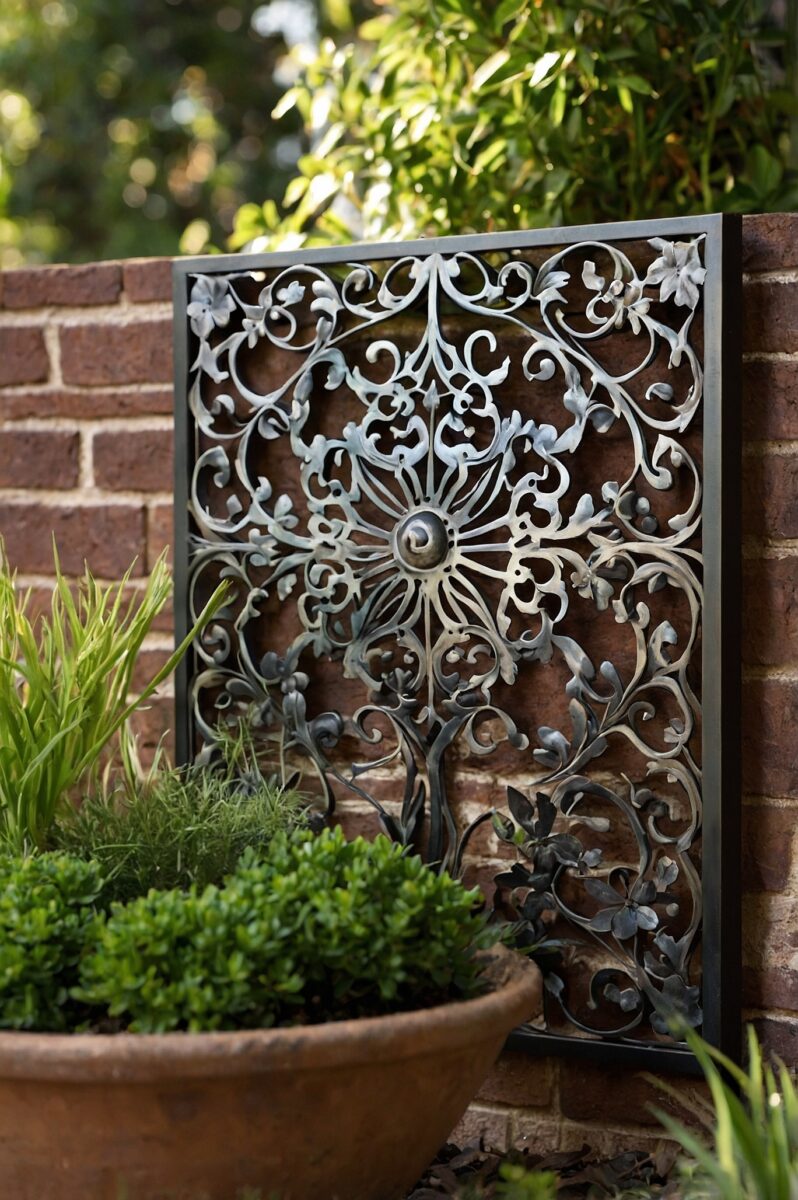 Ornate Wrought Iron decorative wall panel with floral scrollwork leaning against brick wall in garden setting” class=”wp-image-48946″/>
Okay, can we just talk about metal fence panels for a second?
Because I am obsessed.
Large-scale laser-cut metal art panels have this incredible way of looking high-end and architectural without being stuffy or cold.
I added a large geometric black metal panel to my back fence last summer and it genuinely looked like something from a boutique hotel courtyard.
The shadows it casts throughout the day are almost like a second piece of art all on their own.
In the morning, the cutouts throw soft lacy patterns across the patio.
By afternoon, the whole thing turns bold and graphic.
I love a decor piece that changes with the light.
Metal panels come in so many styles now — botanical cutouts, abstract waves, geometric lattice, mid-century sunburst shapes.
You can go matte black for something modern and dramatic.
Weathered bronze if you want something warmer and more organic.
They hold up beautifully through rain and wind, which honestly sold me more than the aesthetics did.
My personal tip: go bigger than you think you need.
A panel that feels almost too large in the store will look perfectly proportioned once it’s up against a full fence line.
Trust me on that one.
Macramé and Woven Fiber Art: Softer Than You’d Expect Outside

I know what you’re thinking.
Macramé?
Outside?
Yes.
Absolutely yes.
Modern outdoor macramé has come such a long way, and some of the pieces being made now are genuinely stunning.
Large woven fiber wall hangings bring this incredibly cozy, textural softness to a fence that metal and wood simply can’t replicate.
I hung an oversized cream-colored woven piece on my side fence — the shadier, more private side — and it completely transformed that corner into what I can only describe as a little outdoor nook.
It felt warm.
Almost like a living room wall, but outside.
The trick with fiber art on fences is placement.
You want it somewhere sheltered — under a pergola overhang, beneath a patio awning, or in a covered corner — so it isn’t getting soaked every time it rains.
Look for pieces made from weather-resistant cotton or synthetic macramé cord.
They hold their shape and color so much better than natural fiber options in outdoor conditions.
And if you’re feeling creative?
Making your own basic macramé piece is genuinely one of the most satisfying weekend projects.
It doesn’t have to be perfect to be beautiful.
In fact, the slight imperfections are sort of the whole point.
Vertical Garden Frames as Living, Breathing Fence Art

This one is my absolute favorite for anyone who loves plants as much as I do.
A vertical garden frame — essentially a structured planting panel that mounts directly to your fence — is like hanging a painting, except the painting grows.
And blooms.
And smells incredible in the evening.
I mounted two matching black powder-coated grid frames on my back fence and planted a mix of trailing pothos, small ferns, and trailing petunias in little hanging pots.
The result looks like a curated living wall without the complexity or cost of a built-in system.
What I love most is how it layers.
You get the texture of the frame, the color of the blooms, the different shades of green, all against the warmth of the wood fence behind.
It’s dimensional in a way flat art simply isn’t.
For a more modern, minimal look, try planting only one or two varieties in a consistent color palette.
All white blooms.
All deep green foliage.
The restraint makes it feel elevated and intentional rather than chaotic.
My practical tip: mount frames slightly away from the fence surface — even just an inch or two — to allow airflow behind the pots.
It keeps moisture from damaging your fence and keeps your plants healthier too.
Outdoor Mirror Panels That Make Your Space Feel Twice as Large

This one is a little unexpected, and I think that’s exactly why it works so well.
Mirrors on fences.
Seriously.
Large, weather-resistant outdoor mirrors mounted on a fence create this gorgeous illusion of depth that makes even a small yard feel open and expansive.
When I added two arched framed outdoor mirrors to my side fence — the one facing my little garden bed — the effect was genuinely jaw-dropping.
Suddenly my garden looked doubled.
The light bounced around in this warm, dreamy way.
And every time I walked outside, the reflection caught the sky and the trees and made the whole space feel alive.
Modern fence mirror styling leans toward clean geometric shapes — large rectangles, arched tops, or simple round mirrors grouped in a cluster.
Black metal frames read as very current and sleek.
Aged gold frames feel a little more romantic and European.
A few things to keep in mind: make sure any mirror you use is specifically designed for outdoor use.
Regular indoor mirrors can fog, crack, or warp with temperature changes.
Also, be thoughtful about sun placement — you don’t want to accidentally direct a blinding glare toward your seating area or your neighbor’s windows.
But positioned thoughtfully?
Absolutely stunning.
mural Wall

If you have even a tiny bit of artistic confidence — or know someone who does — a painted mural on your fence is one of the most personal, personality-packed things you can do to an outdoor space.
And it doesn’t have to be elaborate or photorealistic to feel incredible.
Modern fence murals lean toward abstract botanicals, loose brushstroke florals, geometric color blocking, or simple line art.
Even a single oversized painted leaf or branch motif in a muted tone can turn a plain wood fence into something that looks genuinely intentional.
When I tackled my own small side fence last fall, I used a chalk paint in a deep sage green and added abstract cream-colored botanical shapes with a wide brush.
It was imperfect.
The lines weren’t perfectly even.
And I love it more because of that.
The key thing to do first — and I cannot stress this enough — is to use a proper exterior primer before painting.
It makes the color richer, protects the wood, and extends how long your mural actually lasts.
For color palette ideas, I always think about what already grows in my yard.
If you have lots of warm terracotta pots and golden grasses, lean into those tones.
If your space is cool and lush and green, go for deep blues and soft whites.
Let your existing palette lead the way.
Geometric Wooden Accents Mounted to Your Fence

This idea feels a little more architectural, and I am completely here for it.
Adding dimensional wooden geometric shapes — hexagons, diamonds, layered squares, or abstract sculptural forms — directly onto your fence surface creates this beautiful interplay of shadow and texture.
It’s art.
But it also feels structural.
Like your fence has its own design language.
I experimented with this on my back fence using a series of different-sized natural wood hexagons, staggered at varying heights.
Some were stained dark walnut.
Some were left natural.
The combination felt organic and collected rather than matchy-matchy, which is always the look I go for.
If you want something even more modern, go for black-stained geometric forms against a light gray or white-painted fence.
The contrast is sharp, clean, and incredibly photogenic.
You can find pre-made wooden geometric wall art in outdoor-safe finishes, or if you’re handy, this is honestly a great weekend DIY.
Basic router cuts on cedar or pressure-treated wood can produce really beautiful shapes.
Seal everything with an outdoor-grade clear coat and you’re set for seasons.
My personal tip: don’t overthink the arrangement.
Start by laying your pieces on the ground to test different configurations before committing to hardware.
Sometimes the most asymmetric, imperfect arrangement ends up being the most interesting one.
Ceramic and Mosaic Tile Art for a Touch of Global Soul

This one always surprises people.
Ceramic and mosaic tile art — the kind traditionally used on indoor walls or kitchen backsplashes — can be absolutely gorgeous mounted on an exterior fence.
It adds this artisan, handcrafted quality that no mass-produced piece can replicate.
I’ve seen small clusters of hand-painted Spanish-style ceramic tiles mounted in a simple floating grid arrangement on dark wood fences, and the effect is breathtaking.
Rich blues, warm terracottas, creamy whites — they catch the light differently at every hour of the day.
For modern spaces, consider a more restrained approach: a single large mosaic panel in a muted, tonal palette rather than a burst of bright pattern.
Think soft whites and grays in a geometric arrangement.
It reads contemporary without losing that beautiful handmade quality.
Make sure any tiles you use are rated for outdoor use — look for frost-resistant options if you live somewhere with cold winters.
Mounting them with an exterior-grade adhesive and sealing the grout is non-negotiable if you want them to last.
This is also one of my favorite ideas for small fence sections — a gate entry, a courtyard corner, a short wall section.
You don’t need a lot of space for the impact to be massive.
Sometimes a small, curated tile installation does more than a large, busy one.
Sculptural Metal Cutouts That Look Custom and Expensive

There is something about sculptural metal cutout art that feels genuinely luxurious to me.
Maybe it’s the weight of it.
Maybe it’s the way it interacts with light and shadow.
Either way — I think it’s one of the most elevated things you can add to a modern fence.
Unlike flat wall art, sculptural pieces have depth and dimension.
Some panels are designed so that sections curve forward, creating a beautiful three-dimensional effect that shifts depending on where you’re standing.
Others are made from hammered or textured metal that catches light in this warm, rippled way.
My favorites are abstract organic forms — flowing shapes that suggest leaves, water, or wind without being literal about it.
They work beautifully in modern minimalist outdoor spaces because they add visual interest without pattern or color.
Just form and shadow.
For a cohesive look, I like to pick one or two large sculptural pieces and let them anchor a section of fence rather than layering lots of smaller pieces.
Let each piece breathe.
Give it space to be seen.
Black steel is incredibly versatile and holds up beautifully outside.
Copper and bronze patina over time in the most gorgeous, natural way.
If you want something that evolves and deepens with age — copper is your material.
It’s one of those things that just keeps getting better.
Hanging Lanterns and Light Art for Evening Magic

Okay, this might be my most used category of fence decor, and I think it often gets overlooked in the “art” conversation because people think of it purely as function.
But lighting is art.
Especially on a fence.
Large hanging lanterns mounted along a fence line — think Moroccan-style perforated metal, sleek Japanese paper lanterns, or bold industrial cage-style pendants — do something incredible to an outdoor space after dark.
They create pools of warm light.
Little constellations along your fence that make the whole yard feel cozy and intentional.
I have a row of oversized black metal lanterns mounted at varying heights along my back fence.
When they’re lit in the evening, the perforated patterns throw tiny stars across my patio floor.
It’s sort of magical.
For modern styling, I love pairing lanterns with low-wattage Edison-style LED bulbs in a warm amber tone.
Nothing cool or blue — warmth is everything outside at night.
You can also consider solar-powered lanterns with built-in dusk-to-dawn sensors.
They charge all day and flick on automatically at sunset, which means zero effort and maximum cozy.
Group odd numbers — three, five, seven lanterns — for a grouping that feels curated rather than symmetrical and rigid.
Mix sizes for a layered, collected look.
It never fails.
Repurposed Salvage and Vintage Finds as Fence Art

This is where things get really fun.
Some of my absolute favorite fence art moments have come from completely unexpected objects that were never designed to be wall art at all.
Old iron gates.
Vintage window frames.
Worn wooden architectural elements salvaged from old buildings.
An antique bicycle wheel.
When I hung a set of old painted shutters — the kind with the chippy, layered paint that shows years of color — on a section of my garden fence, people thought I had hired a decorator.
I found them at a local salvage yard for next to nothing.
The beauty of repurposed finds is that they carry history.
A texture.
A story.
And that’s exactly what gives a space real soul — the kind you cannot buy brand new.
For a more modern interpretation, think about the materials rather than the objects.
Reclaimed wood pieces cut into abstract shapes.
Industrial pipe fitted into geometric forms.
Vintage ironwork panels in a minimal arrangement.
The idea is to find the artistic quality already embedded in old materials and let it speak.
My practical tip: treat all salvaged wood with an outdoor sealant before mounting.
Old wood is beautiful, but it needs protection to hold up in the elements without deteriorating.
And always check that mounting hardware is weatherproof — stainless steel screws and anchors are worth the small extra cost.
Layering Textures for a Gallery Wall Fence Feeling

Once you’ve fallen in love with fence art — and I promise you will — the next evolution is thinking about how to layer multiple elements together.
Not in a chaotic, cluttered way.
In a curated, gallery-wall way.
Think: a large metal sculptural panel as the anchor piece, surrounded by a cluster of smaller ceramic tiles, with a hanging lantern pulled forward in front.
Different heights.
Different materials.
Different scales.
The result is layered and rich in a way that a single piece simply cannot achieve.
When I redesigned my main back fence section, I worked in a triangle arrangement — my largest piece at center-height, two medium pieces slightly offset on either side, and a few small accent pieces tucked in at varying points.
It felt intentional without feeling rigid.
Warm without feeling cluttered.
The trick with layering is to stay within a consistent material palette even if you’re mixing styles.
Black metal + natural wood + deep terracotta ceramics.
Or weathered steel + cream fiber + aged bronze.
Let the color story tie everything together even when the shapes and textures are varied.
Also — and this is personal experience talking — step back frequently as you add pieces.
Your eye sees things differently from ten feet away than it does when you’re up close fussing with positioning.
Distance reveals the truth of any arrangement.
My Favorite Tips for Making Fence Art Last Through Every Season

There is nothing worse than loving a piece of outdoor decor and watching it deteriorate by the end of the first season.
So before I let you run off and start shopping and planning, let me share the practical things I’ve learned the hard way.
Always, always check that any art piece is rated for outdoor use before buying.
“Weather-resistant” and “weatherproof” mean different things — and some pieces marketed for outdoor use are really only suitable for covered, protected areas rather than full exposure.
For metal pieces, look for powder-coated finishes over raw paint — powder coat resists chipping and rusting dramatically better.
For wooden elements, seal them twice a year with a quality exterior wood oil or sealant.
For fiber and macramé pieces, bring them inside or store them during periods of heavy rain or snow.
Even weather-resistant fibers benefit from a break.
Mounting hardware matters as much as the art itself.
Use stainless steel or galvanized hardware throughout — it will not rust or stain your fence even after seasons of exposure.
And finally, don’t be afraid to rearrange.
One of the things I love most about fence art is how easy it is to swap things around as your style evolves.
Your fence isn’t permanent like an interior wall.
It’s a living space.
Let it change with you.